Chatbot for Retail: Build Conversions, Not Just Tickets
Chatbot for Retail. Learn how a retail chatbot drives sales and support. Explore use cases, implementation steps, and real results for modern stores.
47% of e-commerce customers already use chatbots to place orders, and 25% buy after a successful interaction. A chatbot for retail is therefore a proven conversion channel, not merely a way to deflect support tickets.
The practical challenge appears late at night, when a shopper is comparing sizes, checking delivery timing, or trying to understand a return window. A static FAQ can't answer the question in context, and a contact form can't help before the shopper loses momentum. A useful retail chatbot needs to respond quickly, use current commerce data, and admit when a human should take over.
That last requirement matters most. Speed helps, but trust determines whether automation creates revenue or creates cleanup work. The strongest systems prevent unsupported product claims, complete routine tasks, and pass sensitive exceptions to an agent with the conversation intact.
Why Retail Chatbots Now Drive Revenue, Not Just Answers
A shopper visits an online store after work and finds a jacket that looks right. The product page answers the obvious questions, but not the ones blocking the purchase: Is medium available in the local market? Will it arrive before the weekend? Can it be exchanged if the fit is wrong? Does the discount code apply to this item?
A retail chatbot can turn those questions into a guided buying conversation. It can retrieve the relevant product attributes, check availability, explain delivery rules, and point the shopper toward a suitable alternative. It can also recognize when the question has moved from product discovery into order support, without forcing the customer to start again.

The commercial role is already clear
A survey of e-commerce behavior reports that 47% of customers use chatbots to place orders, 46% use them when reporting an issue or initiating a return, and 25% purchased a product after successfully interacting with a chatbot (Plivo's chatbot statistics overview). Those figures describe two connected jobs: helping customers buy and helping them remain confident after purchase.
That changes how teams should judge a chatbot. Ticket volume matters, but it isn't enough. A bot that answers many low-value questions while giving unreliable stock or returns information can increase contact volume later. A better system is measured by completed tasks, accurate guidance, sensible recommendations, and safe handoffs.
Practical rule: Automate the customer journey, not just the customer's sentence.
Retail teams can use a practical analysis of chatbot ROI from Reddog Consulting Group when defining the commercial questions behind deployment. The useful questions are concrete: Did the shopper find a product? Did the customer complete an order? Did the bot resolve a delivery question without making a promise the business couldn't keep?
Start with outcomes, not a widget
A chatbot shouldn't appear on every page just because the technology is available. Place it where uncertainty blocks progress, such as product comparison, sizing, delivery, returns, and checkout. For lead capture and pre-purchase conversations, a focused lead generation chatbot workflow can collect useful context without interrupting shoppers who are ready to buy.
The best first release is usually narrow. Connect a small set of reliable sources, define clear escalation rules, review failed conversations, and expand only after the bot demonstrates that it can handle the existing workflow without inventing answers.
What a Retail Chatbot Actually Is and Does
A retail chatbot is a conversational interface connected to commerce operations. It interprets a shopper's language, retrieves evidence from approved systems, produces a controlled response, and either completes an action or routes the issue to a person.
That makes it different from a generic AI assistant. A general assistant may produce a fluent answer from broad knowledge. A retail system needs to know which price applies in a specific market, whether a product is available now, which return rule governs the order, and whether the customer is authorized to request an account action.
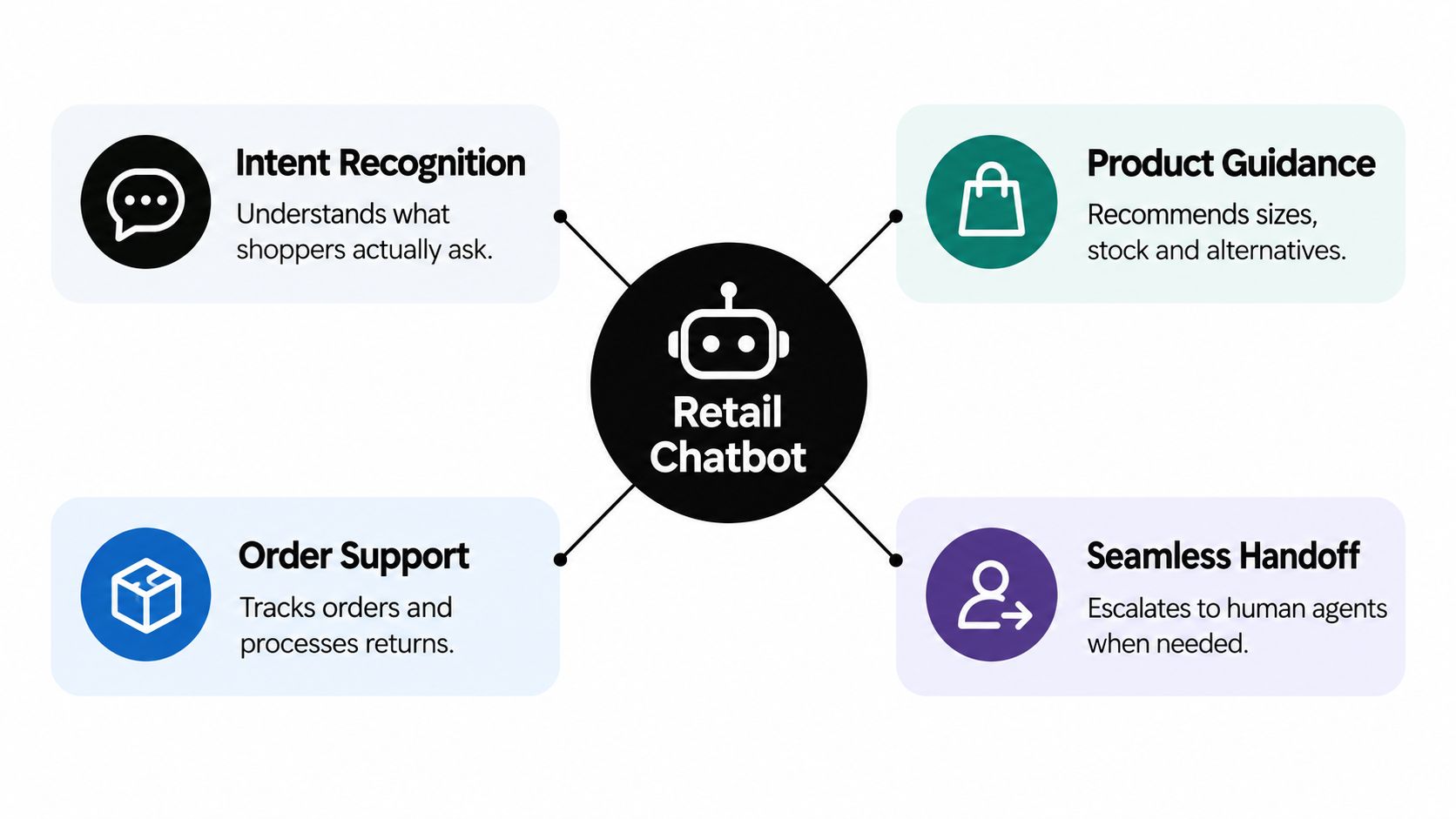
Four layers make the system useful
Intent recognition identifies what the shopper is trying to accomplish. “Can I get this in navy?” may mean a color question, an inventory check, or a request for alternatives. Context matters, especially when the shopper follows up with “What about medium?”
Retrieval finds the evidence. Product catalogs, inventory services, shipping policies, returns documentation, and order systems should remain authoritative. The chatbot should filter information by market, language, eligibility, and current availability before generating a reply.
Controlled generation turns retrieved evidence into plain language. The system should preserve important conditions, such as exclusions or expiration rules, instead of smoothing them away for a more natural-sounding answer.
Escalation handles uncertainty and risk. Payment disputes, suspected fraud, damaged goods, account security, and policy exceptions deserve an explicit route to a human agent. The bot should pass the transcript, retrieved evidence, and attempted actions along with the handoff.
Retail and e-commerce represent 21% of the global conversational-AI market, while reported industry research says 49% of U.S. retail professionals were already using artificial intelligence and 31.4% of those professionals deployed virtual agents or chatbots (World Metrics' chatbot statistics summary). The adoption context is important, but adoption alone doesn't prove answer quality.
Choose the right operating model
A rule-based bot works well for fixed requests, such as store hours or a clearly defined returns flow. It offers control, but it struggles when customers use unexpected language or combine several needs.
A retrieval-based AI chatbot handles more natural questions while keeping answers tied to approved content. An action-oriented agent goes further by checking order status, initiating an eligible return, or applying a workflow through a connected system. In practice, a hybrid design is often safer than choosing one model for everything.
The system can use deterministic logic for sensitive actions, retrieval for product and policy questions, and human review where confidence is low. That division keeps conversational flexibility from becoming operational freedom without controls.
Four High-Impact Use Cases in Retail
A useful chatbot earns its place by helping customers complete specific jobs. Four journeys usually deserve attention first because they combine repetitive questions with clear commercial or service outcomes.
Product discovery
A shopper might ask, “I need a waterproof black shoe for commuting, but I don't want a heavy sole.” A basic FAQ bot can only point to a category. A connected chatbot can interpret the preferences, retrieve matching products, explain the differences, and disclose when a recommendation is based on incomplete information.
The workflow should expose the evidence behind the suggestion. Product attributes, current availability, price context, and relevant restrictions should come from the catalog, not from model memory. If the preferred item is unavailable, the bot can offer alternatives only when their attributes support the comparison.
Order and shipment status
Order questions are usually simple but time-sensitive. The bot authenticates the customer through the approved account flow, retrieves the current order state, and explains the next relevant event. It shouldn't guess an arrival date when the connected carrier or order system doesn't provide one.
This journey often continues into another one. A customer asking about a delayed parcel may immediately ask whether they can cancel, exchange, or return the item. The conversation should retain that context rather than sending the customer through unrelated menus.
Returns and policy guidance
Returns need careful language. The bot can explain the applicable policy, identify required conditions, and guide an eligible request. It should surface exceptions instead of burying them, especially for clearance products, personalized goods, opened packages, or market-specific rules.
Human escalation becomes essential when the customer reports damage, disputes a decision, or asks for an exception. Automation can gather order details and issue category information, but accountability should remain visible.
Recommendations and relevant next steps
Personalization works when it helps the customer decide, not when it merely adds promotional language. A chatbot can compare compatible products, suggest an accessory that solves a stated need, or explain an alternative when stock changes.
A recommendation should answer the shopper's question before it tries to increase the basket.
These workflows can also support operational risk indirectly. Retail teams dealing with loss prevention can review resources such as systec POS-Technology GmbH's guidance on preventing retail theft, while keeping customer-facing automation focused on legitimate service and commerce tasks.
For broader workflow ideas, AI automation examples for support teams can help teams identify repeatable actions worth connecting to a chatbot. The priority should remain narrow: select journeys with clear inputs, reliable data, and an obvious success condition.
Engineering Trust Through Speed and Grounded Answers
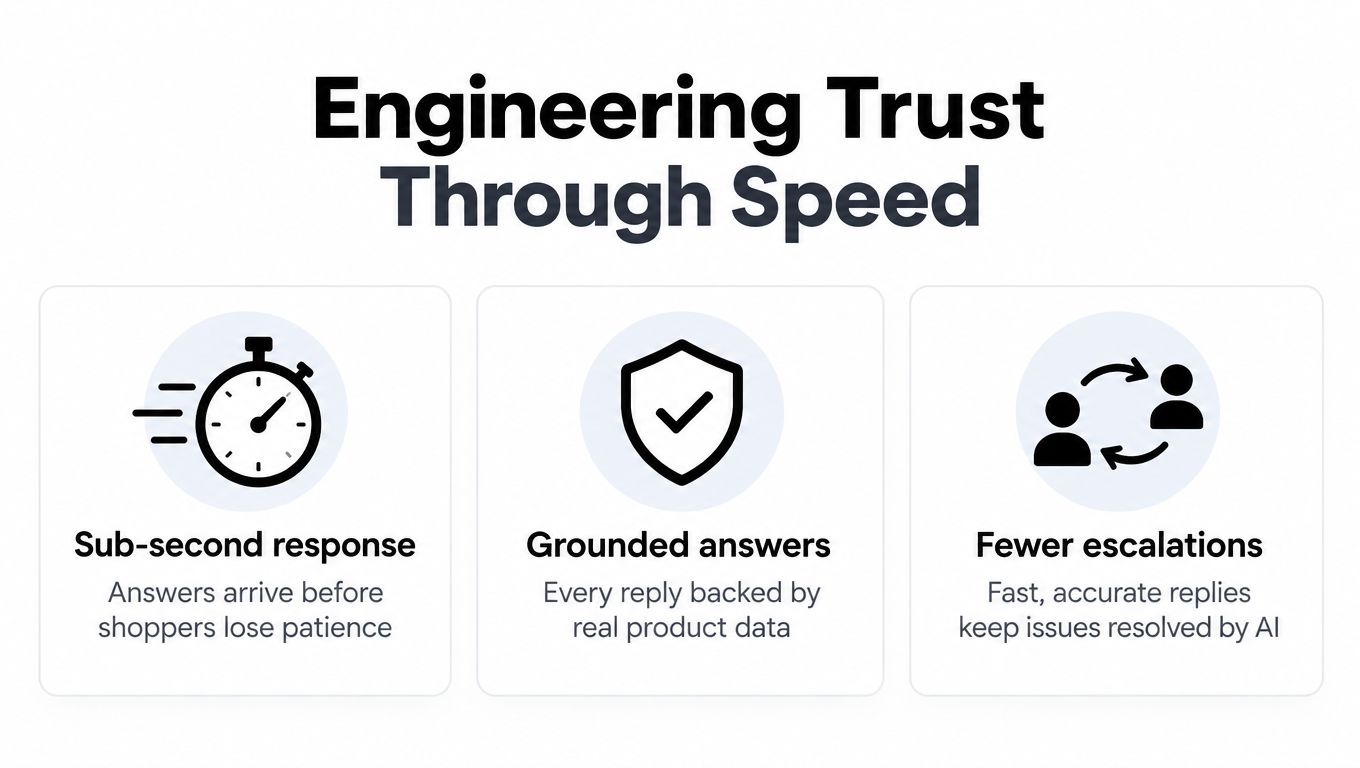
Fast replies matter because shoppers interpret silence as friction. But a quick wrong answer is worse than a slower accurate one when the subject is price, stock, delivery, eligibility, or a refund.
An analysis of more than 2.3 million anonymized chatbot interactions found that top-performing systems averaged 0.9 seconds for an initial response. Conversations answered in under one second showed 31% higher completion rates and 40% lower escalation rates than slower interactions, according to the response-time benchmark. The source identifies these figures as a vendor-associated benchmark, so retailers should validate them against their own catalog, traffic, and escalation policies.
Design the response path, not only the prompt
A practical architecture separates fast retrieval from slower actions. Precompute searchable indexes for product attributes, shipping rules, and returns content. Cache common intents, stream an initial acknowledgement, and place strict timeouts around inventory, order, and policy tools.
Measure time-to-first-token separately from full-resolution time. “I'm checking that” may arrive quickly while the actual stock or order answer remains pending. Track p50, p95, and p99 latency so averages don't hide poor experiences during traffic spikes.
Grounding requires equally deliberate design:
- Filter before generation: Apply market, language, availability, and eligibility rules before the model sees the candidate evidence.
- Attach freshness metadata: Keep price timestamps, stock status, and policy versions available to the answer layer.
- Check contradictions: Stop or escalate when two connected sources disagree.
- Set confidence thresholds: A missing product attribute should trigger a clarifying question or handoff, not a confident guess.
Make transparency part of the interface
Consumers may accept automated help while still demanding accountability. Adobe's 2025 retail research found that 66% of consumers expect fast support through automated systems, but only 33% believe brands deliver it. The same research reports that 87% expect responsible and secure data handling, while only 46% believe brands meet that standard (Adobe's retail digital trends report).
Disclose that the customer is interacting with AI, explain what information the system uses, and make the human route visible. A customer shouldn't have to defeat the bot to reach an agent. The case for grounding AI responses is operational as much as technical, because evidence-backed responses make review and correction possible.
Choosing a Retail Chatbot Platform and Setup Path
Platform selection should start with the store's workflows, not the model name. A retail chatbot that supports several language models but can't retrieve current product information won't solve the central problem.
Compare the capabilities that affect operations
| Requirement | What to verify | Why it matters |
|---|---|---|
| Commerce data access | Catalog, inventory, orders, shipping, and returns connections | The bot needs evidence for decisions and explanations |
| Guardrails | Topic boundaries, source restrictions, contradiction handling, and confidence rules | Fluency shouldn't override policy or data quality |
| Escalation | Natural-language triggers, routing, transcript continuity, and agent ownership | Sensitive cases need a controlled human handoff |
| Channel coverage | Website, product experience, app, and messaging surfaces | Shoppers ask for help in different contexts |
| Language support | Retrieval and escalation behavior across supported languages | Translation alone doesn't guarantee policy accuracy |
| Analytics | Task, latency, evidence, containment, and escalation reporting | Teams need to tune outcomes, not just count chats |
A lightweight website widget may be enough for a focused online store. A larger retailer may need authentication, enterprise identity controls, encryption, compliance support, higher throughput, and stronger separation between markets. Neither setup is automatically better. The correct choice depends on the data, workflows, and ownership model behind the conversation.
Use a staged implementation
Start with read-only questions that have dependable answers. Product attributes, store information, delivery policies, and order status provide useful coverage without giving the bot unrestricted authority.
Next, add guided actions. A return request, address update, or cancellation flow should validate eligibility, show the customer what will happen, and record the result. Keep irreversible or financially sensitive actions behind authentication and explicit confirmation.
SupportGPT is one platform option for this model. It provides embeddable website agents, training on supplied sources and links, multilingual support, AI Actions, analytics, conversation tracking, guardrails, and escalation rules. Teams can compare that approach with an AI agent builder selection framework, focusing on evidence handling and handoff behavior rather than feature count.
Consumer adoption research reports that 54% of adults are likely to engage with an AI chatbot, 31% believe AI can improve customer experience, and 29% associate AI with better personalization (the Consumer Adoption of AI report). That willingness creates an opening for stores and marketplaces, including businesses that offer crafts online, but it doesn't remove the need for a reliable service fallback.
Measuring ROI and Proving Retail Chatbot Value
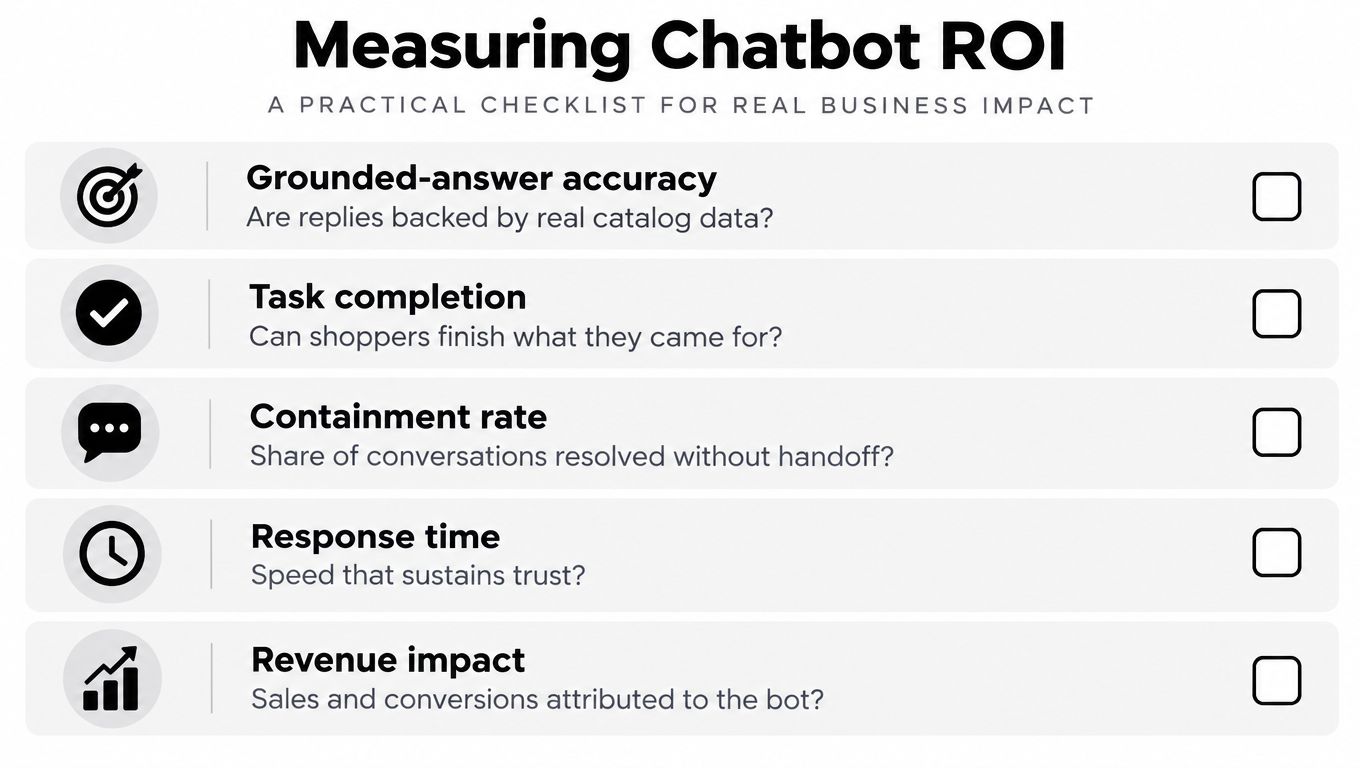
A chatbot's business case should connect conversations to completed work. Counted messages are activity, not value. A useful scorecard shows whether the system answered from reliable evidence, helped the customer finish a task, avoided unnecessary escalation, and influenced a commercial outcome.
Build a scorecard with quality at the center
Track these dimensions together:
- Grounded-answer accuracy: Review whether answers reflect the approved catalog, policy, inventory, and order evidence.
- Task completion: Confirm that shoppers reached the intended result, such as finding a product, checking an order, or submitting an eligible return.
- Containment: Measure conversations resolved without a human, but don't treat higher containment as automatically better.
- Escalation appropriateness: Check whether the bot handed off the right cases, with enough context for the agent to act.
- Latency: Separate the first response from completion of the underlying task.
- Revenue impact: Attribute purchases, assisted conversions, and relevant basket actions only when the measurement design supports that conclusion.
A bot that contains a conversation by refusing to help isn't performing well. Likewise, a bot that escalates every product question may protect accuracy but fail to create operational value. Review samples from both successful and failed sessions, then compare the results with the customer's intended task.
Segment the evidence before changing the system
Aggregate reporting can hide a problem. Segment results by country, language, device, product category, customer status, and journey stage. A bot may handle order tracking well in one market while mishandling return eligibility in another because the policy or data structure differs.
Use a review loop that assigns each failure to a cause:
- Missing source data: Add or correct the catalog, policy, or workflow record.
- Retrieval error: Improve filters, metadata, or indexing.
- Generation error: Tighten response instructions and evidence constraints.
- Tool failure: Fix authentication, timeout, or integration behavior.
- Escalation failure: Adjust triggers and preserve more conversation context.
- Measurement gap: Correct attribution before declaring an improvement.
Adobe's research gives the trust gap a useful business context. 66% of consumers expect fast automated support, but only 33% believe brands deliver it, while 87% expect responsible and secure data handling and only 46% believe brands meet that standard (Adobe's retail findings). A measurement program should therefore include privacy handling, disclosure, and escalation quality, not only speed and containment.
For teams using SupportGPT, a controlled flow might combine product and returns sources, quick prompts for common journeys, AI Actions for approved routine tasks, and natural-language escalation for payment, fraud, damaged goods, or policy exceptions. The chatbot performance metrics guide can support the reporting design, but the store still needs its own definitions of success and failure.
The most credible ROI claim is specific: customers received evidence-backed answers, completed defined tasks, and reached accountable human support when automation wasn't appropriate. That is how a chatbot for retail becomes a durable commerce capability rather than another layer of scripted assistance.
SupportGPT lets retail teams deploy grounded AI support agents with source-based training, quick prompts, AI Actions, multilingual conversations, analytics, and natural-language escalation. Visit SupportGPT to build a controlled retail chatbot that helps shoppers move forward while keeping humans responsible for consequential cases.