Lead Generation Chatbot: Boost Conversions with 24/7 Engagement
Discover how a lead generation chatbot can turn your site into a 24/7 prospect magnet and boost qualified leads.
Imagine you had a sales assistant on your website working around the clock, greeting every single visitor, and instantly flagging your best prospects. That’s the magic of a lead generation chatbot. It’s an automated tool that kicks off conversations with website visitors, figures out how serious they are, and captures their details to turn anonymous clicks into a solid sales pipeline.
What Is a Lead Generation Chatbot
At its core, a lead generation chatbot is a smart piece of software that automates conversations on your website. Its main job is to proactively engage visitors, gather key information, and qualify them as a potential fit for what you're selling.
Think of your classic "Contact Us" form. It's like a silent receptionist sitting behind a desk, just waiting for someone to walk up. The visitor has to do all the work—fill out a bunch of fields and then just hope to hear back.
A lead generation chatbot, on the other hand, is like a friendly concierge who greets everyone at the door. It asks how it can help and immediately points them in the right direction.
This proactive approach completely changes the dynamic from passive to interactive. Instead of making a potential customer hunt for information, the chatbot serves it up in a simple, friendly chat. This lines up perfectly with what people expect today: instant answers and zero waiting.
From Anonymous Traffic to Real Conversations
The central purpose of these bots is to turn anonymous website visitors into qualified leads you can actually talk to. They do this by automating the very first steps of the sales cycle—the parts that used to require a human.
A well-built chatbot can:
- Open the conversation with a personalized greeting.
- Ask smart questions about a visitor's needs, budget, or role.
- Collect contact details like name, email, and phone number.
- Book meetings or demos right on your sales team's calendar.
- Hand off high-intent leads to a live agent in real-time.
This conversational style isn't just more efficient; it’s more effective. The numbers back it up. The global chatbot market was valued at $7.76 billion and is expected to rocket to $61.69 billion by 2032. A striking 64% of companies say AI chatbots help them generate better leads, and businesses using them see a 2.3 times increase in customer engagement. E-commerce is a huge driver here, where 77% of the most successful chatbots are used. You can dig into more chatbot statistics to see just how big their impact is.
Why Conversational Lead Capture Is So Effective
The move away from static forms to interactive chatbots taps into a simple truth: people would rather have a conversation than fill out paperwork. A long form feels like a chore, and many potential leads will just give up and leave.
To see the difference clearly, let's compare the two side-by-side.
Traditional Lead Capture vs Lead Generation Chatbot
| Feature | Traditional Web Form | Lead Generation Chatbot |
|---|---|---|
| Interaction | Passive & one-way. Visitor submits info and waits. | Interactive & two-way. Real-time conversation. |
| Engagement | Low. Often feels transactional and impersonal. | High. Feels personal, responsive, and helpful. |
| Speed | Delayed. Response can take hours or days. | Instant. Engages and qualifies in seconds, 24/7. |
| Qualification | Basic or none. All submissions are treated equally. | Dynamic. Asks tailored questions to score leads. |
| Friction | High. Multiple fields can deter users. | Low. Asks one question at a time in a natural flow. |
| Data Quality | Can be poor. Prone to fake or incomplete info. | Higher. Verifies information conversationally. |
The table makes it obvious why chatbots are winning. A conversation feels natural and offers immediate value.
By breaking down the info-gathering process into bite-sized questions, a lead generation chatbot lowers the barrier to entry and keeps the user engaged from start to finish.
Ultimately, the chatbot is a bridge connecting a visitor’s initial curiosity to your sales team’s pipeline. It filters out the tire-kickers, warms up genuine prospects, and makes sure your sales reps spend their valuable time on conversations that are most likely to convert. This automated efficiency is exactly why it has become an essential tool for any modern marketing and sales team.
The Core Benefits of Using Chatbots for Lead Generation
Bringing a lead generation chatbot onto your website isn't just about adding a flashy new tool. It’s a strategic decision that fundamentally improves how you turn casual visitors into real sales opportunities. These digital assistants are designed to work around the clock, sparking valuable conversations that would otherwise be missed.
Let's break down the real-world advantages you can expect.
Unlocking 24/7 Availability
Your team might head home at 5 PM, but your website is always open for business. Prospects from different time zones or night owls doing late-night research can land on your site at any hour. If no one's there to greet them, those opportunities just vanish into thin air.
A lead generation chatbot is your always-on front line. It works 24/7/365, making sure every single person who visits your site gets a prompt, helpful welcome. This constant presence means you stop losing potential customers just because they showed up after hours.
Mastering Instant Lead Qualification
Let's be honest: not every website visitor is a good fit for your business. Your sales team’s most precious resource is their time, and it's a huge waste to have them chase down leads who were never going to buy anyway. This is where a chatbot really proves its worth.
Instead of passing every single inquiry to your team, a chatbot asks smart, qualifying questions right away. It can quickly figure out things like:
- Budget: Does their budget match your pricing?
- Timeline: Are they looking to buy now or in six months?
- Need: Is your solution a perfect fit for their problem?
- Authority: Are they the decision-maker?
By gathering this intel upfront, the bot separates the serious buyers from the casual browsers. The result? Your sales team gets a clean, pre-vetted list of high-intent leads, letting them focus their energy where it counts.
A great chatbot isn’t just a contact form. It’s an intelligent filter that makes sure only the most promising conversations get passed to your human agents. This single step makes your entire sales process smarter and more efficient.
Achieving Scalable Engagement
Picture this: your new marketing campaign goes viral, and suddenly, thousands of people are flooding your website. Can your team handle hundreds of simultaneous chats? Probably not. People get stuck in queues, frustration builds, and you lose leads.
A chatbot, on the other hand, can manage a virtually unlimited number of conversations at the same time without breaking a sweat. Whether it’s talking to ten people or ten thousand, every single visitor gets the same instant, personal attention.
This ability to scale means you can grow your marketing efforts without worrying about hiring a massive sales team to handle the volume. You can launch big campaigns knowing you have a system in place to capture every lead.
Creating an Enhanced User Experience
First impressions are everything. We all know that classic website contact forms are boring and impersonal. In fact, more than 80% of people who start filling out a form never actually hit "submit." They want answers now, not a one-way ticket to a sales inbox.
A chatbot flips the script. It turns a static form into a dynamic, two-way conversation. By asking simple questions one at a time, it makes the process feel easy and natural.
This conversational style feels more human and helps build trust right from the start. Prospects get their questions answered on the spot, which immediately improves how they see your brand. That positive first touch not only makes them more likely to become a lead but also sets the stage for a great customer relationship down the road.
How to Design a Chatbot Conversation That Actually Converts
A great lead generation chatbot doesn't just answer questions; it steers the conversation. Think of it like a perfectly executed sales pitch. It needs a compelling opener, a few smart questions, and a clear call to action. It’s an art form, really, blending a bit of psychology with a solid strategy to turn a casual website visitor into a real business opportunity.
The aim here is to create a flow that feels less like a robotic interrogation and more like a genuinely helpful chat. Every part of the interaction is designed to do a specific job, all working together to build trust and gather the info you need.
Let’s walk through the four essential stages of a chatbot conversation that turns browsers into qualified leads.
Crafting the Perfect Hook
That very first message your chatbot sends? It’s everything. It's the hook that has to snag a visitor's attention in just a few seconds and make them want to engage. A lazy "How can I help you?" almost always gets ignored because it puts all the work on the user.
A much smarter approach is to be proactive and get specific. Your opening line should show you understand what the visitor might be looking for and offer a shortcut to value.
Here are a few high-impact openers to get you thinking:
- On a SaaS Pricing Page: "Exploring our plans? I can help you find the perfect fit in under 60 seconds. Sound good?"
- On an E-commerce Product Page: "Hey there! Trying to find the right size? I can pull up our sizing guide or check if your favorite color is in stock."
- On a B2B Services Page: "Wondering how our services could boost your ROI? Let's find out. I can ask you three quick questions to see if we're a match."
These hooks work because they’re contextual, they promise a clear benefit, and they propose a simple, low-effort next step. It makes it incredibly easy for the visitor to say "yes."
Asking Smart Qualification Questions
Once you’ve got their attention, it’s time to qualify the lead. This is where your chatbot acts like an intelligent bouncer, separating the serious prospects from the window shoppers. The trick is to ask questions that uncover their needs, budget, and timeline without making them feel like they're filling out a form.
One of the biggest mistakes I see is trying to grab too much information at once. Asking for a name, email, phone number, and company size right off the bat is the digital equivalent of asking for a marriage proposal on a first date. It’s way too much, way too soon.
Instead, you want to build momentum. Start with a sequence of simple, multiple-choice questions. This keeps the friction low and the user engaged.
A Simple Qualification Flow Might Look Like This:
- Uncover the Goal: "What's the main thing you're hoping to achieve with a tool like ours?" (Provide buttons like "Increase Sales," "Save Time," or "Improve Team Collaboration.")
- Determine Company Size: "Great! And how big is your team?" (Offer ranges like "1-10 employees," "11-50 employees," etc.)
- Gauge Urgency: "Got it. And how soon are you looking to get a solution in place?" (Use options like "This Month," "Next Quarter," or "Just Researching.")
This feels more like a helpful consultation than a data-entry chore. With each answer, you’re building a clearer picture of the lead, which lets you tailor the rest of the conversation perfectly.
Capturing Information Seamlessly
After you’ve shown your value and figured out they’re a good fit, now they’ll be much more willing to hand over their contact details. The timing of this "ask" is absolutely critical. You don't lead with it; you earn it. Frame the request as the next logical step to getting them something they actually want.
Here’s how to make it feel natural:
- Offer a Resource: "Based on your answers, our Pro Plan looks like a great match. Where should I send a detailed feature comparison and a special discount code?"
- Book a Demo: "It sounds like we can definitely help you hit your goals. I can book a 15-minute demo with an expert right now. What's the best email for the calendar invite?"
- Provide a Quote: "I can generate a custom quote for a team your size. I just need your work email to send it over."
By tying the data capture to a valuable payoff, you completely change the dynamic. You’re not just taking their info—you’re giving them a great reason to share it.
Defining Clear Escalation Pathways
Finally, you have to know when to get a human involved. The end goal for a hot lead is to connect them with a real person on your sales team who can close the deal. A truly effective chatbot needs clear rules for when to pass the baton.
This handoff process is called escalation, and it ensures your sales team jumps in at the perfect moment. You can set up triggers based on how the lead answers your questions.
For example, you could create a simple escalation rule: "IF a lead is from a company with more than 50 employees AND has a budget over $5,000, THEN instantly notify the sales team and offer a live chat transfer."
Modern platforms like SupportGPT make setting up these kinds of natural-language rules incredibly simple, guaranteeing a smooth transition from bot to human. This hybrid approach gives you the best of both worlds: the 24/7 efficiency of a bot and the expert touch of a salesperson for your most important prospects.
Key Use Cases for a Lead Generation Chatbot
A lead generation chatbot isn't a rigid, one-size-fits-all solution. Think of it more like a multitalented assistant that adapts its approach depending on the job at hand. Whether you’re selling software, boutique clothing, or high-level consulting, a chatbot can be shaped to fit right into your specific sales motion.
The end goal is always the same—turning casual visitors into qualified leads—but how it gets there changes from one industry to the next. This flexibility is precisely what makes a chatbot such a powerful tool for almost any business operating online.
Driving Growth for SaaS Companies
For a SaaS company, the customer journey is all about education, demonstration, and, hopefully, a free trial. A chatbot is a fantastic guide for potential users navigating this critical evaluation phase.
Instead of leaving visitors to wander through dense feature pages on their own, a chatbot can step in and ask, "What problem are you trying to solve?" From there, it can spotlight the exact features that address their pain points. It’s a far more direct and helpful approach than hoping your website copy does all the heavy lifting.
A chatbot built for SaaS can:
- Offer Interactive Demos: Walk users through product capabilities by answering their questions in real-time, almost like a mini-tour.
- Clarify Pricing Tiers: Help prospects figure out which plan fits their team size and needs, cutting through confusion.
- Boost Free Trial Sign-ups: Once it confirms a visitor is a good fit, the chatbot can smoothly capture their email and send them straight to the sign-up page.
Creating Personal Shoppers for E-commerce
In the crowded e-commerce space, a chatbot acts as a 24/7 personal shopper and sales associate. It closes the gap between simply browsing and actually buying by offering the kind of immediate, personalized help you’d expect in a physical store.
Think about how many online shoppers abandon their carts because of a simple, unanswered question about sizing, shipping, or returns. A chatbot can jump in at that exact moment to provide an instant answer and keep the sale moving forward.
By engaging customers right when they need help, an e-commerce chatbot doesn't just solve problems—it builds the confidence and satisfaction that turn one-time buyers into loyal fans.
The impact on conversions is huge. Research shows that shoppers who interact with an AI chat convert at 12.3%, a rate nearly 4x higher than the 3.1% for those who don’t. Just look at Mattress Firm, which used a chatbot to generate 148,000 new leads with a staggering 23.5% conversion rate. You can explore more of the data on chatbot lead generation performance to see just how effective this can be.
Automating Consultation Booking for B2B Services
For B2B businesses like marketing agencies, consultants, or financial advisors, the sales cycle is often longer and more involved. Here, the main goal is usually to get a qualified prospect on the phone for a consultation. A lead generation chatbot is the perfect front-line tool to automate this initial screening and booking process.
Before a lead ever lands on a sales rep's calendar, the chatbot can ask a few key qualifying questions. It can check for things like budget, timeline, company size, and specific needs, ensuring your sales team only spends time on high-potential conversations.
This simple flowchart breaks down the powerful three-step process every successful lead generation chatbot follows.
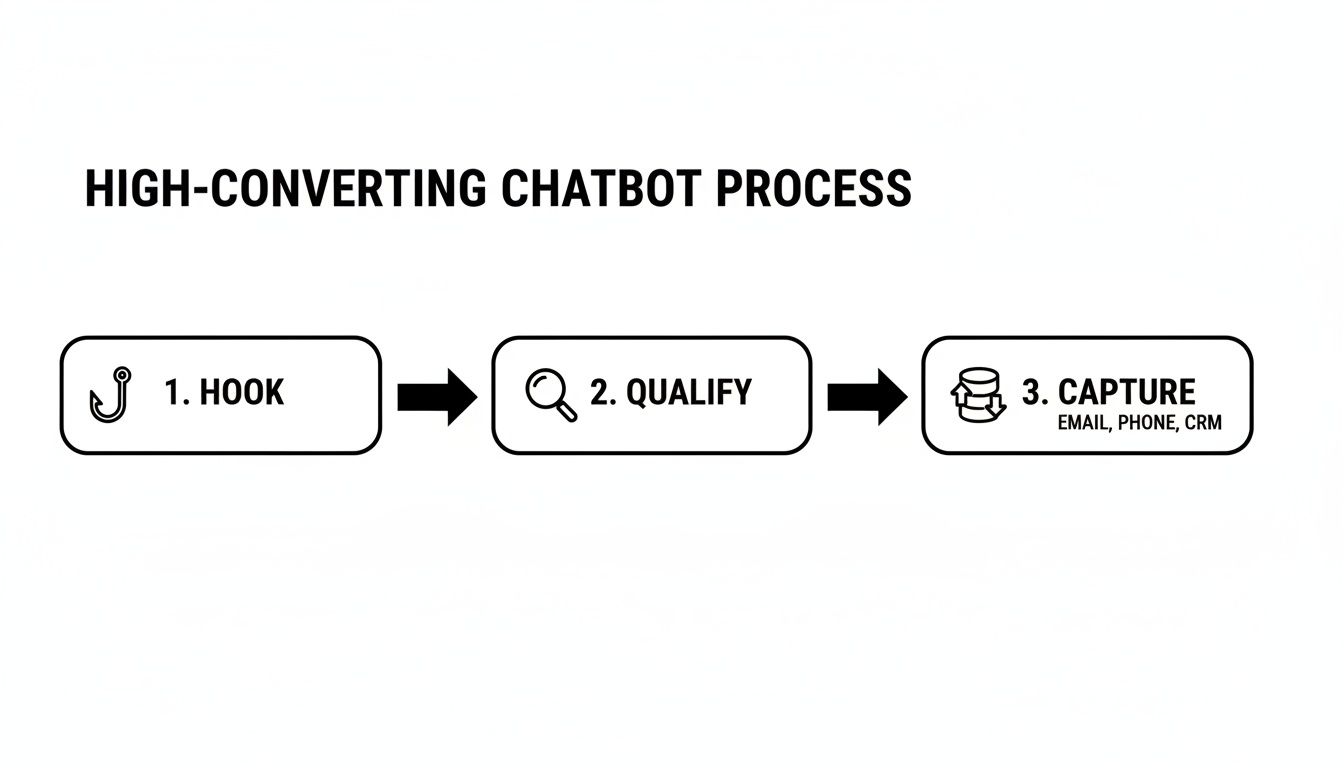
This hook, qualify, and capture flow is the universal blueprint for turning passive website traffic into active leads, no matter the industry. It works because it offers genuine value before asking for contact details, making the whole exchange feel helpful and natural, not pushy.
Implementing Your Chatbot the Smart Way
Getting a lead generation chatbot up and running is less about fancy code and more about having a solid game plan. The real goal isn’t just to have a bot on your site; it’s to launch a digital teammate that starts adding real value to your sales pipeline from day one. A well-thought-out implementation makes sure your bot is actually helpful, sounds like your brand, and delivers results you can actually measure.
It all starts with getting specific about what you want to achieve. A fuzzy goal like "get more leads" isn't going to cut it. You need something concrete, like "increase qualified demo requests by 20%" or "slash our lead response time to under 60 seconds." This kind of clarity becomes your north star, guiding every decision from how the bot talks to where you place it on your website.
This shift toward chatbots is really a response to how customer expectations have changed. People want answers now. In fact, research shows that 83% of website visitors prefer getting instant help. This isn't just a "nice to have"—it directly impacts business. A separate study found that 51% of consumers prefer bots for getting quick answers. Businesses are catching on, with 55% of companies using chatbots reporting they're getting higher-quality leads as a result. You can discover more about how chatbots are impacting lead generation to see why this isn't just a passing trend.
Training and Customization
With your goals locked in, it's time to train your AI. A great chatbot doesn't just pull answers out of thin air; it learns from the information you already have. Think of your help docs, product pages, and company FAQs as its textbook. By feeding it your own trusted content, you make sure it gives accurate, consistent answers that are true to your business.
This is also where you give the bot its personality. Is your brand serious and professional, or more fun and conversational? You can customize everything from its vocabulary and tone to the emojis it uses. The idea is to create an experience that feels like a genuine part of your brand, not some generic, bolted-on widget.
A chatbot without proper training is like a new employee on their first day with no orientation. Giving it the right information and a clear voice is the foundation for its success.
Strategic Placement and Testing
Where you put your chatbot can make or break its effectiveness. Don't just slap it on the homepage and hope for the best. Think about your highest-intent pages—the places where visitors are closest to making a decision—and put your bot there to make the biggest impact.
- Pricing Page: A bot here can greet visitors and offer to help them find the perfect plan.
- Product Feature Pages: It can proactively answer specific questions about how a feature works.
- "Request a Demo" Page: If someone hesitates, the bot can jump in and offer to book a meeting right on the spot.
Before you unleash your bot on the world, you absolutely have to test it. And test it again. Go through every possible conversation path to catch awkward phrasing, broken logic, or dead ends. A good platform will have a real-time "playground" where you can simulate conversations. Better yet, get your team to try and "break" the bot; their feedback is priceless for ironing out the kinks.
The best part? This entire process—from setting goals to going live—can be done without writing a single line of code. Modern tools are built for marketing and sales teams, not developers. Platforms like SupportGPT, for instance, provide a no-code environment where you can build and deploy a reliable AI agent with simple controls and built-in safety features to keep it on track.
Lead Generation Chatbot Implementation Checklist
To pull all these pieces together, a checklist can keep your project organized and ensure you don't miss any critical steps. It turns a potentially complex project into a manageable, step-by-step process.
| Phase | Key Action | Consideration |
|---|---|---|
| 1. Planning & Strategy | Define clear, measurable goals. | What specific metric do you want to improve (e.g., MQLs, demo bookings)? |
| 1. Planning & Strategy | Identify your target audience. | Who are you talking to? What are their common questions and pain points? |
| 1. Planning & Strategy | Map out key conversation flows. | What are the most important user journeys (e.g., pricing questions, booking a meeting)? |
| 2. Building & Training | Gather and upload your knowledge base. | Use help docs, FAQs, and product pages to train the AI with accurate information. |
| 2. Building & Training | Define your chatbot's brand personality. | Settle on a tone of voice, language, and style that aligns with your brand. |
| 2. Building & Training | Set up lead qualification questions. | What information do you need to collect to identify a high-quality lead (e.g., company size, role)? |
| 2. Building & Training | Configure the human handoff process. | When and how should the bot escalate a conversation to a live sales rep? |
| 3. Deployment & Testing | Choose strategic placement locations. | Which high-intent pages (pricing, features, contact) are best for the chatbot? |
| 3. Deployment & Testing | Conduct rigorous internal testing. | Have your team try to break the bot to find flaws before customers do. |
| 3. Deployment & Testing | Go live and monitor initial interactions. | Watch the first few conversations closely to catch any unexpected issues. |
By following a structured approach, you're not just adding a new tool; you're implementing a smart, automated system designed to grow your business.
How to Measure and Optimize Your Chatbot's Performance
Putting a lead generation chatbot on your site isn’t a one-and-done project. Think of it more like hiring a new salesperson. You wouldn't just leave them on their own without any coaching, right? The same goes for your bot. Continuous tweaking and optimization are what turn a simple chatbot into a real lead-generating powerhouse.
To make your chatbot better, you first have to know how it’s doing. This means getting comfortable with a few key metrics—the vital signs of your bot's health. These numbers tell you exactly what's working, what's falling flat, and where you can step in to improve its ROI.
Key Performance Indicators to Keep an Eye On
You don't need a massive dashboard to get started. Just focus on a few core numbers that tell the story of your chatbot's journey from greeting a visitor to capturing a lead.
Here are the most important metrics for any lead generation chatbot:
- Conversation Started Rate: This is simple: of all the people who see your chatbot, what percentage actually starts a conversation? A low number here is a red flag that your welcome message might not be grabbing their attention.
- Lead Capture Rate: This is the big one. It’s the percentage of conversations that end with a user handing over their contact information. This metric tells you if your bot is actually doing its primary job: converting conversations into qualified leads.
- Human Handoff Rate: How often does the bot need to tag in a live agent? This can be a double-edged sword. A high rate might mean your bot is great at identifying hot leads ready to talk, or it could signal that the bot is getting stuck and can't handle common questions.
- Drop-Off Point: Where in the conversation are people giving up and leaving? Finding the exact spot users abandon the chat is like finding gold. It points you directly to the friction in your script so you can smooth it out.
Tracking these KPIs turns optimization from a guessing game into a data-driven strategy. When you know the numbers, you can pinpoint the exact moments of friction in your user experience and make targeted improvements.
Actionable Ways to Start Optimizing
Once you have the data, the real fun begins. Now you can make smart, informed changes to boost performance. Optimization isn't about massive overhauls; it's a continuous cycle of testing small things, learning from the results, and refining your approach over time.
One of the best places to start? Just read the conversation logs. Seriously. The transcripts show you the exact words people are using, uncovering common questions you didn't think of or revealing parts of your script that are just plain confusing.
Here are a few powerful tactics you can try right away:
- A/B Test Your Welcome Messages: The first thing your bot says is critical. Don't just stick with one opener. Test a few different hooks to see what pulls more people in. For instance, you could pit a direct question like, "Looking for the right plan for your team?" against a benefit-driven line like, "I can find your perfect plan in 60 seconds."
- Refine Your Qualifying Questions: Is there one question where everyone seems to disappear? That’s a clear signal that it’s too hard, too personal, or just worded poorly. Try rephrasing it. Even better, swap an open-text field for a few simple buttons to make it effortless for the user to answer.
- Analyze Unanswered Questions: Dive into the questions your chatbot couldn't handle. This is direct feedback telling you what to teach it next. Every "Sorry, I don't understand" is an opportunity to expand your bot's knowledge base and make it more helpful for the next person who comes along.
Got Questions? We've Got Answers.
Jumping into the world of AI chatbots can feel like a big step, and it's natural to have a few questions. Let's clear up some of the most common ones we hear from teams just like yours.
How Much Technical Skill Do I Actually Need?
Honestly, next to none. The days of needing a developer to build a chatbot are long gone. Modern platforms are built with no-code, drag-and-drop interfaces, which means marketing and sales pros can design entire conversation flows and roll out a bot with a simple widget. If you can build a presentation, you can build a chatbot.
Will a Chatbot Sound Like a Robot and Damage Our Brand?
That's a common fear, but the reality is quite different. Today’s lead generation chatbots are designed for natural, human-like conversations. You have complete control over the bot's personality—you can dial in the tone, the language, and the exact phrasing to make sure it sounds just like one of your team members.
Think of it this way: well-designed guardrails keep the chatbot on-script and professional. It becomes a reliable ambassador for your brand, protecting your reputation in every single conversation.
What Happens When a Chatbot Gets a Really Tough Question?
It does the smart thing: it asks for help. A good chatbot knows its limits. When it comes across a complex question, a direct request to speak with a person, or a lead that's clearly hot, it instantly hands the conversation over to a live agent.
You set the rules for this handoff. This creates the best of both worlds—you get the 24/7 efficiency of automation, combined with the expert touch of your sales team right when it counts the most.
Ready to see how this works on your own site? With a platform like SupportGPT, you can build a smart, reliable AI agent in minutes and start turning more of your traffic into qualified leads around the clock. Start your free trial today and see for yourself.