10 Best AI Agent Builder Platforms in 2026
Compare the best ai agent builder platforms for features, pricing, integrations, guardrails, enterprise use, and practical recommendations.
The best AI agent builder isn't universal. A support team may prioritize source-grounded answers, guardrails, analytics, and human escalation, while an automation team may care more about integrations, tool execution, and pricing tied to completed actions. An enterprise buyer may instead choose the platform that fits its existing identity, cloud, security, and data controls.
That distinction matters because the category is moving beyond chatbot experiments. One 2026 estimate places the global AI Agent Builder market at USD 2.05 billion in 2025, rising to USD 2.30 billion in 2026 and projected to reach USD 7.80 billion by 2034, with a 15.9% CAGR over the forecast period, according to this 2026 market estimate. Buyers therefore need to compare more than model access. The practical questions are use-case fit, deployment model, integrations, model flexibility, observability, governance, pricing complexity, and implementation effort.
This list ranks platforms by the operating decision they support. SupportGPT is the featured choice for teams that need a customer-facing support agent live quickly, with control over sources, escalation, and ongoing improvement. For a broader perspective on evaluating software tools, see this comparison of sales data tools from Yalc.
1. SupportGPT
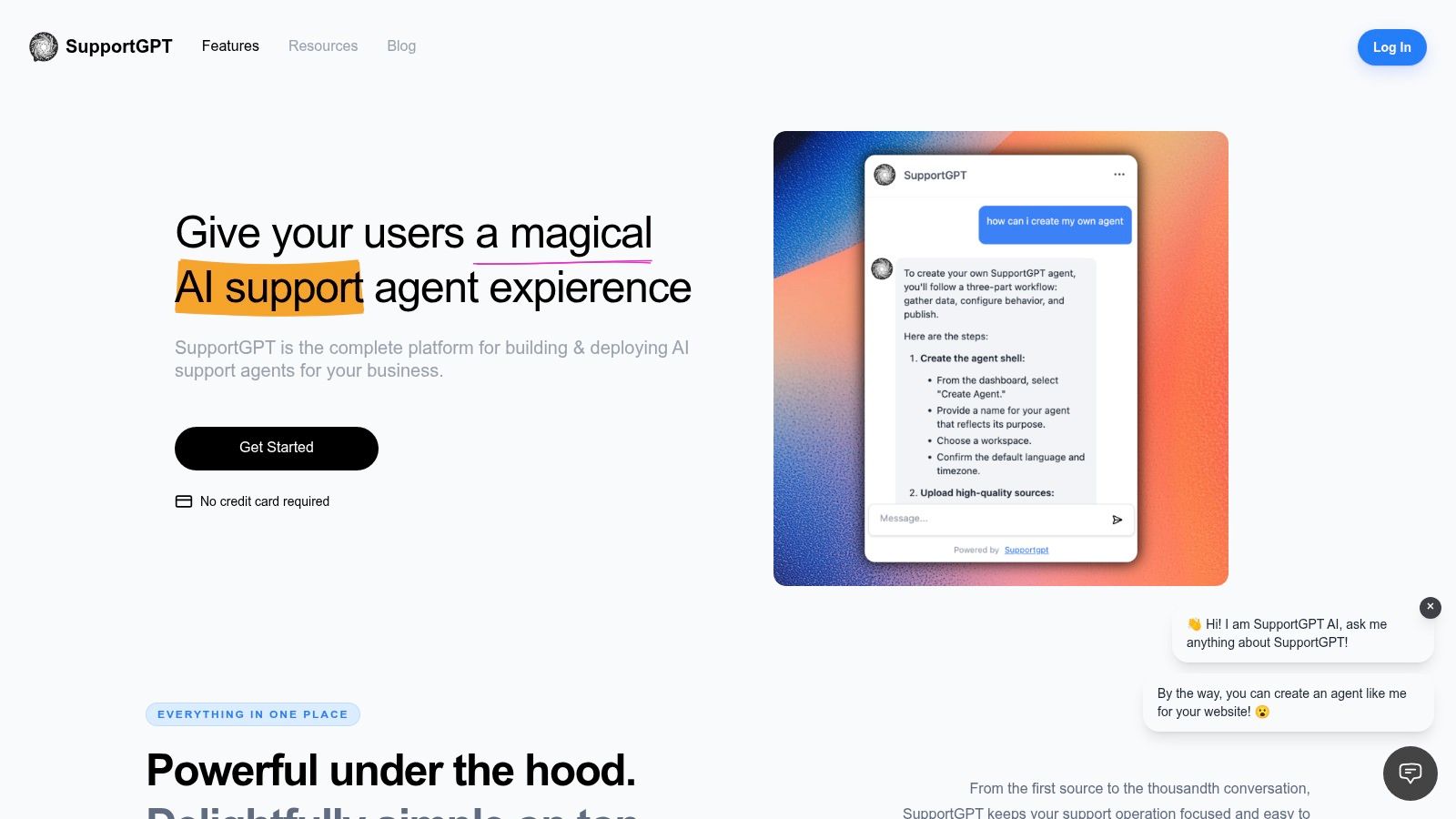
The operating question for a support team is whether it can launch a reliable agent without creating a large engineering project. SupportGPT targets that decision by combining agent creation, knowledge training, deployment, testing, actions, analytics, and escalation in one support-focused platform.
Teams can train agents with their documents and links, define tone and behavior, test responses in a real-time Playground, and deploy through a website widget or iframe. SupportGPT supports OpenAI, Gemini, and Anthropic, works across 90+ languages, and includes AI Actions for lead capture, appointment booking, and other support workflows.
Practical rule: Judge a support agent by how it responds when no grounded answer exists, not by the quality of its demonstration.
Its main trade-off is between rapid deployment and operational control. Non-technical teams can configure an agent, while product and security teams can apply source grounding, role-aware controls, encryption, compliance features, SSO, and SLA options for larger deployments. Smart escalation sends complex conversations to human teammates with context, reducing the chance that automation handles a case requiring judgment.
Economics and implementation trade-offs
SupportGPT offers a $0 Forever Free tier with 50 message credits, followed by Hobby at $40 per month, Standard at $150 per month, Pro at $500 per month, and custom Enterprise plans, according to the provided product plan. The free tier includes 400 KB of storage. Teams with larger knowledge bases or higher conversation volume therefore need to model paid usage and any external LLM costs.
The platform does not remove content-management work. Teams still need to curate sources, tune prompts, test edge cases, review conversations, and maintain escalation rules. For teams assessing AI agents for support, that creates one recurring operating loop instead of requiring separate systems for retrieval, widget deployment, testing, and analytics.
Best for: SaaS support, e-commerce assistance, SMB and mid-market customer teams, product-led companies, and enterprises seeking multilingual, guardrailed support with limited implementation effort.
2. Botpress
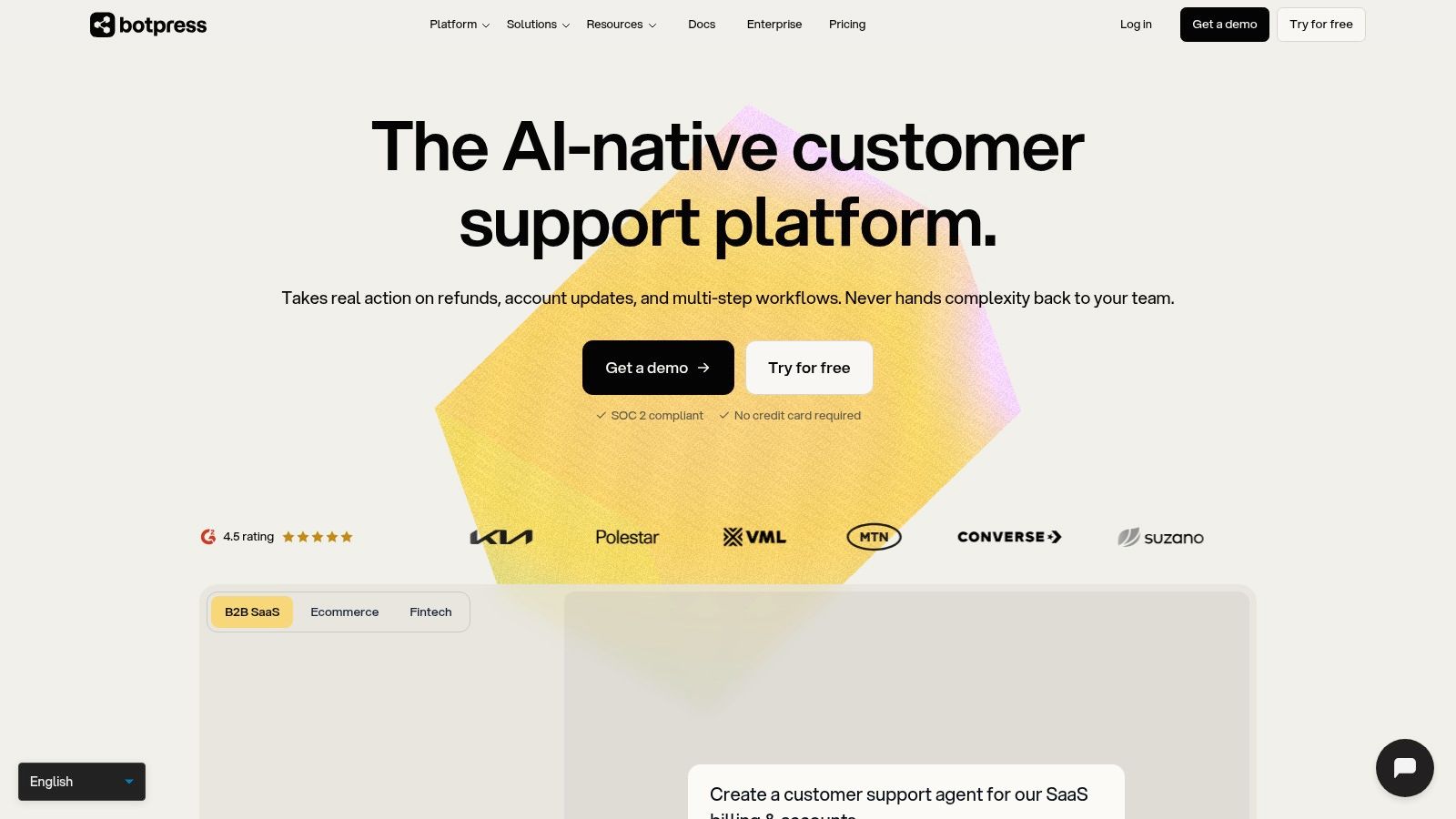
Botpress supports the operating decision of building and running a mature conversational system across multiple customer channels. Its visual Studio is designed for teams that want explicit routing, reusable knowledge, collaboration, and operational management rather than a single embedded chat window.
The platform combines a visual agent builder with a web widget, WhatsApp integration, Help Center content, analytics, vector storage, and file storage. Paid tiers support unlimited agents, role-based access control, team analytics, real-time collaboration, and enterprise services. Native voice is available at the Enterprise level, while other voice deployments depend on integrations.
Botpress separates conversation usage from AI spend. That distinction can make budgeting easier for support and customer experience teams because the business-facing unit is a conversation, while model expenditure remains visible as a separate concern. It also offers auto-recharge for usage, which reduces interruption risk but creates a financial-control issue.
Watch the billing behavior: Conversation overage auto-recharge can't be disabled, so teams need to size plans and establish internal spend controls before launch.
Botpress is a sensible choice for organizations that want a self-serve route into a platform with an enterprise path. Its trade-off is that pricing predictability depends on understanding conversation volume in advance. Native voice also isn't available across every tier, which makes the platform less straightforward for teams that consider voice a launch requirement.
Best for: Structured customer experience deployments, web and WhatsApp support, collaborative teams, and organizations that prefer conversation-based budgeting.
3. Voiceflow
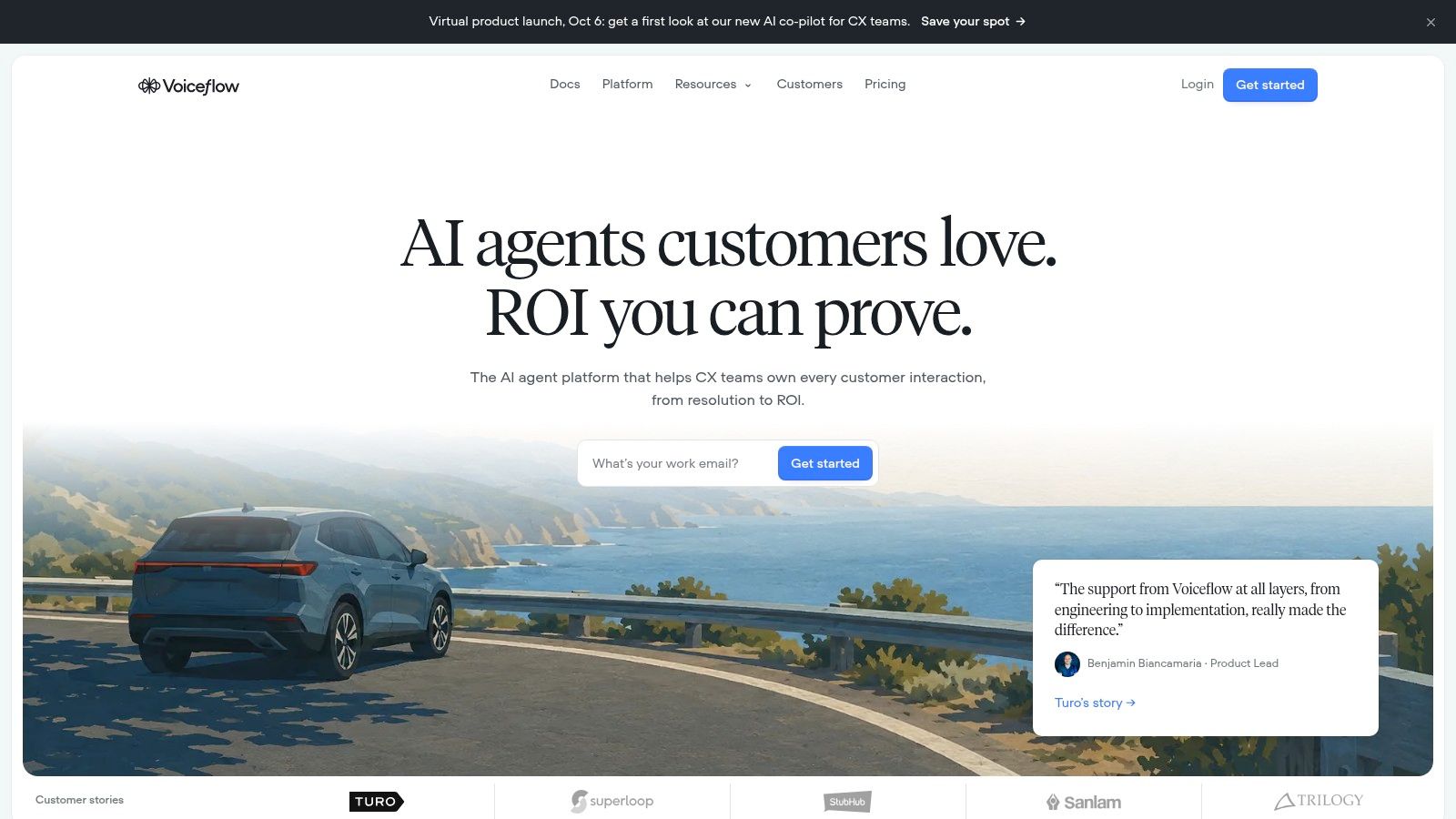
Voiceflow is built for the operating decision of designing a precise conversational experience across chat and voice. It suits teams that need to map intent, routing, fallback behavior, and multi-step dialogue visually before exposing the experience to customers.
Its design canvas gives product, conversation design, and agency teams a clear way to inspect how a user moves through a flow. Voiceflow supports chat channels and telephony deployment, works with major model providers, and includes observability, performance analytics, multi-client workspaces, client handoff, and white-labeling features for agencies.
The design-first approach is its strength and its limitation. A flow-heavy project can give a team more control over conversation paths, but it may take longer to revise than an agent that relies mainly on tool selection and dynamic orchestration. Teams with frequent product changes should test how much of their maintenance burden comes from editing explicit paths.
Voiceflow is also more suitable for complex voice programs than many general-purpose builders. Larger deployments are sales-led, so buyers need a commercial conversation before they can fully assess enterprise pricing and deployment terms.
Best for: Conversation designers, agencies, voice and telephony projects, and organizations where controlled dialogue matters more than the fastest possible prototype.
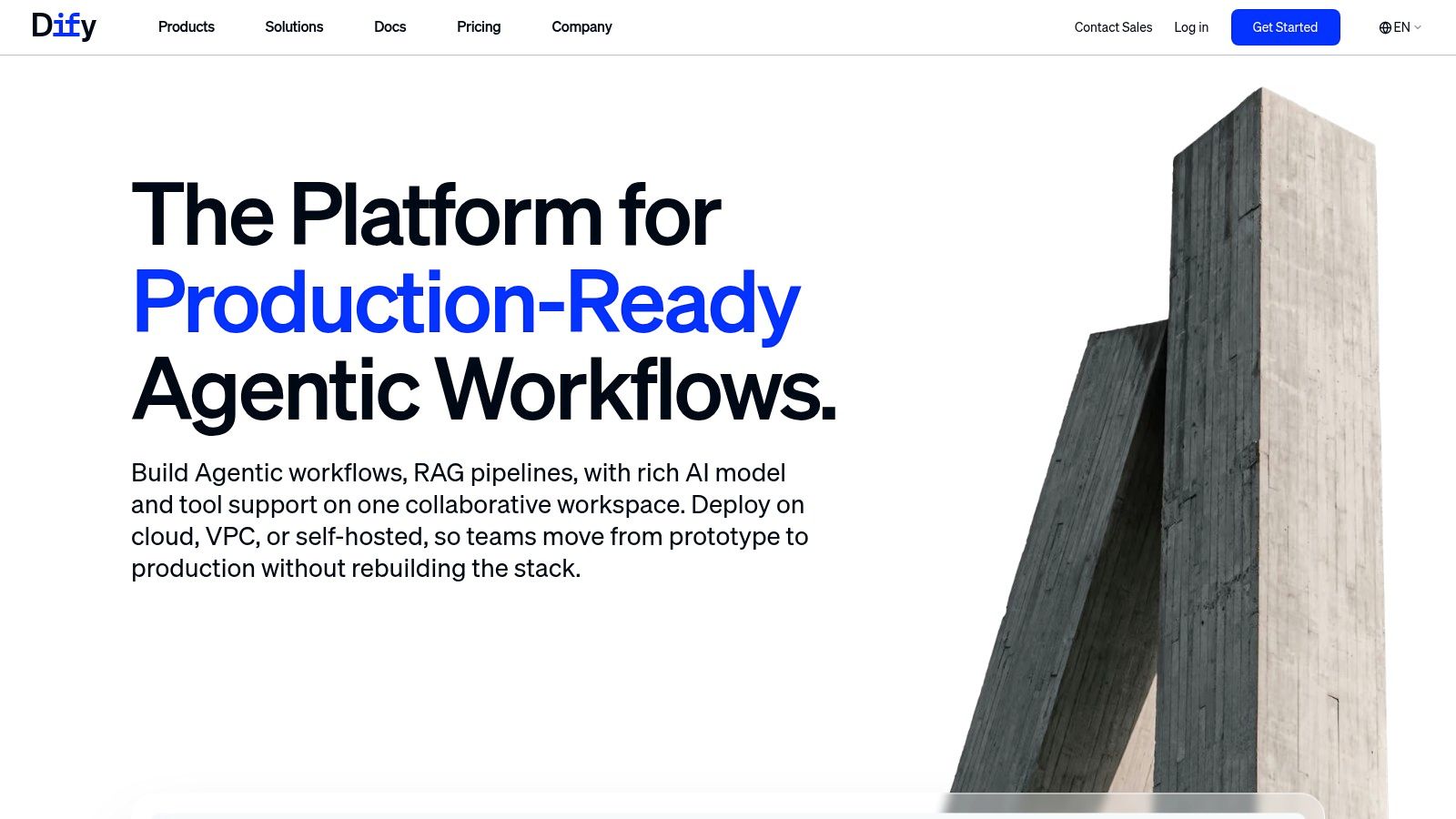
4. Dify
Dify supports the operating decision of moving from visual experimentation to flexible agentic applications without committing immediately to a single deployment model. It offers Cloud, private Enterprise deployment, and an open-source Community edition, giving teams more control over where the builder runs and how much infrastructure they own.
Its Workflow Studio handles agent orchestration, retrieval-augmented generation pipelines, evaluations, observability, knowledge management, and application publishing. A finished application can be exposed through an API or web app, while team management and logs provide the operational layer needed for shared development.
Dify is also useful when model flexibility matters. The platform supports providers including OpenAI, Anthropic, Gemini, xAI, and Tongyi, with a message-credit system for experimentation and the option to bring your own API keys as the application matures.
The economic trade-off is monitoring effort. Credit mapping varies by model, and high-throughput applications require attention to rate limits and consumption. A credit abstraction can simplify early testing, but it doesn't eliminate the need to understand model usage once the agent becomes a production workload.
Best for: Teams that want visual workflows, RAG pipelines, evaluations, model choice, and a credible path from cloud usage to self-hosting.
5. Flowise AI
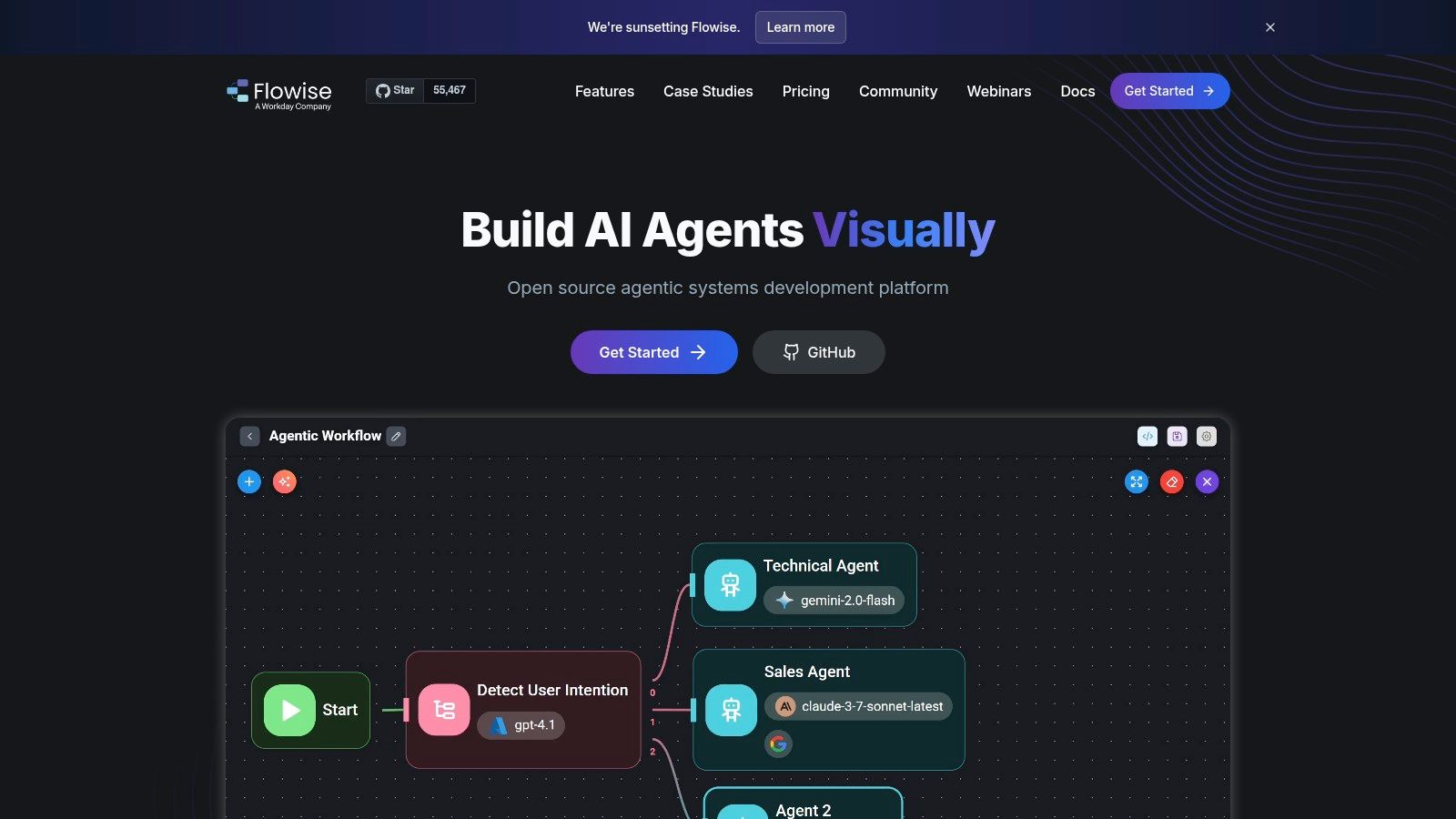
Flowise AI is aimed at teams making the operating decision to retain open-source flexibility while keeping a managed cloud option available. Its drag-and-drop builder lets users assemble agents and LLM workflows, expose them through a prediction API, stream responses, and follow deployment guidance for common cloud environments.
The platform works well for technical teams that want to inspect and shape the workflow rather than accept a fully managed abstraction. Hosted Cloud and Enterprise tiers add workspaces, role-based access control, evaluations, and metrics. Rate-limiting controls and API documentation make it practical to move a prototype into an application, provided the team accepts responsibility for infrastructure and model economics.
Some operational features are reserved for paid hosted tiers. That means the open-source edition gives flexibility, but it may not provide every capability needed for shared governance, evaluation, and multi-workspace operation.
Build decision: Choose Flowise when control over the workflow and deployment matters enough to justify managing infrastructure sizing and LLM costs.
Flowise isn't the simplest choice for a non-technical support team that wants a polished customer-facing agent immediately. It is more compelling for developers and platform teams that want a visual interface without giving up the option to self-host. Teams comparing the broader options can also review these AI agent frameworks before deciding whether they need a builder, a framework, or both.
Best for: Developers, open-source adopters, technical teams, and organizations that want a hosted path without abandoning self-managed deployment.
6. Relevance AI
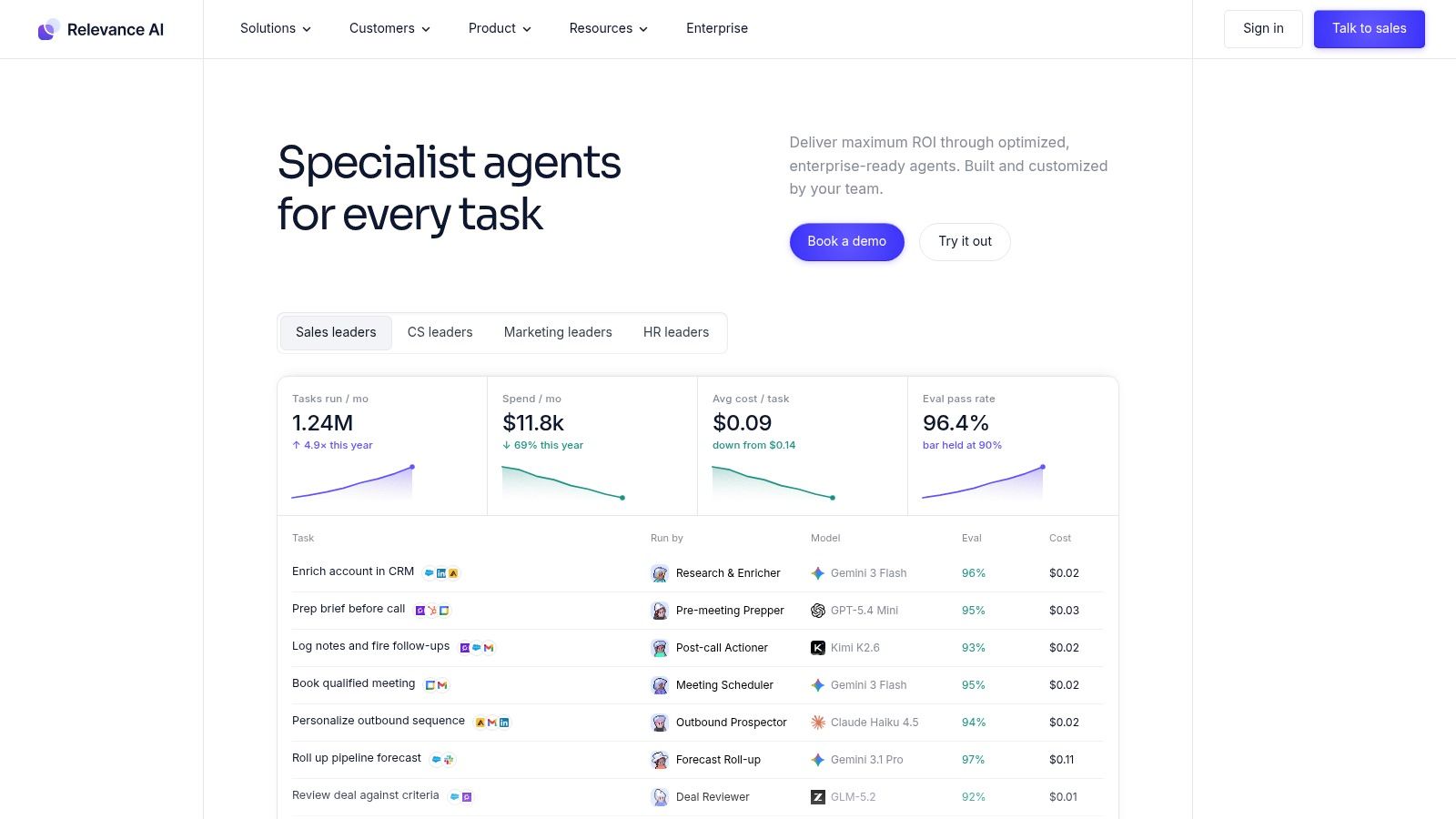
Relevance AI supports the operating decision of automating work rather than answering questions. Its “AI workforce” model is designed for multi-agent systems that can send emails, update CRM records, process tickets, schedule work, and coordinate operational tasks.
The platform combines visual agent and workforce composition with scheduling, ticketing, tools, evaluations, benchmarks, performance tracking, governance, and ROI-oriented analytics. Its model-routing approach can select a lower-cost model when that model passes defined evaluations, which makes quality thresholds part of the economics rather than an afterthought.
That approach is powerful for sales, operations, and support workflows with clear action outcomes. It also introduces a learning curve. Teams need to understand how agents, workforces, actions, credits, evaluations, and handoffs interact before they can forecast usage confidently.
Relevance AI presents pricing around actions and credits, which can be easier to relate to completed work than raw model tokens. However, the units still require upfront planning. A workflow that looks simple in a demo may trigger several tool calls, checks, and agent steps in production.
Best for: Action-heavy operations, sales and support automation, teams that need evaluations and ROI measurement, and enterprises that want governance around multi-agent work.
7. Zapier Agents
Zapier Agents is the practical choice when the operating decision is to let non-technical teams create agents that take action across an existing SaaS stack. Its no-code approach connects agents to thousands of applications, knowledge sources, and tool-based workflows, with governance features available for enterprise use.
The platform's value comes from the integration layer. A team can create an agent that retrieves information, calls connected tools, and updates business systems without building every connector from scratch. BYO LLM keys are supported on Advanced and Premium tiers, which can reduce model spend for tool-heavy runs, subject to documented daily rate limits.
Pricing is tied to tasks and model tier. That makes basic planning approachable, but long-running or complex agents can consume more tasks than a short workflow. Buyers should trace every step of a representative process, including retrieval, branching, retries, and external actions, before assuming a simple per-task estimate.
Some enterprise application restrictions remain, so integration availability needs validation rather than assumption. Zapier Agents is therefore strongest when the target workflow already lives inside supported SaaS applications.
For website use cases, teams can also review this guide on how to integrate AI into a website. The decision is straightforward: choose Zapier Agents for broad business automation, not for a governed knowledge support experience that needs specialized escalation and answer-quality controls.
Best for: No-code automation, SaaS-heavy operations, lead workflows, CRM updates, and teams that prioritize fast tool connectivity.
8. Microsoft Copilot Studio
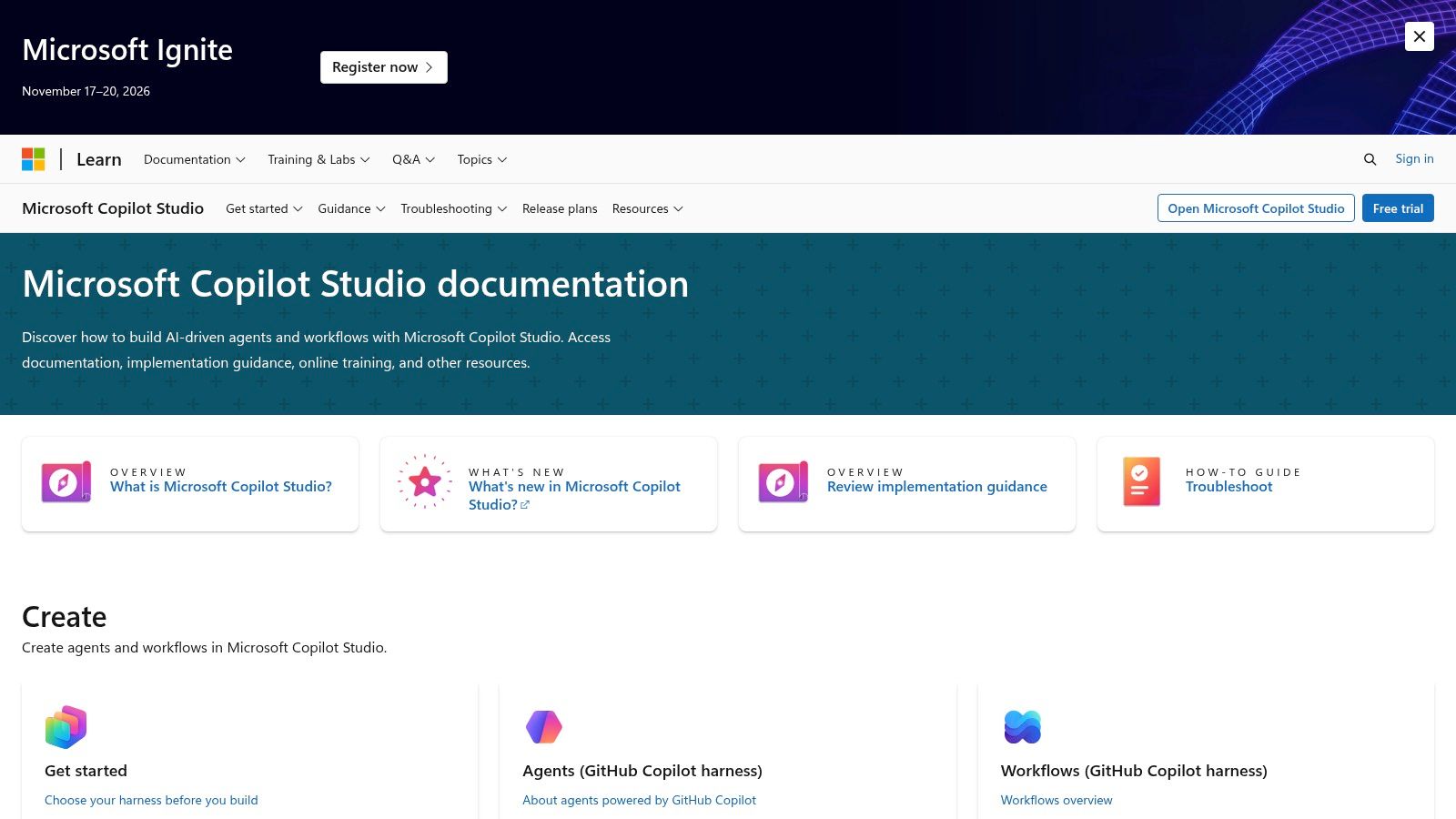
Microsoft Copilot Studio supports the operating decision of standardizing agents inside a Microsoft-controlled identity, security, and administration environment. It offers agent building with classic and generative answers, tools, knowledge sources, Teams deployment, and website embedding.
For organizations already using Microsoft 365, the platform's main advantage isn't a single conversational feature. It's the connection between agent deployment and existing enterprise controls, including SSO, administration, audit visibility, data residency considerations, and security management. Administrators can also inspect consumption through the Microsoft environment.
The platform bills usage through Copilot Credits, with pay-as-you-go and committed pools. That creates a formal cost-control structure, but it also adds another planning layer. Full rate details may require tenant access, so procurement teams shouldn't treat public product descriptions as a complete cost model.
Copilot Studio is a better fit for an enterprise standard than for an independent builder looking for the simplest route to an embedded support assistant. Teams should assess licensing, identity, data access, approval processes, and the cost of integrating systems outside the Microsoft estate.
Best for: Microsoft-centric enterprises, Teams-based deployments, governed internal agents, and organizations where identity and compliance outweigh platform simplicity.
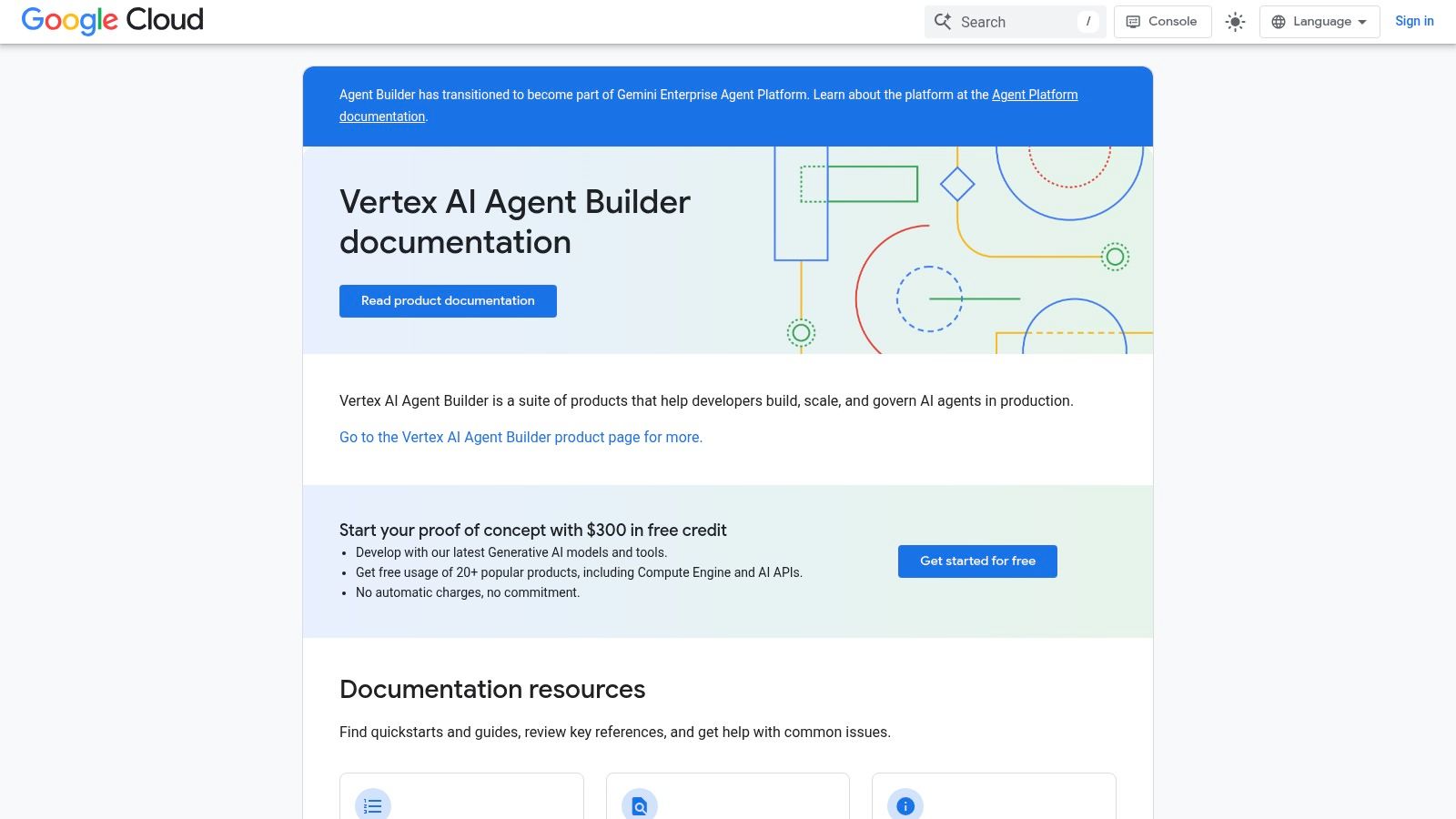
9. Google Cloud Vertex AI Agent Builder
Google Cloud Vertex AI Agent Builder supports the operating decision of building agents as part of a Google Cloud data and application platform. Its low-code console, managed Agent Engine runtime, Gemini integration, Vertex AI Search, retrieval capabilities, Cloud data services, and enterprise observability form a path from agent design to managed scale.
The platform is particularly relevant when search quality, data lineage, and access to Google Cloud services are central requirements. Tool governance, including Cloud API Registry integration, gives cloud teams a way to bring agent actions into established service-management practices.
The trade-off is commercial and architectural complexity. Costs can span the agent runtime, model usage, storage, retrieval, and other cloud services. A procurement estimate that only counts model calls will miss part of the operating picture, so engineering and FinOps teams need to model the complete architecture.
Vertex AI Agent Builder also makes more sense for teams that already have GCP expertise. A company without that foundation may spend significant effort on data permissions, service configuration, monitoring, and deployment practices before the agent produces business value.
For a broader explanation of how agent platforms differ from individual builders, see this guide to AI agent platforms.
Best for: Google Cloud customers, data-rich enterprise applications, retrieval-heavy agents, and teams that need managed runtime and cloud governance.
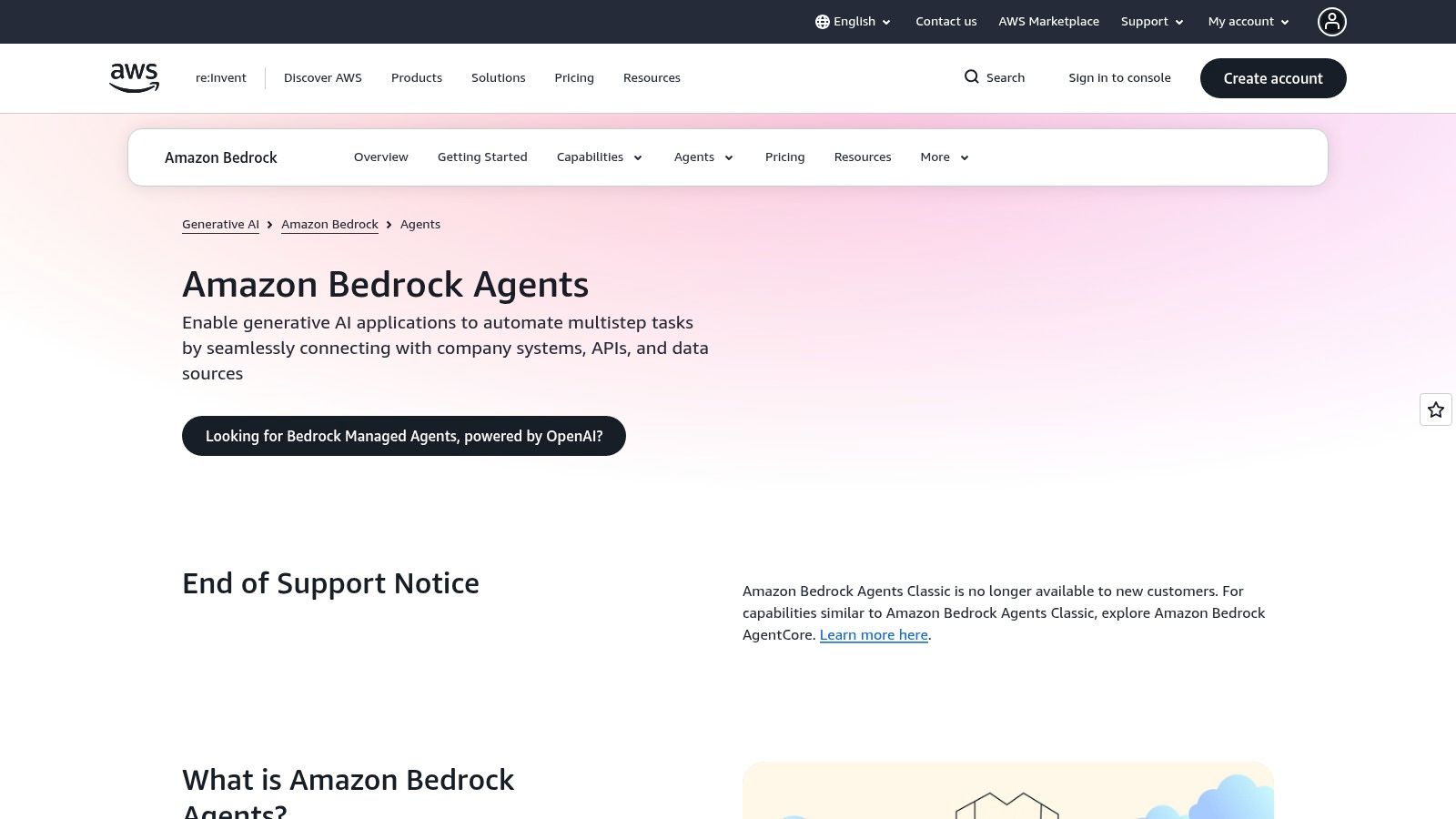
10. AWS Agents for Amazon Bedrock
AWS Agents for Amazon Bedrock supports the operating decision of running production agents within an organization's AWS account and operating model. AgentCore provides managed runtime capabilities, identity and networking controls, tool execution, CloudWatch telemetry, and access to Bedrock foundation models.
The platform's strongest argument is governance at the infrastructure boundary. IAM, KMS, VPC controls, CloudWatch traces, logs, and metrics give AWS teams familiar mechanisms for controlling and observing agent workloads. Bedrock model support and provisioned throughput also provide a path for teams that need to align model access with existing AWS architecture.
That control comes with FinOps responsibility. Costs can include runtime consumption, optional instance compute, model usage, tool and service calls, logs, metrics, and other standard AWS charges. The platform may be operationally predictable for an experienced AWS organization, but it won't automatically produce a simple business-facing price.
AWS Agents for Amazon Bedrock is therefore not the default choice for a small support team trying to launch a website assistant. It becomes compelling when security boundaries, networking, identity, observability, and account-level governance are already managed through AWS.
Teams planning implementation should follow AI agent best practices and define permissions, tool scopes, fallbacks, logs, and human ownership before allowing an agent to perform consequential actions.
Best for: AWS-native enterprises, regulated workloads, infrastructure-led teams, and organizations that need agents operated inside established cloud controls.
Top 10 AI Agent Builders: Side-by-Side Comparison
| Solution | Core features | UX & Trust (★) | Price / Value (💰) | Target audience (👥) | Unique selling points (✨) |
|---|---|---|---|---|---|
| SupportGPT 🏆 | Embeddable widget, multi‑LLM, RAG, analytics, AI Actions | ★★★★★ | 💰 Free tier → Pro/Enterprise; flexible scaling | 👥 SaaS, e‑commerce, support teams, enterprises | ✨ Fast live deploy; enterprise guardrails; smart escalation |
| Botpress | Visual studio, multi‑channel, KB, conversation billing | ★★★★ | 💰 Conversation‑based pricing; paid tiers | 👥 CX/support teams, mid→large orgs | ✨ Predictable convo pricing; unlimited agents (paid) |
| Voiceflow | Visual design canvas, telephony, model‑agnostic, analytics | ★★★★ | 💰 Credits‑based; enterprise sales | 👥 Designers, agencies, voice apps | ✨ Best UX for complex flows; strong voice support |
| Dify | Visual workflow studio, RAG pipelines, marketplace, deploy options | ★★★★ | 💰 SaaS/Enterprise or Community OSS; model credits | 👥 Teams prototyping→production; self‑hosters | ✨ BYO keys, flexible self‑host & cloud paths |
| Flowise AI | Drag‑drop workflows, prediction API, Cloud workspaces | ★★★★ | 💰 Open‑source + hosted tiers | 👥 OSS adopters, rapid prototypers | ✨ OSS flexibility with hosted upgrade path |
| Relevance AI | Multi‑agent workforces, evals, governance, ROI analytics | ★★★★ | 💰 Action/credit pricing; enterprise focus | 👥 Sales, ops, enterprise automation | ✨ Action‑priced "work done" economics; governance |
| Zapier Agents | No‑code agent orchestration across 7k+ apps, BYO LLM | ★★★ | 💰 Task‑based; Premium for heavy use | 👥 Non‑technical teams, automation‑first orgs | ✨ Instant app integrations; clear task math |
| Microsoft Copilot Studio | Generative/classic answers, Teams/web deploy, M365 security | ★★★★ | 💰 Copilot Credits; tenant pricing/commit options | 👥 Microsoft tenants, regulated enterprises | ✨ Deep M365 integration, enterprise compliance |
| Google Vertex AI Agent Builder | No/low‑code builder, Gemini integration, managed runtime | ★★★★ | 💰 Multiple SKUs (platform, engine, models) | 👥 GCP customers, enterprises | ✨ Tight GCP service & RAG integration; scale-ready |
| AWS Agents (AgentCore) | Runtime in AWS account, VPC/IAM, CloudWatch telemetry | ★★★★ | 💰 Consumption + model + infra costs | 👥 AWS‑native enterprises, security teams | ✨ Run agents in your VPC with AWS security controls |
Choose the Builder That Fits Your Operating Model
The market's growth makes the phrase best AI agent builder less useful as a standalone buying question. One 2026 analysis projects the AI agent builder category from USD 2.30 billion in 2026 to USD 7.80 billion by 2034 at a 15.9% CAGR, while a separate analysis projects the broader AI agents builder and platform market from USD 10.75 billion in 2025 to USD 66.38 billion by 2031 at a 35.34% CAGR, as reported in this market coverage. Those projections point to more vendor competition, faster feature changes, and a greater need to avoid platform decisions based on a feature checklist alone.
Start with the work the agent must perform. Choose SupportGPT when the priority is fast, guardrailed customer-support deployment with source grounding, multilingual responses, analytics, AI Actions, and human escalation. Choose Botpress or Voiceflow when the experience depends on structured conversational paths, channel coverage, voice, or collaborative conversation design.
Choose Dify or Flowise AI when deployment flexibility, visual workflows, model choice, and self-hosting matter more than a fully managed support product. Choose Relevance AI or Zapier Agents when the agent must execute actions across business systems and the economic unit is closer to completed work than to a support conversation.
Microsoft, Google Cloud, and AWS become the stronger candidates when existing enterprise identity, security, data services, networking, observability, and cloud operations are decisive. Their integration advantages can outweigh their pricing and implementation complexity, but only when the organization already has the skills and controls to operate them.
Validate the workflow, not the demo
Enterprise adoption provides context for the buying decision. McKinsey reported in 2025 that 88% of organizations were using AI in at least one business function, up from 78% the year before, and that 62% were at least experimenting with autonomous AI agents, according to Brilo's reporting on conversational AI statistics. Another 2026 survey reported that 65% of enterprises were already using AI agents, 81% said adoption was fully scaled or expanding, and 100% planned to expand agentic AI in 2026, as summarized by AI Newspaper.
Adoption doesn't prove readiness. Independent reporting identifies data searchability and reusability as barriers, with 48% of organizations citing data searchability and 47% citing data reusability as challenges, while another survey found 57% of IT leaders viewed security and compliance as a primary concern and 38% struggled with integration complexity, according to ZDNET's analysis of AI agent failures. For support teams, the test should use a representative workflow involving real product documentation, an ambiguous customer request, a missing answer, an escalation, and an action such as order lookup or lead capture.
Measure answer quality, source adherence, latency, handoff behavior, failure recovery, and review effort. Then model the full economics, including credits, messages, actions, model usage, storage, API calls, infrastructure, observability, and human handling. PwC identifies unclear use cases or business value as a major barrier, while G2's 2026 review analysis found pricing concerns and steep learning curves among the leading complaints, with 33% of reviews mentioning pricing concerns and 27% mentioning learning curves, according to PwC's AI agent survey and the provided review analysis.
The right builder is the one your team can operate accurately and affordably after launch, not the one with the longest feature list.
SupportGPT offers a fast path to customer-facing AI support with source-grounded answers, enterprise guardrails, smart escalation, multilingual support, AI Actions, analytics, and a real-time Playground. Visit SupportGPT to test whether its support-focused operating model fits your representative workflow before committing to a broader agent platform.