Helpdesk Systems Comparison: Find the Best Fit for Your Business
Discover which solution fits your business with a helpdesk systems comparison, including AI, automation, and integrations for SaaS, SMBs, and e-commerce.
Choosing the right helpdesk system isn't just about buying software. It’s a strategic move that directly impacts your customer experience and how efficiently your team operates. The perfect system for a high-volume e-commerce store is rarely the right fit for a B2B SaaS startup, so understanding your specific needs is everything. This guide will give you a clear framework to compare the top contenders and pinpoint the features that will actually help you grow.

Navigating Your Helpdesk System Options
Picking a new helpdesk can feel overwhelming, but it doesn’t have to be. The secret is to stop thinking about features first and start thinking about your needs first. Instead of asking, "What can this software do?" ask, "What does my team need to do better?" This simple shift changes the entire helpdesk systems comparison from a checklist exercise into a real strategic evaluation.
The market for these tools is exploding. Projections show the global help desk software market growing from USD 11.85 billion in 2023 to USD 29.40 billion by 2033, according to research from Spherical Insights. This boom proves just how essential these platforms have become for businesses that want to scale their customer support without breaking the bank.
Defining Your Core Requirements
Before you even look at a demo, you need to define what success means for your team. Creating a clear set of criteria will be your North Star, keeping you from getting sidetracked by shiny features that don't solve your actual problems.
Start by focusing on these foundational pillars:
- Scalability: Can the system grow with you? A platform that’s great for 100 customers needs to handle 10,000 without forcing you to start over.
- Integration: How easily does it plug into your existing tech stack? Think about your CRM, e-commerce platform, or internal chat tools.
- Automation and AI: Does it offer smart automation to deflect repetitive questions? This frees up your agents to focus on the conversations that matter most, which is where modern tools like SupportGPT really shine.
The goal isn't to find a helpdesk with the most features, but the one with the right features. An overcomplicated system can kill productivity just as easily as an underpowered one.
A High-Level Comparison of Leading Contenders
To get our bearings, let's look at how different categories of helpdesk systems serve different business needs. This quick overview will help you sort the options you'll see in our more detailed comparison later. Putting these ideas into action is a core component of following proven help desk best practices.
| Helpdesk Type | Primary Use Case | Key Strength | Example Platform |
|---|---|---|---|
| Traditional/Omnichannel | Large enterprises with complex, multi-channel support needs. | Deep customization, robust reporting, and powerful ticketing. | Zendesk, Freshdesk |
| Conversational/Live Chat | Product-led companies focused on real-time user engagement. | Proactive messaging, user onboarding, and lead capture. | Intercom |
| AI-Native/Automated | Startups and SMBs needing 24/7, scalable support. | Instant, accurate answers and smart escalation to human agents. | SupportGPT |
What to Look for in a Helpdesk: The Core Essentials
Before you start comparing helpdesk systems feature-for-feature, we need to lay some groundwork. Picking the right software isn't about finding the one with the most bells and whistles; it's about finding the tool that actually solves your team's problems and can grow with you. Without a clear set of criteria, you'll end up dazzled by slick demos that don't address the real-world headaches your support team faces every single day.
Let's walk through the core pillars that any modern helpdesk needs to get right. These are the non-negotiables that separate a truly valuable tool from just another piece of software.
AI and Automation Capabilities
First up: how well does the system automate the repetitive stuff? Simple, rule-based automation is table stakes now. The real power comes from platforms with genuine AI that can understand what a customer is actually asking, pull the right answer from your knowledge base, and do it all 24/7 without a human lifting a finger.
Think about it in practice. For a SaaS company, this could be an AI walking a new user through the initial setup process. For an online store, it might be an AI instantly answering all those "Where's my order?" questions during the Black Friday rush. The goal here is simple: deflect the easy tickets so your agents can focus their brainpower on the complex, high-stakes issues.
Escalation and Workflow Customization
No AI is perfect, and it won’t solve every problem. That’s why having a seamless handoff to a human agent is absolutely critical. The best systems let you build out custom workflows that automatically route conversations to the right person or team based on specific triggers—things like keywords, customer sentiment, or how complex the issue seems to be.
Imagine a user at a product-led SaaS company reports a major bug. A smart workflow should immediately tag that ticket as urgent, pull the user's account details from your CRM, and assign it directly to a Tier 2 technical specialist. This kind of behind-the-scenes orchestration prevents frustrating bottlenecks and makes sure the most critical problems get immediate attention.
A helpdesk's true power isn't just in answering questions. It's in knowing when to get a human involved and exactly which human that should be. Smart escalation is non-negotiable.
Analytics and Performance Tracking
If you can't measure it, you can't improve it. Any helpdesk worth its salt has to give you clear, actionable analytics on your entire support operation. And I'm not talking about basic stuff like ticket volume or first response time.
You need dashboards that give you real insight, like:
- AI Deflection Rate: What percentage of questions is the AI actually handling on its own, without needing an agent?
- Customer Satisfaction (CSAT) Scores: Are people actually happy with the support they're getting, whether from a bot or a person?
- Top Query Topics: What are customers constantly asking about? This is gold for figuring out where your documentation or product is falling short.
This is the data that helps you fine-tune your entire support strategy, spot training opportunities for your team, and make decisions based on facts, not guesswork.
Integrations and API Access
Your helpdesk can't be an island. It has to connect smoothly with the rest of your tech stack—your CRM, internal chat tools like Slack, project management software, and e-commerce platforms. Solid integrations mean your customer data is consistent and easily accessible everywhere, creating a single, unified workflow.
For instance, a good CRM integration lets an agent see a customer's entire purchase history and past conversations without ever leaving the ticket. For a company that’s growing fast, an open and well-documented API is also a must-have. It gives you the freedom to build your own custom connections and workflows as your needs change, turning the helpdesk into the true command center for all your customer interactions.
A Detailed Helpdesk Systems Comparison
Alright, let's get down to the brass tacks. We've talked about what to look for in a helpdesk, but now it's time to see how the big players actually stack up against each other. This is where we put the leading platforms head-to-head to see how they perform on the criteria that really matter.
I'll be looking at the established giants like Zendesk and Freshdesk, the conversational powerhouse Intercom, and an AI-first newcomer, SupportGPT. The goal here isn't just a list of pros and cons; it's about digging into the differences that will make or break your decision based on your team's specific needs.
Helpdesk Systems Feature Comparison Matrix
Here’s a quick-glance table to help you compare the core features of each platform. Think of this as your cheat sheet for seeing who excels where.
| Feature Category | Zendesk | Freshdesk | Intercom | SupportGPT |
|---|---|---|---|---|
| AI/Chatbot | Zendesk AI assists agents with ticket categorization and suggested replies. | Freddy AI offers similar agent-assist features and basic, rule-based chatbots. | Fin, its AI assistant, is strong at deflecting questions using a knowledge base. | Advanced LLM-powered agent for contextual conversations; no-code AI builder. |
| Escalation/Workflow | Extremely powerful triggers and automation rules, highly customizable for enterprises. | Robust workflow automation for routing tickets based on various properties. | Workflows tied to its live chat messenger, great for real-time sales/support routing. | "Smart escalation" based on natural language rules (e.g., customer frustration). |
| Analytics | Enterprise-grade reporting suite with hundreds of metrics for agent and SLA tracking. | Comprehensive analytics focusing on team performance and traditional support KPIs. | Analytics geared toward user engagement, conversation ratings, and response times. | Dashboards focused on AI performance: deflection rate, user queries, and knowledge gaps. |
| Integrations | Massive app marketplace connecting to CRMs, internal tools, and more. | Extensive integration library, similar in scope to Zendesk. | Large app store with a focus on sales, marketing, and communication tools. | Key integrations with essential tools; offers SSO on more accessible plans. |
| Security/Compliance | Enterprise-level security (SSO, GDPR, SOC 2), often on higher-tier plans. | Strong security features and compliance, typically gated in premium plans. | Solid security and compliance, with advanced features on more expensive plans. | Robust security and compliance; SSO is available on lower-cost tiers. |
| Multilingual Support | Comprehensive multilingual support across knowledge base and agent interface. | Strong multilingual capabilities for global support teams. | Good multilingual support, especially within the chat widget. | Native multilingual support handles conversations in dozens of languages out of the box. |
| Pricing | Tiered, per-agent pricing that scales with team size. | Per-agent model with different feature tiers; can get costly. | Premium per-seat pricing, often best for sales-focused teams. | Usage-based model with a generous free tier, scalable for any size. |
This matrix gives you a high-level overview, but the real story is in the details of how these features work in practice. Let's dive deeper.
AI and Chatbot Capabilities
A helpdesk's "intelligence" is no longer a nice-to-have; it's a core differentiator. We've moved far beyond the clunky, rule-based chatbots of a few years ago. Today, it’s all about AI agents that can actually understand what a customer wants.
- Zendesk & Freshdesk: Both platforms have invested heavily in AI with their respective tools, Zendesk AI and Freddy AI. These are great for helping agents work faster by categorizing tickets or suggesting canned responses. They can power basic chatbots, too, but you’ll find they still lean heavily on a more traditional, rule-based setup.
- Intercom: Best known for its slick chat interface, Intercom’s AI, Fin, is fantastic at pulling answers from your knowledge base to deflect common questions. It's built for real-time engagement, which makes it a powerful tool for sales and customer onboarding.
- SupportGPT: As an AI-native platform, this is where SupportGPT really shines. Its agent is built on a large language model (LLM), allowing it to hold genuine, contextual conversations instead of just deflecting tickets. The real game-changer is its no-code builder, which lets a support manager—not an engineer—deploy a sophisticated AI agent in minutes. For a startup needing 24/7 coverage without the budget for a massive team, this is huge.
Escalation and Workflow Automation
How a system hands off a conversation from AI to a human agent is a make-or-break moment for customer experience. A clumsy handoff feels jarring, while a smooth one is seamless.
Zendesk is the king of customization here, with powerful triggers and automation rules that are perfect for large companies with complex internal processes. Freshdesk is right there with it, offering solid workflow automations that can route tickets based on just about any property you can think of.
Intercom handles this through its messenger, using workflows to route sales leads and support queries in real time. SupportGPT takes a slightly different approach with "smart escalation." You can set rules using natural language, like telling the bot to hand off any conversation where a customer mentions "refund" or expresses clear frustration.
A key differentiator in modern helpdesks is the ease of building intelligent workflows. A system that allows a support manager to create a complex escalation path without writing a single line of code provides a massive operational advantage.
Analytics and Reporting
You can't improve what you don't measure. While every platform offers analytics, what they choose to focus on tells you a lot about their philosophy.
Both Zendesk and Freshdesk come with massive, enterprise-grade reporting suites. You can track hundreds of metrics, from individual agent performance to SLA compliance. This is ideal for large teams that need granular data for performance reviews. Intercom, true to its nature, focuses more on user engagement metrics like conversation ratings and response times.
SupportGPT’s analytics are laser-focused on one thing: AI performance. It gives you clean dashboards showing your AI deflection rate, the top questions users are asking, and where your knowledge base might have gaps. The data is designed to be immediately actionable, helping you improve the AI without getting buried in spreadsheets.
This chart really brings home the three pillars you should be weighing in any helpdesk comparison: the power of its AI, how well it integrates with your other tools, and its security posture.
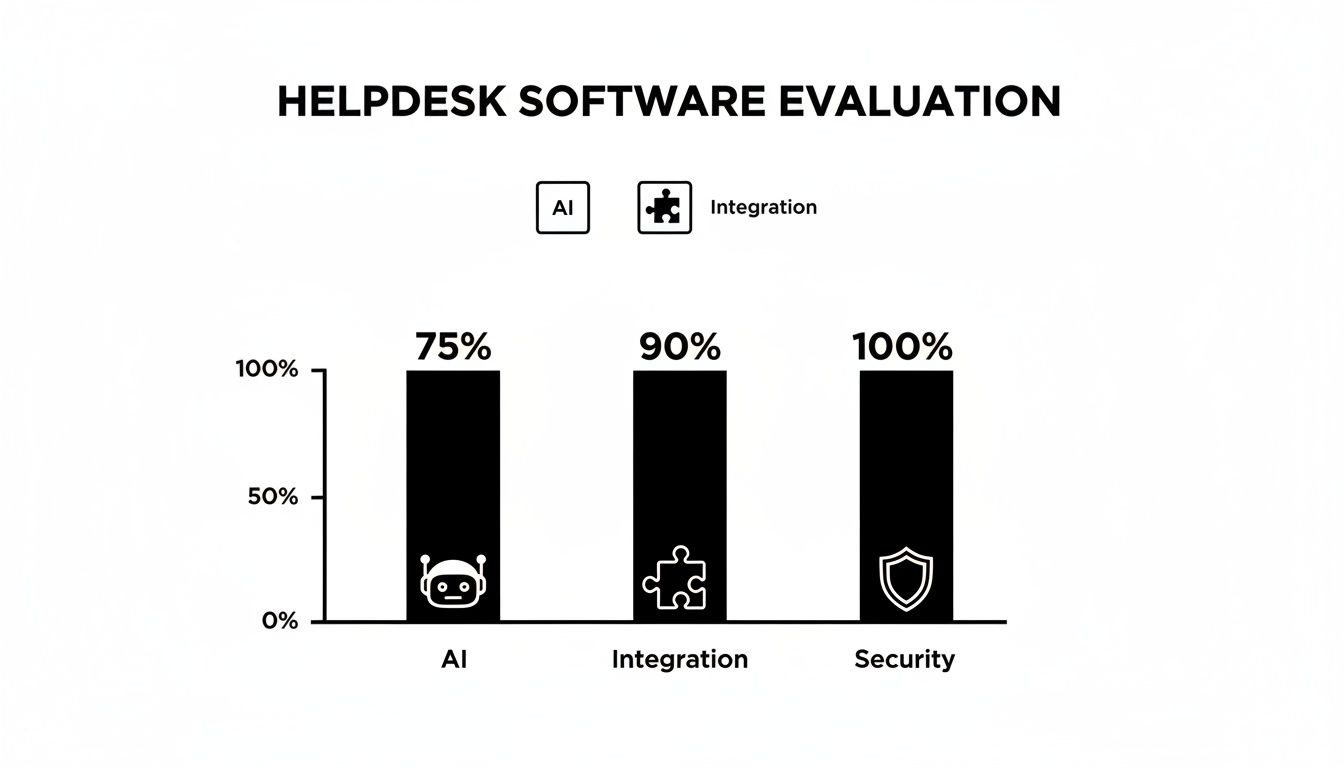
As you can see, while integrations and security are table stakes, AI is where the real innovation—and the biggest efficiency gains—are happening right now.
Integrations and Security
A helpdesk can't live on an island. It has to talk to your other tools and meet modern security standards. All four of these platforms are strong here, but with different nuances.
Zendesk, Freshdesk, and Intercom have massive app marketplaces. If there's a tool you use, they probably integrate with it, from Salesforce to Slack. They all offer enterprise-grade security features like SSO and are compliant with GDPR and SOC 2, but you’ll often have to pay up for their higher-tier plans to get them.
SupportGPT also offers the key integrations you’d expect and takes security seriously with strong encryption and compliance. Its edge is that it often includes features like SSO in more accessible plans, which is a big deal for security-conscious startups that don't have an enterprise budget.
The growth in this space has been staggering. The adoption of help desk software has exploded from just 11% in 2020 to 53% in 2024, which shows just how essential these tools have become. With 86% of technical support teams saying it significantly improves their output, it’s clear that a good helpdesk is a necessity, not a luxury. For more stats on this trend, you can find some great insights on help desk statistics.
Pricing and Scalability
Finally, let's talk money. The best tool in the world is useless if you can't afford it as you grow.
- Zendesk & Freshdesk: Both use a traditional, tiered, per-agent pricing model. This is straightforward but can get expensive quickly as you hire more support staff. Their most powerful AI and automation features are almost always locked away in the pricier Professional or Enterprise plans.
- Intercom: This platform also uses a per-seat model and is widely considered a premium option. It can be quite costly, especially for teams with a lot of support agents, making it a better fit for companies focused on conversational sales and marketing.
- SupportGPT: This is where things get interesting. SupportGPT uses a more modern, usage-based model with a generous free tier. This lets even early-stage startups get 24/7 AI support up and running from day one. Your costs scale with customer interaction volume, not with how many people you have on your team, which makes it incredibly flexible.
If you’re particularly focused on real-time customer interaction, it’s worth taking a look at our guide on live chat software comparison to see a more specialized breakdown of those tools.
Matching Your Helpdesk to Your Business Needs
A detailed feature matrix is a great starting point, but you can't really compare helpdesk systems until you connect those features to what they'll actually do for your business. The "best" platform is completely relative. It depends on how you operate, the size of your team, and what your customers have come to expect.
A tool that’s perfect for a lean startup could easily create bottlenecks for a growing mid-market company. So, let's move beyond the checklist and look at some clear, situational recommendations. We'll explore three common business types and figure out which kind of helpdesk is best suited to solve their unique problems. This should help you make a decision that feels right for your specific situation.
For the Lean SaaS Startup
If you're running a SaaS startup, your main challenge is scaling up without blowing your budget. Your support team might be just one or two people, but you still need to provide a top-notch, responsive experience to keep users happy and prevent churn. Your priorities are efficiency, cost-effectiveness, and offering 24/7 availability without hiring a global team.
For this exact scenario, an AI-native platform like SupportGPT is a natural fit. Its generous free tier lets you deploy a powerful AI agent from day one. It can handle common questions about password resets or product features around the clock, instantly deflecting a huge chunk of your ticket volume.
For a startup, every deflected ticket is more than just a cost saving—it's reclaimed time. Your small team can now focus on high-value work like user onboarding, fixing bugs, and gathering crucial product feedback.
The no-code AI builder is another massive advantage here. It means your support lead, who might not be a developer, can train and tweak the AI agent without needing to pull in engineering resources. That kind of agility is essential when your product is evolving quickly.
For the High-Volume E-Commerce Store
E-commerce businesses live and die by customer satisfaction, especially during intense periods like Black Friday. The big challenges are managing a flood of tickets, constantly answering "Where is my order?" (WISMO) questions, and sorting out returns and shipping issues. Your goal is speed and accuracy, plus the ability to handle huge spikes in demand without hiring an army of seasonal staff.
A hybrid approach usually works best here. A traditional system like Zendesk or Freshdesk gives you robust ticketing for complex order problems, but layering a strong AI on the front end is what makes it all work. This is where automation becomes a superpower.
Think about a holiday shopping surge. An AI agent can:
- Instantly answer WISMO questions by plugging directly into your shipping provider's API.
- Walk customers through the entire return process without a human ever getting involved.
- Triage the tricky issues by gathering order numbers and customer details before handing them off to a live agent.
This frees up your human team to focus on genuinely frustrated customers or complex logistical nightmares. The key is to pick a platform with strong integration capabilities, ensuring your AI has real-time access to order and shipping data to give accurate answers.
For the Mid-Market Company with Complex Needs
As a company grows, so does its complexity. A mid-market business often has tiered support teams, multiple product lines, and strict security requirements. You're probably supporting enterprise clients with specific Service Level Agreements (SLAs) and need deep integration with your CRM, like Salesforce.
In this kind of environment, a platform known for its deep customization and powerful workflow engine, like Zendesk, is often the go-to choice. Its real strength is how it can be molded to fit intricate internal processes. You can build complex, multi-step approval workflows, create very specific routing rules, and generate granular reports to track how your team is performing against SLAs.
But even at this scale, AI plays a critical role. Many mid-market companies use Zendesk for its best-in-class agent tools while deploying a separate AI layer like SupportGPT to handle those first-line inquiries. This setup gives you the best of both worlds: scalable, 24/7 AI support for the initial customer contact, backed by an enterprise-grade ticketing system for the complex, human-led resolutions. The trick is making sure the two systems integrate seamlessly for a smooth handoff.
Understanding the AI Advantage in Customer Support
When you're doing a helpdesk systems comparison, the conversation around AI has moved way past simple automation. We're not talking about those old, clunky, rule-based chatbots anymore—the ones that followed a rigid script and couldn't handle a question if you phrased it slightly differently. The game has changed. Today's advanced AI agents can actually understand context, nuance, and what a customer is truly trying to accomplish.
This massive leap forward is all thanks to large language models (LLMs). They’re the reason AI can deliver responses that feel surprisingly human and, more importantly, are genuinely helpful. It's the difference between a bot that can only spit out a link to your return policy and an AI agent that walks a customer through the entire return process for their specific order, step by step.
Differentiating AI Platforms
Here's a critical point: not all AI is built the same. A lot of traditional helpdesks have bolted on AI features, but they often just act as a sidekick for human agents—things like suggesting replies or auto-tagging tickets. That’s helpful, sure, but it’s a world away from an AI-native platform that was designed from the ground up to handle entire conversations on its own.
An AI-first strategy gives you a serious competitive edge. It means you can offer instant, multilingual support 24/7, and it scales without you having to hire an army of agents. That’s becoming non-negotiable as customer expectations for immediate help just keep climbing.
The real value of modern AI isn't just deflecting tickets; it's resolving customer issues completely, accurately, and instantly, without human intervention. This frees up your team to focus on the most complex and high-value customer interactions.
The SupportGPT Approach to AI
Platforms like SupportGPT really show what an AI-native approach can do. It’s not just a fancy Q&A bot. It's a full toolkit for building and managing a reliable AI workforce.
One of the biggest differentiators is the focus on enterprise-grade guardrails. These controls are absolutely essential for preventing the AI from giving out wrong information, going off-topic, or adopting a weirdly unprofessional tone. For any business, brand integrity and accuracy are everything, and these guardrails ensure the AI operates within safe, predefined boundaries.
Plus, the whole platform is built for non-technical teams. A support manager can build, train, and deploy a sophisticated AI agent in minutes using a no-code interface, without waiting on engineering. That kind of agility is a game-changer.
- Real-Time Playground: You can test prompts and see exactly how the AI will respond before you push anything live. No more guessing.
- Smart Escalation: Set up simple, natural-language rules that tell the agent precisely when to hand a conversation over to a human teammate for a seamless customer experience.
- Custom Training: The AI learns directly from your own knowledge base, website content, and other documentation, so its answers are always grounded in your company's source of truth.
This push toward automation is completely reshaping support operations. The helpdesk automation market is expected to explode from USD 8.23 billion in 2025 to a massive USD 40.76 billion by 2031. This growth is fueled by the need for 24/7 availability without constantly adding to your payroll. You can dig into more of the data in the full industry research.
Why an AI-First Strategy Wins
Choosing an AI-first helpdesk isn't just about cutting costs—it's about building a more resilient and scalable support operation from the ground up. It lets you meet customer demands for instant help, anytime, in any language. To get a better feel for what’s possible, it’s worth checking out some of the top AI chatbot platforms out there.
This strategy creates a better customer experience while freeing your human agents to handle the truly critical issues that need a human touch and complex problem-solving. It’s a powerful partnership: AI handles the volume and speed, while your team manages the nuance and builds customer relationships. You can learn more about the benefits of AI in customer service in our detailed guide.
Got Questions About Helpdesk Systems? Let's Talk.
Choosing a new helpdesk system is a big deal, and it's natural to have questions about what comes after you sign on the dotted line. This is where the practical, real-world concerns pop up—the ones about migrating your data, understanding the real cost, and figuring out where your team fits in with all this new AI tech.
Let’s get straight to the point and tackle some of the most common questions I hear from teams making this exact decision.
How Do I Actually Move From an Old Helpdesk System?
Migrating from one helpdesk to another feels like a massive project, but with the right game plan, it’s completely manageable. A smooth transition all comes down to a clear, step-by-step approach.
First things first: audit your current setup. Go through your tickets, customer contacts, and knowledge base articles and decide what’s truly essential to bring over. You probably don’t need every single ticket from five years ago. Focus on what’s valuable right now for your team and your customers.
Most modern helpdesk providers have import tools or even dedicated migration services to help you out.
My Two Cents: Don't even think about doing a full migration without running a pilot test first. Take a small, representative chunk of your data and run it through the import process. This is your chance to catch formatting glitches, broken links, or data mapping problems before they become a full-blown crisis.
Finally, training is non-negotiable. Get your team comfortable with the new platform long before you flip the switch. A phased rollout can also be a lifesaver. You could, for instance, introduce an AI-native platform like SupportGPT to handle initial customer questions alongside your old system. This lets you train the AI and gradually phase out the legacy software without disrupting your support.
What Are the Hidden Costs of Helpdesk Software?
The price on the website is almost never the final price. To figure out the true total cost of ownership, you have to dig a little deeper than the monthly subscription fee and watch out for common "gotchas."
Here’s what often flies under the radar:
- Premium Integrations: That connection to your CRM or analytics platform? It might cost extra.
- Agent Seat Add-Ons: Costs can climb fast as your support team grows, since every new agent usually means another paid seat.
- Data and API Limits: If you exceed your data storage or API call limits, you could be looking at some hefty overage fees.
- Gated Enterprise Features: Critical functions like single sign-on (SSO) or advanced security compliance are often locked away in the most expensive enterprise plans.
Don't forget to factor in the time and money for implementation, customization, and ongoing training. Always look for providers with transparent pricing that spells out exactly what’s included in each plan. For example, some platforms like SupportGPT are built to be more predictable, often including enterprise features like SSO in more accessible packages. This kind of clarity helps you budget accurately and avoid nasty surprises down the road, which is a major factor in any solid helpdesk systems comparison.
Will AI Completely Replace My Human Support Agents?
This is easily the most frequent question, and the answer is a hard no. The future of customer support isn’t about AI replacing people—it’s about creating a powerful partnership between them. Think of AI as a tool that supercharges your team, not one that makes them obsolete.
The new standard is a hybrid model where AI is brilliant at handling the high-volume, repetitive questions 24/7. This is stuff like answering FAQs, checking on an order status, or walking a user through a simple process. By automating this, you free up your human agents to pour their expertise into the complex, high-empathy situations that require real critical thinking and relationship-building.
This is exactly how modern systems are designed to work. For instance, a platform like SupportGPT uses what’s called "smart escalation" to seamlessly hand off a conversation to a human teammate. The AI is trained to spot triggers—like a customer's frustration, specific keywords, or a direct request to talk to a person—and knows exactly when to get a human involved. This gives customers the best of both worlds: the instant help of AI and the thoughtful expertise of a human agent, right when they need it most. This synergy makes your whole operation more efficient and keeps customers happier.
Ready to see how an AI-native approach can transform your support operations? With SupportGPT, you can build and deploy a sophisticated AI agent in minutes, offering instant, 24/7 assistance to your customers. Start for free and discover a smarter way to scale your customer experience. Get started with SupportGPT today!