Unlocking the Benefits of AI in Customer Service
Explore the key benefits of AI in customer service. Learn how AI transforms support with 24/7 availability, instant responses, and personalized interactions.
When you boil it down, the benefits of AI in customer service are a game-changer for everyone involved. For customers, it means getting help that's incredibly fast, personalized, and available 24/7. For businesses, it translates into huge gains in operational efficiency and the ability to scale support on a dime.
AI fundamentally changes the role of customer support. It stops being a reactive cost center and starts becoming a smart, proactive engine driving customer happiness. This shift lets companies solve problems instantly while freeing up their human experts to tackle the really tough, high-value issues.
The New Standard for Customer Support Is Here
In a world that never sleeps, the old 9-to-5 customer service model just doesn't cut it anymore. People expect immediate answers, not "business hours." They want their problem solved on the first try, without being stuck on hold or repeating themselves to three different agents. This is where traditional support often falls short, creating frustration and driving customers away.
The arrival of tools like generative AI in customer service is completely resetting those expectations and creating a new benchmark for what "good" support looks like. It's not just about answering questions anymore; it's about delivering instant, accurate, and context-aware help whenever and wherever it's needed. This isn't some far-off idea—it's what customers are starting to demand right now.
Why AI Is the Answer to Modern Demands
AI steps in to fix the biggest flaws of legacy support systems, mainly by automating repetitive tasks and offering genuinely helpful self-service. Instead of waiting in a queue for a person, customers can get instant help with common things like tracking an order, resetting a password, or asking a basic product question. This approach creates value in a few critical ways:
- Unmatched Speed: AI agents respond instantly. This shrinks resolution times from minutes or even hours down to just a few seconds.
- Operational Efficiency: By handling the flood of common questions, AI deflects tickets that would otherwise swamp human agents, which dramatically lowers operational costs.
- Deep Personalization: A well-trained AI can pull up a customer's history to give them answers that are actually relevant to their situation, making the whole experience feel less robotic and more helpful.
- Effortless Scalability: When you have a sudden surge in customer requests—say, during a holiday sale or a service outage—AI can scale up instantly to handle the load without you needing to hire and train a new team.
This is all about creating a faster, smarter, and more personal support experience.
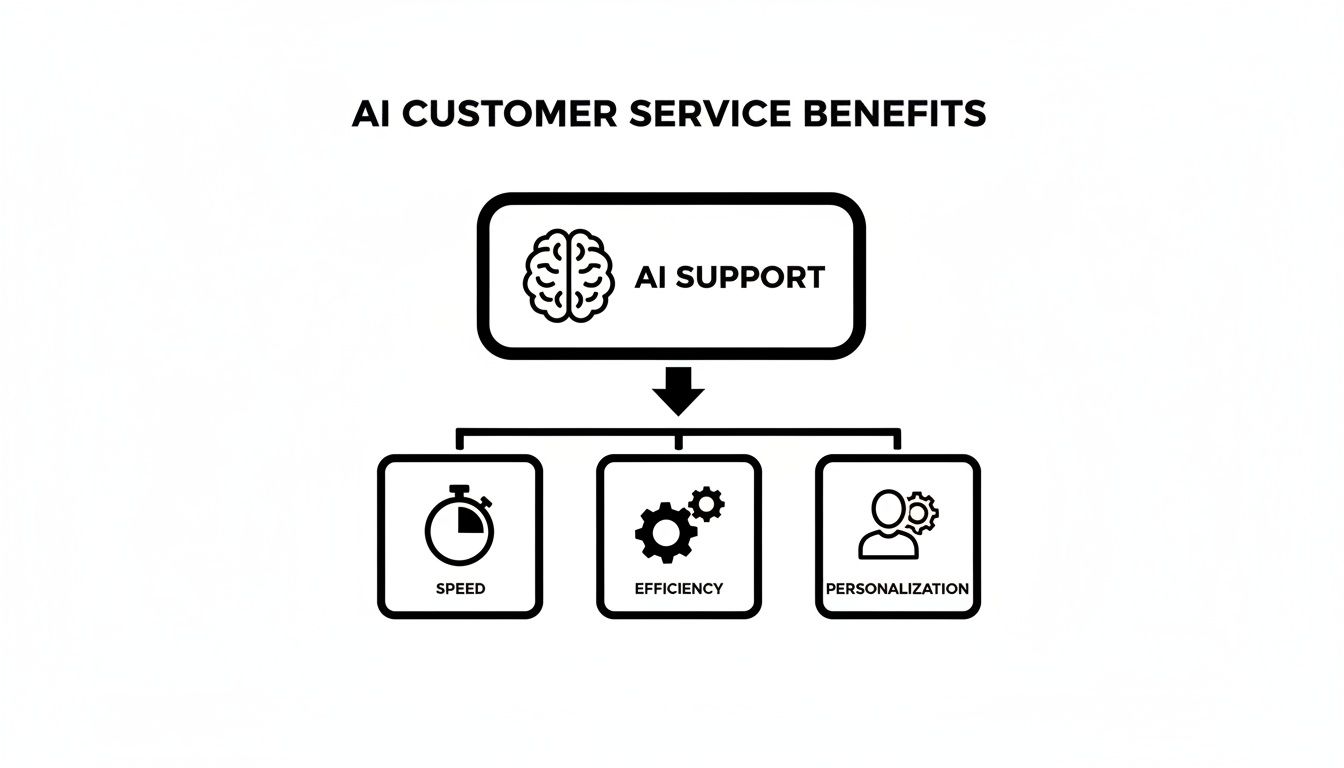
As you can see, these advantages don't exist in a vacuum. They all work together to build a much better support system that keeps customers happy and lets businesses operate more effectively.
To put it simply, here’s a quick rundown of how AI makes a tangible difference across the board.
Key AI Customer Service Benefits at a Glance
| Benefit Area | How It Improves Customer Experience | How It Boosts Business Operations |
|---|---|---|
| Speed & Availability | Customers get instant, 24/7 answers without waiting in queues. | Reduces ticket backlog and frees up human agent time for complex issues. |
| Personalization | Support is tailored to the customer's history and specific needs. | Increases first-contact resolution rates and builds stronger customer loyalty. |
| Efficiency & Cost | Simple queries are resolved immediately through self-service. | Lowers cost-per-contact and deflects a high volume of repetitive tickets. |
| Scalability | Support capacity scales instantly to meet any level of demand. | Avoids the high costs of hiring and training seasonal or temporary staff. |
This table shows a clear win-win: customers get a far better experience, and the business runs a more streamlined, cost-effective operation.
Platforms like https://supportgpt.app are built specifically to deliver these kinds of results, making it straightforward to build and launch intelligent support agents. Seeing AI as the definitive solution to today's support challenges helps us understand how this technology is truly reinventing the entire customer experience. This isn't just a tech trend; it's a strategic move for any company that's serious about keeping customers happy and growing their business.
Deliver Instant Resolutions Around the Clock
Let's be honest, nobody likes waiting. That hold music, the "we'll get back to you in 24 hours" email—these are the classic pain points of customer service. But what if you could eliminate them entirely?
That's one of the most immediate and powerful benefits of bringing AI into your support workflow. It’s not some far-off future concept; it's a practical solution to the two things customers hate most: waiting in a queue and seeing that dreaded "we're currently closed" message.
Picture a typical scenario. A customer has a simple question about their order status late on a Friday night. Without AI, they'd fire off an email and hope for a reply on Monday. That delay, even if it seems small, creates friction. It subtly tells your customer that their problem has to wait.
Now, let's run that back with an AI assistant. The customer asks the same question and gets a precise, helpful answer in seconds. Problem solved. This isn't just about convenience; it’s about showing you respect their time, which is a massive step toward building real customer loyalty.

The Power of 24/7 Availability
Your customers aren't living in a 9-to-5 world, and they expect your business to be there when they need you. In fact, research shows that 51% of customers expect businesses to be available around the clock. AI makes that a reality without the staggering cost of staffing a human team 24/7.
An AI support agent, like one built on a platform like SupportGPT, doesn't sleep or take breaks. It’s always on, ready to help, no matter the time zone. This turns your support function from a limited service into an ever-present resource.
- For E-commerce: An AI can answer questions about returns and shipping policies at 3 AM, capturing a sale that might have otherwise been lost to morning distractions.
- For SaaS Companies: A user hitting a roadblock on a Saturday can get instant troubleshooting steps, preventing frustration and improving their overall product experience.
- For Global Businesses: Customers around the world get the same quality of instant support, making your brand feel local and responsive everywhere.
This constant presence is a huge competitive advantage. It reassures customers that help is always just a click away, fostering a sense of reliability that’s essential for building lasting relationships.
Slashing Resolution Times for Happier Customers
In customer service, speed is everything. It's not just about being available; it's about solving problems fast. Even the best human agent can only handle so many conversations at once. An AI assistant, on the other hand, can manage thousands of inquiries simultaneously, all with immediate responses.
By getting rid of queues and instantly handling common questions, AI can take resolution times from many minutes—or even hours—down to a matter of seconds. That efficiency is something customers feel immediately.
And this isn't just a theory. Leading companies are seeing massive improvements. Just look at Klarna, the fintech giant. Their AI support system cut the average time to resolve an issue from 11 minutes down to just 2—a staggering 82% improvement. H&M saw a 70% reduction in their response times after implementing their own generative AI chatbot. You can dig into more of these kinds of results in these AI customer support statistics on ChatMaxima.
These numbers aren't small tweaks; they represent a fundamental change in how support works. When customers know they can get a quick, accurate answer every single time, their entire perception of your brand improves. This kind of consistent, high-speed service is how you build a great customer experience and keep people coming back.
Run a Leaner, More Scalable Support Operation
While instant, 24/7 support is a massive win for your customers, the benefits of AI for your actual business operations are just as compelling. Think of AI as a powerful force multiplier for your support team. It helps you build a leaner, more responsive organization that can easily handle the natural ebbs and flows of business.
This is where your team finally gets to stop putting out fires and can start solving genuinely important problems. AI takes over the predictable, repetitive questions that eat up most of an agent's day. That simple shift creates the breathing room for your human experts to focus their talents where they truly count.
Instead of answering "Where's my order?" for the hundredth time, your agent can now help a customer troubleshoot a tricky product issue or sort out a sensitive billing dispute. It's not just about efficiency—it makes the job more engaging for your team, which helps boost morale and prevent burnout.
What "Ticket Deflection" Really Means
One of the biggest operational wins you'll hear about is ticket deflection. The term gets a bad rap sometimes, making it sound like you're trying to avoid your customers. But when done right, it's the complete opposite.
Great ticket deflection isn't about blocking people from getting help. It's about empowering them to find answers instantly, on their own terms. When an AI-powered tool like a knowledge base assistant from SupportGPT can give someone an immediate answer, they don't need to open a support ticket in the first place.
This is a true win-win. Customers feel great because they solved their own problem in seconds. Your support queue stays clear of simple, repetitive tasks, freeing up your team for more complex work. It’s all about fast resolutions, not customer avoidance.
This is how a small team can successfully support a massive user base. The AI handles the high volume of basic queries, so when a customer genuinely needs a person, an agent is available and ready to dive deep.
Scale Up Instantly When Demand Spikes
Every business deals with surges in customer questions. It might be a holiday shopping rush, a big product launch, or an unexpected service outage. In the old support model, these spikes meant chaos. Wait times ballooned, agents got overwhelmed, and customer satisfaction tanked.
The traditional fix—hiring a bunch of temporary staff—is expensive, slow, and the quality of service is often all over the place. This is where AI’s ability to scale becomes a game-changer.
An AI agent can handle ten conversations just as easily as it can handle ten thousand. Its capacity scales up instantly to meet any demand, ensuring that every customer gets the same fast, high-quality response, even during your absolute busiest moments.
Think about these common scenarios where that kind of scalability is essential:
- E-commerce Flash Sales: A promotion goes live, and AI instantly manages thousands of questions about discount codes, shipping, and stock levels.
- SaaS Product Updates: After a new feature release, an AI assistant can walk users through the changes and field all the initial "how-to" questions.
- Unexpected Outages: If your service goes down, AI can deliver real-time status updates to everyone, preventing a tidal wave of identical tickets from flooding your team.
This isn't just theory. A study by Juniper Research predicts that chatbots will drive cost savings of over $8 billion per year for businesses. That money comes directly from automating conversations that would otherwise require a ton of human resources, especially during those peak times.
Being able to scale on demand without adding headcount is one of the biggest financial arguments for AI in customer service. It lets your business grow and react to the market without watching support costs spiral out of control.
Improve Support Quality with Personalization and Accuracy
Let's clear up a common misconception: the idea that AI support is cold and robotic. That might have been true for the old, clunky, rule-based bots of the past, but modern generative AI is a completely different ballgame. Today, the goal isn't just to spit out an answer—it's to deliver a deeply personalized and accurate interaction that actually builds customer trust.
This is a massive leap forward. Instead of shoehorning customers into a rigid script, today’s AI assistants can grasp context, pull up past conversations, and craft responses that fit each person's specific situation. The experience feels less like you're talking to a machine and more like you're chatting with a sharp, well-informed specialist.

This kind of personalization isn't just a nice-to-have; it directly impacts how customers feel about your brand. In fact, research shows that 71% of consumers expect it and get frustrated with generic, one-size-fits-all interactions. AI trained on your own company knowledge nails this, turning every support touchpoint into an opportunity to strengthen customer relationships.
Train an AI That Knows Your Business Inside and Out
So, how do you get an AI to be this helpful and personal? It all comes down to the training data. With platforms like SupportGPT, you can build an AI assistant that learns exclusively from your own trusted content—your knowledge base, help docs, and website.
Think of it like onboarding a new support agent. You hand them your company’s "employee handbook," and they study it until they know your products, policies, and procedures by heart. This focused training is the secret sauce that enables the AI to provide relevant, context-aware answers every single time.
This approach gives you a few major advantages:
- Hyper-Relevant Answers: The AI gives information that directly applies to a customer’s problem with your specific service, not some generic advice.
- Access to History: It remembers past conversations, so customers never have to repeat themselves. It’s a small thing that makes a huge difference.
- Product-Specific Guidance: It can walk users through complex troubleshooting steps or explain features with perfect accuracy.
By learning from your unique content, the AI becomes a true extension of your brand. It doesn't just pull generic answers from the web; it speaks with the authority and accuracy of an in-house expert, making customers feel understood and well-cared for.
To take it a step further, customer sentiment analysis tools can give the AI an almost human-like sense of empathy. This tech helps the bot detect if a customer is frustrated, confused, or happy, allowing it to adjust its tone and approach on the fly.
Ensure Safety and Consistency with AI Guardrails
Of course, accuracy is only half the battle. You also need to be certain that every AI interaction is safe, professional, and on-brand. That's where guardrails come in.
Think of guardrails as a built-in quality assurance manager for your AI. They are a set of rules and constraints you put in place to govern the AI’s behavior, making sure it never goes off the rails.
Modern AI platforms use guardrails to control several key things:
- Preventing Hallucinations: This is the big one. Guardrails force the AI to stick to your approved knowledge sources, which stops it from making up facts or giving wrong answers.
- Maintaining Brand Voice: You can define a specific tone—whether you want it to be friendly, formal, or highly technical—and the AI will stick to it consistently.
- Staying On-Topic: Guardrails keep the AI from getting sidetracked by conversations that have nothing to do with your business. The focus always stays on solving the customer's issue.
By putting these safety measures in place, you can roll out an AI agent with confidence, knowing every interaction will be accurate, helpful, and professional. It's this powerful combination of deep personalization and rock-solid reliability that turns AI from a simple tool into a cornerstone of a truly great customer service strategy.
Why Modern Customers Actually Prefer AI Support
It’s a common myth that customers always want to talk to a person. And while a human touch is absolutely essential for complex or sensitive issues, the data tells a different story for most everyday problems. The move toward AI in customer service isn't just about companies trying to save a buck; it’s a direct response to a huge shift in what customers actually want.
Think about it. We’ve all gotten used to getting what we need, right now. Whether it’s ordering dinner, queuing up a movie, or finding a quick fact online, we expect instant results. This "on-demand" mindset has completely changed our expectations for customer support. When you have a simple question, waiting on hold to talk to an agent feels like a frustrating, unnecessary delay.
This is exactly where AI-powered self-service comes in. It hands the controls back to the customer, letting them solve problems on their own time, without ever waiting for an email or sitting in a phone queue. This isn't about replacing human connection; it's about respecting the customer's time—and that's a powerful way to build loyalty.
The Overwhelming Demand for Self-Service
This preference for doing it yourself isn't a fringe behavior anymore; it's what most people expect. Your customers are already trying to solve their own problems first. The smart move is to give them intelligent, easy-to-use AI tools that actually help them succeed.
The proof is in the numbers. A staggering 69% of consumers say they prefer to use AI self-service for quick fixes. When speed is the top priority, 51% actively choose bots over humans. Even more telling is that 61% of new buyers would rather get an immediate AI response than wait for a person. You can dig into more of this data and find other great insights in this report on AI in customer service statistics from Master of Code.
These stats paint a very clear picture. For a huge and growing part of your audience, AI isn’t a backup plan. It's their first choice for getting fast, accurate help.
By offering a robust AI support agent, you’re not just making your operations more efficient—you’re meeting your customers where they are and giving them the experience they actually want.
This makes AI a critical piece of the puzzle for both customer satisfaction and retention. When you empower customers with the tools they prefer, they feel more in control and walk away with a better impression of your business.
Why Speed and Autonomy Matter So Much
To really get why AI support has become so popular, you have to look at the psychology driving it. A few core human needs are at play here, and AI is perfectly built to meet them.
- Immediacy: In a world built on instant gratification, patience is a limited resource. AI cuts out the single biggest frustration in customer support: waiting. Getting an answer right away makes the customer feel heard and shows that your business is on the ball.
- Autonomy: People have a natural desire to be in control. Self-service puts them in the driver's seat, making them feel capable and respected. They can find what they need at their own pace, without feeling rushed or misunderstood.
- A Low-Friction Experience: Let’s be honest, contacting support can feel like a chore. You have to explain your problem, maybe get transferred, and navigate a whole conversation. For simple questions, AI offers a frictionless path of least resistance.
This blend of speed, control, and simplicity creates an experience that’s a perfect match for today's consumer. Platforms like SupportGPT are designed around this very idea, helping businesses launch AI assistants that deliver the instant, independent experience customers now demand.
Trying to ignore this shift is no longer an option. If you don't offer effective AI-powered self-service, you're not just behind on technology; you're failing to meet the basic expectations of your customers. For any business serious about growth, embracing AI support isn't just an advantage anymore—it’s a necessity.
How to Measure the ROI of Your AI Support
It’s one thing to say an AI agent is a great idea, but it’s another thing entirely to prove it on the balance sheet. To show the real value, you have to connect your investment in AI to cold, hard numbers—the Key Performance Indicators (KPIs) that your business already runs on.
This is how you build a powerful business case that gets everyone on board. It’s about moving past the theory and demonstrating a clear return on investment (ROI) that translates directly to bottom-line results.
Core Metrics That Reveal AI's Impact
To calculate the ROI, you need to zero in on the metrics that AI has a direct and immediate effect on. These numbers tell a clear story about speed, efficiency, and customer happiness.
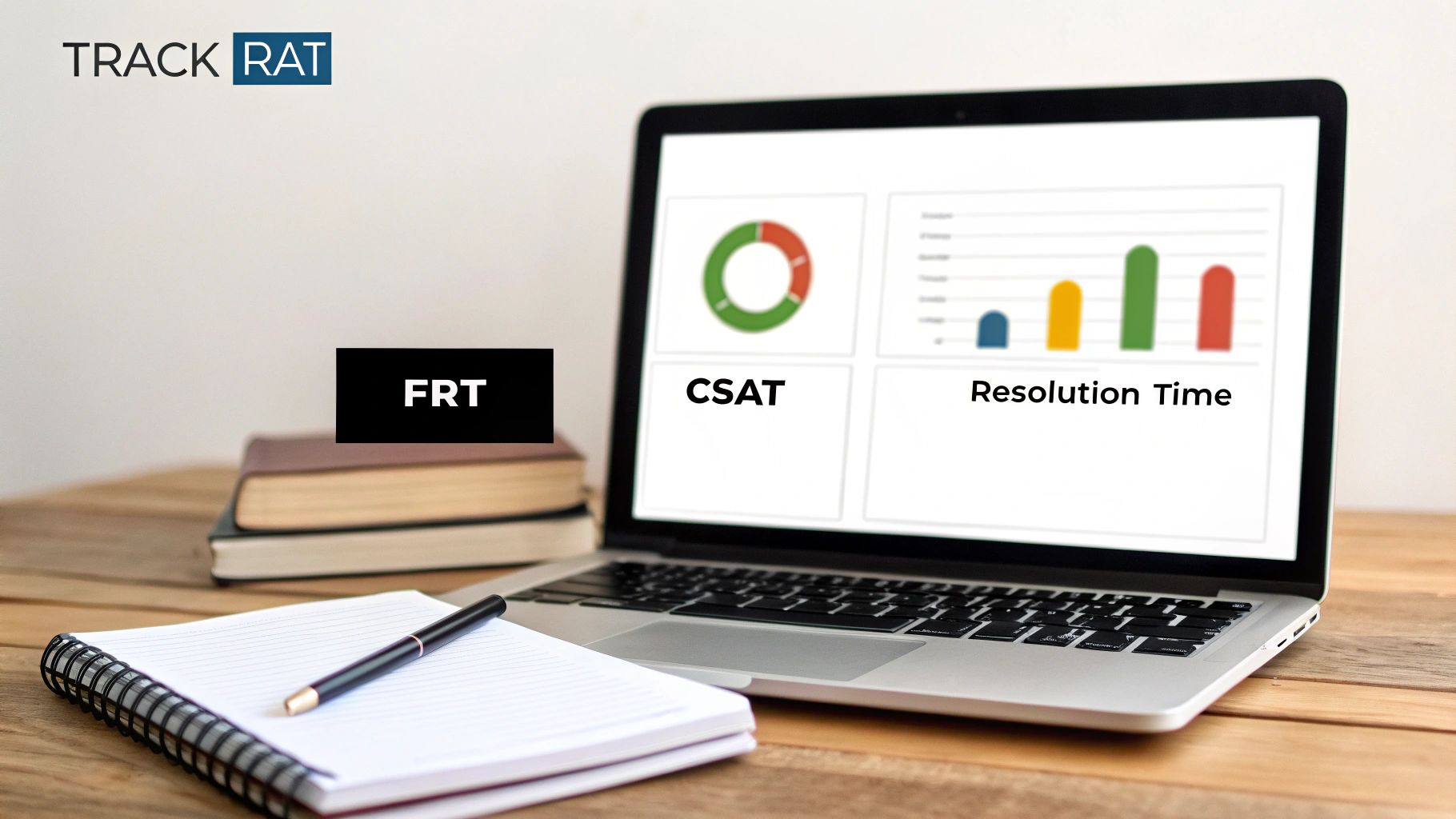
- First Response Time (FRT): This is the stopwatch on how long a customer has to wait for a first reply. An AI agent, like one built with SupportGPT, responds instantly, so you should see this metric plummet to mere seconds. It's a quick, undeniable win.
- Average Resolution Time (ART): This tracks the entire lifecycle of a ticket, from the moment it’s opened to when it’s marked as solved. Since AI can resolve common questions on the spot, you'll see this average time drop significantly, signaling a much leaner support operation.
- Ticket Deflection Rate: This is the big one. It's the percentage of customer questions that the AI handles completely on its own, without ever needing to loop in a human agent. A high deflection rate is a direct indicator of cost savings and newfound team capacity.
These three KPIs form the bedrock of your ROI calculation. They show exactly how AI is making your support faster and more efficient.
Proving value is straightforward when you can say, "Our AI agent deflects 40% of routine tickets, freeing up X hours of agent time per week." This connects AI performance directly to resource allocation and operational costs.
Linking AI Performance to Customer Satisfaction
Speed is great, but not if it comes at the cost of happy customers. The ultimate goal is to improve the customer experience, so you have to track satisfaction metrics to make sure your AI is helping, not hurting.
Two metrics are absolutely essential here:
- Customer Satisfaction (CSAT) Scores: This is the classic "How did we do?" survey sent after an interaction. A well-trained AI that gives quick, correct answers should keep your CSAT scores steady or even give them a boost. It's the proof that customers are genuinely happy with the self-service experience.
- Customer Effort Score (CES): This metric asks a simple question: "How easy was it to get your issue resolved?" AI is fantastic at lowering customer effort by providing immediate answers, which directly leads to a better (lower) CES.
When you bring these satisfaction scores together with your operational KPIs, you get the full story. You can confidently show that your AI is not only cutting costs and speeding things up but also delivering a quality experience that keeps customers loyal. That holistic view is the key to proving the true value of AI in your customer service world.
Common Questions About AI in Customer Service
When you're thinking about bringing AI into your support team, a few key questions always come up. Let's walk through them, because getting clear answers is the first step toward understanding just how valuable this technology can be.
Will AI Actually Replace My Support Agents?
This is easily the biggest myth out there. The goal isn't replacement; it's teamwork. Think of AI as your team's most efficient new member, the one who loves handling all the repetitive, straightforward questions that clog up the queue.
This frees up your experienced human agents to focus their energy where it truly counts—on the complex, high-stakes, or emotionally charged conversations that demand a human touch. It’s about making your entire support operation smarter, not smaller.
How Hard Is It to Get an AI Support Agent Running?
You might be picturing a massive, months-long IT project, but modern no-code platforms have completely changed the game. You can genuinely build, train, and launch a custom AI assistant in a matter of minutes, all without writing a single line of code.
The process is surprisingly simple: you just point the AI to your existing help center articles, website pages, or knowledge base. From there, ongoing tweaks are just as easy, usually handled through a simple dashboard.
The Bottom Line: The days of long, complicated AI setups are over. Today’s tools are designed for business users, not just engineers, so you can get up and running incredibly fast.
How Do I Know the AI Won't Give Wrong Answers?
This is a crucial point, and the answer comes down to two things: controlled knowledge and built-in guardrails. First, you train the AI only on your own trusted company information—your help docs, your policies, your product specs. This creates a secure, closed loop of knowledge.
It means the AI can only pull answers from content you've already approved.
On top of that, modern systems come with essential safety features. These guardrails are designed to stop the AI from:
- Answering questions that are off-topic or have nothing to do with your business.
- "Hallucinating," which is just a term for making things up.
- Adopting a tone that doesn't match your brand's voice.
These controls work together to ensure every single AI-powered response is accurate, on-brand, and genuinely helpful.
Ready to see how an AI agent can elevate your support operations? With SupportGPT, you can build and launch a custom AI assistant trained on your own knowledge in just minutes. Start exploring the benefits today at the official SupportGPT website.