A Practical Guide to AI Customer Service Software
Discover how AI customer service software transforms support. This guide covers key benefits, choosing the right tools, and proven implementation strategies.
Picture this: you have a support agent who’s on the clock 24/7, speaks every language fluently, and has every single answer your customers could ever need, right at their fingertips. That's the dream, and it's essentially the core promise of AI customer service software. These intelligent systems are built to automate conversations, resolve issues instantly, and provide a personal touch for every customer, no matter how big you grow.
What Is AI Customer Service Software
At its core, AI customer service software is a tool that uses artificial intelligence—specifically technologies like Natural Language Processing (NLP)—to understand what customers are asking and respond to them without human help. It’s a massive leap forward from the clunky, script-driven chatbots of a few years ago. Instead of just looking for keywords, modern AI gets the context, figures out the customer's real intent, and can even pick up on their sentiment.
This means the software can tackle tricky, multi-part problems that go way beyond a basic FAQ search. Think of it like the difference between navigating a rigid phone menu ("press 1 for billing...") and actually talking to a sharp, helpful assistant. One forces you down a narrow path, while the other listens and adapts to what you actually need.
Shifting from Reactive to Proactive Support
The real magic here is how this technology can flip your entire support model from being reactive to proactive. For decades, support has been a waiting game—wait for a customer to have a problem, then try to fix it. AI turns that whole idea upside down.
By spotting patterns in thousands of customer conversations, an AI system can get ahead of problems before they even start.
- Anticipatory Assistance: It can see when a customer is stuck on a certain part of your website and pop up with a helpful suggestion.
- Instant Resolutions: It can give immediate, accurate answers to common questions, often resolving up to 50% of tickets before they ever reach a human agent.
- Data-Driven Insights: It collects a goldmine of data on customer frustrations, pointing you directly to areas where you can improve your products or services.
When you automate all the routine, repetitive questions, you free up your human agents to focus on what they do best: handling complex, sensitive issues that require real empathy and creative problem-solving. This doesn't just make your team more efficient; it elevates their role and makes your entire support operation better.
The Foundation of Modern Customer Experience
Ultimately, this software becomes the central brain of your support ecosystem. It learns from every single interaction, getting smarter and more helpful over time. It plugs directly into your existing knowledge—your help docs, old support tickets, and internal guides—to deliver consistently correct information, no matter where the customer asks.
That consistency is everything when it comes to building trust. When a customer gets the right answer whether they're using a chat widget, your mobile app, or sending a DM on social media, their confidence in your brand skyrockets. This is what makes AI customer service software an indispensable part of any modern business that's serious about delivering great support at scale.
Understanding the Core Capabilities
When you hear “AI customer service software,” it's easy to picture a simple chatbot. But that's just scratching the surface. What we’re really talking about is a sophisticated system with several interconnected parts, all working in concert.
Think of it less like a single tool and more like an operational nervous system for your entire support team. These capabilities are what allow it to handle complex customer interactions, automate the grunt work, and uncover insights that were practically impossible to find before.
Let's break down what makes these platforms tick.
1. The Conversational AI Agent
This is the part your customers actually talk to, but it’s a world away from the clunky, rule-based bots of the past. Modern agents are powered by Large Language Models (LLMs), which gives them the ability to understand context, nuance, and what a customer really means.
They can handle conversations that go in multiple directions. For instance, a customer might say, "My last order hasn't arrived, and I also need to update my shipping address for future purchases." A truly capable AI agent can juggle both requests in one go—pulling up the tracking link while simultaneously updating the customer’s profile in your CRM. No more "I can only handle one thing at a time."
2. Intelligent Routing and Escalation
Of course, not every problem can or should be solved by an AI. The smartest systems know their own limits. That’s where intelligent routing and escalation comes into play, acting like an expert dispatcher for your team.
The AI analyzes the conversation for complexity, keywords, and even the customer's sentiment. If it detects high frustration or a problem that needs a human touch, it seamlessly transfers the entire conversation—context and all—to the right person.
The customer doesn't have to repeat a single thing. They just get connected to a specialist who already knows what's going on.
The goal isn't to block customers from talking to humans. It’s to make sure that when they do, it's with the right person who is fully equipped to help them immediately. This single capability can drastically improve your first-contact resolution rates.
This is where you see AI enabling both reactive support and proactive growth. It's not just about cutting costs; it's about creating a better experience that builds loyalty.
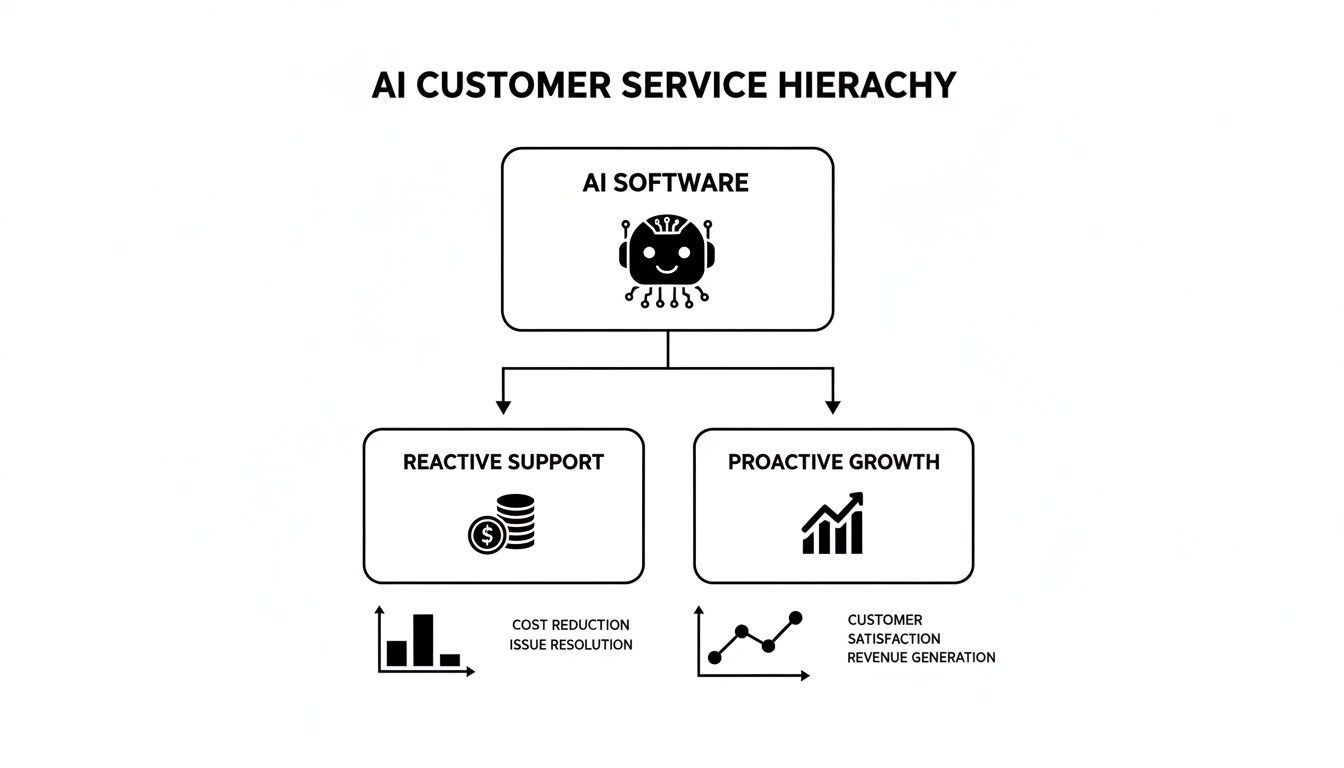
As the hierarchy shows, this technology directly impacts everything from customer satisfaction to revenue opportunities.
3. Analytics and Actionable Insights
One of the most powerful—and often overlooked—features of good AI customer service software is its analytical engine. Every single customer interaction becomes a data point, and the platform crunches all that information to reveal trends you can actually use.
In a few clicks, you can get clear answers to critical questions:
- Top Customer Issues: What are people getting stuck on most often?
- Performance Metrics: What percentage of queries is the AI resolving? How fast is it happening?
- Content Gaps: What are customers asking about that we don't have a help article for?
This data gives you a direct line into your customers' experience, showing you exactly where the friction is. It allows you to stop guessing and start making decisions based on what people are actually telling you. For those who want to get even more specific, you can learn more about how to fine-tune an LLM with your own data to make these insights even sharper.
4. Security and Brand Safety Guardrails
Finally, none of this matters if you can't trust the system. Handing over customer conversations to an AI requires absolute confidence that it will be reliable, secure, and on-brand.
This is where enterprise-grade platforms really separate themselves. They are built from the ground up with robust security and guardrails. These controls are designed to protect sensitive data and keep the AI from going off-script.
For example, guardrails prevent the AI from sharing personally identifiable information (PII), using inappropriate language, or giving answers on topics you haven't approved. These features ensure every response is accurate, safe, and aligned with your company’s voice, making it a solution you can scale without worry.
The Business Benefits of AI-Powered Support
Knowing what AI customer service software can do is one thing. But seeing how those features translate into real-world business results is where things get interesting. This isn't just about adding another tool to your tech stack; it’s a strategic move that directly impacts your bottom line, customer loyalty, and your ability to adapt.
The whole idea is simple but powerful: let AI handle the repetitive, high-volume questions. Doing so frees up your most valuable resource—your human team—to focus on the complex, high-stakes conversations that actually build relationships. This one shift can completely change the economics of how you run customer support.
Drastic Cost Reduction and Operational Efficiency
One of the first things you'll notice is a major drop in operational costs. In a traditional support model, you're stuck in a tough cycle: more customers means you have to hire more agents. AI breaks that expensive, linear connection.
By automatically resolving a huge chunk of incoming tickets, AI lets you handle a much larger volume of inquiries without constantly growing your headcount. We're not talking about a small dent, either. Industry data shows AI agents can successfully resolve 40-60% of common support tickets right out of the gate, leading to immediate savings.
Where does this efficiency come from?
- Smarter Scaling: You can meet customer demand without the constant pressure of hiring and training new agents.
- Lower Training Costs: AI is trained once on your knowledge base. You avoid the recurring expense of onboarding new staff for those common Tier 1 questions.
- 24/7 Coverage, No Overtime: Offer instant, around-the-clock support anywhere in the world without paying for overnight shifts or weekend staff.
The market's explosive growth tells the story. In 2024, the global AI for customer service market hit USD 13,012.4 million. It's projected to grow at a compound annual rate of 23.2%, climbing toward USD 83,854.9 million by 2033. This isn't just hype; it shows how seriously businesses are taking AI to build leaner, more scalable operations.
Enhanced Customer Satisfaction and Loyalty
Let's face it, modern customers expect answers now. Making them wait in a queue or hunt through a clunky FAQ page creates friction and kills trust. AI-powered support completely eliminates that waiting game.
Giving people immediate, accurate answers 24/7 is a game-changer for the customer experience. When a user gets a helpful response at 2 AM on a Sunday without having to wait for a human, their satisfaction goes through the roof.
AI doesn't just make support faster; it makes it more consistent. By pulling from a single source of truth—your knowledge base—it ensures every customer gets the same correct, on-brand answer, every single time.
This kind of reliability builds the trust and loyalty you need for long-term growth. It's a proven way to improve ecommerce customer experience and keep customers coming back. The combination of speed and consistency is a direct path to higher Customer Satisfaction (CSAT) scores and a much stronger brand reputation.
Calculating Your Potential Return on Investment
Building a business case for AI customer service software is surprisingly straightforward. The return on investment (ROI) isn't some fuzzy, abstract idea; it's a real number you can calculate based on cost savings and efficiency gains.
Start by grabbing a few of your current support metrics:
- Ticket Volume: How many support tickets do you get each month?
- Cost Per Ticket: What's the average cost to resolve a single ticket? (Think agent salary, tools, and overhead.)
- Top Inquiry Types: Pinpoint the top 5-10 repetitive questions your team answers all day long.
With these figures in hand, you can easily project your savings. If AI deflects 50% of your monthly tickets, you can calculate the direct cost reduction right there. This simple framework shows the clear financial upside of investing in AI, making it an easy "yes" for any leader focused on smart growth. You can dive deeper into the key benefits of AI in customer service in our article.
How to Choose the Right AI Software for Your Business
Picking the right AI customer service software can feel like trying to find a needle in a haystack. Every vendor claims their platform is the best, but what works for a huge enterprise might be a terrible fit for a growing startup. The trick is to tune out the noise and focus on what will genuinely help your customers and your team.
This isn't just about ticking off a list of fancy features. It's about finding a true partner—a platform that aligns with your business goals, plays nicely with the tools you already use, and can scale as you grow. A wrong turn here can lead to months of frustration and a lousy return on your investment.
Start With Your Non-Negotiables
Before you even book a single demo, you need to be crystal clear on your must-haves. Think of this as your core filter. A great platform needs to be immediately usable by the people on the front lines—your support agents—not just a team of engineers.
A complicated setup process is a huge red flag. If you need a developer on speed dial just to get started, it's going to slow you down. Look for no-code or low-code options that empower your customer service managers to build, test, and launch AI agents on their own.
Here are the absolute basics to look for:
- Ease of Use: Is the interface intuitive? Can your non-technical team members actually manage and train the AI without pulling their hair out? If it’s confusing, it won’t get used.
- Quality of AI Models: Find out what’s under the hood. Does the software use top-tier large language models from providers like OpenAI, Google (Gemini), or Anthropic? The engine a platform uses directly dictates the quality of every single customer interaction.
- Scalability: Can this tool keep up with you? Check for limits on conversation volume, how many agents you can build, and whether it can handle unexpected surges in customer queries without breaking a sweat.
The real goal is to find a tool that makes your team more powerful, not one that creates a new dependency on your tech staff. Simplicity in day-to-day management is often the clearest sign of a well-built product.
Dig Into Integration and Security
An AI agent that’s disconnected from your other business systems is basically just a glorified FAQ page. It can answer questions, but it can’t solve problems. What makes an AI truly effective is its ability to plug into your existing ecosystem.
Your chosen AI customer service software has to connect directly with the tools you live in every day, like your CRM and helpdesk. This is non-negotiable. For a closer look at how various platforms connect, check out our in-depth helpdesk systems comparison guide.
Security is the other, equally important, side of the integration coin. You’re giving this platform access to customer conversations, which are often loaded with sensitive data. Rock-solid security and data privacy aren't just nice-to-haves; they're absolute deal-breakers. Ask potential vendors pointed questions about their compliance with regulations like GDPR and their enterprise-grade security protocols.
Create a Vendor Evaluation Checklist
To avoid getting swayed by a slick sales pitch, create a simple checklist. This forces you to evaluate every vendor against the same set of criteria, making your decision much more data-driven and objective.
Here's a practical checklist you can use to compare different AI customer service software vendors and keep your evaluation process on track.
Vendor Selection Checklist
| Evaluation Criteria | What to Look For | Why It Matters |
|---|---|---|
| Integration Power | Pre-built connectors for your CRM, helpdesk (e.g., Zendesk, Salesforce), and other key tools. | This is what allows the AI to do real work, like checking an order status or updating a customer record. |
| Security & Compliance | Clear data privacy policies, encryption standards, and compliance with regulations like GDPR or SOC 2. | It protects your customers' sensitive information, which is fundamental to building and maintaining trust. |
| Guardrail Features | Controls to stop the AI from sharing PII, going off-script, or using inappropriate language. | This ensures brand safety and guarantees the AI provides accurate, approved information every single time. |
| Analytics & Reporting | Dashboards that track key metrics like resolution rate, top customer questions, and escalation patterns. | You can't improve what you don't measure. This data gives you the insights to refine your AI and your overall support strategy. |
By using a structured approach like this, you can cut through the hype and confidently choose an AI customer service software that not only solves today's problems but also sets your support team up for success down the road.
Best Practices for a Successful Implementation
Picking the right AI customer service software is just the starting line. The real magic—and the real work—happens during implementation. A smart, deliberate rollout is what separates a tool that offers minor perks from one that truly changes the game for your entire support operation.
Think of it less like flipping a switch and more like a continuous process of learning and refinement. Rushing into a massive, company-wide launch is a recipe for frustrated agents and confused customers. The best way to get this right? Start small, score some quick wins, and build from there.

Start with a Focused Pilot Program
Don't try to boil the ocean. Instead of automating everything on day one, launch a pilot program that targets a specific, high-impact area. A perfect place to start is with your most common, simple, and repetitive questions. You know the ones—"Where is my order?" or "How do I reset my password?" These are low-hanging fruit for automation.
Starting small lets you prove the AI's value right away. Your pilot should aim to:
- Deflect common inquiries: Let the AI handle the basics so your human agents don't have to.
- Measure initial success: Keep a close eye on metrics like resolution rate and ticket deflection from the get-go.
- Gather real-world data: Use the pilot's performance to fine-tune the AI's answers and spot where it can get even better.
This focused approach delivers a clear, immediate return and gets your team genuinely excited about the possibilities.
Train Your AI with High-Quality Data
Your AI agent is a student, and its textbook is your knowledge base. It will only ever be as good as the information you feed it. That's why the absolute foundation of a successful launch is training it on clean, comprehensive, and up-to-date documentation.
A well-structured knowledge base is the single most critical factor in achieving high resolution rates. An AI trained on messy or outdated content will only amplify confusion, not solve it.
This isn’t a set-it-and-forget-it task. Your knowledge base needs to be a living document. As your products, services, and policies change, your documentation must keep pace. Regular audits are non-negotiable if you want your AI to provide consistently accurate help.
Define Clear Escalation Paths
Let's be realistic: no AI can solve every single problem. It shouldn't have to. A crucial best practice is to map out clear and seamless escalation paths to your human agents. You're building a safety net. When a customer has a complex, sensitive, or emotionally charged issue, they need to get to a person—fast.
This means setting up triggers for a handoff. For instance, if a customer types words like "frustrated" or "cancel," the AI should immediately offer to connect them with a team member. And critically, it must pass along the entire conversation history. Nobody wants to repeat themselves.
The market for this tech is exploding because businesses are seeing the payoff. The customer self-service software industry is projected to hit USD 65.66 billion by 2031. Yet, even though 88% of contact centers have some AI, only 25% have truly integrated it into their workflows. That leaves a massive opportunity for companies willing to go all-in. You can dive deeper into these trends with the rise of AI in self-service from Mordor Intelligence.
Position AI as a Team Augmentation Tool
How you frame this new technology for your team is everything. It's not a replacement; it's a powerful assistant. You have to position the AI as a tool that's here to make their jobs easier, not obsolete.
Frame it as the new team member that handles all the boring, repetitive tasks. This frees up your agents to tackle the interesting, strategic problems and build real relationships with customers. When you approach it this way, you get buy-in instead of fear, turning your team into the AI's biggest champions.
Real-World Examples of AI in Customer Service
It’s one thing to talk about features and capabilities, but where the rubber really meets the road is seeing how AI customer service software solves actual business problems. Seeing this tech in action is what truly brings its value to life. Let’s look at a few practical scenarios where companies are using AI to tackle specific challenges and get real, measurable results.
These examples are a great blueprint for how you can adapt AI to just about any industry or goal.

The SaaS Startup In-App Assistant
Picture a fast-growing SaaS company. They're constantly buried under a mountain of "how-to" questions from new users. The support team is stuck answering the same questions about setup, features, and billing on a loop, pulling them away from customers who need help with more complex, strategic issues.
So, they implement an AI assistant right inside their app, trained on all their help center articles.
- The Goal: Give users instant, contextual answers without them ever leaving the product. The big metric they're tracking is ticket deflection rate—the percentage of issues the AI solves on its own.
- The Result: The AI immediately takes over the high volume of routine questions. Users get answers in seconds, which dramatically improves their onboarding experience. The company sees a 45% drop in "how-to" tickets within the first three months, freeing up their human agents to focus on high-value customer success.
The E-commerce Holiday Rush Bot
Now think about an online retailer bracing for the holiday season. Every year, they get a massive surge of inquiries about order tracking, returns, and shipping. Their small team gets overwhelmed, leading to long wait times and unhappy shoppers. They need a way to scale up instantly.
They decide to launch an AI chatbot on their website, programmed specifically to handle these common e-commerce questions.
- The Goal: Tame the holiday chaos by giving customers 24/7 access to order info and return processing. The key metrics for success here are first-contact resolution (FCR) and customer satisfaction (CSAT).
- The Result: The bot ends up handling over 60% of all incoming chats during their peak season. It gives out real-time tracking updates by plugging into their shipping provider's system and even kicks off the return process automatically. CSAT scores hold steady despite the insane volume, and the company avoids the cost and hassle of hiring a bunch of temporary staff.
These scenarios highlight a fundamental shift in customer expectations. People now value speed and convenience as much as a human touch, especially for straightforward problems.
This isn't just a gut feeling; the data backs it up. AI is completely rewriting the rules of customer service. According to recent research, 59% of consumers believe generative AI will transform how they interact with companies in the next two years. A whopping 51% now prefer a bot over a human for quick fixes, proving that speed often wins. By 2026, 56% of customers expect bots to hold natural, human-like conversations. You can dig into more of these game-changing AI customer service stats from Zendesk.
The B2B Lead Qualification Agent
Here’s another one: a B2B software company gets a lot of website traffic, but most visitors are just kicking the tires. The sales team wastes too much time sifting through low-quality inquiries instead of talking to people who are actually ready to buy.
They put an AI customer service software agent on their pricing and features pages to proactively engage with visitors.
- The Goal: To automatically qualify website visitors by asking a few smart questions, identifying the real decision-makers, and booking demos for the sales team. Their north star metric is the number of qualified leads the AI generates.
- The Result: The AI agent starts conversations with questions like, "What's your team's biggest challenge?" or "How large is your company?" Based on the replies, it figures out if a visitor is a good fit. If they are, it seamlessly books a meeting on a sales rep's calendar—with all the qualifying info attached—leading to a 30% increase in qualified demo bookings.
Your Top Questions About AI Support, Answered
Stepping into the world of AI-powered customer service always kicks up a few questions. It's only natural. You want to be sure you're making a smart move that actually helps your team, makes customers happier, and keeps everyone's data safe.
Let's cut through the noise and get straight to the answers you're looking for. We'll tackle the big concerns around security, setup, and how AI really works with your team.
Will AI Replace Our Human Customer Service Agents?
Nope, and it’s not designed to. The real purpose of AI in support is to augment your team, not replace it. Think of it this way: AI is fantastic at handling the high-volume, repetitive questions that flood your inbox every day. It can answer them instantly, 24/7.
This frees up your incredible human agents to focus on what they do best: solving complex, nuanced problems that require real empathy and critical thinking. The AI handles the "Where's my package?" so your team can tackle the "I need a creative solution to a tricky problem." It’s about letting everyone play to their strengths.
How Hard Is It to Set Up and Maintain AI Software?
You might be surprised. The best modern AI platforms are built to be set up in minutes, not months, and you don't need a degree in computer science to do it. The process is usually pretty straightforward: connect your help docs, customize the AI’s personality a bit, and paste a small code snippet onto your website.
The goal of a great AI tool is to empower the support team itself. You shouldn't have to file a ticket with engineering just to update a response or tweak a setting. A well-designed system puts the control right where it belongs: in the hands of the support managers.
As for keeping it running? Maintenance is usually light. It’s mostly about checking the analytics every so often to see what questions are being asked and making sure your knowledge base is up-to-date. This keeps your AI sharp and genuinely helpful.
Is AI Customer Service Software Secure for Handling Customer Data?
Absolutely, as long as you choose a reputable vendor. For any enterprise-ready AI platform, security isn't just a feature; it's the foundation everything is built on. Protecting your company and your customers is non-negotiable.
Here are the critical security features you should always look for:
- Data Encryption: All data, whether it's sitting on a server or moving across the internet, needs to be fully encrypted.
- Compliance Certifications: Look for vendors that meet major security standards like GDPR and SOC 2. This is proof they take data protection seriously.
- Built-in Guardrails: These are essential controls that prevent the AI from ever sharing private information like names, emails, or account details. It's what keeps conversations safe and builds trust.
When your AI platform is secure, you can scale up your support with total peace of mind.
Ready to see how an AI assistant can transform your support operations? With SupportGPT, you can build and launch a secure, intelligent agent trained on your own knowledge in just a few minutes. Start your free trial today and automate up to 70% of support tickets.