A Practical Guide to AI Agent Platforms
Discover how AI agent platforms work and why they matter for business. Learn key features, use cases, and how to choose the right platform to automate tasks.
AI agent platforms are the command centers for building, deploying, and managing armies of autonomous digital workers. These aren't your typical chatbots. We're talking about sophisticated AI agents that can actually reason, plan, and execute complex jobs to hit specific goals. They become a genuine extension of your human team.
What Are AI Agent Platforms and Why Do They Matter?
Picture hiring a team of digital employees. They work around the clock, never call in sick, handle intricate workflows, and get smarter with every interaction. That’s exactly what AI agent platforms deliver. They provide the complete operational framework—the tools, rules, and resources—that these autonomous agents need to get things done.
A good way to think about it is this: if an individual AI agent is a skilled digital worker, the platform is the entire office environment that enables them to do their job. It's where you set their objectives, give them the knowledge they need, and establish the guardrails for how they operate.
The Shift from Answering to Acting
The real magic of these platforms is how they let businesses automate multi-step processes without having to hire a squad of data scientists. This is a massive leap forward from old-school chatbots that were stuck following rigid, pre-programmed scripts.
An AI agent, backed by a powerful platform, can do so much more:
- Autonomously solve problems: Instead of just sending a help article link, an agent can diagnose a customer's technical issue, look up their order in your database, process a full refund, and fire off a confirmation email—all on its own.
- Integrate with business tools: They plug directly into your CRM, e-commerce backend, and other critical software to perform real, tangible work.
- Learn and adapt over time: By analyzing their own performance, they constantly fine-tune their responses and actions to become more accurate and helpful.
This ability to act is what’s fueling a huge wave of business investment. The global AI agent market is on a rocket ship trajectory, projected to blast off from $5.26 billion in 2024 to an incredible $52.62 billion by 2030. This explosive growth shows just how fast companies are jumping on this technology to get a leg up on the competition. You can dig into the drivers behind this market boom in recent industry reports.
An AI agent platform isn't just another piece of software; it's a force multiplier for your entire workforce. It lets you scale your operations, create better customer experiences, and free up your human experts for the high-value, strategic work they were hired to do.
To truly grasp how these platforms work, it helps to see them as a specialized form of AI operations software. This broader category covers the essential infrastructure needed to manage and deploy AI solutions reliably at scale. It’s what transforms a promising AI model from a cool experiment into a dependable business asset.
2. What Makes an AI Agent Platform Tick? The Core Features
To really get what makes these AI agent platforms so effective, you need to pop the hood and look at the engine. They aren't just a single piece of tech; they're more like a high-performance pit crew, with a collection of specialized components all working in sync to create an intelligent, autonomous system.
Think of it like building a custom race car. You've got the engine, the steering, the safety features, and the onboard diagnostics. Each part is crucial, and they all have to work together perfectly.
This map shows how a platform acts as the central hub, connecting the AI agent to the data it needs and the tasks it has to complete.
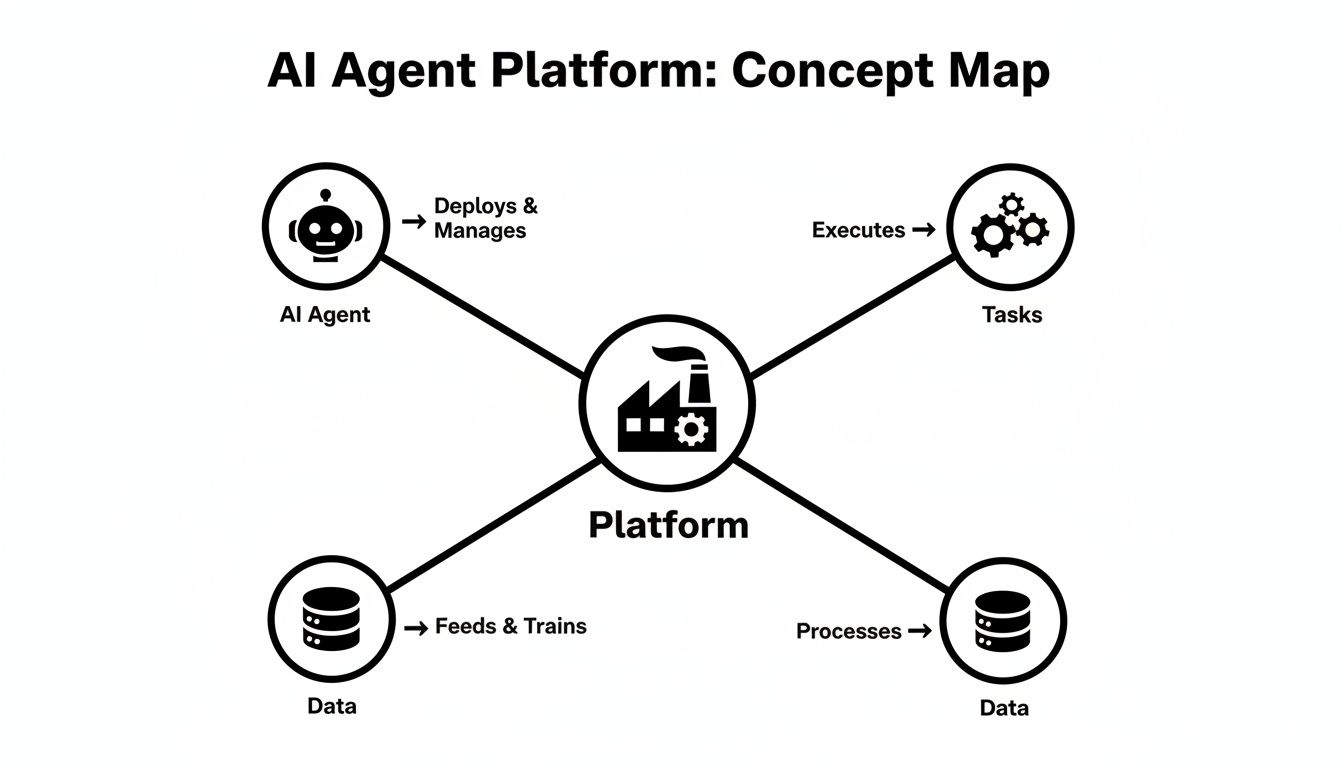
It’s this orchestration—the seamless flow of information and action—that makes the agent truly effective. Let's break down those key components.
LLM Support: The Brains of the Operation
At the very heart of any AI agent is its "brain"—the Large Language Model (LLM). This is the engine that does all the heavy lifting: processing language, reasoning through problems, and crafting responses that sound genuinely human. For a deeper dive, check out this guide to understanding Large Language Models (LLMs).
The best platforms don’t lock you into a single LLM. Instead, they give you options, letting you switch between leading models like OpenAI's GPT series, Google's Gemini, or Anthropic's Claude.
Why does this matter? Because different models are good at different things. One might be a wizard at creative, free-flowing conversation, while another excels at giving you precise, data-backed answers. A flexible platform lets you choose the right brain for the job.
Guardrails: Setting the Rules of Engagement
An AI agent without clear rules is a huge risk. That’s where guardrails come in. Think of them as the agent's code of conduct or its operational playbook. These are the specific constraints you set to make sure the agent behaves exactly how you want it to, every single time.
Effective guardrails are essential for managing a few key things:
- Staying on Topic: They keep the agent from wandering off into irrelevant or off-brand subjects.
- Brand Voice: They ensure every single interaction matches your company's tone, whether it’s buttoned-up and professional or friendly and casual.
- Preventing Mistakes: This is a big one. Guardrails stop the agent from "hallucinating" or just making things up by forcing it to stick to your approved knowledge sources.
Without solid guardrails, an AI can quickly become a liability to your brand. With them, it becomes a consistent and trustworthy ambassador. Getting this right often involves skillful prompt design; you can learn more about how that works in our guide on what is prompt engineering.
Smart Escalation: Knowing When to Call for a Human
Let's be realistic—even the smartest AI has its limits. A truly enterprise-ready platform needs smart escalation. This is the built-in intelligence to recognize when a query is too complex, too sensitive, or just needs a human touch.
Smart escalation isn't a failure of the AI; it's a sign of its intelligence. It guarantees that customers with tricky or urgent problems are passed smoothly to a human expert, which prevents frustration and ultimately delivers a much better experience.
This isn’t just about the agent saying, "I don't know." A good escalation process understands the context of the problem and routes the entire conversation history to the right person or department.
Actions and Analytics: The Power to Do and to Improve
The best platforms have two more tricks up their sleeve: AI Actions and powerful analytics.
AI Actions are what turn a conversational bot into a problem-solver. These are specific, pre-defined tasks the agent can execute on its own. We’re talking about things like processing a refund, scheduling a sales demo, or updating a customer’s contact information in your CRM—all without human intervention.
Meanwhile, analytics create the feedback loop you need to keep getting better. By tracking things like conversation outcomes, user satisfaction scores, and the most common questions people ask, you can spot gaps in your knowledge base and fine-tune the agent’s performance. This data-first approach is the key to getting a real return on your investment.
To give you a clearer picture, here’s a quick summary of the features that really matter for a business.
Essential Features of an Enterprise-Ready AI Agent Platform
| Feature | What It Does | Why It Matters for Your Business |
|---|---|---|
| LLM Support | Integrates with various Large Language Models (e.g., GPT-4, Gemini, Claude). | Gives you the flexibility to choose the best AI "brain" for your specific needs, avoiding vendor lock-in and optimizing performance. |
| Guardrails | Enforces rules on topic, tone, and information sources. | Protects your brand reputation, ensures consistency, and prevents the AI from providing incorrect or off-brand information. |
| Smart Escalation | Intelligently identifies when to hand off a conversation to a human agent. | Improves customer satisfaction by getting complex issues to the right person quickly, preventing user frustration. |
| Multilingual Capabilities | Understands and responds in multiple languages. | Allows you to support a global customer base with a single platform, expanding your reach and improving user experience. |
| AI Actions | Executes tasks within other systems (e.g., CRM, billing). | Moves beyond simple answers to actively resolve issues and complete tasks, automating entire workflows. |
| Integrations | Connects with your existing software stack (Helpdesks, CRMs, etc.). | Creates a seamless flow of information, making the AI a natural extension of your current business processes. |
| Analytics & Reporting | Tracks performance metrics, conversation outcomes, and user feedback. | Provides the data you need to continuously improve the AI's effectiveness and demonstrate its value to the business. |
| Security & Compliance | Adheres to data protection standards like SOC 2, GDPR, and HIPAA. | Ensures that customer data is handled safely and that your business remains compliant with industry regulations. |
These features work together to create a system that's not just intelligent, but also reliable, secure, and genuinely useful for your business goals. The demand for platforms that bake these capabilities right in is surging, with the solution segment projected to capture 64.06% of the agentic AI market share by 2026.
Exploring Real-World Use Cases and Applications
It’s one thing to talk about theory, but the real magic happens when you see AI agent platforms solving actual business problems. These aren't just some far-off concepts; they are actively working today, making businesses more efficient and customers happier across all sorts of industries.
Let's dive into a few practical scenarios where AI agents are making a real impact.

A New Era for Customer Support
Picture a SaaS company drowning in a sea of repetitive support tickets. Human agents are spending most of their day answering the same old questions about billing, password resets, and how to use basic features. This leads to burnout for the team and frustratingly long waits for customers who have truly complex problems.
This is a perfect job for an AI agent. Once you deploy it on the company’s website or in their app, it can handle these common queries instantly, 24/7. The agent is trained on all the help center documentation, so it pulls up accurate, step-by-step instructions in a heartbeat.
The result? Customers get immediate answers to simple questions, which makes them happy. Meanwhile, your human support team is free to tackle the tough, high-value conversations that require real expertise and a human touch. This is the foundation of modern AI-powered customer service, where automation and people work in sync.
Personal Shoppers for E-commerce
Imagine you're browsing an online clothing store. Hundreds of options are staring back at you, and it’s overwhelming. You’re trying to find a specific style of dress for an event, but you have no idea where to even begin.
This is where an AI agent steps in as a personal shopper. It strikes up a conversation, asking helpful questions like, "What's the occasion?" or "Do you have a color or budget in mind?" Based on your answers, the agent sifts through the entire product catalog in seconds and presents you with three perfect dresses, complete with links to each.
By guiding the customer from a vague idea to a confident purchase, the agent does more than just answer questions—it directly boosts revenue and slashes cart abandonment rates. It turns a passive browsing session into a helpful, interactive shopping experience.
Automating Lead Capture and Qualification
Think about a B2B tech company that gets thousands of website visitors every month. The sales team can't possibly talk to everyone. They need a smarter way to find the serious buyers among the casual browsers without annoying people.
An AI agent on their pricing and features pages can automate this entire process. It can proactively engage visitors, asking things like, "What business challenge are you trying to solve?" or "How many people are on your team?"
Based on the answers, the agent qualifies the lead right then and there. If the visitor fits the ideal customer profile (say, a company with over 50 employees), the agent can use an AI Action to book a demo directly on a salesperson's calendar. This ensures your sales team spends its valuable time talking to well-qualified prospects who are actually ready to talk business.
How to Choose the Right AI Agent Platform
Picking an AI agent platform feels a lot like choosing a new CRM or helpdesk. It’s a foundational piece of your tech stack, and getting it right from the start can save you a world of hurt later on. The market is crowded, and the best choice really boils down to your specific goals, the technical muscle you have on your team, and where you see your company heading.
This isn't just about grabbing the shiniest new tool with the longest feature list. You're looking for a genuine partner that fits how your team works and can scale with you. We've hit a tipping point with this technology. Recent data shows that 79% of organizations are already using agentic AI in some capacity, and a staggering 96% plan to do more with it.
With 93% of business leaders convinced that scaling AI agents gives them a competitive advantage, the pressure to choose wisely is on. You can explore more of these agentic AI statistics here. To help you navigate the options, we've put together a practical framework for evaluating potential platforms.
AI Agent Platform Evaluation Checklist
Finding the right platform means asking the right questions. This checklist breaks down the most important criteria to consider, helping you systematically compare your options and ensure you choose a platform that truly meets your needs.
| Evaluation Criteria | Key Questions to Ask | Why It's Important |
|---|---|---|
| LLM Flexibility | Are we locked into a single LLM, or can we switch between models like OpenAI, Gemini, or Anthropic? | Different models excel at different tasks. Flexibility lets you pick the best tool for the job without being stuck with one vendor's choice. |
| Ease of Use | Can our non-technical teams (like support or marketing) build and manage agents without writing code? | A no-code or low-code interface democratizes the technology, allowing the people who know the customer best to build the solutions. |
| Integration Ecosystem | How well does it connect with our existing tools (helpdesk, CRM, databases)? Are there pre-built connectors? | Seamless integrations are crucial for pulling real-time data and allowing the agent to take meaningful action within your current workflows. |
| API Access | Is there a robust and well-documented API available? | A strong API is essential for creating custom workflows and enabling the agent to perform complex, multi-step tasks unique to your business. |
| Security & Compliance | Does the platform meet enterprise-grade standards like SOC 2 and GDPR? Does it offer SSO? | Protecting customer data is non-negotiable. You need a platform built with security at its core to earn and maintain customer trust. |
| Scalability & Pricing | Does the pricing model make sense for our usage? Can the platform handle our peak volumes and grow with us? | A transparent and scalable pricing model ensures you won't face surprise bills and that the platform can support your long-term growth. |
This checklist isn't exhaustive, but it covers the core areas that will make or break your implementation. A platform might look great on paper, but if it fails in one of these key areas, it can quickly become a roadblock rather than an asset.
Digging Deeper: Technical and Business-Critical Factors
Let’s expand on a few of those points.
First, you have to look under the hood. The platform's real power and flexibility are tied directly to its core architecture and how well it plays with the tools you already rely on.
- LLM Flexibility: Seriously consider this one. Being tied to a single Large Language Model is risky. The field is moving incredibly fast, and you want the freedom to swap in the best model for a specific job, whether it’s from OpenAI, Gemini, or Anthropic.
- Integrations: Think about your daily workflow. The agent needs to talk to your helpdesk, your CRM, and your internal knowledge bases. Pre-built, reliable integrations make this a plug-and-play process instead of a months-long engineering project.
- API Access: A robust API is your ticket to customization. It’s what allows your AI agent to go beyond simple Q&A and start performing complex actions, like processing a return or updating a customer record directly in your systems.
Beyond the technical guts, the platform has to actually work for your people and your business. Even the most powerful tool is useless if your team can't figure out how to use it.
The best AI agent platforms are designed for the teams that will actually manage them day-to-day—often customer support or marketing, not just developers. Usability is just as important as capability.
Think about these practical elements:
- Ease of Use: Can a support manager or a marketing specialist build, train, and tweak an AI agent? A no-code interface, like the one we've built for SupportGPT, empowers your entire team to contribute their expertise without needing a developer.
- Security and Compliance: This is a big one. You need to know that the platform adheres to standards like SOC 2 or GDPR. Enterprise-grade security features like SSO (Single Sign-On) and end-to-end data encryption aren't just nice-to-haves; they're essential for protecting your customers and your company.
- Scalability and Pricing: Make sure you understand the pricing model. Does it scale logically as your usage grows, or are there hidden fees that will bite you later? The platform must be able to handle your current ticket volume and be ready for where your business is going next year.
Your Step-by-Step Implementation Guide
Getting a powerful AI agent live on your website or app doesn't mean you need to hire a team of engineers. Modern AI agent platforms have made the whole process surprisingly straightforward, even if you’re not a technical person. The entire journey breaks down into a few common-sense steps that turn your existing knowledge into a helpful assistant for your customers.

Let's walk through a typical setup using a no-code platform like SupportGPT. The focus here is on keeping things simple and fast, getting you from zero to a live agent in just a few minutes.
Step 1: Train Your Agent on Your Knowledge
First things first: you have to give your agent a brain. But don't worry, this isn't about writing complex code. It's more like onboarding a new employee—you simply connect the agent to your company's sources of truth.
Think of it as giving a new hire access to the company wiki. You can point the platform to:
- Your Help Center or Knowledge Base: This is the goldmine for answering customer questions accurately.
- Product Documentation: For those really specific, technical queries, this gives the agent deep product insight.
- Website Pages: Your "About Us," "Pricing," and "Features" pages are perfect for helping it grasp the business context.
The platform then reads and understands all this content, building a secure knowledge bank it can pull from to craft its answers. This crucial step ensures every response is firmly rooted in your own approved information. For a deeper dive, check out this guide on how to build an AI chatbot that breaks down these foundational steps.
Step 2: Define Rules and Guardrails
Next up, you set the personality and boundaries for your agent. This is where you lay down the rules of engagement to make sure every single interaction feels right for your brand.
You can instruct it to adopt a specific persona, whether that's "friendly and helpful" or "formal and professional." Even more importantly, you configure guardrails to stop it from going off-topic, answering weird questions, or making things up. This is also where you set up escalation paths, telling the agent exactly when it's time to pass the conversation over to a human.
Defining clear guardrails is non-negotiable. It's the critical step that transforms a powerful language model into a reliable, trustworthy brand ambassador that you can deploy with confidence.
Step 3: Embed the Agent on Your Site
With your agent trained and its rules in place, getting it live is the easiest part. Most platforms, including SupportGPT, just give you a small snippet of code.
You literally copy and paste this code into your website's header or footer. That’s it. A chat widget instantly appears on your site, customized to your brand and ready to help visitors. The beauty of this no-code approach is that you can launch, test, and make changes on the fly without ever having to bug your development team.
Step 4: Monitor and Iterate for Improvement
Getting your agent live is just the starting line. The final step is an ongoing loop of monitoring and tweaking. A good platform will have built-in analytics that let you see exactly what's happening in every conversation.
You can easily see what questions pop up the most, read through transcripts to find opportunities for improvement, and even measure user satisfaction. This constant feedback loop helps you refine your knowledge base and adjust the agent's instructions, making it smarter and more effective over time. It’s this iterative process that turns a good agent into an indispensable one.
Common Questions About AI Agent Platforms
As you start looking into AI agent platforms, you're bound to have some questions. It’s a new space, and getting straight answers is key to figuring out how this technology can actually help your business. Let's dig into a few of the most common things people ask.
Aren't These Just Fancy Chatbots? What's the Real Difference?
It’s a fair question, and the answer comes down to one crucial thing: autonomy. A traditional chatbot is basically an interactive FAQ. It’s built on rigid, pre-programmed scripts and can only spit out answers it's been explicitly told to give. If a customer asks something outside that script, it hits a wall.
An AI agent is a different beast entirely. Think of it less like a script and more like a junior team member. It uses a Large Language Model (LLM) to truly understand what a user wants, reason through the request, and then—this is the important part—take action. It can connect to your other systems to process a refund, book a demo, or update an account, going way beyond just answering questions.
A simple way to think about it: a chatbot is a glorified search bar for your help docs. An AI agent is a digital employee that can handle entire tasks from start to finish.
How Technical Do I Need to Be to Build One of These?
This is a huge point of concern for a lot of people, but the good news is you need far less technical skill than you'd imagine. The whole point of modern no-code AI agent platforms is to take this powerful technology out of the hands of developers and put it into the hands of the people who will actually use it.
You absolutely do not need to be a machine learning engineer or know how to code. The best platforms are built for business users. If you can write a clear set of instructions or upload a PDF, you have all the skills required.
The process usually looks something like this:
- Point it to your knowledge: You give it links to your help center, upload product docs, or connect other data sources.
- Give it instructions: You write out its personality and rules of engagement in plain English.
- Put it on your site: You copy a small snippet of code and paste it onto your website.
This approach means the teams who know your customers best—your support, sales, and marketing folks—can build and manage the agents themselves.
How Can I Trust It to Give Accurate Answers?
This is probably the most important question of all. An agent that gives wrong or "hallucinated" answers is worse than no agent at all. The key to ensuring accuracy lies in a three-part system: trusted data, strict guardrails, and continuous monitoring.
First, you ground the agent's knowledge entirely in your own trusted sources. You’re not letting it browse the open internet for answers. It can only use the information from your official help center, product documentation, and other data you provide. This immediately slashes the risk of it making things up.
Next, you set up clear guardrails. These are your non-negotiable rules, written in plain language. You can instruct the agent to never guess an answer, to always cite its sources, and to escalate to a human if it's even slightly unsure.
Finally, a solid feedback loop is created through analytics and conversation monitoring. You can easily review transcripts to see where the agent did well and where it stumbled. Those insights allow you to quickly update your knowledge base or tweak the agent's instructions, so it gets smarter and more reliable with every conversation.
Ready to build an AI agent that your customers can trust? SupportGPT provides a simple, no-code platform with enterprise-grade guardrails, smart escalation, and powerful analytics to help you deploy a reliable AI assistant in minutes. Start building for free.