AI Customer Support Agents: How They Work and Their Limits
AI customer support agents explained: how they work, where they fail, and how to deploy one safely with the right metrics to track.
Your support queue is full of familiar questions: where an order is, how to change a plan, whether a feature is included. You're considering an AI agent to answer them, but you've also been the customer trapped in a chat that keeps repeating the wrong advice.
The useful question isn't whether software can reply. It's whether it can resolve the right requests and recognize when someone else needs to take over. That distinction changes how you choose, configure, and measure AI customer support agents.
What AI Customer Support Agents Are
An AI customer support agent is software that interprets a customer's free-text question, answers from company-approved information, performs permitted actions, and transfers requests it can't safely handle to a person. It combines a conversational interface with knowledge retrieval and, when configured, access to business systems.
Say a customer messages your store overnight about a delayed parcel. The agent identifies the delivery question, retrieves the order's tracking status, and explains the latest update. If the carrier marks the parcel as lost, the agent can route the case to someone authorized to arrange a replacement.
That's different from displaying a delivery FAQ because the message contains the word parcel.
Scripted chatbot, AI agent and human agent compared
A scripted chatbot resembles a vending machine with fixed buttons. An AI agent is closer to a trained counter clerk who can look things up but still needs a manager for exceptions.
| Type | How it answers | Handles new wording | Takes actions in systems | Escalates |
|---|---|---|---|---|
| Scripted chatbot | Matches fixed menu buttons or keywords | Poorly | Rarely | Fixed menu option to a person |
| AI support agent | Interprets free text and drafts answers from approved sources | Well within trained topics | Limited, through defined actions | Based on rules and query complexity |
| Live human agent | Answers from experience and judgment | Very well | Full, within permissions | Not applicable, owns the case |
These are practical distinctions, not guarantees attached to a product label. A chatbot can have a complex workflow behind it, while an agent with no system access might only answer questions. Check what the software does.
Adoption doesn't mean unrestricted autonomy
In a survey of nearly 1,500 customer-service leaders across 34 countries, the IBM Institute for Business Value found that every respondent's organization planned to use generative AI in customer service, and 67% had begun implementation. The surveyed organizations already had operational experience with conversational AI, so these findings shouldn't be treated as adoption rates for every business.
An agent also isn't necessarily customer-facing. Some systems suggest answers for a human representative to review rather than sending them directly.
Before evaluating software, ask yourself: are you buying a scripted chatbot, an autonomous support agent, or assistance for your human team? Each requires a different test of success.
How an AI Support Agent Handles a Conversation
Consider a customer who writes: My replacement headphones haven't arrived. Can you check what happened? A useful agent needs more than a fluent response. It needs to connect that request to the correct information and decide what it's permitted to do.
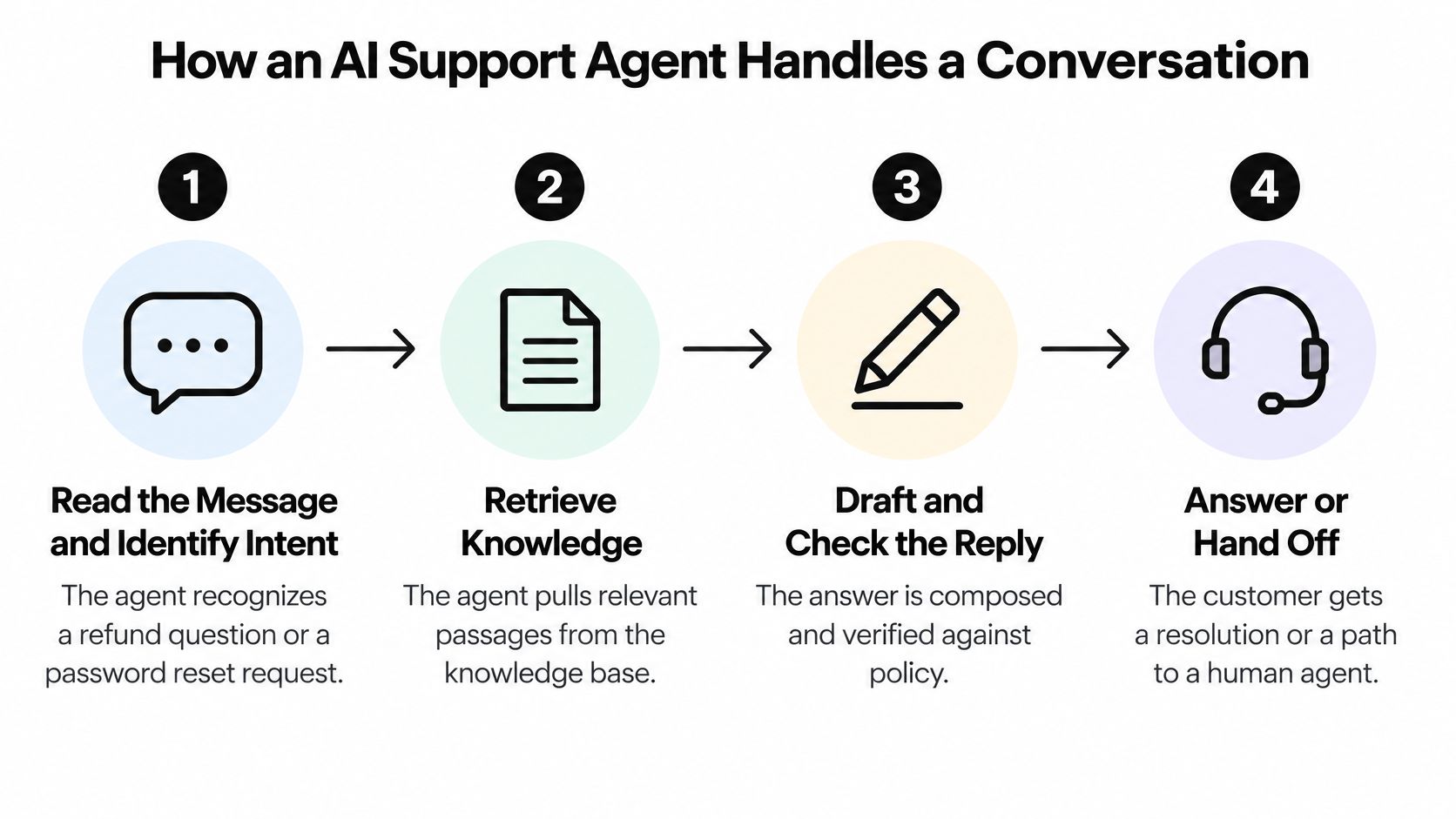
The conversation moves through these stages.
-
Read the message and identify intent.
The agent recognizes an order-status request involving a replacement shipment. It should preserve that distinction instead of treating the message as a new purchase inquiry. If the order can't be identified from the authenticated session, it asks for the missing reference without requesting unnecessary personal information. -
Retrieve approved knowledge.
The agent looks for relevant delivery guidance and replacement-shipment policies. This process, often called retrieval, supplies company-specific context before the agent writes its answer. A shipping policy explains what should happen, but it doesn't establish where this particular parcel is. -
Draft a grounded reply.
The answer should reflect the retrieved material rather than general assumptions about shipping. With our configuration, answers can be kept grounded in approved sources, and you can control what the agent is allowed to discuss. Our guide to AI question answering explains this connection between source material and responses. -
Call a defined action if needed.
To check the actual shipment, the agent needs an authorized order-lookup action. That action returns structured information, such as carrier status, which the agent explains in plain language. Looking up a shipment doesn't automatically grant permission to change its address or issue a refund. -
Check evidence, permissions, and complexity.
The agent evaluates whether the available information supports an answer and whether the next step falls within its instructions. Don't treat a confident tone as proof of correctness. Missing tracking information or conflicting records should change the response. -
Answer or transfer the case.
If the shipment is progressing normally, the customer gets a concise update. If records conflict or the request requires an exception, the conversation goes to the appropriate person with its context intact.
The visual summarizes those stages into a simpler flow.
Why the knowledge base matters
An agent answering from general model knowledge can sound convincing while inventing your refund conditions. Grounding means giving it relevant, approved material to use, although that alone doesn't eliminate mistakes.
Treat your knowledge base as part of the service itself. Remove contradictory policies, distinguish public guidance from internal procedures, and assign owners to updates.
A good customer conversation feels short because the system does the checking, not because it skips the checking.
Which Tickets to Automate and Which to Hand Off
| Intent class | Automate | Reason |
|---|---|---|
| Order status lookup | Yes, with an action | Structured data lookup, low risk |
| Policy or product explanation | Yes, grounded in approved sources | Well-defined answers that change slowly |
| Subscription cancellation | Yes, with a structured workflow | Clear steps, but needs confirmation before action |
| Repeat complaint about the same problem | Assist, then hand off early | Often an operational failure the agent cannot fix |
| Refund exception or billing dispute | Hand off | Requires judgment and account authority |
| Account security or legal request | Hand off only | High risk and often regulated |
Use this as a starting routing policy, not blanket permission. An order-status lookup is only low risk when the customer is authorized to access that order. A policy explanation is suitable for automation only when the policy is current and unambiguous.
A randomized online-chat experiment described by Harvard Business School found stronger benefits from AI suggestions for less-experienced agents and subscription-cancellation requests, while repeat-complaint conversations showed the weakest gains. Importantly, the experiment involved AI suggestions for human agents, not proof that autonomous systems can safely complete every cancellation.
Route by the work required
A cancellation can have a clear sequence: verify the account, explain the effect, obtain confirmation, and execute the approved workflow. A billing dispute might require investigating conflicting records and deciding whether an exception is justified. Similar wording doesn't make those requests equally suitable for automation.
Classify conversations using intent, customer history, emotional intensity, and required system actions. A routine delivery question becomes a different service problem when the customer has already contacted you repeatedly and received contradictory promises.
Write an escalation process that makes these distinctions explicit. Include the receiving team, the reason for transfer, and what the agent should do while the customer waits.
Signals that should interrupt automation
- Repeat contact: Route a returning complaint to someone who can investigate the unresolved cause.
- Request for a person: Honor the request instead of forcing further troubleshooting.
- Legal or regulatory language: Transfer for qualified review rather than generating an interpretation.
- Account distress: Prioritize cases where urgency, service commitments, or account context require attention.
Don't use sentiment as the sole gatekeeper. A calm account-security request can be more consequential than an angry question about a feature label.
Compare results within each intent class. A strong score for policy explanations shouldn't offset failed billing-dispute routing, and a successful cancellation shouldn't count as evidence that the agent can resolve a recurring product defect.
Measured Results and What They Do Not Show
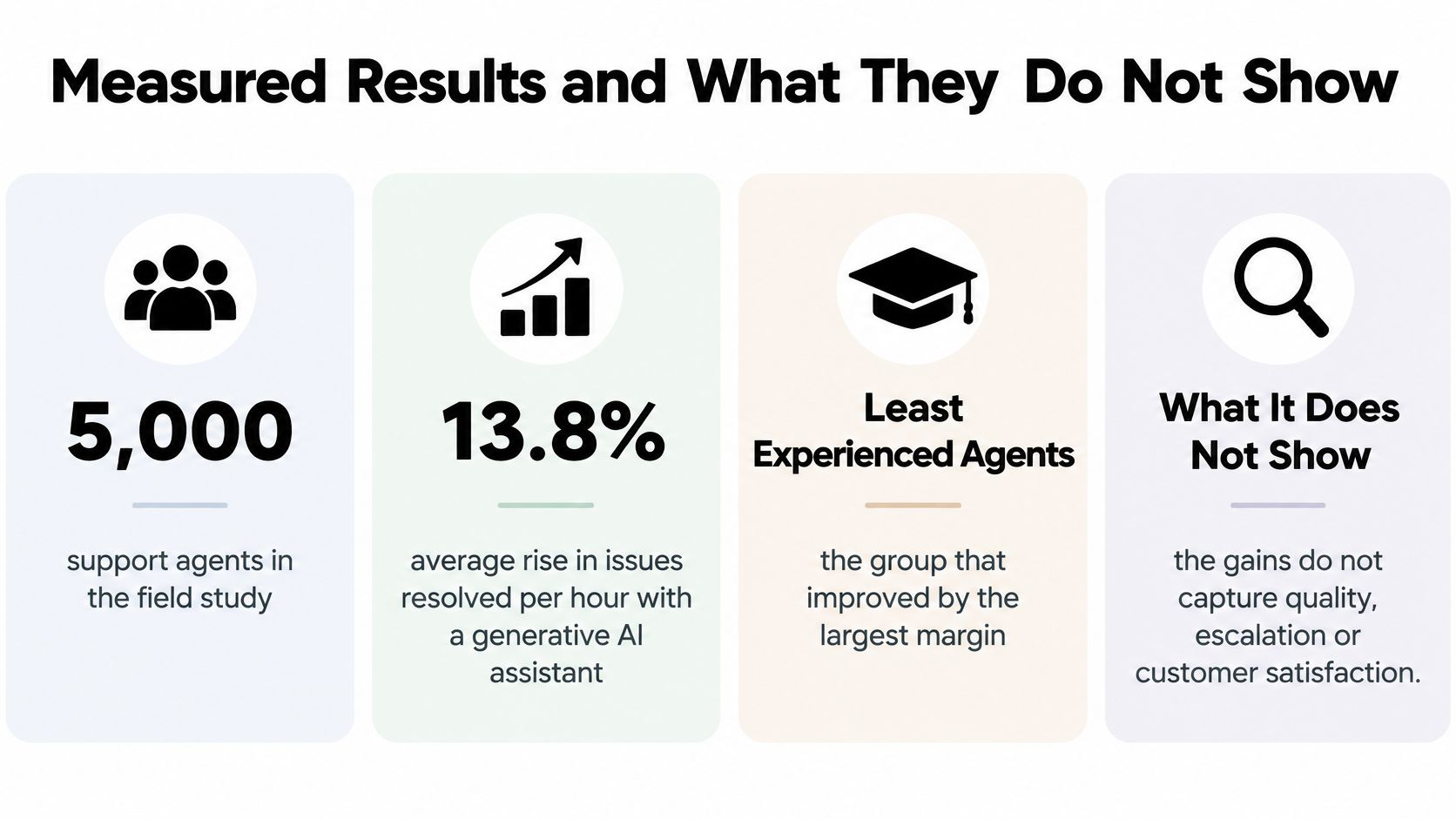
A field study of approximately 5,000 customer-support agents found that access to a generative-AI conversational assistant increased issues resolved per hour by 13.8% on average, with the lowest-performing or least-experienced agents improving by roughly 35%. Those are results for people working with an assistant, not an autonomous agent's resolution rate.
The distinction matters when building a business case. You can use assisted-agent evidence to justify testing response suggestions, but you can't apply that productivity lift to a customer-facing bot as-is.
The visual highlights the headline result and its limits.
Understand what changed
The study's explanation centered on knowledge transfer. Suggested responses helped less-experienced representatives use practices associated with stronger colleagues, reducing the effort involved in composing answers and seeking assistance.
That suggests a practical evaluation question: does your system make useful organizational knowledge easier to apply? A polished answer isn't enough if the representative still has to verify every sentence or search elsewhere for the actual procedure.
Faster replies are useful only when customers reach the right outcome.
Separate throughput from service quality
Issues resolved per hour is more informative than response speed alone, but no single metric captures the entire experience. An interaction can end quickly because the customer gives up, and a longer conversation can be worthwhile when someone finally fixes a difficult problem.
Use performance benchmarking to define comparable groups before launch. Randomize eligible conversations where practical, or stagger access across comparable teams while recording changes in staffing and ticket mix.
Review outcomes through several lenses:
- Agent experience: Check whether newer and experienced representatives benefit differently.
- Intent class: Separate straightforward requests from exceptions and unresolved complaints.
- Resolution quality: Audit whether the answer and action were correct.
- Customer outcome: Monitor repeat contacts, escalation, and satisfaction alongside throughput.
Keep expected benefits separate from observed results in your reporting. A forecast about retention or satisfaction isn't evidence that your deployment improved either, and a productivity gain doesn't establish that your customers received better service.
Limits, Bot Loops and Handoff Failures
A bot loop starts when the customer receives the same irrelevant answer, supplies information again, and still can't reach someone who can help. Adding a transfer button doesn't solve the problem if it opens an empty conversation in another queue.
This is the experience your handoff design needs to prevent.

The Liveops holiday AI customer-service report found that 55% of surveyed U.S. holiday shoppers had to escalate an AI-handled issue to a human, while 45% said the AI failed to understand their problem. These findings describe that surveyed shopping audience, not a universal failure rate for AI support.
Transfer a usable case, not just a transcript
The receiving representative needs a concise case summary backed by the original conversation. Include the customer's goal, verified identifiers, relevant system results, troubleshooting already attempted, urgency, and the reason the agent stopped.
Keep facts separate from inferences. Customer reports being charged after cancellation is useful; billing system incorrectly charged customer asserts something the agent may not have established.
Before launch, decide:
- What passes across: Specify the summary, transcript, action results, and relevant account context.
- When troubleshooting stops: Define stopping conditions for missing evidence, failed actions, complexity, and customer requests.
- How priority changes: Set routing rules for urgency, account circumstances, and regulatory risk without relying solely on emotional language.
We use natural-language instructions to tell the agent when to escalate, with escalation based on query complexity. You can revise those instructions, but you still need to test whether the resulting behavior matches your intent.
A useful handoff review focuses on what happens after automation stops.
Test continuity across channels
Include channel changes in your edge-case testing. A customer moving from a website chat to email shouldn't lose their case history, and a voice transfer shouldn't leave the representative guessing what the automated system attempted.
If staff aren't available, state that clearly and explain the next step. Containment rate, the share of conversations ending without a human, cannot tell you whether the customer received help or abandoned the attempt.
Deploy in Five Phases and Start with One Pilot
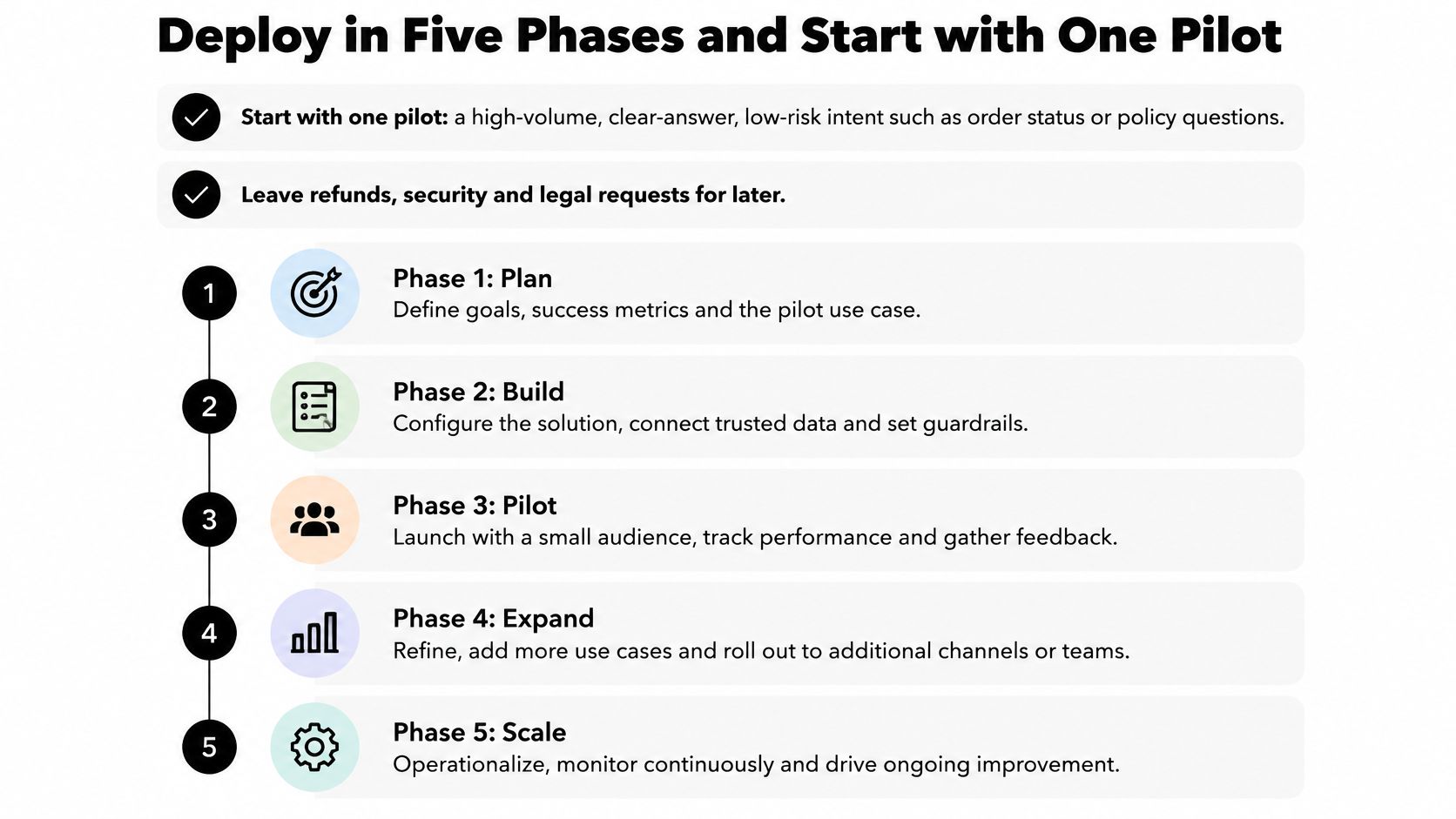
Start with a narrow policy-question pilot when you have clear, approved answers and limited need for customer-specific data. Choose order status instead if secure lookup access is ready. Keep refund exceptions, security issues, and legal requests outside the initial scope.
The pilot should test an operational promise: customers get correct answers, and cases outside the boundary reach the right person. Don't make the first release a referendum on whether your entire support function can be automated.
Use this roadmap to organize the work.
Scope and ground the pilot
Phase one is scope. Name the eligible intent, exclusions, success measure, and person responsible for reviewing results. Decide what would cause you to pause the pilot, such as unsupported answers or transfers reaching the wrong queue.
The exit test is ownership: a named person can explain what success means and make the expansion decision.
Phase two is grounding. Gather the approved help articles, policy pages, and product documentation needed for that intent. Remove obsolete material and resolve contradictions before uploading it.
Assign an update owner, especially for plan entitlements and product behavior. The exit test is traceability: each expected pilot answer can be supported by an approved source.
Configure and test before release
In phase three, set the tone, permitted topics, available actions, and escalation instructions. Confirm what visitor information the agent can collect, read, and retain; don't assume a conversational interface changes your privacy responsibilities.
Our customers decide what content they submit and how their agents collect visitor information. They're responsible for any additional notices and consent their use case requires.
The exit test is clarity: a reviewer can describe exactly when the agent should answer, act, or transfer.
Phase four tests behavior against real questions. Use past tickets with customer information appropriately protected, including misspellings, ambiguous wording, conflicting requests, and questions the agent must decline. Check both the response and any resulting action.
Test changes to prompts and sources again before publishing them. The exit test is that sampled conversations meet your agreed accuracy and routing requirements, not merely that the agent sounds helpful.
Launch with a comparison
Phase five is a limited release with a meaningful comparison. Use a control group or staggered rollout, then inspect outcomes by intent before expanding access. Your exit test is improvement against the comparison without unacceptable deterioration in quality or continuity.
No technical setup is required to build an agent with us. You can move from idea to a live agent in minutes by adding knowledge, shaping tone, testing real questions, and deploying, but quick configuration doesn't remove your responsibility to test behavior and review important output.
For implementation planning, use our AI agent integration guide to connect deployment decisions with the customer journey.
Launch metrics to track by intent
| Metric | What it measures | Warning sign |
|---|---|---|
| Containment rate | Share of conversations ended without a human | High containment with low satisfaction |
| Successful-transfer rate | Handoffs where the human could continue without re-asking | Falls below the control group |
| Repeated-explanation rate | Customers asked for details they already gave | Rises after a prompt or source change |
| Time-to-human-resolution | Time from handoff to resolved case | Longer than before the agent launched |
| Resolution quality by intent | Accuracy checked against sources on sampled chats | Strong overall, weak on one intent |
| Customer satisfaction by intent | Ratings split by ticket type | Drop concentrated in high-friction intents |
Launch discipline: Agree on the warning signs before you see the results, so enthusiasm doesn't become the approval criterion.
This week, export a recent batch of support tickets and label them using the routing categories. Shortlist the clearest low-risk intents, choose a pilot owner, and write the stopping rules before building the agent.
SupportGPT offers embedded AI support agents that answer visitor questions and hand complex conversations to human teammates. Visit SupportGPT to build a focused pilot with your approved knowledge, test real customer questions, and configure the handoff rules before deployment.