What is conversational ai: A practical guide
Learn what is conversational ai, how it works, and practical uses for your business. A concise guide to components and easy implementation.
Ever found yourself chatting with a support bot that actually gets it? That’s conversational AI in action. It’s the technology that lets machines chat with us in a way that feels natural and genuinely helpful, moving way beyond simple commands to have real, context-aware conversations.
Understanding Conversational AI Beyond the Hype
Let's cut through the noise. At its heart, conversational AI is all about automating communication and giving users personalised experiences, but on a massive scale. Instead of a rigid, script-following robot, think of it as a smart digital assistant that can learn on the job, adapt to new situations, and solve problems. It’s what makes talking to technology feel less like talking to a machine and more like talking to a person.
This is a huge leap from the old, rule-based chatbots many of us have learned to dread. Those bots could only follow a strict script triggered by keywords. Conversational AI, on the other hand, understands what you mean, remembers what you said earlier, and can handle conversations with twists and turns.
The real goal here is to create an experience so smooth that you could talk to a machine just like you would a human expert—asking follow-up questions, clarifying things, and getting smart, relevant answers every time.
This is exactly why businesses are so interested in it. It allows them to offer high-level, round-the-clock support without burning out their human agents.
The Shift from Simple Scripts to Smart Dialogue
The biggest difference comes down to intelligence and flexibility. Traditional chatbots are stuck on pre-programmed tracks. If you ask a question they weren't programmed for, you hit a dead end, and frustration quickly sets in. Conversational AI is different; it's dynamic. It deciphers the subtleties of your language to figure out your true intent, not just the specific words you used.
To make this crystal clear, let's compare the two side-by-side.
Conversational AI vs Traditional Chatbots
This table breaks down the core differences, showing why one is a simple tool and the other is a strategic powerhouse.
| Feature | Traditional Chatbot | Conversational AI |
|---|---|---|
| Logic | Follows pre-defined rules and scripts. | Understands context, intent, and sentiment. |
| Interaction | Keyword-based and often rigid. | Natural, flexible, and human-like dialogue. |
| Learning | Static; does not improve without manual updates. | Learns and adapts from every conversation. |
| Complexity | Best for simple, repetitive FAQ-style questions. | Manages complex, multi-turn conversations. |
This evolution is precisely why it’s so critical to understand what is conversational AI. It’s not just a fancier chatbot. It’s a tool for automating meaningful conversations and completely changing the game for customer experience.
How Conversational AI Learns to Talk
Think about how a child learns to talk. It’s not just about memorising vocabulary; it’s about grasping context, understanding the give-and-take of a conversation, and figuring out what someone really means. Conversational AI learns in a strikingly similar way, relying on a powerful trio of technologies to turn a user's typed or spoken words into a genuine dialogue.
The entire process is built on a foundation of Natural Language Processing (NLP). You can think of NLP as the AI's ears and mouth. It’s the core technology that allows the system to first read or hear our language, then deconstruct it into bits and pieces it can understand, and finally, piece together a logical response. It’s the essential translator between human expression and machine logic.
Inside NLP, two key jobs are happening constantly:
- Natural Language Understanding (NLU): This is the listening and comprehension part. NLU is what helps the AI figure out the user's actual goal, even if their phrasing is a bit quirky, full of slang, or grammatically imperfect. It picks out the important details—like a product name or the type of problem—to understand the intent behind the words.
- Natural Language Generation (NLG): This is the speaking part. Once the AI knows what you want, NLG steps in to build a response that sounds natural and human. It’s responsible for crafting sentences that are grammatically correct and contextually appropriate.
This diagram helps visualise how the system understands, responds, and gets smarter over time.
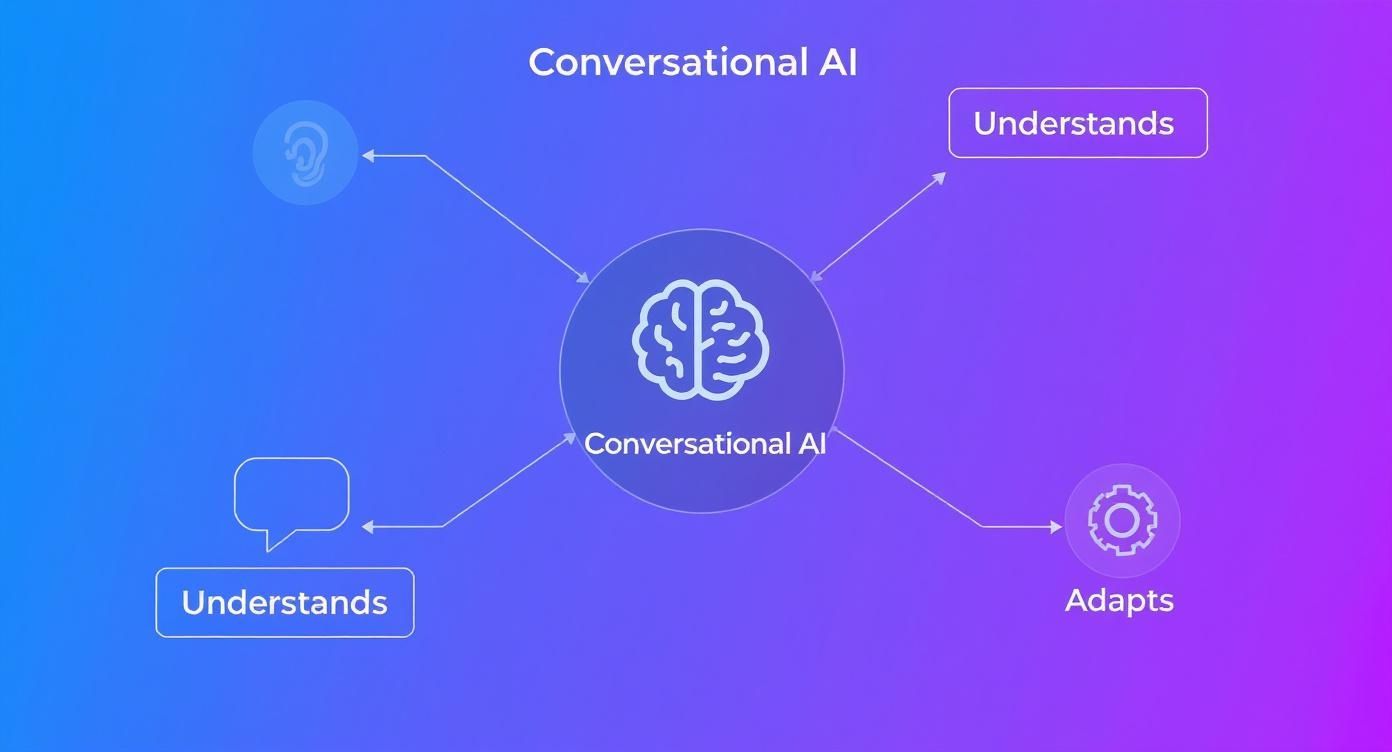
As you can see, there’s a central ‘brain’ processing what you say, figuring out how to reply, and constantly adapting. It’s a continuous loop of intelligent interaction.
The Brain Behind the Conversation
So what powers this learning loop? The engine running the whole show is Machine Learning (ML). If NLP is the ears and mouth, ML is the brain, and it gets better with every single conversation it has. Unlike an old-school chatbot that just follows a rigid script, an AI powered by ML can spot patterns in huge volumes of conversational data.
This means that over time, the AI improves its ability to anticipate what a user might need, offer more personalised answers, and handle tricky, multi-part questions with much better accuracy. It’s not just following orders; it’s learning from experience.
At the heart of today’s conversational AI, you’ll find Large Language Models (LLMs). These are incredibly sophisticated ML models that have been trained on mind-bogglingly large datasets of text and code. This massive training gives them a deep, nuanced understanding of language, which is why they can produce dialogue that feels so human and relevant.
All these components have to work in perfect harmony. NLP handles the raw language, NLU deciphers the intent, and advanced ML models like LLMs use that understanding to learn, adapt, and generate genuinely helpful responses. This cycle is what separates modern conversational AI from basic bots, allowing it to move beyond simple keyword-matching to solve real problems. It’s precisely how a platform like SupportGPT can provide accurate, human-like help around the clock.
Conversational AI in Action Across Industries
It’s one thing to understand the technical nuts and bolts, but the real magic of conversational AI shines when you see it solving actual business problems. This isn't some far-off concept anymore; companies are actively using it to redefine how they operate and engage with customers. It's quickly becoming a non-negotiable part of modern business, particularly anywhere a customer is involved.
The most obvious place you’ll see this is in customer support. Businesses are deploying AI agents to field a constant stream of customer questions, 24/7. Think about the simple stuff: order tracking, password resets, or booking an appointment. An AI can handle those in a heartbeat, which leaves the human support team free to focus on the trickier, more sensitive issues that really do need a human touch.

This image gets to the heart of it—conversational AI isn't a one-trick pony. It's being put to work in wildly different fields like e-commerce, banking, and even healthcare. The core technology might be the same, but it can be fine-tuned to guide a patient through a health query, securely process a bank transaction, or help a shopper track down the perfect pair of shoes.
Boosting Efficiency and Customer Happiness
But its uses go way beyond just answering basic questions.
In e-commerce, AI assistants act like personal shoppers, guiding customers through catalogues, suggesting products they might actually like, and smoothing out the checkout process. In banking, they’re the first line of defence, helping you check your balance, move money, or report a lost card without waiting on hold.
Product teams are finding it incredibly useful, too. Imagine an AI that walks new users through your app, pointing out key features so they don't get lost and frustrated. It also becomes a powerful, always-on feedback loop, collecting insights from conversations that can be fed directly back into product development. A platform like SupportGPT, for instance, gives businesses the building blocks to create these kinds of sophisticated AI agents without starting from scratch.
By taking over the routine, repetitive tasks and delivering instant, accurate support, businesses aren't just getting more efficient. They're making customers happier. People get what they need, right when they need it, and that’s a huge win.
The Booming Market and What’s Next
The speed at which companies are adopting this technology is staggering, and the market numbers back it up. This is especially true in regions that are rapidly going digital.
Take India, for example. The conversational AI market there was valued at USD 516.8 million this year. By 2033, it’s expected to explode to USD 4,936.9 million. That’s a compound annual growth rate (CAGR) of about 26.4%. This surge is driven by a massive digital shift, the demand for round-the-clock customer service, and the rise of voice assistants that can understand regional languages.
This kind of growth sends a clear message: knowing what conversational AI is has moved from a "nice-to-have" to a "need-to-know." Whether it’s a healthcare provider assisting patients or a retailer creating personalised shopping journeys, the impact is real, and it’s only getting bigger.
Here’s the rewritten section, crafted to sound like it was written by an experienced human expert.
What Are the Real-World Benefits and Limitations of Conversational AI?
Any new technology comes with its own set of trade-offs, and conversational AI is no different. It offers some game-changing advantages, but you’ve got to be clear-eyed about its current limitations. Getting this balance right is the key to figuring out if it’s the right move for your business right now.
The biggest wins are often in efficiency and cost. It’s pretty straightforward: when you can automate the routine, repetitive questions that flood your support queues, your operational costs drop. More importantly, your customers get instant answers, day or night.
That 24/7 availability can’t be overstated. It completely changes the customer experience, moving them from frustrating hold music to immediate resolutions. A well-trained AI can also deliver surprisingly personal interactions by tapping into past conversations and user history, making people feel like you actually know them.
What’s in It for Your Business?
Beyond the immediate cost savings, a smart conversational AI strategy can unlock some serious growth potential:
- Scale Without Breaking a Sweat: AI can juggle thousands of conversations at once without dropping the ball. This means you can handle sudden spikes in customer queries—like during a sale or an outage—without hiring an army of temporary staff.
- Uncover Hidden Customer Insights: Every single chat is a goldmine of data. Conversational AI platforms can analyse these interactions at scale, spotting common friction points, flagging popular feature requests, and giving you an unfiltered look at what your customers really think.
- Let Your Team Focus on What Matters: When bots handle the "Where's my order?" and "How do I reset my password?" questions, your human agents are freed up. They can then apply their skills to the tricky, high-stakes issues where their expertise and empathy make a real difference.
The Other Side of the Coin: Navigating the Challenges
Of course, it’s not all smooth sailing. One of the biggest hurdles is that AI still struggles with emotional intelligence. It can’t truly replicate human empathy, which makes it a poor fit for sensitive situations where a customer is angry, upset, or needs a delicate touch.
Another major watch-out is the risk of bias. An AI is a reflection of the data it learns from. If that data is skewed or contains historical biases, the AI will learn and amplify them. This can lead to some serious brand damage if not managed carefully through thoughtful data curation and constant monitoring.
Finally, getting started isn't just a flick of a switch. It requires a proper investment of time and resources upfront to define your goals, prepare clean training data, and integrate the system smoothly with the tools your team already uses.
But make no mistake, the shift is happening fast. A major forecast for the Indian market predicts that by 2027, nearly 50% of all customer service interactions will be handled by AI systems. This shows just how quickly businesses are turning to automation to keep up with customer demands for instant, round-the-clock support. You can explore the full report on India’s AI adoption in customer service for a deeper dive.
So, while conversational AI isn't a silver bullet, it's a powerful tool. Understanding its strengths and weaknesses is the first step to using it effectively to build better, more efficient customer relationships.
To make this even clearer, let's break down the main pros and cons in a simple table.
Benefits vs Limitations of Conversational AI
| Benefits (Pros) | Limitations (Cons) |
|---|---|
| Instant, 24/7 Support: Always on, providing immediate answers to customers anytime, anywhere. | Lacks Human Empathy: Struggles with emotionally charged or complex nuanced conversations. |
| Significant Cost Reduction: Automates routine tasks, lowering operational and staffing costs. | Risk of Algorithmic Bias: Can perpetuate biases present in the training data if not carefully managed. |
| Effortless Scalability: Handles massive volumes of conversations simultaneously without performance degradation. | High Initial Setup Cost: Requires significant investment in data, development, and integration. |
| Valuable Data Insights: Gathers and analyses customer interaction data to inform business strategy. | Dependency on Data Quality: Performance is directly tied to the quality and quantity of training data. |
| Increased Agent Productivity: Frees up human agents to focus on high-value, complex problem-solving. | Potential for Generic Responses: Can sound repetitive or unhelpful if not designed and trained properly. |
Ultimately, the goal is to play to the AI's strengths—speed, scale, and data processing—while keeping your human experts in the loop for situations that require a genuine human connection.
A Practical Roadmap to Implementation
Bringing conversational AI into your business isn't as simple as flipping a switch; it needs a solid plan. The first step has nothing to do with technology. It starts with your business goals.
What, exactly, are you trying to fix or improve? Are you drowning in support tickets? Do you want to qualify leads more effectively? Or maybe you just need to offer customers help around the clock. You need a clear objective to guide every decision you make.
Once you know where you're heading, you’ll hit a major fork in the road: do you build a custom solution from scratch or buy an existing platform? Building gives you complete control, but it requires serious technical know-how and a hefty investment. For most companies, buying a platform like SupportGPT is the faster, more practical route, giving you a powerful foundation to build on.
No matter which path you take, success comes down to one thing: high-quality training data.

Preparing Your Data and Systems
Your AI will only ever be as smart as the data it learns from. That means you need to pull together all your relevant, clean information—things like past customer support chats, your knowledge base articles, and product manuals. The cleaner and more organised this data is, the more accurate and genuinely helpful your AI agent will become.
At the same time, you need to be thinking about data privacy from the very beginning. It's vital to set up strong rules to protect customer information and comply with regulations like the Digital Personal Data Protection Act (DPDPA). This isn’t just a box-ticking exercise; it’s fundamental to earning and keeping your users’ trust.
Seamless integration is the next big hurdle. Your conversational AI can't work in isolation. For it to be truly effective, it needs to connect with the systems you already use.
Think of it this way: when your AI can see your CRM, it knows a customer's entire purchase history. When it's linked to your helpdesk, it understands their past support queries. This context is what turns a simple bot into a truly intelligent assistant.
Launching and Refining for Success
With your AI trained and integrated, you’re ready to launch. But the job is far from over. Conversational AI is not a ‘set and forget’ solution. You have to constantly monitor how it's performing, dig into conversation logs, and find opportunities to make it better. This continuous cycle of refinement is what makes your AI more valuable over time.
This is especially true in a diverse market like India, where recent developments are allowing conversational AI to interact fluently in a huge number of regional languages and dialects. This multilingual capability is critical for reaching a wider audience, as many people prefer to communicate in their own language. As you can imagine, this focus on language has unlocked a much better user experience across countless industries. You can explore more on the latest conversational AI trends in India.
To recap, your implementation plan should look something like this:
- Define Clear Goals: Start with a specific, measurable business problem you want to solve.
- Make the Build vs. Buy Decision: Pick the option that aligns with your budget, team, and timeline.
- Prepare Quality Data: Collect, clean, and organise the information your AI will use for training.
- Integrate with Core Systems: Connect your AI to your CRM, helpdesk, and other essential tools.
- Monitor and Iterate: Continuously track performance and refine your AI's responses based on real-world interactions.
The Future Is Collaborative, Not a Replacement
Conversational AI is fundamentally changing the way businesses talk to their customers. We've moved far beyond the clunky, first-generation chatbots. Today, this technology is becoming a true strategic partner.
It’s not just about automating repetitive answers. The real power lies in creating efficient, personalised, and scalable conversations that make customers feel genuinely heard. As we've seen, AI is brilliant at handling the high volume of routine queries with incredible accuracy, which in turn frees up your human agents to focus on what they do best.
The evolution of conversational AI is rapidly moving towards greater emotional intelligence and a much deeper understanding of context. This constant improvement highlights a critical point: the goal isn't to replace people. The future is all about smart collaboration.
The ultimate aim is to forge a seamless partnership where AI handles the predictable, freeing up human experts to tackle complex problem-solving, build lasting customer relationships, and navigate sensitive issues that demand real empathy.
By adopting this collaborative model, companies can unlock entirely new levels of team productivity and customer happiness. It’s a classic case of augmenting human talent, not making it redundant. This positions AI as the indispensable tool it is—one that helps us create smarter, more human-centric ways to communicate.
Frequently Asked Questions
Let's wrap up by tackling some of the questions that often come up when people start digging into what conversational AI can do.
What Is the Main Difference Between a Chatbot and Conversational AI?
Think of it this way: a basic chatbot is like a vending machine. You press a specific button (use a keyword), and it gives you a pre-programmed item (a scripted answer). It works, but only if you know exactly what you're asking for and stick to the script. It’s all based on fixed rules.
Conversational AI, on the other hand, is more like having a conversation with a sharp personal assistant. It doesn't just look for keywords; it uses things like Natural Language Processing (NLP) to actually understand what you mean, remember what you've already talked about, and figure out your intent. This allows it to handle messy, unpredictable conversations and get better over time, making the interaction feel much more natural and human.
How Much Does It Cost to Implement Conversational AI?
The cost really depends on how you go about it. If you decide to build a custom solution from the ground up, you're looking at a serious investment. It means hiring a team of AI specialists and data scientists, and the costs can climb very quickly.
For most businesses, especially small to medium-sized ones, plugging into a ready-made platform is a much more sensible route. These platforms usually work on a monthly subscription model, with costs based on usage and the features you need. The more complex your automated conversations and the more systems you need to connect it with, the more it will influence the final price tag.
Is Conversational AI Secure for Handling Customer Data?
Absolutely, as long as you're using a reputable platform. Security isn't an afterthought for these providers; it's built into their core. They use things like end-to-end encryption and are designed to comply with major data protection laws, like GDPR and India's Digital Personal Data Protection Act (DPDPA).
The key takeaway here is to do your homework. Always check a provider’s security certifications and data policies. While the platform gives you a secure foundation, your business is still the one responsible for using it in a compliant way.
Do I Need a Lot of Data to Start with Conversational AI?
Not always. It’s a common misconception that you need a mountain of data just to get started. While more high-quality data will always help the AI get smarter, many modern platforms come with pre-trained models designed for specific industries, like e-commerce or finance.
This gives you a huge head start. You can launch with a strong baseline and then fine-tune the system by feeding it your own unique data—things like past support tickets, help centre articles, or internal product guides. The best approach is to start with one clear, focused job for the AI and let it learn and grow from there.
Ready to see how a purpose-built AI support agent can transform your customer experience? With SupportGPT, you can build, manage, and deploy an AI assistant in minutes, trained on your own data and equipped with enterprise-grade guardrails. Start for free on supportgpt.app and deliver instant, accurate answers 24/7.