Your Guide to Modern Web Self Service
Discover how web self service can transform your customer support. This guide covers benefits, implementation, best practices, and the future with AI.

Think about the last time you had a question about a product or service. Did you immediately pick up the phone to call support? Probably not. You likely went straight to their website, hoping to find the answer yourself.
That's web self-service in a nutshell. It’s about giving customers the tools they need to find information, troubleshoot issues, and manage their accounts on their own, whenever they want. Instead of waiting in a queue for a support agent, they can use resources like a detailed knowledge base, an AI-powered chatbot, or a customer portal to get instant help.
The Rise of Web Self-Service in a Digital-First World

Picture your website having a digital librarian—a tireless expert available 24/7. This assistant knows exactly where everything is and can guide any visitor to the precise information they need, without ever putting them on hold. That's the real power of web self-service: creating an online space where your customers can help themselves, entirely on their own schedule.
In a world where we expect everything instantly, waiting for answers is no longer an option. The standard has shifted from company-led support to user-led problem-solving. This makes a solid self-service strategy more than just a nice extra; it’s a core part of any modern customer experience that builds genuine trust and loyalty.
Empowering the Modern Customer
Great self-service isn't just about deflecting support tickets or trimming operational costs, though it certainly does both. At its heart, it's about respecting your customer's time and capability. When you provide clear, easy-to-find, and accurate resources, you're empowering them and boosting their confidence in your brand.
This shift is especially obvious in rapidly growing digital markets. Just look at the trend in India. The country's self-service technologies market hit USD 1.44 billion in 2024 and is on track to reach USD 3.05 billion by 2033. This incredible growth is being driven by the surge in AI solutions and a huge mobile user base, making India a hotbed for mobile-first self-service innovation. You can dig deeper into these market growth insights on IMARC Group.
By letting customers solve problems on their own, you turn your website from a simple storefront into a powerful support hub. This not only makes customers happier but also creates a more scalable and efficient support system for your business.
Ultimately, web self-service meets customers exactly where they are. It gives them the independence and instant answers they’ve come to expect from every online interaction.
Here's the rewritten section, designed to sound like it was written by an experienced human expert.
Why Are So Many Businesses Switching to Web Self-Service?
Let's be clear: the shift towards web self-service isn't just another passing trend. It's a fundamental change in how companies approach customer support, driven by what customers actually want and what makes good business sense. Businesses are quickly learning that when you give customers the tools to find their own answers, you create a powerful engine for both efficiency and loyalty.
This creates a genuine win-win. The company benefits from a smarter, more streamlined operation, while customers get the instant, on-demand help they've come to expect.
At its core, web self-service offers a double-sided advantage, benefiting both the organisation that implements it and the customers who use it. It's a rare case where improving the customer experience also leads directly to operational excellence.
Here’s a quick breakdown of how both sides come out ahead:
Business and Customer Benefits of Web Self Service
| Benefit Category | Advantage for the Business | Advantage for the Customer |
|---|---|---|
| Cost & Efficiency | Drastically reduces support ticket volume and operational costs. Fewer calls mean lower staffing needs. | Gets immediate answers to common questions without waiting in a queue or for an email reply. |
| Support Team Impact | Frees up human agents to focus on complex, high-value problems that require real expertise. | Can solve simple issues instantly, leaving human support channels free for more urgent problems. |
| Availability & Access | Provides 24/7 support without the massive overhead of a round-the-clock contact centre. | Support is always available, anytime, anywhere—not just during 9-to-5 business hours. |
| Customer Experience | Boosts customer satisfaction and loyalty by empowering users with control and immediate solutions. | Feels empowered and in control of their own support journey, leading to a more positive brand perception. |
Ultimately, a well-executed self-service strategy transforms the support function from a reactive cost centre into a proactive driver of customer satisfaction and business growth.
Slash Support Costs, Not Quality
The most obvious, hard-hitting benefit for any business is a dramatic drop in support costs. Think about it: every time a customer can solve an issue using a knowledge base or a chatbot, that's one less phone call, one less email, and one less live chat session for your team to handle.
The numbers don't lie. Research from Forrester puts a figure on it, showing that every interaction deflected to a self-service channel can save a company around $11 per call. For a business fielding thousands of queries a week, those savings snowball into a significant financial windfall.
Let Your Agents Tackle the Tough Stuff
When you cut down the flood of simple, repetitive questions, something amazing happens to your support team. They get their time back. Instead of repeatedly explaining how to reset a password, they can sink their teeth into the tricky, high-stakes problems that genuinely need a human touch.
It’s no surprise that 44% of agents say self-service tools free them up to focus on more complex work. This isn't just about efficiency; it's about morale and purpose. Your support team evolves from a group of ticket-closers into a team of expert consultants, strengthening customer relationships with every meaningful interaction they have.
By automating the routine, web self-service unleashes your support agents to become the expert problem-solvers your customers—and your business—truly need.
Meet the Demand for "Always-On" Support
We live in a 24/7 world. Customers don't run on a 9-to-5 schedule, and they expect help to be there when they need it, whether that's late at night or on a Sunday morning. A solid self-service portal delivers exactly that, without the astronomical cost of staffing a round-the-clock support centre.
The data backs this up completely: 51% of customers simply expect a business to be available 24/7. A comprehensive self-service portal is the most effective way to meet that expectation head-on. It puts the power back in the customer's hands, giving them the instant gratification of finding an answer on their own terms. That sense of control and immediacy is what builds real, lasting trust in your brand.
The Essential Parts of a Great Self-Service Portal
Building an effective self-service portal is so much more than just slapping a few FAQs on a webpage and calling it a day. A truly helpful portal is more like a well-organised digital library, where every single piece is intentionally designed and placed to get users to their answers fast. It should feel cohesive and effortless.
Think of it as a carefully constructed ecosystem. Different tools need to work together seamlessly. Some elements provide the foundational knowledge, while others offer interactive, real-time help. When they all click, you empower your customers to solve problems on their own terms.
The Knowledge Base: Your Foundation of Truth
The absolute cornerstone of any self-service strategy is a solid knowledge base. This is your company's single source of truth. It should house everything from step-by-step tutorials and troubleshooting guides to in-depth articles explaining how your product features work. A well-tended knowledge base answers the most common questions your support team gets, before they even become tickets.
But just having the content isn't enough. To make it genuinely useful, it has to be structured logically. That means clear categories, intuitive titles, and a search function that actually works. This simple setup ensures people can find what they need without getting lost in a maze of articles, making the knowledge base a reliable first stop for any problem.
This map helps visualise how self-service benefits everyone involved—it's a win for the business's bottom line and a win for the customer's experience.
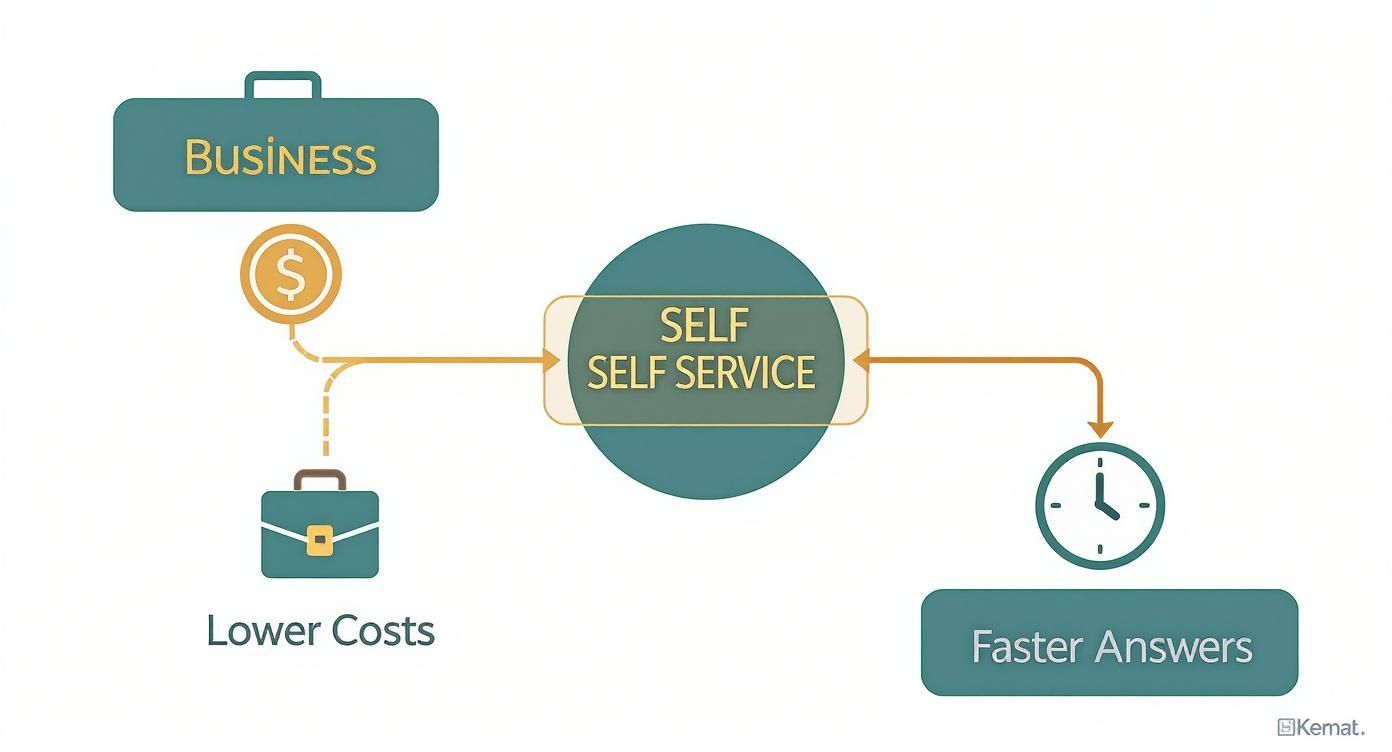
As you can see, lowering operational costs for your business goes hand-in-hand with giving customers faster, more efficient answers.
Smart Search and Interactive Helpers
A knowledge base is critical, but people also need more dynamic ways to find information. This is where the more advanced tools come in, turning a static library of articles into a genuinely interactive support hub.
These components are built to understand what a user is trying to do and give them personalised guidance.
- AI-Powered Chatbots: Today's chatbots are a world away from the old keyword-matching bots. They use natural language processing (NLP) to understand what people are asking in plain English, walk them through troubleshooting, and provide instant answers, 24/7.
- Virtual Assistants: Think of these as a step up from chatbots. They can handle more complex tasks by connecting to your other business systems, like checking an order status or starting a return. They’re less of a search bar and more of a digital concierge, able to both answer questions and take action.
- Community Forums: Let's be honest, sometimes the best person to answer a question is another customer who has already been there. Forums create a peer-to-peer support network where users can share tips, workarounds, and best practices. Over time, this becomes an incredibly valuable library of real-world knowledge.
A truly great web self-service portal doesn't just present information. It anticipates what users need and offers multiple paths to a solution—whether that’s through a perfectly written article, an intelligent chatbot, or a helpful peer in a forum.
By bringing these core pieces together, you build a multi-layered support system. If someone can’t find their answer in an article, a chatbot can step in. If the chatbot gets stuck, it can point them to a relevant discussion in the community forums or, as a last resort, escalate the ticket to a human agent. This seamless flow means users always have a clear next step, which builds their confidence and removes friction from the whole experience.
AI and the Future of Web Self Service
Artificial Intelligence isn't some far-off concept anymore; it's the engine powering the next evolution of web self-service. Think of traditional self-service portals as digital encyclopaedias—packed with information, but ultimately static. AI breathes life into them, turning them into dynamic, personal tutors. It elevates a simple Q&A page into an interactive experience that understands, predicts, and resolves customer needs on the spot.
The real magic is in AI's ability to grasp what a user actually means, not just what they type. Instead of just matching keywords, modern AI systems understand the context behind a query. When a customer types "my last payment," they aren't looking for a generic article. They want to see their specific transaction details. AI makes that connection, transforming a support portal from a passive resource into an active problem-solver.
From Simple Bots to Smart Assistants
The most obvious sign of AI's impact is the chatbot's glow-up. Early bots were frustratingly rigid, relying on specific keywords and often leading users down a dead end. Today’s AI-powered conversational agents are in a completely different league.
These sophisticated assistants can:
- Handle Complex Queries: They can hold natural, back-and-forth conversations to get to the root of an issue.
- Authenticate Users Securely: They can verify a user's identity to safely share account-specific information.
- Perform Actions: They can do things like process a refund, update a subscription, or book an appointment right inside the chat window.
This is a huge leap from just dishing out information to actively resolving problems. For businesses, this means genuine automation of complex support tasks, ready to go 24/7.
AI doesn't just answer questions; it completes tasks. It transforms your web self-service portal from a place where customers find answers to a place where they get things done.
Meeting Skyrocketing Customer Expectations
This technological shift is happening just as customer behaviour is changing, especially here in India. Artificial intelligence adoption has exploded, with 80% of Indian consumers now using AI chatbots for everything from checking an order status to getting product advice. This isn't just a niche trend; five out of six people are actively using AI to solve problems.
But there's a flip side to this widespread adoption. A huge 82% of customers say these new AI tools have raised their expectations for service. They now demand support that is faster, smarter, and more personalised. The data is clear: AI is no longer a futuristic nice-to-have; it's a must-have for any business that wants to keep up. You can dig deeper into these trends in the full ServiceNow report on customer experience.
Platforms like SupportGPT are leading this charge, giving businesses the power to build and launch advanced AI agents that meet these new, higher standards. By training on a company's own knowledge base, these tools provide accurate, on-brand help that feels both intelligent and personal, turning your website into your most valuable support channel.
Implementing Your Web Self-Service Strategy
Putting a web self-service portal in place isn't just about plugging in new software. The real goal is to build a reliable, go-to resource that customers genuinely want to use. A deliberate, step-by-step approach is what separates a portal that solves real problems from one that just adds to the confusion.
The whole thing starts not with technology, but with people. Before you write a single help article or pick a platform, you need to get inside your customers' heads and understand what they're actually struggling with. This is the foundation for everything else.
Start by Identifying Common Questions
Think of your support ticket history as a treasure map. Dive into your help desk data and start pulling out the most common, repetitive questions that pop up again and again. Are people constantly asking how to reset a password, how to read their bill, or where to find a certain feature?
These frequently asked questions are your starting point. They're the low-hanging fruit—the problems you can solve right now with some clear, easy-to-find content. Don't forget to talk to your support agents. They're on the front lines and know exactly which issues cause the most frustration.
Pull together a list of your top 10-20 most common queries. This gives your content creation a sharp, impactful focus right from the get-go.
Create Clear and Helpful Content
Once you know what to write about, the next challenge is creating content that actually helps. Your aim should be to make instructions so straightforward that a customer can fix their problem on their own, without ever needing to reach out to your team.
Here are a few pointers for creating self-service content that works:
- Keep it simple. Ditch the internal jargon and use plain English. Short sentences and paragraphs make your articles much easier to scan and digest.
- Show, don’t just tell. A picture is worth a thousand words, and this is especially true here. Use screenshots, annotated images, and short video tutorials to walk users through the steps. A quick screen recording can explain a process far more effectively than a wall of text.
- Structure for scanning. People don't read online; they scan. Use clear headings, bullet points, and bold text to break up your information and make it easy for users to find the exact answer they need.
A great self-service article doesn't just answer the initial question. It anticipates the next one and provides the answer before the user even thinks to ask. It’s about guiding them from problem to solution in one smooth journey.
Choose the Right Technology Platform
With some initial content in hand, it’s time to pick the right home for it. The technology you go with should match your ambitions, whether you’re starting with something simple or planning for a more sophisticated setup down the line.
- Simple FAQ & Knowledge Base Software: Tools like Freshdesk or Zoho Desk are fantastic for organising articles and getting a basic portal up and running quickly.
- Integrated Solutions: Platforms like HubSpot and Zendesk offer a more unified experience by combining a knowledge base with ticketing and live chat.
- AI-Powered Platforms: For a truly modern approach, solutions like SupportGPT let you build an AI agent that taps into your knowledge base to provide instant, conversational answers 24/7.
Promote and Gather Feedback
Finally, remember that "if you build it, they will come" rarely works. You have to actively drive people to your new self-service hub. Make sure to promote it across all your customer touchpoints—link to it in email signatures, mention it on support calls, and give it a prominent spot in your website's main navigation.
But launching is just the beginning. The real work is in the continuous improvement. Keep gathering feedback through surveys and watch your analytics to see which articles are a hit and where you might have content gaps. This constant cycle of listening and refining is what turns a good self-service portal into an indispensable customer asset.
Localising Content for Maximum Impact in India

If you're aiming for success with web self-service in India, a one-size-fits-all, English-only approach just won't cut it anymore. Truly putting the customer first means meeting them where they are—in the language they think and speak every single day. This isn't just about convenience; it's about building immediate trust and making sure people actually use the tools you provide.
The numbers tell a compelling story. A staggering 98% of users in India get their online content in regional languages such as Tamil, Telugu, and Malayalam. And this isn't just happening in rural areas. Even in cities, 57% of internet users prefer to browse in their regional language, highlighting a deep-seated cultural preference for localised experiences. To get a better sense of this trend, you can dive into more details about India's language-driven digital economy on IBEF.org.
Putting Localisation into Practice
Getting localisation right is more than just running your text through a translation tool. It's about thoughtfully adapting your entire self-service portal so it genuinely connects with the diverse regional audiences across the country.
Here’s what that looks like in action:
- Translate your knowledge base: Start by converting your most important articles and FAQs into the primary languages spoken by your customers.
- Localise the user interface: Make sure every button, menu, and navigation label on your portal appears in the user’s selected language.
- Deploy multilingual chatbots: Your AI assistants need to be smart enough to understand and reply naturally in multiple Indic languages, not just English.
When you adopt a multilingual strategy, you're doing more than just adding features. You're acknowledging and respecting India's incredible linguistic diversity. This simple act can transform your self-service portal from a merely functional tool into a genuinely welcoming and helpful resource for everyone.
Frequently Asked Questions
Even with a great plan in place, a few questions always pop up when you're rolling out a new system. Let's tackle some of the most common ones about web self-service to help iron out those final details.
What Is the Main Goal of Web Self-Service?
At its heart, the main goal is to empower your customers. You're giving them the tools to find answers and sort out their own problems, right when they need to, without having to wait for a support agent.
Of course, this brings fantastic business benefits like lower support costs and a more efficient team. But the real win is a better customer experience. A great self-service portal shows you respect your customer's time and intelligence by making it quick and easy to get help. That's what builds real, long-term loyalty.
How Do I Know If My Self-Service Portal Is Working?
You don't have to guess. Measuring the success of your portal is straightforward once you know what to look for. Tracking a few key metrics will tell you exactly how well your efforts are paying off.
Key performance indicators (KPIs) to watch include:
- Ticket Deflection Rate: This is the big one. It measures the percentage of issues that get solved by the portal instead of turning into support tickets. A high rate is a clear sign you're on the right track.
- Customer Satisfaction (CSAT): A simple "Was this article helpful?" poll at the end of a page gives you instant, direct feedback on the quality of your content.
- Portal Usage/Adoption Rate: How many people are actually visiting your self-service portal? A steady increase in unique visitors shows that customers are finding it and, more importantly, choosing to use it.
By keeping an eye on these numbers, you stop guessing and start knowing. The data will point you to what’s working and what needs a bit of a tune-up, so you can keep making your portal better and better.
Will Self-Service Replace My Human Support Team?
Not a chance. Think of web self-service as a powerful partner for your human agents, not a replacement. Its job is to handle all the common, repetitive questions that eat up so much time.
This frees up your support team to focus on what they do best: solving the complex, high-stakes problems that genuinely need a human touch. Your agents become expert consultants for your customers' most important challenges, which is far more rewarding for them and incredibly valuable for your business.
Ready to build a smarter, more efficient support experience? SupportGPT provides a complete platform to create and deploy AI agents that deliver instant, accurate help 24/7. Explore how you can elevate your web self-service strategy at https://supportgpt.app.