A Clear Tone of Voice Definition for Modern Customer Support
Get a clear tone of voice definition and learn how to build a brand personality that creates trust, loyalty, and a competitive advantage for your support team.
Think of it this way: if your brand were a person, its voice would be its core personality. It’s who you are at your heart—maybe you're quirky and fun, or perhaps you're serious and authoritative. That personality doesn't really change day-to-day.
But tone? That’s the emotional color you add to your voice depending on the situation. It’s your mood. You wouldn't use the same tone to share exciting news with a friend as you would to offer comfort after a setback. Your brand needs that same flexibility.
What Is Tone of Voice and Why It Matters Now

The distinction between voice and tone has become incredibly important. Customers interact with brands across dozens of channels—from chatbots and social media to emails and knowledge base articles. In every single one of those interactions, your words are building an impression.
A consistent voice builds trust and makes you recognizable. But it's the right tone that builds a real connection.
Voice vs Tone at a Glance
To make this distinction crystal clear, let's break it down. Think of your brand's voice as the foundation and the tone as how you decorate the house for different occasions.
| Concept | Definition | Analogy | Example |
|---|---|---|---|
| Brand Voice | The distinct, unchanging personality of your brand. It’s who you are. | Your core personality. | A brand's voice is "Helpful and Expert." |
| Tone of Voice | The emotional inflection you apply to your voice to suit a specific situation. It’s how you express yourself. | Your mood in a specific conversation. | The tone is "Patient and Reassuring" when a customer is frustrated. |
This table shows how voice remains the constant anchor, while tone provides the necessary adaptability for every unique customer conversation.
Why Tone Is a Business Imperative
Not too long ago, detailed tone of voice guidelines felt like a "nice-to-have," something reserved for big-budget consumer brands. That’s no longer the case. The explosion of digital communication has made a defined tone a strategic must-have for every business. You can read more about this strategic shift on davechaffey.com.
Every email, every social media reply, and every AI-powered chat is a chance to either strengthen your brand or weaken it.
Getting your tone right delivers real business results:
- Builds Trust and Recognition: A consistent tone makes your brand feel familiar and dependable. Customers learn what to expect, which makes your company feel more human and trustworthy.
- Creates Differentiation: In a crowded market, anyone can copy your features or undercut your prices. But nobody can replicate your unique personality. A distinctive tone makes you memorable.
- Improves Customer Satisfaction: Imagine dealing with a frustrating support issue. An empathetic tone makes you feel heard and valued. That same principle applies across the board, directly impacting how customers feel about their experience.
Tone of voice is not just a creative exercise; it's a critical component of customer experience. It’s the difference between a transaction and a conversation, shaping customer perception and fostering long-term loyalty with every word you write.
Ultimately, mastering your tone ensures every interaction—whether it's with a human agent or an AI like SupportGPT—reinforces who your brand is. It turns every touchpoint into an opportunity to build your brand, one conversation at a time.
The Real Impact of Tone on Customer Perception
Let's be clear: your brand’s tone of voice isn’t just about sounding nice. It’s a powerful tool that directly shapes how customers see you—how competent, friendly, and, most importantly, how trustworthy you are. This isn't just a hunch; it's a reality that hits your bottom line. Especially in tricky support situations, how you say something can matter far more than what you say.
Imagine a frustrated customer getting two different replies. One is robotic and cold, the other is warm and understanding. Both might technically solve the problem, but only the second one actually builds a relationship. That feeling of being heard and respected is what turns a one-time customer into a loyal fan.
From Feeling to Fact
The link between a company's tone and how people perceive it is backed by solid research. A landmark study from the Nielsen Norman Group showed just how much tone can sway a user's opinion.
They tested four key tonal dimensions—funny vs. serious, formal vs. casual, respectful vs. irreverent, and enthusiastic vs. matter-of-fact. The results? Even small tweaks along these lines completely changed how users rated a brand's friendliness and trustworthiness. You can check out a great summary of the full findings on tonal impact on seozoom.com.
This proves that the tone of voice definition is more than just a style choice; it’s a strategic decision. The study also uncovered a critical link: a customer's perception of a company's trustworthiness is a strong predictor of whether they'll recommend it to others.
In short, a trustworthy tone directly fuels word-of-mouth marketing and improves crucial metrics like your Net Promoter Score (NPS). It’s the bridge between a good customer experience and real business growth.
Why This Matters for Both Humans and AI
This principle is universal—it doesn’t matter if the customer is talking to a person or an AI agent like SupportGPT. An AI assistant with a generic, flat tone can come across as unhelpful or dismissive, even if its answers are technically correct. On the other hand, an AI fine-tuned to be empathetic, clear, and reassuring can solve problems and strengthen the customer relationship at the same time.
Think about how specific tonal choices change the game:
- Enthusiastic vs. Matter-of-Fact: An enthusiastic tone is perfect for a new feature announcement, but you'll want a matter-of-fact tone for walking someone through a complex technical process.
- Formal vs. Casual: A formal tone conveys authority and seriousness, which is ideal for a security notice. But a casual, friendly tone is much better for a welcome email.
Every decision you make in your tone of voice guidelines is actively building—or breaking—customer loyalty. It's the invisible blueprint behind a great customer experience, guiding how people feel about you and turning simple conversations into lasting brand value. When you get it right, customers don't just get an answer; they feel seen.
Using Tone to Build Your Competitive Advantage
In a market where new features get copied overnight and prices are in a constant race to the bottom, what actually sets you apart? It’s not just what you sell, but how you make your customers feel. This is where your tone of voice stops being a line item in a style guide and becomes a real, sustainable competitive advantage.
Think of it as building a moat around your brand. A competitor can mimic your product, sure. But they can't replicate the unique relationship you build with every single conversation. A distinct tone turns every support ticket and every chatbot interaction into a moment that builds genuine loyalty.
That loyalty is the key to retention. Studies have shown that a strong, well-defined tone of voice is a powerful retention tool because it creates much higher engagement with the customers you already have. When people feel a real connection to a brand, they’ll often stick around even when a similar product pops up somewhere else. You can read more about how tone creates a sustainable competitive advantage on sdm.fi.
Differentiating in a Crowded Industry
Look at the airline industry for a perfect example. Two airlines can fly the exact same route on the same type of plane, but the experience can feel worlds apart. A huge part of that difference comes down to tone.
- A Budget Airline: They might go for a cheeky, informal, and even irreverent tone. Think social media feeds full of memes and witty comebacks. This approach cleverly manages expectations—it signals low costs and no frills, but wraps it in a fun, modern personality.
- A Luxury Carrier: Their tone is more likely to be formal, respectful, and reassuring. Every communication is designed to convey comfort, exclusivity, and impeccable service. This builds a perception of quality and reliability that justifies a higher ticket price.
Neither approach is wrong, but they attract and keep completely different customers. The budget airline's followers love the humor and feel like they're in on the joke. The luxury carrier's clientele values the feeling of being personally catered to. In both cases, the tone creates a distinct brand experience that’s incredibly hard for a competitor to just copy and paste.
Your tone of voice is your brand’s personality in action. It’s the consistent, recognizable way you show up for your customers, building an emotional connection that price points and feature lists can never match.
When you consciously define and apply your tone, you’re doing more than just providing a service; you're creating a memorable experience. Every single time a customer interacts with your support—whether it's a human agent or an AI like SupportGPT—they get a little reminder of why they chose you in the first place. This constant reinforcement builds a loyal customer base that won't churn easily, cementing your place in the market and turning how you talk into one of your most valuable assets.
How to Define Your Brand Tone of Voice
Figuring out your brand's tone of voice isn't about inventing a personality from scratch. It’s more like an archeological dig—you're uncovering the personality that’s already there, deep in your company's DNA. The trick is to turn that core identity into a clear, methodical process that gives you practical guidelines for communication.
By breaking it down into a few key steps, you can build a blueprint that lets both your human team and your AI agents speak with one, consistent voice. This is how you transform an abstract idea into a real asset that builds customer loyalty and makes your brand instantly recognizable.
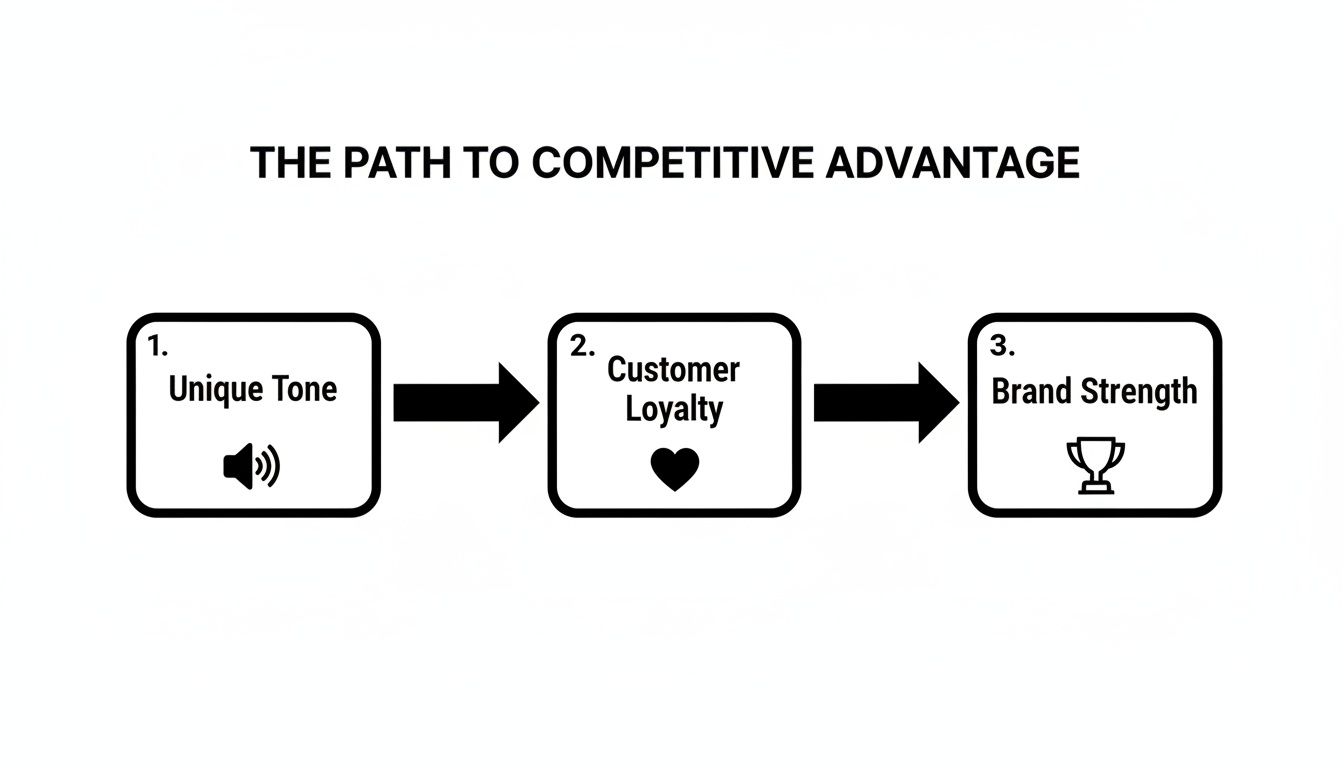
As you can see, a distinct tone isn't just a "nice-to-have." It’s the very first step toward creating the kind of deep customer connection that gives your brand a real competitive edge.
Start with Your Core Values
Before you figure out how to speak, you have to know who you are. Your tone of voice should be a natural extension of your company’s mission and core values. If you stand for simplicity and innovation, for example, your language should be clear, direct, and forward-thinking—not weighed down by corporate jargon.
Get your team together and ask some foundational questions:
- What are three words that truly describe our brand's personality?
- If our brand was a person at a party, what would they be like?
- What's the main feeling we want customers to walk away with after talking to us?
The answers you get here are the bedrock of your tone of voice definition. This isn't just a marketing exercise; it's about putting your identity into words so it can be applied consistently.
Understand Your Audience
Great communication is always a two-way street. Your tone has to connect with the people you’re actually talking to. A playful, meme-filled tone that works for Gen Z gamers will almost certainly fall flat with enterprise-level CIOs.
You need to go deeper than basic demographics. Try to really understand your customers' expectations and how they communicate. Look at the language they use in social media comments, product reviews, and support tickets. This research helps you mirror their natural communication style, making every conversation feel more intuitive and genuine.
Audit Your Current Content
You can't map out a new path without knowing your current location. It’s time to do a thorough audit of all your existing communications—from your website copy and blog posts to marketing emails and chatbot scripts. Pull out examples that feel spot-on and, just as importantly, some that feel a bit off-brand.
This audit gives you a practical, real-world starting point. It shows you the good habits you already have and shines a light on the inconsistencies that need fixing. Identifying these gaps is the key to creating unified guidelines that actually work.
Map Your Tone Dimensions
The final step is to translate your abstract values into concrete, actionable rules. The best way to do this is by mapping your tone on a few key spectrums. This is what turns your definition from theory into practice. Researchers at the Nielsen Norman Group identified four primary dimensions that are perfect for this exercise:
- Formal vs. Casual: How relaxed is your language? Are you using contractions and maybe even a little slang, or are you sticking to formal grammar?
- Funny vs. Serious: Is there room for humor and wit in your conversations, or is your communication strictly business?
- Respectful vs. Irreverent: Is your tone polite and conventional, or do you like to challenge the status quo with a bolder, more provocative attitude?
- Enthusiastic vs. Matter-of-Fact: How much energy comes through in your words? Are you upbeat and expressive, or calm and straight to the point?
Decide where your brand lands on each of these spectrums. The most important part, though, is to provide clear examples for each. This specific guidance is what makes a tone of voice playbook useful for everyone on your team, including an AI agent like SupportGPT.
Putting Your Tone of Voice into Action with AI

Defining your tone of voice is a huge first step, but the real test is seeing it come to life—especially when you're handing the reins to an AI agent.
Simply telling an AI to be "friendly and helpful" won't cut it. That's a recipe for the kind of generic, slightly robotic responses that customers can spot from a mile away. To get that genuine brand personality to shine through, you have to translate your high-level guidelines into specific, actionable instructions the AI can actually follow.
This means crafting detailed prompts that serve as a playbook for your AI. Think of these prompts as your way of teaching it the brand's unwritten rules: the core personality traits, the hard-and-fast dos and don'ts, and real-world examples of how to shift its tone based on the customer's mood. You're essentially building guardrails so it can navigate conversations with real emotional intelligence.
Crafting Effective AI Prompts
Think of your AI prompt as its foundational training manual. A weak, lazy prompt creates a generic assistant. A detailed, thoughtful one creates a true brand ambassador. The difference between a basic instruction and a fine-tuned prompt is night and day.
Let’s look at an example.
Before (A Generic Prompt):
“You are a helpful and professional customer support agent. Answer the user’s questions accurately.”
This prompt is too vague. It has no personality and no context, which almost guarantees a bland, unmemorable interaction.
After (A Fine-Tuned Prompt):
“You are a support specialist for our brand. Our voice is 'Helpful and Expert,' but our tone adapts. When a customer is frustrated, your tone must be 'Patient and Reassuring.' Never use corporate jargon. Always use contractions like 'you're' and 'we've' to sound more human. Start every reply by acknowledging their issue before offering a solution.”
See the difference? This refined prompt gives the AI a clear framework, ensuring its responses feel like they're coming from your brand, not just any brand. For businesses ready to put this into practice, tools like SupportGPT make it incredibly easy to build and launch AI agents programmed with these precise tonal instructions.
Adapting Tone for Common Support Scenarios
A single, static tone doesn't work for customer support. Your brand voice has to be flexible enough to match the customer's emotional state. Imagine using a cheerful, bubbly tone when a customer is reporting a critical, business-halting bug—it would feel completely tone-deaf and frustrating.
Your AI has to understand this nuance to build trust and actually solve problems. Let's break down how a single brand voice (we'll stick with “Helpful & Professional”) should adapt its tone for different situations.
This table shows exactly how the AI should modulate its tone based on what the customer is feeling.
Adapting Tone for Common Support Scenarios
| Customer Scenario | Customer Emotion | Required Tone | AI Agent Response Example |
|---|---|---|---|
| New Feature Question | Curious, Excited | Enthusiastic & Clear | "That's a great question! Our new feature helps you do X, Y, and Z. Here’s a quick guide to get you started." |
| Bug Report | Frustrated, Stressed | Reassuring & Urgent | "I'm so sorry you're running into this issue. Let's get this sorted out for you right away. Could you please provide..." |
| Refund Request | Disappointed, Unhappy | Empathetic & Direct | "I understand this wasn't the right fit, and I'm sorry to hear that. I've processed your refund, and you should see it in 3-5 business days." |
| Billing Inquiry | Confused, Concerned | Patient & Informative | "I can certainly help clarify that charge for you. It looks like it’s for your annual subscription renewal. I'm happy to walk you through the details." |
By mapping out these common scenarios, you give your AI a practical cheat sheet for applying the right tone at the right time. This is the kind of detail that turns an automated interaction from just "functional" into something genuinely helpful and human. It's how you make your tone of voice definition a living, breathing part of every customer conversation.
How to Measure and Maintain Tonal Consistency
Defining your tone of voice is a huge first step, but the real magic happens when you can actually apply it consistently. Without a system to measure and maintain it, even the most brilliant guidelines will just gather dust, and your customer experience will start to feel disjointed.
Think of your tone as a living, breathing part of your brand. You have to actively monitor how it’s being used and create a feedback loop for your team to keep getting better. This is how you make sure every single interaction—whether it’s with a human agent or an AI like SupportGPT—strengthens your brand identity.
Key Metrics for Tracking Consistency
You can’t improve what you don’t measure. To really understand how your team is doing, you need to move beyond just a gut feeling and look at a mix of hard data and real-world feedback.
Here are a few key things you should start tracking:
- Sentiment Analysis: Use tools to scan the emotional tone of your support tickets and chat logs. Are customer conversations trending more positive since you rolled out the new guidelines?
- CSAT Scores: When you get a Customer Satisfaction score, link it back to the specific conversation. A high CSAT score combined with a positive sentiment analysis is a fantastic sign that your tone is hitting the mark.
- Qualitative Conversation Reviews: Set aside time to regularly read through a sample of customer interactions. This manual check helps you spot the subtle details and nuances that automated tools can miss, giving you great examples for coaching sessions.
A consistent tone isn't about making every agent sound identical. It's about ensuring every customer feels they are talking to the same reliable and trustworthy company, no matter who they're speaking with.
This whole process turns your tone of voice definition from a static document into an active, operational standard that actually works.
Creating a System for Governance
Keeping your tone on track requires more than just a few random spot-checks. You need a structured approach that empowers your whole team to own it.
Start by creating a centralized style guide that's dead simple to access. Fill it with clear "dos and don'ts" and plenty of real-world examples. Then, set up a regular feedback process where teams can talk about what’s working, what’s not, and share tips.
Finally, you can use AI tools to automatically test and enforce your guidelines. This helps catch inconsistencies before they ever get to a customer, making sure your brand always speaks with one clear, effective voice.
A Few Common Questions About Tone of Voice
As you start to put these ideas into practice, a few questions always seem to pop up. Let's clear up some of the most common points of confusion so you can move forward with confidence.
Key Concept Clarifications
People often get tangled up in the difference between brand personality, voice, and tone. Think of it this way:
Brand personality is the collection of human-like traits you want people to associate with your company. Are you the quirky innovator, the dependable friend, or the witty expert?
Your brand voice is how that personality consistently sounds. It's your core identity—the "who" behind the words—and it shouldn't change.
Tone is the emotional flavor you add to that voice depending on the situation. It’s the "how" you say something in a specific moment. Your voice is steady; your tone adapts.
Maintaining Your Guidelines
So, how often should you dust off your tone of voice guidelines? A good rule of thumb is to review them at least once a year. You should also revisit them anytime your company makes a big change, like a major rebrand or a shift in strategy. This keeps your communication feeling fresh and aligned with where your business is headed.
And yes, your tone should change across different channels—it's not just okay, it's necessary! The playful, GIF-heavy tone that kills it on social media would feel jarring in a serious security update email. The trick is to adapt the tone to the context while the underlying voice remains unmistakably yours.
When it comes to AI support agents, the goal isn't to trick customers into thinking they're human. It's about authenticity. You make an AI sound human by programming it with natural language, empathetic responses, and the specific nuances of your brand's tone. Always be transparent; don't try to pass your bot off as a person.
Amplify your brand's voice with SupportGPT, the platform for building AI support agents that speak your language. Create your first AI agent for free at supportgpt.app.