Single Agent vs Multi Agent in AI Support Architectures
Compare single agent vs multi agent in AI support architectures with 2026 research on performance, cost, and when each design actually pays off for your team.
The popular advice is simple: add more agents, assign each one a specialty, and expect better support. That advice is wrong often enough to be dangerous. In production, single agent vs multi agent in AI is not a contest between a basic design and an advanced one. It's a decision about whether the workflow can be split into independent workstreams without creating more coordination problems than value.
A single agent can be faster, cheaper, easier to audit, and more consistent when every step depends on one conversation history. A multi-agent system can be the right choice when separate tasks can run in parallel, use different permissions, or require distinct expertise. The architecture should follow the work, not the novelty of the stack.
Why Agent Count Is the Wrong Question
The first question shouldn't be “How many agents should we deploy?” It should be “Can this workflow be decomposed cleanly?” If the answer is no, adding agents usually creates handoffs, duplicated context, synchronization delays, and more places for an incorrect intermediate result to spread.
A controlled study evaluated 260 agent configurations across six benchmarks and identified a decision rule near 45% single-agent success. Above that baseline, adding agents was predicted to produce zero or negative gains in the tested conditions, according to the study's reported findings. That threshold isn't a universal law, but it's a useful engineering warning. If one capable agent already solves the workflow reliably, orchestration needs to earn its place.
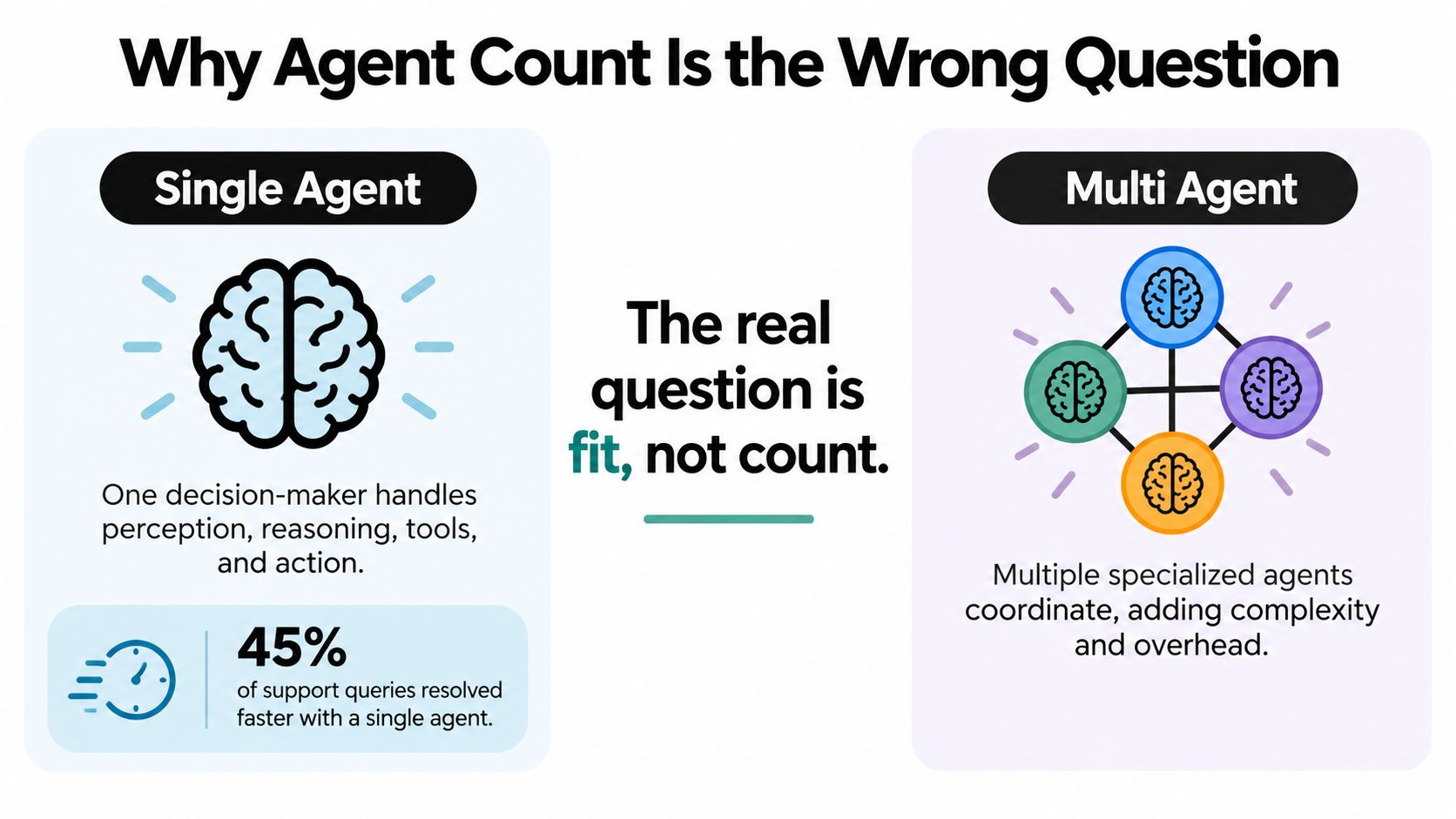
Fit matters more than novelty
Support teams often confuse specialization with improvement. A retrieval agent, policy agent, billing agent, and response agent may sound more capable than one support agent, but each additional role needs routing rules, shared state, permissions, validation, and failure handling. Those mechanisms consume time and resources even when the customer asks a straightforward question.
A single agent is usually the right starting point for account questions, product guidance, and troubleshooting that follow one evolving conversation. A multi-agent design earns consideration when the request naturally separates into independent checks, such as billing verification, order lookup, and fraud screening.
Practical rule: Add an agent only when you can name the independent task it owns, the input it receives, the output it must produce, and the measurable failure it prevents.
Teams evaluating practical automation use cases can also review AI tools for property managers to see how domain-specific workflows differ from general support conversations. For the broader distinction between generative and agentic systems, this comparison of generative AI and agentic AI provides useful context.
What Each Architecture Actually Is
A single-agent system puts perception, reasoning, tool use, memory, and action behind one decision-maker. The agent receives the customer's message, retrieves relevant information, decides which tool to call, interprets the result, and produces the response within one coordinated context.
That design has an important advantage: the agent can see the conversation as one continuous problem. If a customer first reports a failed login, then explains that the password reset email never arrived, then asks whether the account is locked, the same reasoning path can connect those details. The system has fewer handoffs to manage and fewer intermediate messages to validate.
A multi-agent system distributes responsibility across specialized agents. One agent might retrieve account information, another might check policy, another might troubleshoot the product, and a final agent might verify and write the response. An orchestrator assigns tasks, collects results, manages shared state, and resolves conflicts.
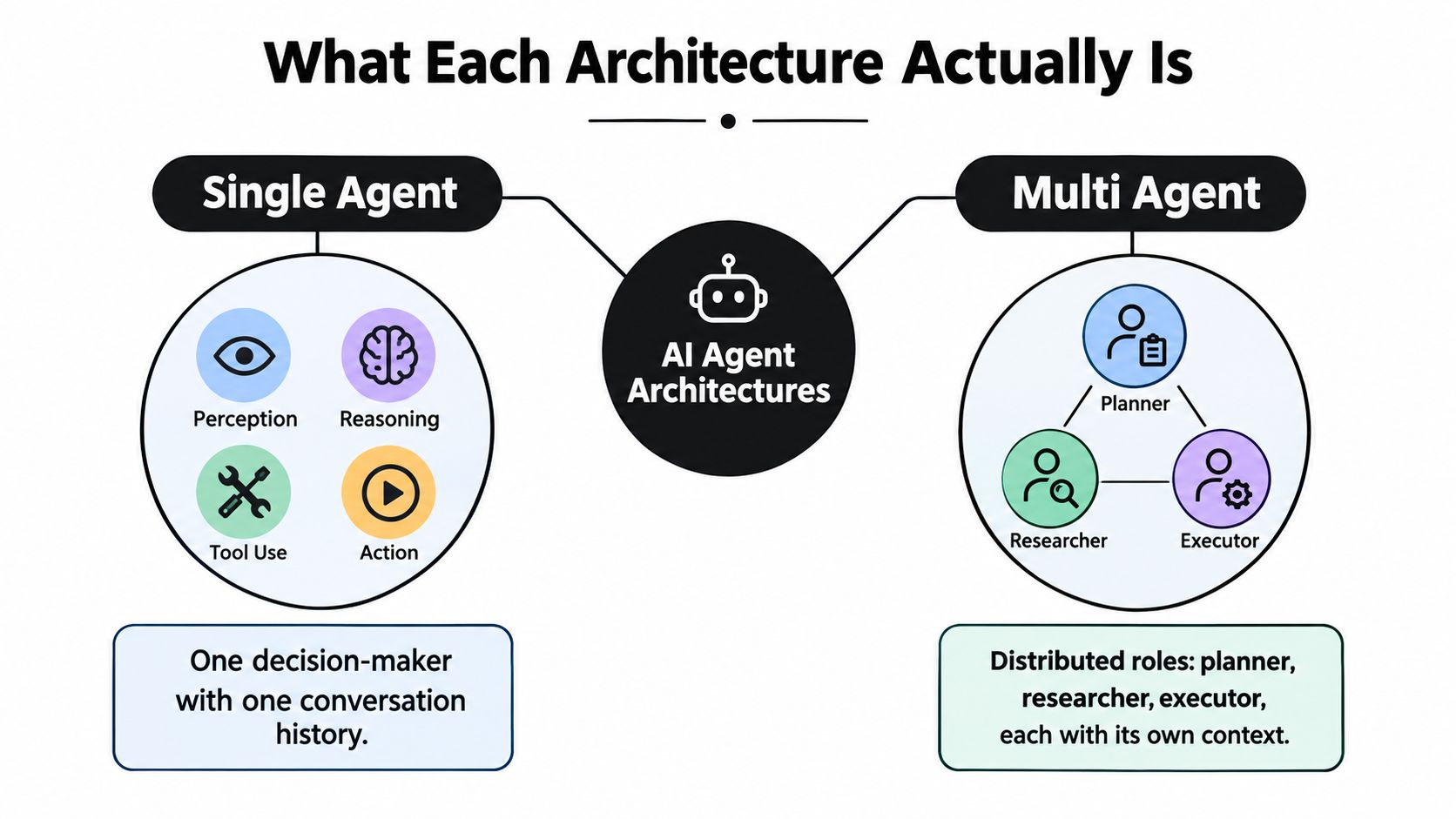
The coordination layer is the real difference
The second architecture doesn't just divide one agent into several smaller agents. It adds a system around them:
- Task allocation decides which specialist should act.
- Communication protocols define how agents exchange information.
- Shared state preserves the facts needed across handoffs.
- Conflict resolution handles contradictory recommendations.
- Verification checks whether intermediate results are safe to use.
- Escalation determines when a human must take over.
This pattern has deep roots. Multi-agent AI traces back to Distributed Artificial Intelligence research, including the first DAI workshop at MIT in 1980, where researchers examined how multiple autonomous problem solvers could coordinate on problems such as distributed scheduling and robotic coordination, as described in the historical overview of DAI research.
The same distinction appears in commercial workflows. A single support agent might answer a product question from one knowledge base. A multi-agent commerce workflow might retrieve product data, check inventory, apply a promotion rule, confirm payment status, and then assemble a response. Readers exploring that broader pattern can consult PlatformDTC's explanation of agentic commerce.
The multi-agent approach can improve modularity and parallelism, but it also creates more system behavior to test. A single agent concentrates risk in one reasoning path. A multi-agent system distributes responsibilities while increasing the number of interactions that can fail.
Performance, Cost, and Governance Compared
Accuracy is only one production metric. A design that wins a benchmark but doubles latency, duplicates context, complicates permissions, and makes incidents hard to investigate may deliver negative business value.
The strongest evidence comes from tasks with different structures. On the Finance-Agent benchmark, centralized multi-agent coordination improved performance from 34.9% to 63.1%. On the sequential PlanCraft benchmark, every tested multi-agent variant underperformed the single-agent baseline by 39% to 70%, according to Google's analysis of scaling agent systems.
Accuracy follows workflow structure
Financial analysis can split into parallel investigations. Different specialists can examine separate evidence, then a coordinating layer can combine the results. Sequential planning works differently. Each step depends on the previous state, so delegation can add messages and opportunities for error without creating useful parallel work.
That difference matters for support. A customer asking for an order status and a refund policy may benefit from separate lookups. A customer describing a complicated account problem over several conversational turns may be better served by one agent that maintains the complete context.
Cost and latency are architectural outcomes
Multi-agent systems make multiple model calls, pass context between roles, and often invoke more tools. Even when each individual call is small, duplicated instructions and intermediate results can increase total token consumption. Parallel execution may reduce elapsed time for independent tasks, but orchestration can also serialize work through planning and verification steps.
A single agent usually offers a more predictable cost pattern. Its weaknesses are easier to isolate because the execution path is centralized. That makes it simpler to set budgets, reproduce failures, and identify whether retrieval, tool selection, or response generation caused the problem.
Governance favors explicit boundaries
Multi-agent systems can create useful permission boundaries, but those boundaries don't appear automatically. Each specialist needs a defined scope, access policy, output contract, and audit trail. The orchestrator must prevent one agent from treating another agent's unverified text as authoritative.
Governance also affects return on investment. Deloitte found that 14% of surveyed organizations had agentic solutions ready for deployment, while 11% were actively using them in production. KPMG reported that 82% of leaders expected risk management to be the biggest challenge for their generative-AI strategies in 2025, as summarized in Deloitte's agentic AI strategy coverage. Those figures reinforce a practical point: production readiness depends on controls, not just capability.
Teams should assess enterprise AI governance alongside answer quality. A single agent with strict retrieval boundaries, deterministic tools, monitoring, and human escalation can beat a loosely coordinated group when auditability and recovery matter.
Mapping Request Types to the Right Architecture
Support requests vary less by industry label than by workflow shape. The decisive properties are whether the work can run independently, whether the customer needs an immediate answer, and whether the team must explain every decision.
| Request type | Decomposable | Latency sensitive | Audit sensitive | Recommended architecture |
|---|---|---|---|---|
| Account access question | No | Yes | Moderate | Single agent |
| Product troubleshooting | Usually no | Yes | Moderate | Single agent |
| Policy lookup | Sometimes | Yes | High | Single agent with controlled retrieval |
| Billing dispute | Partly | Moderate | High | Hybrid, with deterministic billing tools |
| Order status and delivery lookup | Yes | Yes | Moderate | Single agent or selective specialist |
| Fraud screening | Yes | Moderate | High | Multi-agent with centralized verification |
| Cross-system account investigation | Yes | Moderate | High | Hybrid orchestration |
The matrix points to a clear default. Sequential, conversational, latency-sensitive work belongs to a single agent. Independent checks with separate data domains can justify specialized agents, but the final answer still needs centralized verification.
A hybrid design often works best when the request contains both patterns. One primary agent can interpret the customer's intent, call a billing or fraud specialist only when required, and remain responsible for the final explanation. That approach avoids turning every conversation into a distributed workflow.
Routing can also happen before orchestration. A skill-based system may send billing conversations to a controlled workflow and product questions to a general support agent. Skill-based routing is useful when the team can identify stable request categories before deciding whether each category needs one agent or several.
Don't use multi-agent architecture to compensate for poor retrieval, unclear policies, or weak tool contracts. Those problems remain after adding specialists, and coordination may make them harder to diagnose.
Three Real Scenarios for SaaS and Ecommerce Teams
A SaaS startup with mostly account and feature questions should run a single agent first. The support workflow is usually conversational: identify the customer, retrieve the relevant product documentation, explain the next step, and escalate when the request exceeds the knowledge boundary.
The architecture should use strong retrieval, clear escalation rules, and deterministic actions for sensitive account changes. A platform such as SupportGPT can support that operating model through trained knowledge sources, natural-language escalation rules, analytics, and AI Actions. The important choice isn't the number of agents. It's whether the team can observe unanswered questions and improve the one workflow before splitting it apart.

Ecommerce marketplace with independent workstreams
An online marketplace has a different shape. A customer may ask about a delayed order, a refund, and suspicious account activity in the same interaction. Order status, billing records, delivery information, and fraud signals may live in separate systems and require different access rules.
A centralized multi-agent design can make sense here. The order agent retrieves fulfillment data, the billing specialist checks transaction state, and the fraud workflow evaluates risk signals. The orchestrator should merge those outputs, verify contradictions, and give one clear answer. Parallel work creates value only when the system preserves traceability and prevents one unverified result from driving the response.
Model capability still matters. On four visual-math benchmarks, multi-agent pipelines improved Qwen-2.5-VL 7B by 6.8 percentage points on Geometry3K, while Gemini-2.0-Flash generally performed better in single-agent mode on classic benchmarks, according to the visual-math evaluation. The lesson for support teams is straightforward: test the architecture with the model and workload you plan to operate.
Regulated enterprise with sensitive data
A regulated enterprise should default to one agent with restricted retrieval, deterministic tools, complete logging, and human escalation. Additional agents can multiply permissions, intermediate data exposure, and investigation paths without improving the customer outcome.
Use specialist components only where the boundary has a clear compliance purpose or where independent processing is measurable. The final response should pass through a controlled verifier, and the system should preserve enough evidence for a reviewer to understand why the answer was produced.
From Distributed AI Research to 2026 Support Stacks
The architectural argument is older than modern language models. Distributed Artificial Intelligence research examined how multiple autonomous problem solvers could coordinate when information, authority, and decisions were spread across locations or organizational units. That setting naturally favored specialization and communication.
Modern support stacks use different tools, but the design tension remains. A single agent centralizes perception, reasoning, tools, and action. A multi-agent system distributes those responsibilities and accepts coordination overhead in exchange for modularity or parallel execution.
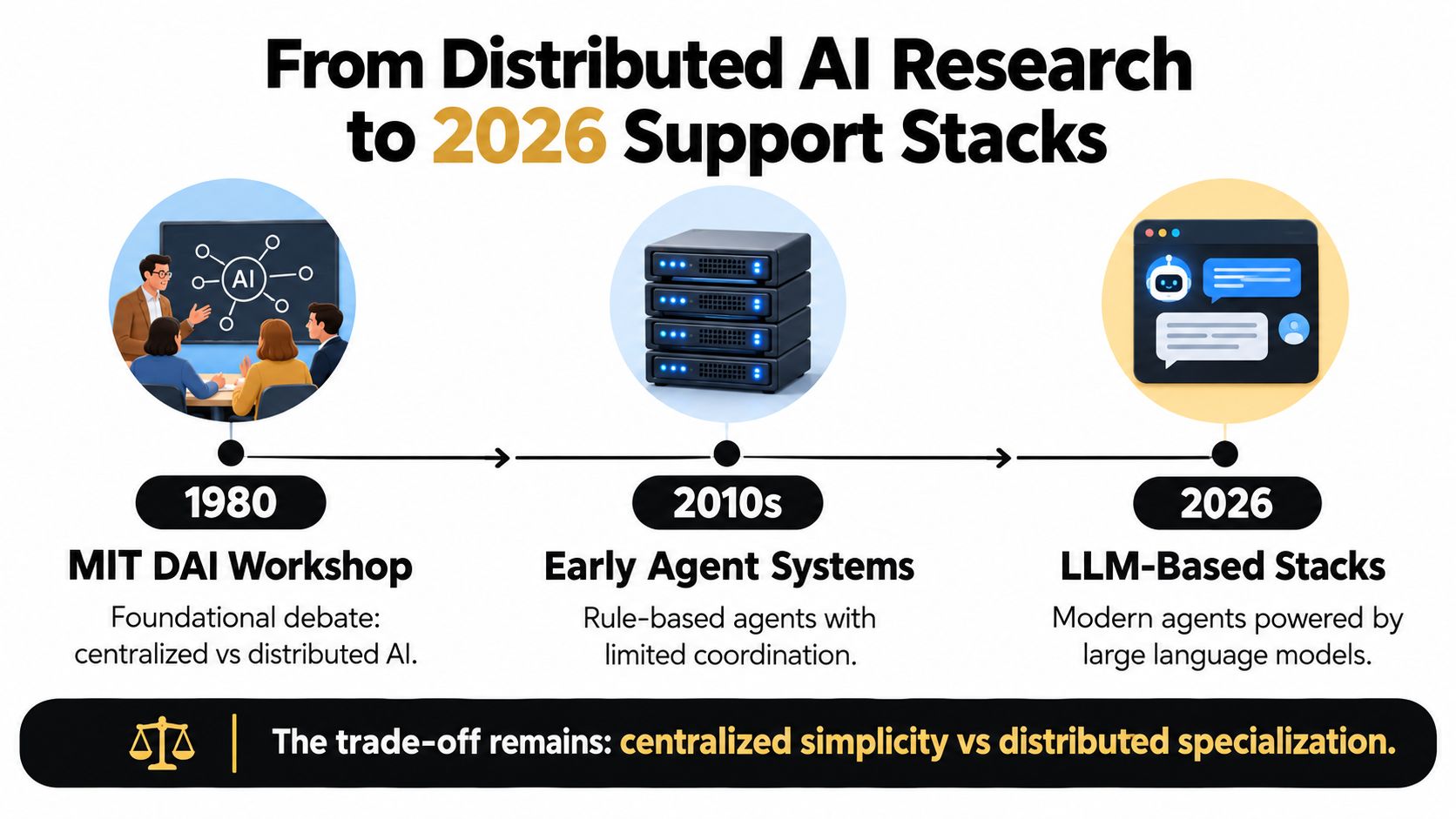
The old trade-off has better measurement now
The current evidence makes the trade-off easier to evaluate. The 2026 controlled research did not show that multi-agent systems win by default. It showed that performance depends on task structure, baseline capability, coordination design, and compute limits.
That changes how architects should discuss the decision. “Multi-agent” isn't a maturity level, and “single agent” isn't an admission that the team lacks ambition. The right design is the one that produces a reliable outcome with an acceptable failure surface and operating cost.
Teams hiring for these systems need people who understand workflow decomposition, tool contracts, evaluation, permissions, and incident response. A practical guide for hiring AI engineers can help hiring managers assess those skills without treating framework familiarity as architectural judgment.
The research lineage matters because it prevents a common mistake. Today's orchestration tools make it easier to create agent networks, but they don't remove the underlying coordination problem. Better tooling gives teams more control. It doesn't make every workflow distributable.
Decision Criteria and Monitoring Baseline You Can Use Today
Use a measurable selection rule:
Start with one agent. Add specialists only when the workflow contains independent tasks, the baseline fails for a known reason, and the added coordination produces a measurable improvement.
That rule keeps architecture tied to evidence. First identify the top request types, map their tool calls and dependencies, and measure how one agent performs under realistic conditions. Then test a narrowly scoped specialist rather than redesigning the whole support stack at once.
Your baseline should include the following:
- Task success: Did the system complete the customer's actual request, not merely produce a plausible answer?
- Containment rate: Did the customer receive a satisfactory resolution without unnecessary human intervention?
- Hallucination rate: How often did the system state unsupported information or misuse retrieved context?
- Escalation accuracy: Did the system transfer the conversations that required human judgment while retaining those it could safely resolve?
- Cost per resolved conversation: Include model calls, tool calls, retrieval, verification, and coordination overhead.
- Incident-recovery time: How quickly can the team identify the failure, restore safe behavior, and explain what happened?
Benchmarking should compare architectures under equivalent requests, tools, model access, and operational constraints. Performance benchmarking for AI support offers a useful frame for making those comparisons systematic.
Measure the failure surface, not just the answer
A multi-agent system may improve coverage while making failures harder to attribute. Track which agent made each decision, what context it received, which tools it called, and whether a later agent accepted or changed its result.
A single agent has a different risk profile. It may lack specialist depth, but its behavior is easier to inspect and constrain. Teams should test retrieval boundaries, tool permissions, refusal behavior, escalation rules, and recovery procedures before expanding the system.
Architecture reviews should also include ownership. Someone must be accountable for the orchestrator, each specialist, shared state, evaluation data, and production incidents. If nobody owns those boundaries, the multi-agent design will become an expensive collection of prompts rather than a dependable support system.
Quick Answers and First Step
When is a single agent the right default?
Use one agent for routine FAQ, account, product, and troubleshooting requests that depend on one evolving conversation. It's the better default when latency, consistency, auditability, and predictable cost matter more than parallel specialization.
How should you estimate the cost difference?
Count every model call, tool call, retrieval step, duplicated context, verification pass, and orchestration message. Compare the total cost per resolved conversation, not the price of one response. A multi-agent workflow can be worthwhile when it prevents expensive failures or handles independent work in parallel, but the benefit must appear in production metrics.
When does multi-agent architecture make sense?
Use it when the request can split into independent workstreams, specialists need distinct permissions, or separate domains must be investigated at the same time. Keep a central verifier responsible for the final answer.
Which metrics should you track first?
Start with task success, containment, hallucination rate, escalation accuracy, cost per resolved conversation, latency, and incident-recovery time. Add agent-level tracing when the workflow becomes distributed.
The first step is concrete: run a one-week single-agent baseline against your top five request types. Record outcomes, tool usage, escalations, cost, and failure reasons. Only then test a specialist on the workflow that shows a genuine decomposition problem.
SupportGPT lets teams build and operate AI support agents with custom knowledge sources, escalation rules, analytics, AI Actions, and website deployment. Use SupportGPT to establish a measurable single-agent baseline first, then decide whether selected workflows justify a multi-agent design.