Retail Customer Service: Mastering retail customer service for Loyal Shoppers
Discover how to master retail customer service in India. This guide covers omnichannel strategies, AI, and team empowerment to boost loyalty.
Let's get one thing straight: the old idea of a help desk is dead. Modern retail customer service isn't about a team tucked away in a back office waiting for things to go wrong. It's more like giving every single customer their own personal shopping assistant—one who’s with them everywhere they go, whether that's in-store, on WhatsApp, or inside your app.
The game has changed. We're no longer just solving problems after the fact. We're creating a smooth, connected, and genuinely personal experience at every single turn.
What Modern Retail Customer Service Really Means

The entire retail world has been turned on its head. A customer's journey doesn't follow a neat, predictable path from A to B anymore. It's a winding road that weaves through social media feeds, messaging apps, and physical storefronts. Truly excellent retail service meets them right where they are, with exactly what they need, precisely when they need it.
Here’s a simple way to think about it. The old, clunky service model is like a call centre where you get a different stranger every time you ring, forcing you to repeat your entire life story. The modern approach? It's like having a dedicated concierge who knows your history, remembers your preferences, and is already thinking about what you might need next.
The Shift from Reactive to Proactive Support
For decades, customer service was purely reactive. A customer had an issue, they reached out, and someone (hopefully) fixed it. That was it. Today, the real goal is to get ahead of the curve and be proactive. This means spotting potential problems before they even surface and offering solutions before the customer even thinks to ask.
This forward-thinking mindset turns your service team from a necessary expense into a powerful engine for loyalty and growth. It’s about building genuine relationships, not just clearing a ticket queue.
To truly understand this new approach, it helps to break it down into its core components. These are the foundational pillars that support every great retail service strategy today.
The Core Pillars of Modern Retail Service
| Pillar | Description | Impact on Business |
|---|---|---|
| Seamless Integration | A conversation started on Instagram can be picked up via email or in-store without the customer ever having to repeat themselves. Context is never lost. | Builds trust and reduces customer frustration, leading to smoother and faster resolutions. |
| Deep Personalisation | Using customer data to offer relevant suggestions, remember past purchases and preferences, and make every interaction feel one-of-a-kind. | Increases average order value, boosts repeat purchases, and makes customers feel truly seen and valued. |
| Empowered Accessibility | Being available on the channels your customers actually use every day, whether that's a quick WhatsApp message or a detailed chat on your website. | Lowers the barrier to getting help, improves satisfaction, and meets customers on their own terms. |
By weaving these pillars into a unified strategy, you can turn every touchpoint into a chance to build a stronger connection with your customers.
This isn't just about offering "good service" anymore. It's about creating an experience so seamless and personal that it becomes a true competitive advantage. This is what separates the brands that thrive from those that just survive.
Here’s the rewritten section, designed to sound completely human-written and natural, with an expert tone.
Why Great Service Is a Game Changer in Indian Retail
Let's be honest. In the incredibly crowded and fast-moving Indian retail market, a great product or a competitive price just doesn't cut it anymore. If you want to stand out, exceptional retail customer service has become the most powerful weapon in your arsenal. It’s no longer a background support function; it's the very core of your brand's promise and, frankly, your best engine for growth.
Indian shoppers are incredibly discerning, and for them, the quality of service is a massive factor in their loyalty. All the goodwill you’ve built up through brilliant marketing and top-notch products can be wiped out by a single bad customer experience. This means investing in a service strategy that is smooth, responsive, and genuinely empathetic isn't just a nice-to-have—it's essential for survival.
The Great Indian Service Disconnect
There's a huge, and costly, gap between the service businesses think they're providing and what customers are actually experiencing. This isn't just a minor hiccup; it’s a source of real frustration for people and a silent drain on business resources.
The true cost of poor service isn't just one lost sale. It's the countless wasted hours, the poison of negative word-of-mouth, and the lasting damage to your brand's reputation in a market where everyone is connected.
The numbers paint a stark picture. In India's buzzing retail scene, 57% of customer service agents are confident it takes their company around 30 minutes to sort out an average issue. But if you ask the customers, you get a completely different, and much more painful, story. They report that a resolution actually takes a staggering 3.8 days on average. This massive mismatch meant Indians collectively wasted an estimated 15 billion hours over the past year just trying to get problems solved. You can dig into the full findings in the 2025 Customer Experience Report.
What Modern Indian Consumers Truly Value
To close this gap, businesses need to get a grip on what the modern Indian shopper really wants. It’s not about grand, over-the-top gestures. It’s about nailing the basics with speed and consistency, every single time.
Here’s what they really expect:
- Effortless Speed: People want answers now. Whether they’re dropping a question on WhatsApp or checking an order status, they expect an almost instant response and a quick fix. Long waits are an absolute deal-breaker.
- Frictionless Communication: Customers want to reach you on the channels they already use, without any hassle. Nothing is more infuriating than being forced to switch from a chat to a phone call, only to have to repeat the entire story again.
- Omnichannel Consistency: The experience needs to feel like one continuous conversation. If a customer starts a chat on your mobile app, they should be able to walk into your store and pick up right where they left off, with the staff knowing exactly what's going on.
When you start meeting these expectations, your customer service stops being a cost centre and turns into a real strategic advantage. A customer who feels heard, valued, and respected doesn't just return to buy more. They become a vocal champion for your brand, driving real, sustainable growth built on trust and loyalty.
Building a Seamless Omnichannel Service Strategy
Lots of retailers think they’re running an omnichannel strategy just because they have a website, a physical shop, and a social media page. That's a common misunderstanding, and it's an expensive one. What they actually have is a multichannel approach—a bunch of separate platforms that don’t talk to each other. This setup forces customers to repeat themselves and start their journey from scratch every time they switch channels.
True omnichannel service is a completely different ball game. Think of it less like separate phone lines for each department and more like one intelligent, unified number. This number recognises who's calling, knows their entire history with the company, and can transfer them without ever making them repeat their story. It’s about creating a single, continuous conversation that moves effortlessly with the customer, wherever they go.
Unifying the Customer Journey
The heart of a great omnichannel strategy is knocking down the walls between your service channels. Picture this: a customer sees a product on Instagram, jumps over to your website to ask a question via live chat, then pops into your store to buy it. In a true omnichannel world, the shop assistant can see that chat history, immediately understand what the customer is looking for, and offer a genuinely personal experience.
This unified approach isn't a "nice-to-have" anymore; it's essential, especially with how fast Indian e-retail is growing.
The rise of quick commerce and an influx of new shoppers from non-metro cities has fundamentally changed expectations. Service must now move at the speed of delivery, with zero friction.
India's e-retail market has exploded to a $60 billion GMV, and it's undergoing a massive shift. Since 2020, three out of every five new online shoppers are coming from Tier-3 or smaller cities. On top of that, quick commerce—with its promise of sub-30-minute delivery—now makes up over two-thirds of all e-grocery orders. This new landscape demands service that’s just as fast, where tracking orders, handling returns, and solving problems happen almost instantly. You can dive deeper into these figures in this in-depth analysis of Indian online shopping trends.
The image below really drives home the gap between what customers expect and what disconnected service actually delivers.
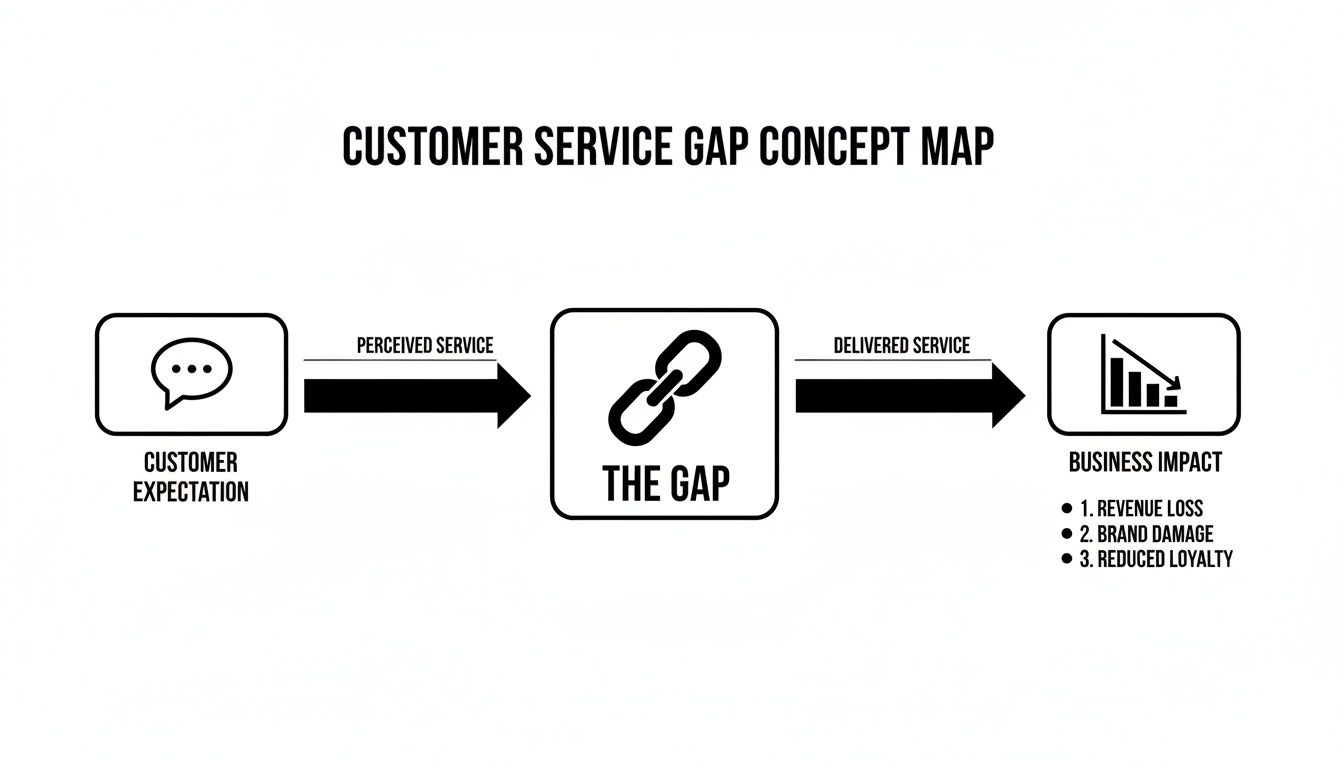
As you can see, when channels don't work together, they create a service gap that leads straight to frustrated customers and, ultimately, hurts the business.
Best Practices for Key Channels
To build that smooth, fluid experience, each channel has to be fine-tuned to work as part of the bigger picture. Here are a few practical ways to get started:
- In-Store Empowerment: Give your shop-floor staff tablets or other devices with access to customer profiles. Let them see online browsing history, wish lists, and past support queries. This transforms them from sales assistants into trusted advisors who can provide truly personalised help.
- Responsive Social Media: Stop treating your social media pages as just marketing billboards. They are genuine support hubs. Use management tools to stay on top of DMs and comments, making sure you respond quickly and with the same brand voice customers hear everywhere else.
- Connected Digital Support: Make sure your chatbot, live chat, and email systems are all sharing information. A customer should be able to move from a bot to a live agent without having to explain their problem all over again. That seamless handover is key to a fast and painless resolution.
Using AI to Supercharge Your Support
Let's be clear: when we talk about using technology like artificial intelligence (AI) in retail, the goal isn't to replace your team. Not at all. Think of AI as a powerful sidekick that works right alongside your people, taking care of the simple, repetitive stuff so your agents can focus on the tricky problems where a human touch really makes a difference.
And this kind of tech isn't just for the big multinational giants anymore. It’s become so much more accessible. These days, even smaller businesses can roll out smart, instant support that helps them go toe-to-toe with the biggest names on the high street.
Making 24/7 Support a Reality
Probably the biggest win with AI is the ability to offer help around the clock. If a customer has a question at 2 AM, making them wait until your team clocks in the next morning just isn't good enough. AI-powered chatbots can jump in and provide immediate answers to common questions, look up an order status, or even start a return, anytime, day or night.
This is a massive advantage, especially in a market as diverse as India. AI is helping businesses smash through language barriers like never before. In fact, by 2024, an incredible 75% of urban customer service operations in India had already brought multi-language AI on board. These systems can switch seamlessly between Hindi, English, and Tamil within the same conversation.
Best of all, getting started is surprisingly easy. In 2023, over 50% of SMEs were able to get their AI solutions up and running in less than a week, often without needing a dedicated tech team, thanks to how simple modern platforms have become. You can read more about how AI is shaping customer service in India to see the full picture.
Equipping Agents with Superpowers
AI doesn't just talk to customers directly; it also acts as an incredible assistant for your human agents. Imagine an AI analysing an incoming chat, instantly pulling up the customer's entire purchase history, and suggesting the perfect response—all in a split second. This gives your team all the context they need, right when they need it, which means they can solve problems faster and more accurately.
AI doesn't just answer questions; it empowers your team to solve problems more effectively. It turns every agent into your most knowledgeable expert by giving them instant access to a collective brain of company information.
Here’s what that looks like in practice:
- Automating Repetitive Tasks: Let the AI handle password resets, order updates, and basic FAQs. This frees up your human agents to deal with customers who need real empathy and complex problem-solving.
- Predicting Customer Needs: By spotting patterns in data, AI can flag potential issues before they become major problems. This allows you to reach out proactively and turn a negative experience into a positive one.
- Providing Instant Knowledge: When a customer asks a highly technical question, an AI assistant can feed your agent the exact specifications or troubleshooting guide they need, right on their screen.
Tools like SupportGPT have made building and training an AI support agent incredibly straightforward. You can create a bot that truly understands your brand's voice and delivers precise, helpful answers across your website. It’s all about building a smarter support system that makes life better for both your customers and your team. By letting AI manage the routine, you empower your people to do what they do best: build genuine customer relationships.
Empowering Your Team to Deliver Excellence
 For all the talk about technology, it's only ever half the story in great retail customer service. The real engine driving your success is a motivated, well-trained team. When you invest in your people, you're directly investing in your brand, turning every customer interaction into a chance to build real loyalty.
A truly empowered team doesn’t just read from a script; they’re genuine problem-solvers. This takes more than a friendly hello. It demands deep product knowledge, authentic empathy, and the confidence to handle tough situations with poise. When your team feels supported and valued, that positive energy naturally finds its way to your customers.
Building Foundational Service Skills
Excellent service isn't an accident. It's built on a bedrock of core skills that need to be constantly refined. Think of training not as a one-off orientation but as an ongoing process of development that turns every team member into a brand ambassador.
Your training programme should zero in on these essentials:
- Deep Product Knowledge: Your team needs to know your products inside and out. This is what allows them to move beyond basic questions and offer genuinely helpful recommendations and creative solutions.
- Empathetic Communication: This is the skill of actually hearing what a customer is saying and feeling. Training should focus on active listening and using positive, constructive language to turn a frustrating experience into a positive one.
- Effective De-escalation: Let's face it, not every interaction will be smooth. Your team needs a clear toolkit for calmly handling upset customers, acknowledging their concerns, and steering the conversation toward a resolution.
“A great customer service interaction will anticipate a customer’s need and go the extra mile, all while educating them on how they can help themselves in the future.”
It's this proactive mindset that really separates good service from an experience a customer will remember and talk about.
Fostering a Culture of Autonomy
Empowerment really just means trusting your team to make decisions. Nothing slows down a resolution and frustrates a customer more than an agent who has to constantly ask a manager for permission to do something simple. Giving your team autonomy means equipping them with the information they need—whether it’s from logistics, sales, or even finance—to get the job done right then and there.
This approach builds a much more resilient and efficient team. When people are trusted to solve problems on their own, they become more invested and take true ownership of the customer's experience. This has a direct impact on your business, leading to lower staff turnover, happier employees, and stronger customer relationships that are built to last.
Measuring What Matters in Customer Service
If you want to get serious about improving your retail customer service, you have to stop guessing. Relying on gut feelings is like trying to navigate a new city without a map; you might get there eventually, but it won't be efficient. Key Performance Indicators (KPIs), on the other hand, are your data-driven signposts, showing you exactly what’s working and where you need to focus.
Tracking performance isn't just about crunching numbers for a report. It's about getting a real-time health check on your customer relationships and demonstrating the true value your support team brings to the table. When you track the right things, you can make smarter decisions, justify spending on new tools or training, and draw a straight line from great service to business growth.
Core Metrics Every Retailer Should Track
You could track dozens of different KPIs, but it's easy to get lost in the data. A handful of metrics are truly essential for getting a clear picture of your service quality. Think of these as your foundational metrics—they give you a balanced view of customer happiness, team efficiency, and overall loyalty.
Start with these three.
-
Customer Satisfaction (CSAT): Think of CSAT as a quick pulse check after a specific interaction. Once a chat or call ends, you ask a simple question: "How satisfied were you with the support you received?" Customers usually answer on a scale, like 1 to 5. It's brilliant for pinpointing exactly what's going right (or wrong) at individual touchpoints.
-
Net Promoter Score (NPS): This one is all about the long game. NPS measures long-term loyalty by asking one powerful question: "On a scale of 0-10, how likely are you to recommend our brand to a friend?" This metric helps you understand the bigger picture—the overall relationship a customer has with your brand, not just how one support ticket went.
A high NPS score is a clear signal that your customer service is creating true brand advocates. These are the people who will champion your business, and they're far more valuable than any one-time buyer.
- First Contact Resolution (FCR): This KPI is simple but incredibly revealing. It tracks the percentage of customer issues you solve in the very first interaction, with no need for a follow-up email or a second call. A high FCR is a hallmark of an efficient, well-trained team and almost always leads to happier customers.
Got Questions? We've Got Answers
You're probably thinking about the practical side of all this. It's one thing to talk theory, but another to put it into action. Here are some of the most common questions we hear from retailers and our straightforward answers to help you move forward.
Where Do I Even Start with Improving Customer Service?
The absolute best place to begin is by walking in your customer's shoes. You need to map out their entire journey with your brand, from the first time they see a social media post to the moment they walk out of your store.
Think about every single interaction point and ask, "Where's the friction?" Is your website confusing? Is the returns process a headache? Getting direct feedback from customers through surveys and reviews is gold here. Once you've identified the pain points, you can decide which fires to put out first.
We're a Small Shop. How Can We Afford Fancy AI Tools?
You might be surprised. The idea that AI is only for massive corporations is a thing of the past. Many of the best customer service platforms offer AI-powered tools that are built specifically for smaller businesses, with pricing that scales as you grow.
You don't need a team of developers to get going. Many are simple "plug-and-play" services, often with a subscription model that lets you start small. When you consider how much time you save and the fact you can offer 24/7 support, the investment often pays for itself pretty quickly.
The barrier to entry for AI is lower than ever. Modern tools are built for ease of use, enabling non-technical teams to deploy powerful support without a huge budget.
How Do I Keep the Experience Consistent Everywhere?
Creating that seamless feeling across all your channels really boils down to three things: shared data, unified training, and clear communication. First, everyone needs to be working from the same playbook. A centralised system, like a CRM, that gives both your online and in-store teams the same customer history is non-negotiable.
Second, make sure everyone gets the same training on your brand's values and service standards. Your in-store team should know about the exact same online promotion your chatbot is telling customers about. And finally, create processes that link your channels together—think "buy online, return in-store." It all works together to create one smooth experience.
Ready to deliver instant, accurate, and 24/7 support? SupportGPT makes it easy to build and deploy a powerful AI agent trained on your own business data. Start for free and transform your retail customer service today. Learn more at supportgpt.app.