A Practical Guide to Omnichannel Customer Service
Discover how omnichannel customer service can transform your business. Learn to build a seamless strategy that boosts loyalty, reduces churn, and drives growth.
Ever had to repeat your entire problem to three different people at the same company? That's the exact frustration omnichannel customer service is designed to eliminate. It’s all about creating one single, continuous conversation that follows your customer wherever they go—from your website's chatbot to an email, or from a social media message to a phone call.
The goal is a seamless journey where the context and history travel with the customer. No more starting from scratch.
What Is Omnichannel Customer Service, Really?

Let's ditch the jargon. The easiest way to grasp omnichannel is to think about a conversation with a friend. You might start texting, switch to a call on your drive home, and then pick things up in person later. You never have to re-explain everything because the context is shared and travels with you. That's it.
Omnichannel support simply applies that natural, intuitive logic to your business. It’s a strategy focused on creating one unified customer journey, not just offering a bunch of disconnected ways to get in touch. So when a customer starts a query with an AI assistant on your website, that entire chat log is right there for the human agent who helps them later on a different channel.
This connected ecosystem is the crucial difference between a true omnichannel approach and a multichannel one, where you have lots of channels that don't talk to each other.
The Power of a Unified Journey
In any modern business—whether you’re in SaaS, e-commerce, or a large enterprise—your customers interact with you all over the place. They might see a social media ad, browse your site, and then hit up your chatbot with a question. After they buy, they might need help via email.
An omnichannel strategy pulls all of those touchpoints into a single, cohesive customer profile. This unified view gives your team the power to deliver support that’s both incredibly personal and brutally efficient.
At its core, omnichannel customer service is about recognizing that you aren't having ten different one-minute conversations. Instead, you're having one continuous ten-minute conversation that happens to span multiple channels.
This shift from a channel-first to a customer-first mindset has a huge impact. It builds trust, cuts down on the effort customers have to put in, and makes every interaction feel less like a transaction and more like a relationship. The results aren't just about making people happy; they hit the bottom line, hard.
Connecting Conversations to Business Growth
When the customer journey flows this smoothly, it creates a powerful flywheel for growth. Happier customers don't just stick around; they tend to spend more over their lifetime. This isn't just a hunch—the data is crystal clear.
Companies with strong omnichannel strategies see customer purchase rates that are 250% higher than those using just a single channel. On top of that, their average order value gets a 13% bump. As detailed in these omnichannel performance findings on WiserReview.com, a seamless experience across web, mobile, and social media keeps customers engaged and spending more.
It proves that investing in a truly connected experience is one of the most reliable ways to drive both retention and revenue.
Omnichannel vs. Multichannel: A Critical Distinction

It’s easy to get omnichannel and multichannel mixed up. People often use them interchangeably, but they represent two completely different philosophies when it comes to customer support. Getting this distinction right is the first real step toward building an experience that keeps customers, rather than losing them to frustration.
Many companies think they’re doing omnichannel just because they’re available on email, live chat, and the phone. But simply being present on multiple channels is the very definition of multichannel. It’s a strategy focused on the channels themselves, with each one operating in its own little world.
Think of a multichannel setup like a city with a bunch of one-way streets. A customer can drive down the “email street” or the “live chat street,” but those roads never intersect. If they need to switch, they’re forced to find their own way back to the beginning and start a brand-new journey, repeating every single detail along the way.
The Interconnected Highway Analogy
This is where omnichannel customer service flips the script. It’s a strategy built entirely around the customer. It’s not just about offering different roads; it's about designing an interconnected highway system where every channel is just an on-ramp to a single, continuous journey. The customer’s context—who they are, their purchase history, their past conversations—travels with them, no matter which ramp they take.
When a customer starts a chat with a bot and needs to merge into the "live agent" lane, their entire conversation history merges right along with them. No more starting from scratch. That continuity is the heart of a true omnichannel experience, and it’s what turns a series of disjointed interactions into one fluid conversation.
It's pretty shocking, but 56% of customers say they constantly have to repeat themselves to support agents. That’s a classic sign of a multichannel system trying to pass itself off as omnichannel. With a true omnichannel architecture, that repetition becomes a thing of the past.
This unified approach isn’t just better for the customer. It’s a game-changer for your agents, giving them the full picture so they can resolve issues faster and offer genuinely personal support.
Omnichannel vs. Multichannel Support At a Glance
To really nail down the difference, let's compare these two approaches side-by-side. The table below breaks down how they stack up in the areas that matter most, highlighting the fundamental shift from just being available to being truly integrated.
| Attribute | Multichannel Service | Omnichannel Customer Service |
|---|---|---|
| Customer Experience | Fragmented and repetitive. The customer has to do the heavy lifting to connect the dots between channels. | Seamless and continuous. The system remembers the context, so the customer never has to explain themselves twice. |
| Data Integration | Siloed. Data from email, chat, and phone calls are all stuck in separate systems, creating a blind spot. | Centralized. All interaction data flows into one customer profile, giving you a complete 360-degree view. |
| Agent Workflow | Inefficient and often frustrating. Agents work in the dark without context, leading to slower resolutions and guesswork. | Efficient and empowered. Agents see the full conversation history across all channels for quick, informed responses. |
| Business Goal | Channel presence. The focus is on being available on as many platforms as possible—a quantity-over-quality approach. | Customer centricity. The goal is to design a single, effortless customer journey that prioritizes the quality of the experience. |
Ultimately, this choice defines the kind of relationship you want to have with your customers. A multichannel approach might tick a box on a feature list, but an omnichannel customer service strategy builds genuine loyalty by showing customers you respect their time and remember their history with you.
The Real Business Case for an Omnichannel Strategy
It's one thing to know the difference between multichannel and omnichannel, but it's another thing entirely to see how that difference hits your bottom line. An omnichannel customer service strategy isn't just a "nice-to-have" for a smoother customer journey. It’s a direct investment in the core metrics that fuel real, sustainable growth.
Think about it: when conversations are siloed and broken, customers get frustrated. And frustrated customers churn. By weaving all those conversations together into a single thread, you're not just smoothing over a few rough patches; you're attacking the root cause of that frustration and turning your support team into a powerful retention engine.
Slashing Customer Churn and Boosting Lifetime Value
The first and most powerful impact you’ll see is on customer loyalty. When a customer doesn't have to explain their problem for the third time to a third person, they feel seen and respected. That simple feeling of being understood is often the deciding factor that keeps them from jumping ship to a competitor.
This boost in retention naturally snowballs into a higher customer lifetime value (LTV). A unified customer profile does more than just help your team solve problems faster. It gives them the context they need to be proactive. An agent can instantly see a customer's entire purchase history and past support tickets, which means they can offer a relevant upsell or a well-timed loyalty discount that actually makes sense.
The link between seamless support and revenue is crystal clear. Companies that get omnichannel right see a 5-15% increase in total revenue and a major lift in customer loyalty.
Suddenly, your support team isn't just a cost center anymore. They become a revenue driver. Every interaction becomes smarter and more personal, building the kind of relationships that convince customers to stick around longer and spend more.
Driving Operational Efficiency and Competitive Advantage
An omnichannel approach doesn't just benefit your customers; it creates massive efficiencies for your internal teams. When agents have a single, unified view of every customer's journey, they stop wasting time digging for information across ten different tabs and can focus on what they do best: solving problems.
This single pane of glass directly improves the key performance indicators (KPIs) that matter most to your operations.
- Reduced First-Resolution Times: With the full story right in front of them, agents can nail the solution on the first try far more often.
- Lower Average Handle Time: Agents move quicker because they aren't forced to ask customers to repeat information they already gave to a chatbot or another agent.
- Decreased Cost Per Contact: More efficiency means you can handle a higher volume of inquiries without having to constantly expand your headcount.
Today's customers bounce between an average of nine different channels when talking to a brand. This shift to omnichannel customer service has completely reset expectations, yet a staggering 84% of CX leaders admit their support channels aren't properly connected. As highlighted in these customer service statistics on Trengo.com, this integration gap is a huge problem, with 81% of brands agreeing that a single source of truth would drastically improve their customer experience.
That gap—between what customers expect and what most businesses deliver—is your opportunity. It's your competitive advantage, just waiting for you to seize it.
Building Your Omnichannel Architecture From the Ground Up
Moving to a true omnichannel customer service model isn't like flipping a switch. It’s more like laying a foundation, piece by piece. This takes a deliberate, phased approach that rebuilds your entire support structure around the customer, not just around individual channels. The end goal is to create one seamless system where information flows just as easily as the customer does.
It sounds complex, but breaking it down into a clear roadmap makes it manageable. You start by seeing the world through your customer's eyes and end with a system that's built to constantly get better.
Phase 1: Map the Complete Customer Journey
Before you build anything, you need a blueprint. Your first step is to meticulously map out every single touchpoint a customer has with your brand. Don't just think about support tickets. This includes the pre-sales questions they ask on social media, how they browse your website, and any follow-ups after they buy.
Ask yourself some tough questions at this stage:
- Where do people first hear about us?
- Which channels do they use to ask questions before becoming a customer?
- How do they prefer to get help after a purchase—chatbot, email, phone?
- Where do they get stuck or experience the most friction?
This exercise will show you the natural paths your customers take. More importantly, it shines a light on the exact moments where a disconnected experience is likely to cause frustration. The insights you gather here will tell you exactly which channels to prioritize and how to link them together.
The flow chart below shows the core business goals that drive this kind of architectural shift—slashing churn, growing LTV, and boosting overall efficiency.
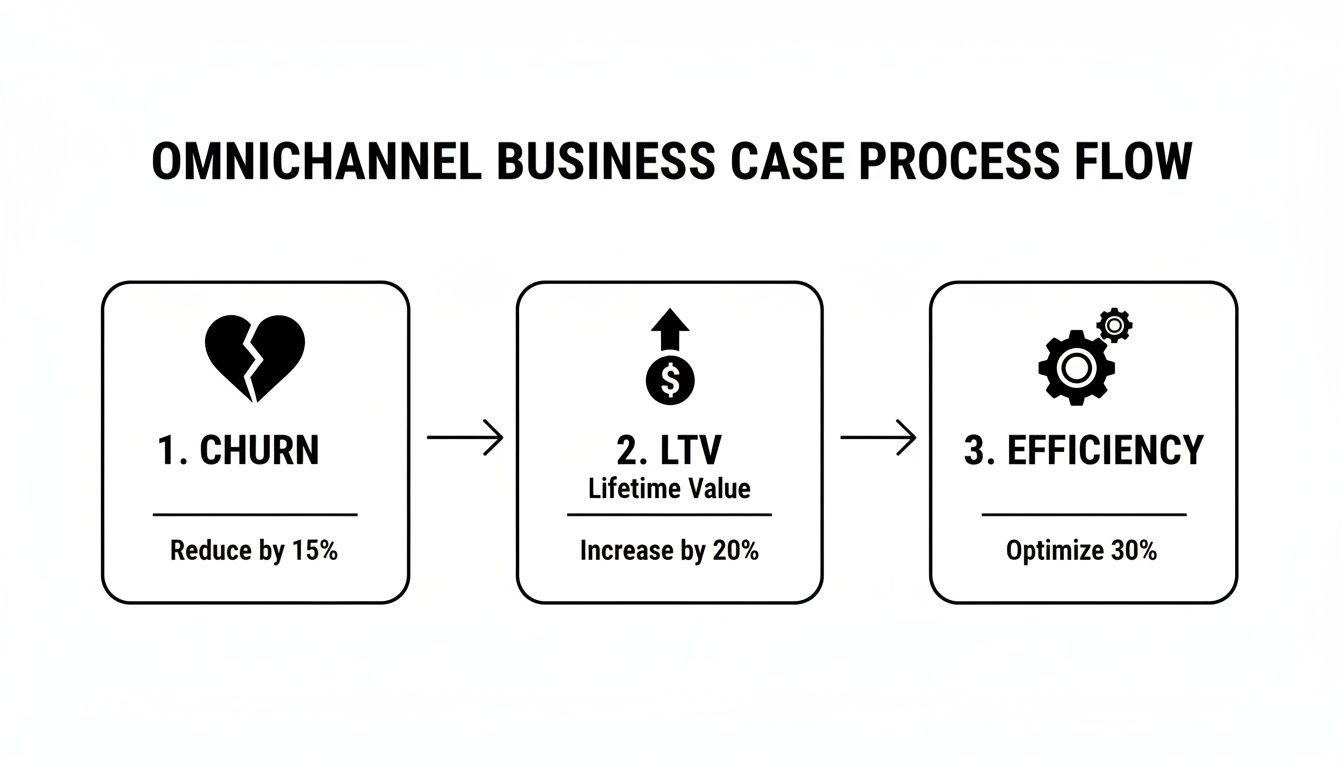
Every piece of your architecture should directly feed these goals, effectively turning your support department into a growth engine.
Phase 2: Select a Centralized Platform
Once you understand the customer's journey, you need a central hub to manage it all. This is single-handedly the most important decision you'll make. A centralized platform acts as your "single source of truth," pulling every interaction from every channel into one unified customer profile.
Without this hub, you're not building an omnichannel system; you're just managing a more complicated multichannel mess. The right platform breaks down data silos and gives agents a 360-degree view of the customer's entire history. When a customer moves from a chatbot to a live agent, the context moves right along with them. Platforms like SupportGPT are designed for exactly this, bringing conversations from your website and other digital spots into one clean dashboard.
Phase 3: Integrate and Unify Key Channels
With your central platform chosen, it’s time to connect the dots. Start by integrating the channels your journey map flagged as most critical—the ones with high traffic or high impact. This usually includes:
- Website Live Chat: Often the first stop for quick questions.
- Email Support: A classic for detailed or less urgent issues.
- Social Media Messaging: For public questions and brand interactions.
- Phone Support: The go-to for complex or sensitive problems that need a human touch.
The keyword here is integration, not just presence. Each channel has to feed directly into your central platform. This is what ensures a conversation that started on Twitter can be picked up seamlessly over email without the customer having to repeat a single word.
Think about this: only 13% of businesses actually carry customer context across all their channels. Getting this step right immediately catapults you into the top tier of customer experience providers and gives you a serious competitive edge.
Phase 4: Deploy AI for Frontline Support
Now you can bring in automation to handle the volume and make your team more efficient. Deploy an AI assistant on your website and other busy digital channels. Its job is to provide instant answers to common, repetitive questions, freeing up your human agents to focus on the complex, high-value interactions that truly need their expertise.
A good AI assistant should be trained on your specific knowledge base, FAQs, and product guides to make sure its answers are spot-on. Modern AI platforms let you build and deploy a capable frontline agent in minutes, no deep technical skills required. This step alone can tackle a huge chunk of your inbound questions, dramatically improving response times for everyone.
Phase 5: Define Smart Routing and Escalation Paths
AI can't solve everything. The next logical step is to create intelligent pathways to get conversations to the right human agent. This isn't just a simple handoff; it’s a transfer packed with context.
Smart routing rules can be based on all sorts of factors:
- Issue Complexity: The AI can determine when a problem needs a human brain.
- Customer Value: A high-LTV customer might get routed directly to a senior specialist.
- Agent Skillset: Billing questions go to the finance team, while technical queries go to product experts.
This ensures that when a human agent steps in, they are the right person for the job and they already have the full conversation history from the AI. No more painful internal transfers or forcing customers to repeat themselves—two of the biggest sources of bad experiences.
Phase 6: Establish Analytics and Feedback Loops
Finally, an omnichannel architecture is never "set it and forget it." The last phase is building a cycle of continuous improvement driven by analytics. Your centralized platform should give you a holistic view of performance across every single channel.
Track key metrics like first-contact resolution, average handle time, and customer satisfaction (CSAT) scores. Use this data to spot bottlenecks, fine-tune your AI's knowledge, and perfect your routing rules. This feedback loop turns your support system into a living, learning machine that gets smarter and more efficient with time.
Key Technologies Powering Modern Omnichannel Support
A truly omnichannel customer service experience feels seamless and intuitive to the customer. But behind the curtain, a powerful collection of interconnected technologies is working in perfect harmony. This isn't magic; it's a carefully designed system built to make conversations flow without a hitch.
Understanding these core components helps you see how a disconnected support setup can become a unified powerhouse. At the heart of it all is the tech that tears down data silos, giving both AI and human agents the full story they need to be effective. Let's pop the hood and look at the four pillars that make it all work.
AI Assistants and Large Language Models
Today's AI assistants are the first line of defense in any serious omnichannel strategy. These aren't the clunky, keyword-driven bots of the past. Powered by sophisticated Large Language Models (LLMs), they can hold natural, human-like conversations, grasping intent and nuance to deliver instant, accurate help 24/7.
These AI agents are trained on your company’s own knowledge base—everything from help center articles to technical documentation. This ensures every answer they give is on-brand and reliable. Their main job is to handle the common, repetitive questions on the spot, freeing up your human team to focus on the complex, high-stakes issues where their expertise really shines.
The real power of this AI isn't just in answering questions, but in intelligently gathering context. When a conversation needs to be passed to a person, the AI hands over a complete, detailed record. No more asking the customer, "Can you please explain your issue all over again?"
Platforms specializing in this space, like SupportGPT, are built to make this kind of technology accessible. You can see how AI can streamline customer support on their website, which gives a great overview of how these tools plug into a broader omnichannel framework.
Intelligent Routing and Escalation Engines
When a problem is too complex for an AI, the handoff to a human agent has to be flawless. This is where an intelligent routing engine comes in. Think of it as the air traffic controller for your entire support operation, making sure every single query lands in exactly the right place.
Instead of dumping everyone into a generic queue, these engines use a smart set of rules to direct conversations based on what the customer actually needs.
- Skill-Based Routing: A technical question about an API automatically goes to a product specialist, while a billing inquiry is sent straight to the finance team.
- Priority-Based Routing: High-value customers or urgent tickets can jump to the front of the line, guaranteeing they get the immediate attention they deserve.
- Channel Origin: A question that starts on a specific product page can be sent to an agent who knows that product inside and out.
This automated triage means customers connect with the best person to solve their problem on the very first try, which drastically cuts down resolution times and frustrating internal transfers.
Unified Customer Data Platforms
The single biggest obstacle to a true omnichannel experience is fragmented data. A Unified Customer Data Platform (CDP), or a similar centralized system, is the technology that smashes through those walls. It acts as the central nervous system for all your customer information.
A CDP pulls together every interaction from every channel—live chat, email, social media, phone calls—and ties it all to a single, comprehensive customer profile. When an agent pulls up a ticket, they don't just see the latest message; they see the customer's entire journey.
This 360-degree view includes things like:
- Past support tickets and how they were resolved.
- Recent purchases or browsing activity on your website.
- Previous chats with AI assistants.
This unified profile is the "single source of truth" that allows agents to provide support that feels personal and context-aware. It’s what lets them pick up a conversation exactly where it left off, no matter which channel the customer decides to use next.
Advanced Analytics and Reporting Tools
You can't fix what you can't see. Advanced analytics tools are crucial for monitoring, refining, and optimizing your omnichannel strategy over time. These platforms give you a bird's-eye view of your entire support operation, tracking performance across all your channels from one central dashboard.
With this data, you can spot trends, identify recurring pain points for your customers, and measure how effective your AI and human agents truly are. You can analyze key metrics like First Contact Resolution (FCR), Customer Satisfaction (CSAT), and Average Handle Time (AHT) across the entire customer journey, not just within isolated channels. This creates a continuous feedback loop, helping you make data-driven decisions that consistently improve both your team's efficiency and the customer's experience.
Common Questions About Omnichannel Service
Even with a clear plan in hand, switching to a true omnichannel customer service strategy can feel like a huge undertaking. It's completely normal to have questions about the cost, the strain on your team, and what roadblocks you might hit. Let's tackle some of the most common concerns we hear from businesses before they take the plunge.
Getting these questions out in the open helps clear up the confusion and gives you the confidence to move forward.
How Much Does It Cost to Implement This?
This is always the first question, and the answer is almost always: "less than you'd expect." Modern platforms have made an omnichannel setup surprisingly affordable. The old model of massive, upfront capital investments has been replaced by flexible subscription plans that grow with you.
The trick is finding a solution that bundles multiple tools into one neat package. When your AI chatbot, live chat, analytics, and agent dashboard all live in the same system, the total cost plummets compared to duct-taping a bunch of separate, non-communicating tools together.
A study by Forrester found that omnichannel engagement led to a 25% reduction in costs for businesses. The return on investment—fueled by better customer retention and more efficient agents—often means the platform ends up paying for itself.
Can a Small Team Really Handle an Omnichannel System?
Absolutely. This is probably the biggest myth holding smaller businesses back. A well-designed omnichannel platform is built to make your team more efficient, not bury them in more work. It’s all about empowering a small crew to punch well above their weight and deliver enterprise-grade support.
Here’s how it actually helps:
- AI handles the noise: An AI assistant can field all the repetitive, easy-to-answer questions. This frees up your human agents to focus on the complex, high-stakes issues where their expertise really matters.
- Smart escalation provides context: Conversations only get passed to an agent when necessary, and they arrive with the full chat history. No more wasted time asking "what have you tried so far?"
- One screen to rule them all: With all customer data in one place, agents can solve problems faster without having to toggle between a dozen different browser tabs.
What Is the Biggest Challenge When Switching to Omnichannel?
Honestly, the technology is the easy part. The biggest hurdle is almost always organizational. It’s about shifting the company's entire mindset from thinking in separate channel silos to focusing completely on the customer's journey. This cultural shift means getting your marketing, sales, and support teams to work from the same playbook, using the same data.
The technology makes it possible, but the strategy's success hinges on everyone seeing the customer journey as one continuous conversation. The best way to get over this hump is to start with a platform that gives you that unified customer view from day one and to have leadership champion this new, integrated way of working.
Ready to build a seamless support experience? SupportGPT provides a complete platform to deploy AI agents, unify conversations, and delight your customers. Start for free and see how easy it is to deliver true omnichannel customer service.