A Guide to knowledge based agent in artificial intelligence
Explore knowledge based agent in artificial intelligence: what it is, how it reasons, and real-world applications.
A knowledge-based agent in artificial intelligence is a system that thinks less like a machine and more like a seasoned expert. It doesn't just react to inputs; it draws from a deep well of pre-loaded facts and rules—its Knowledge Base—to reason its way through problems and come up with intelligent answers.
This approach allows it to explain the 'why' behind its decisions, something purely reactive AI systems can't do.
Defining the Knowledge-Based Agent

Think about a master detective at a crime scene. A rookie might just point out the obvious clues—a footprint here, a dropped key there. But the master detective connects those dots. They lean on years of experience, a deep understanding of forensics, and knowledge of criminal behaviour to piece together a theory of the crime.
That detective is essentially acting like a knowledge-based agent.
In the world of AI, these agents are built to replicate that same expert reasoning. They aren’t just following a simple script. Instead, they operate using two key components: a Knowledge Base (KB) and an Inference Engine. The KB is the "library" of what the agent knows, and the inference engine is the "brain" that applies that knowledge to figure out new situations.
Core Principles of Operation
The real power of a knowledge-based agent comes from its structured, logical way of solving problems. It’s not just spotting patterns in raw data like many machine learning models. It’s starting from a solid foundation of proven facts and rules, which gives it a few key advantages.
- Transparency: Every decision can be traced. Since the agent is following logical rules, you can literally follow its "train of thought" to see exactly how it arrived at a particular conclusion.
- Accuracy in Specific Domains: For specialised fields like medicine or engineering, if you build a comprehensive and accurate knowledge base, the agent can perform with incredible precision.
- Consistency: The agent is reliable. It will give you the same answer to the same problem every single time because its logic is based on a fixed set of rules, not shifting statistical probabilities.
A knowledge-based agent is less like a simple calculator and more like an experienced consultant. It doesn't just give you an answer; it can walk you through its reasoning, drawing on its accumulated wisdom to solve complex challenges.
This approach is seeing real growth worldwide. In India's AI scene, for instance, the use of these agents has come a long way since the early 2000s. As of 2023, the country has over 500 AI startups, and an estimated 15-20% of them are using these reasoning systems to improve how decisions are made in finance, healthcare, and customer support. You can explore additional insights about knowledge-based agents in AI and their applications.
Ultimately, it’s this powerful combination of a structured knowledge base and a smart inference engine that lets these agents handle complex tasks where both accuracy and the ability to explain oneself are absolutely critical.
Exploring the Agent's Digital Brain
To really get what makes a knowledge based agent tick, you have to look under the bonnet. Think of it like the human brain, which has different parts for memory and for reasoning. These agents have two main systems that work together: the Knowledge Base (KB) and the Inference Engine.
These two parts are the agent's digital mind, and they're what allow it to go beyond just reacting to things and actually start solving complex problems.
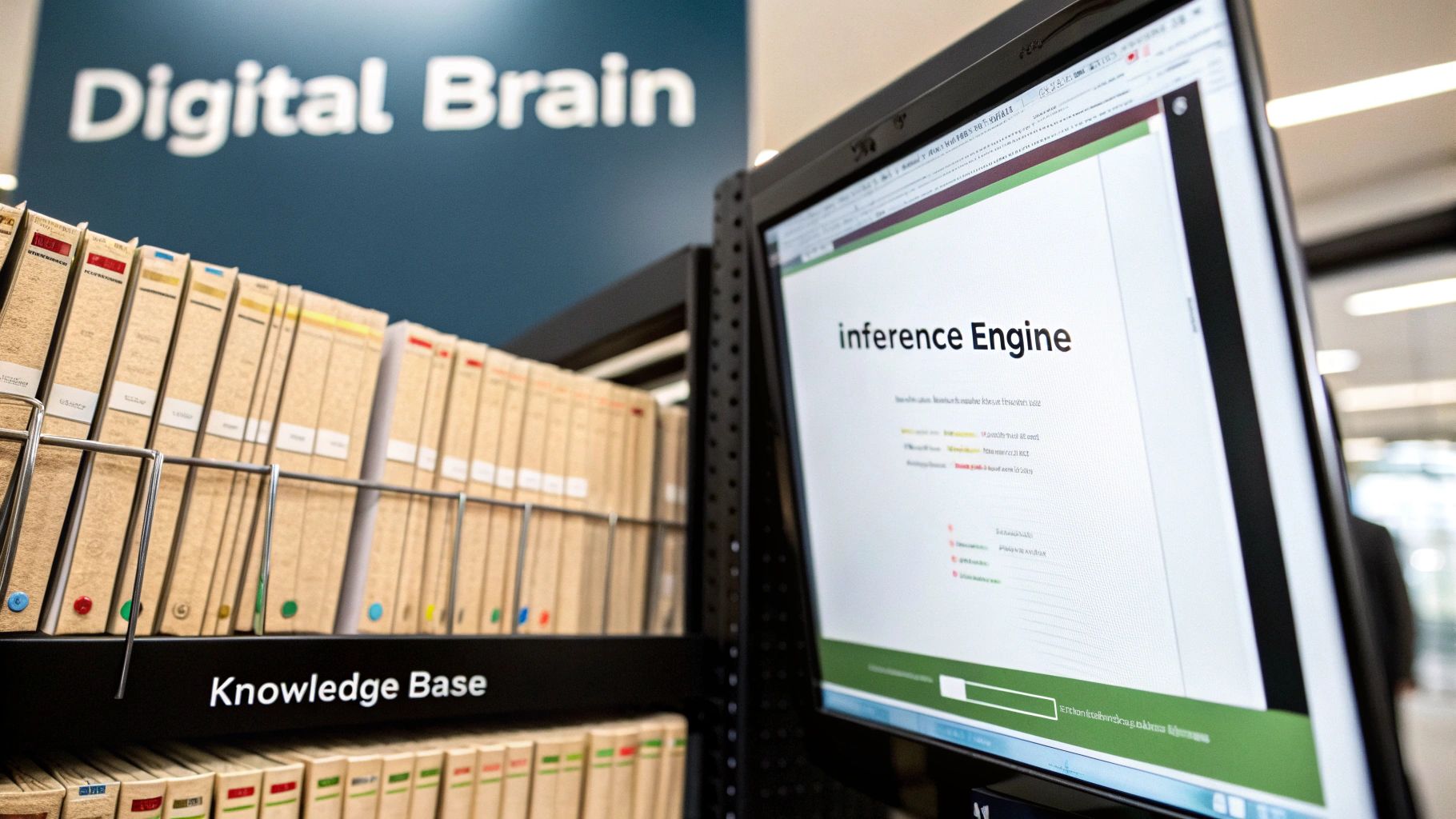
This setup is the secret sauce that lets an agent operate with deep expertise in a specific area, delivering results that are both consistent and easy to understand. Let’s break down each of these crucial pieces.
The Knowledge Base: The Agent's Library of Wisdom
The Knowledge Base isn't just a database stuffed with raw data. It’s more like a perfectly organised library, put together by an expert on the subject. It doesn’t just hold facts; it also contains all the rules and relationships that define how a particular domain works.
Think about a chess grandmaster. Their brain doesn't just know how the pieces move. It holds a massive collection of opening gambits, mid-game strategies, and endgame tactics built up over years of play. The KB of a knowledge based agent in artificial intelligence plays a similar role, storing structured information that’s ready to be used for making decisions.
This knowledge is usually written in a formal language so the agent can process it logically. Typically, you'll find:
- Facts: These are straightforward, unconditional truths about the world. For example, "The primary server is located in Mumbai."
- Rules: These are conditional statements that lay out relationships, often in an "IF-THEN" structure. For instance, "IF a user reports a login failure, THEN check the authentication service status."
This organised structure gives the agent a solid foundation of reliable information, a bit like a doctor consulting a medical textbook before making a diagnosis. It's the source of the agent's "smarts."
The Inference Engine: The Agent's Reasoning Mind
If the Knowledge Base is the library, then the Inference Engine is the agent's active, thinking mind. This is the component that takes a question or a new piece of information, digs into the KB, and applies logical rules to figure out something new or decide what to do next. This process of creating new information from what's already known is called inference.
Let's go back to our doctor analogy. The inference engine is like the doctor who looks at a patient's chart (the KB), considers their symptoms (the new info), and uses established medical principles (the rules) to figure out what's wrong. The engine isn't just fetching facts; it's actively reasoning with them.
The Inference Engine is the core processing unit that gives a knowledge based agent its intelligence. It systematically applies logical rules to the facts in the Knowledge Base to deduce new information and solve problems transparently.
To do its job, the engine uses specific reasoning methods to work through the knowledge base. Two of the most common are forward chaining and backward chaining, and each is better for different types of problems.
Comparing Agent Reasoning Strategies
The two primary inference mechanisms, forward and backward chaining, give agents different ways to "think." One starts with the data and sees where it leads, while the other starts with a goal and works its way back to see if the data supports it. This table breaks down how each approach is suited for different types of problems.
| Inference Strategy | Approach | Starting Point | Best Suited For |
|---|---|---|---|
| Forward Chaining | Data-Driven Reasoning | Starts with known facts and applies rules to derive new conclusions. | Situations where you have initial data and need to see where it leads, such as monitoring system alerts to predict a potential failure. |
| Backward Chaining | Goal-Driven Reasoning | Starts with a potential conclusion (a hypothesis) and works backwards to find supporting evidence. | Diagnostic scenarios where you need to confirm a specific outcome, like troubleshooting why a customer's order failed. |
So, what does this look like in practice? A forward-chaining agent watching a network might notice high latency (a fact), apply a rule ("IF latency > 200ms, THEN trigger alert"), and decide an alert is necessary.
On the other hand, a backward-chaining agent might start with a goal like, "Is the customer eligible for a refund?" and then work backwards through rules about purchase dates and product conditions to find the facts to prove it.
Ultimately, it’s the powerful combination of a comprehensive Knowledge Base and a logical Inference Engine that makes a knowledge based agent in artificial intelligence such a reliable tool for handling complex decisions.
How These Agents Stand Apart from Other AI
In the sprawling world of artificial intelligence, not all agents are built the same way. The difference between a knowledge based agent in artificial intelligence and other types, especially machine learning models, is a big one. Think of it like this: it’s the difference between an apprentice who learns by watching others and a master engineer who works from a precise blueprint.
A machine learning agent is great at finding statistical patterns in huge amounts of data. A knowledge based agent, on the other hand, operates from an explicit, pre-defined library of facts and logical rules. This fundamental split changes everything about how they tackle problems and how much we can trust their answers.
The Master Engineer vs. The Observant Apprentice
Let's imagine you need to fix a complex piece of machinery. One way is to call in an apprentice who has seen senior mechanics fix similar issues hundreds of time. They have a good gut feeling for what's wrong based on what they've observed, but they can't always articulate the deep engineering principles behind the failure. That’s a machine learning agent in a nutshell—it learns from data to make predictions.
Now, picture the master engineer. They don't guess. They pull out the official schematics (the knowledge base), apply principles of physics and engineering (the inference engine), and logically deduce the exact point of failure. Crucially, they can explain every single step of their diagnosis with complete certainty. That’s our knowledge based agent.
This distinction is absolutely vital in fields where the "why" behind an answer matters just as much as the answer itself.
A machine learning model is a master of perception, figuring out what is likely to be true from data. A knowledge based agent is a master of reasoning, determining what must be true based on established facts and logic.
This difference in philosophy isn't new. The ideas behind knowledge-based agents go way back to the AI boom of the 1980s, when expert systems first captured the world's imagination. During that time, India’s own research hubs, like the Indian Institutes of Technology (IITs), were at the forefront of exploring rule-based systems built on knowledge representation and logical inference. As technology progressed, these classic reasoning principles were woven into modern applications, creating powerful systems that blend old-school interpretability with new-school machine learning. You can trace this entire evolution by reading up on the history of artificial intelligence on Wikipedia.
A Comparative Look at AI Agent Types
To really get a feel for what makes a knowledge based agent special, it helps to see it side-by-side with other common types of AI agents. Each one has a different way of seeing the world and making decisions, which makes them better suited for different kinds of tasks.
Here's a breakdown of the fundamental differences in how various AI agents perceive their environment and make decisions.
Knowledge Based Agents vs Other AI Agent Types
| Agent Type | Decision Basis | Key Characteristic | Example |
|---|---|---|---|
| Simple Reflex Agent | Current perception only | Acts on pre-programmed "if-then" rules without memory of past events. | A thermostat that turns on the heat when the temperature drops below a set point. |
| Model-Based Agent | Internal model of the world | Maintains an internal state to track how the world changes over time. | A self-driving car that remembers the position of a vehicle that just went out of view. |
| Knowledge Based Agent | Logical reasoning on a knowledge base | Uses explicit facts and rules to deduce new information and justify its actions. | A medical diagnostic system that suggests illnesses based on symptoms and a vast medical KB. |
| Learning Agent | Learning from experience | Improves its performance over time by analysing feedback from its actions. | An AI that gets better at playing chess by learning from millions of past games. |
As you can see, the knowledge based agent in artificial intelligence holds a pretty unique spot. It goes far beyond simple reflexes by using a deep, structured understanding of its subject area, which allows it to solve complex problems with a level of transparency and precision others can't match.
While a learning agent might eventually figure out the best move in chess, a knowledge based agent can tell you why it's the best move by citing established strategic principles. That's the real difference.
Real-World Applications of Knowledge-Based Agents
It's one thing to talk about concepts and theories, but the real measure of any technology is what it can do in the wild. Knowledge-based agents in artificial intelligence aren't just academic thought experiments; they’re out there today, solving tough problems in industries where precision, logic, and traceability are absolutely critical.
Think of these agents as highly specialised digital experts. They take a huge, curated body of domain-specific knowledge and use it to help human professionals, automate complex workflows, and deliver outcomes you can trust. From helping doctors make better diagnoses to keeping financial trades above board, their impact is both wide-ranging and significant.
Transforming Healthcare Diagnostics
In a hospital or clinic, a knowledge-based agent can be an invaluable partner to a doctor. Picture a clinician faced with a patient showing a confusing and rare mix of symptoms. The doctor draws on their years of hard-won experience, but the agent can instantly scan the patient's data—symptoms, lab results, family history—and compare it against a vast medical knowledge base.
This isn't just a simple search. The knowledge base is a deep repository of information on diseases, drug interactions, and the very latest clinical research. The agent's inference engine then logically connects the dots between the patient's unique situation and established medical facts, flagging potential diagnoses a human might not have considered. It can even raise an alarm about specific treatments that might clash with the patient’s existing conditions.
This isn't just a future vision; it's already making a difference. In India, for instance, AI adoption in healthcare is on the rise. A 2022 report highlighted that over 40% of AI solutions in the country's health-tech startups were built on knowledge-based systems. Early projects in hospitals in cities like Bengaluru and Hyderabad have suggested that these diagnostic agents can help cut down diagnostic errors by an estimated 25-30%. You can explore more about how these AI agents are being used in healthcare.
Powering Intelligent Customer Service
Customer support is another domain where knowledge-based agents truly shine, leaving simple, scripted chatbots in the dust. A basic chatbot hits a wall the moment a customer asks something outside its pre-programmed flow, which only leads to frustration. A knowledge-based agent, on the other hand, works from a genuine understanding of product manuals, troubleshooting guides, and company policies.
Let's say a customer is wrestling with a tricky technical problem in their new software. Instead of just walking them through a generic checklist, the agent can:
- Grasp the Problem: It actually parses and understands the user's description of the issue.
- Find the Right Knowledge: It pulls up technical specs, known bug reports, and detailed repair guides from its knowledge base.
- Figure out a Solution: Using its inference engine, it pieces together a specific, step-by-step solution that matches the customer's exact situation.
This lets the agent solve problems that would normally need a human expert, freeing up support staff to focus on the truly unique or sensitive cases that require a human touch.
The real power of a knowledge-based agent in customer support isn't just recognising keywords. It's about genuinely understanding and solving a user's problem by drawing on a deep well of product knowledge.
Ensuring Financial and Regulatory Compliance
The world of finance is a maze of dense, constantly shifting regulations. For banks and investment firms, staying compliant is a massive undertaking, and a single mistake can result in eye-watering fines. Knowledge-based agents are tailor-made for this kind of complex, rule-based environment.
These systems are loaded with a knowledge base containing everything from regulatory documents and legal precedents to internal compliance manuals. When a new trade or transaction is proposed, the agent can instantly check it against thousands of rules to spot potential violations. For example, it might flag a transaction that looks suspiciously like it could violate anti-money-laundering (AML) laws or identify investment advice that doesn't fit a client's stated risk tolerance.
By acting as an automated first line of defence, a knowledge-based agent in artificial intelligence delivers a consistent, auditable compliance check. This not only boosts accuracy but also lets human compliance officers focus their skills on investigating the tricky exceptions the agent flags, rather than slogging through every single transaction. Best of all, the agent can point to the exact rule or regulation that was breached, making the entire process transparent and easy to defend.
Building a Modern Knowledge Based System
Alright, let's move from the theoretical to the practical. Building your own knowledge based agent in artificial intelligence isn't some far-off dream anymore; it's surprisingly accessible. The most effective way to do it today is with a hybrid model, one that pairs the strict logic of a traditional knowledge base with the conversational flair of a Large Language Model (LLM). This blend creates an agent that’s not just smart but also genuinely helpful to talk to.
This powerful combination lets you build an AI assistant that does more than spit out generic, web-scraped answers. It delivers responses grounded in your company's own verified information, all while sounding like a friendly, competent expert. The journey starts with the most important step: building a rock-solid, well-organised knowledge base.
Sourcing and Structuring Your Knowledge
Think of your knowledge base as the brain of your agent. The quality of what goes in directly dictates the quality of what comes out. The aim is to create a single source of truth that the AI can turn to without hesitation. This means pulling together information from all corners of your organisation and arranging it so a machine can actually find what it needs.
First, you need to hunt down all the potential goldmines of information in your business. These usually include:
- Internal Documentation: Think product manuals, technical spec sheets, and those internal wikis your own teams rely on every day.
- Customer-Facing Content: Your website's FAQ pages, help centre articles, and blog posts are already answering common questions—let's put them to work.
- Databases and Records: Information sitting in your CRM or old support tickets holds priceless clues about recurring customer problems and how they were solved.
- Expert Interviews: Often, the most critical knowledge isn't written down at all. Sitting down with your senior support staff or product developers can uncover troubleshooting hacks and best practices you won't find anywhere else.
Once you’ve gathered all this raw material, the real work begins. It all needs to be cleaned up, organised, and structured so the AI can make sense of it.
Powering Conversations with Retrieval-Augmented Generation
So, how do you get a chatty LLM to stick to the script and use your carefully curated knowledge without just making stuff up? The secret sauce is a technique called Retrieval-Augmented Generation (RAG). RAG is the essential bridge connecting the LLM's massive, general-purpose intelligence to your company's specific, private information.
Picture a brilliant student taking an open-book exam. The student (the LLM) already has a ton of general knowledge, but for the tricky, specific questions, they can check their textbook (your knowledge base) to nail the answer perfectly. That’s exactly how RAG works.
Retrieval-Augmented Generation (RAG) is a game-changing technique that grounds an LLM's responses in factual data. It forces the AI to "look up" the answer in your trusted knowledge base before generating a reply, dramatically reducing errors and ensuring accuracy.
When a user asks something, the RAG system first dives into your knowledge base to find the most relevant documents or snippets of data. It then hands this retrieved information to the LLM along with the user's original question, essentially telling it: "Formulate your answer based only on what I'm giving you." This keeps the agent on-brand and factually correct.
This infographic shows how knowledge based agents are put to work in key industries, using structured data to solve very specific challenges.
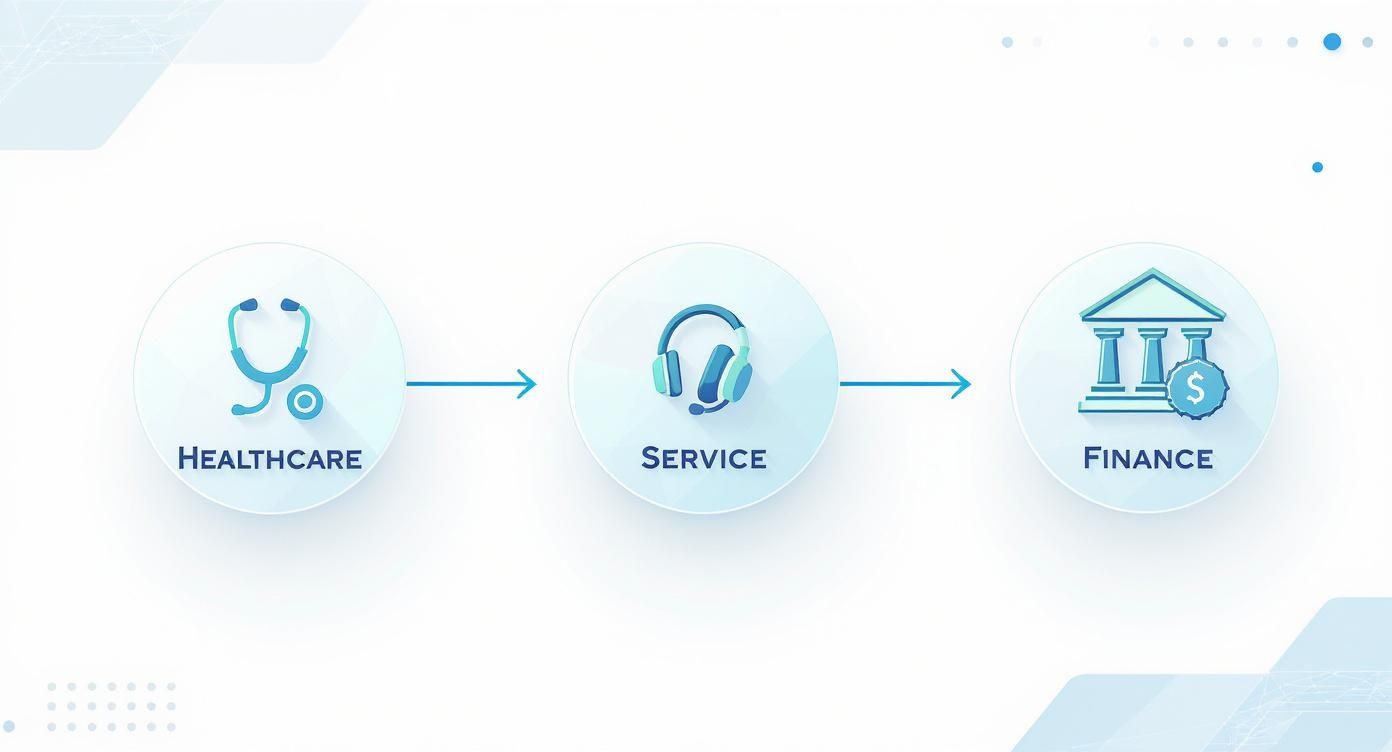
As you can see, these agents aren't just generalists; they become specialised tools in fields like healthcare, customer service, and finance, where getting the details right is absolutely critical.
Implementing Guardrails and Escalation Paths
Finally, a trustworthy agent needs clear boundaries. Safety guardrails are the non-negotiable rules that stop the AI from wandering off-topic, giving bad advice, or trying to answer questions it has no business answering. Enterprise platforms like SupportGPT build in robust guardrails to ensure conversations stay professional and secure.
Just as crucial is a smart escalation workflow. Let's be realistic—no AI is all-knowing. You have to set up clear triggers for when the agent needs to raise its hand and pass the conversation to a human. This ensures tricky or sensitive problems get the expert attention they deserve, creating a seamless experience where your AI and human teams work in perfect sync.
The Future of Intelligent Agents
While the power of a knowledge based agent in artificial intelligence is undeniable, it's crucial to look at the full picture, including the challenges. These systems aren't perfect. Their entire intelligence hinges on the quality and completeness of their knowledge base, which takes a massive effort to build and keep up-to-date.
This reliance on a pre-built KB can also make them brittle. If an agent runs into a scenario that isn't covered by its rules, it can simply freeze, unable to think on its feet. The real world is messy and constantly changing, and trying to code a rule for every possibility is a fool's errand. This rigidity has long been a major barrier to seeing them used more widely.
But the future isn't about ditching these logical agents; it's about upgrading them. The most interesting work today is happening in hybrid systems, which blend the logical, structured reasoning of a KBA with the flexible, adaptive power of machine learning.
The Rise of Hybrid AI Systems
The next wave of intelligent agents really does offer the best of both worlds. Picture an agent that starts with a solid foundation of verified facts and rules but can also learn from new information and conversations as they happen. That's the whole idea behind hybrid AI.
This approach directly tackles the biggest weakness of traditional KBAs. When a hybrid agent hits a problem it doesn't recognise, it doesn’t just give up. It can lean on its machine learning side to look at the new data, find patterns, and propose a sensible way forward.
Even better, it can then take that new insight and add it back to its own knowledge base. This creates a fantastic feedback loop, allowing the agent to get smarter and more effective over time without a developer having to manually update it every single time.
The future of intelligent agents lies in synergy. By combining the explainable reasoning of knowledge bases with the adaptive power of machine learning, we are building systems that are not only smarter but also more resilient and trustworthy.
Creating More Robust and Autonomous Agents
This evolution is leading us to agents that are far more autonomous and adaptable. They’re moving beyond being rigid, single-minded experts and becoming dynamic partners that can navigate ambiguity and react to new situations. This mix of hard-coded knowledge and learned intuition is opening doors to all sorts of new applications.
We're already seeing this in sophisticated platforms like SupportGPT. These systems use a core knowledge base to ensure every answer is factually correct, while a large language model gives them the ability to hold a natural, fluid conversation. The agent knows what it knows for a fact, but it can also understand the subtle complexities of how people actually talk.
This combination of strengths—the strict logic of a knowledge base and the adaptive intelligence of machine learning—is giving rise to a completely new type of knowledge based agent in artificial intelligence. These systems are on track to become indispensable tools, powering the next generation of automation and smart decision-making across every industry.
Frequently Asked Questions
Got more questions? Let's clear up a few common points about knowledge-based agents to make sure everything clicks into place.
What Is the Primary Role of the Knowledge Base?
Think of the Knowledge Base (KB) as the agent's brain and its entire library, all in one. It’s a carefully organised collection of facts, rules, and information about a specific subject. For a medical AI, this would be its digital textbook of diseases and treatments.
Ultimately, the agent is only as smart as its knowledge base. The quality, accuracy, and depth of the KB directly determine how intelligently it can act.
How Is a Knowledge-Based Agent Different from a Learning Agent?
The core difference is how they get smart. A knowledge-based agent starts with a pre-loaded library of facts and rules created by human experts. It reasons based on what it has already been told.
A learning agent, on the other hand, is more like an apprentice. It starts with little knowledge and learns by observing patterns in data, making mistakes, and adjusting its approach over time. Think of machine learning models that get better at identifying images the more images they see.
A knowledge-based agent is like a seasoned expert referring to a comprehensive encyclopaedia, whereas a learning agent is like a student learning a new skill through practice and repetition.
Are These Agents Still Relevant with Modern LLMs?
Absolutely, and perhaps more than ever. While Large Language Models (LLMs) are fantastic at generating human-like conversation, they have a notorious habit of "hallucinating"—making things up. This is where knowledge-based systems make a huge comeback.
The most powerful approach today is a hybrid model. By connecting an LLM to a curated knowledge base, you create a system that can:
- Guarantee Factual Accuracy: The agent is forced to pull answers directly from your trusted, verified information.
- Maintain Conversational Fluency: The LLM then polishes that factual data into a natural, easy-to-understand response.
This combination gives you the best of both worlds. You get the conversational flair of an LLM grounded by the unwavering reliability of a knowledge-based agent in artificial intelligence. For any serious business application where accuracy is non-negotiable, this hybrid architecture is the way to go.
Ready to build an AI agent that delivers accurate, on-brand answers every time? SupportGPT provides the complete platform to train, manage, and deploy intelligent agents grounded in your own knowledge. Start your free trial today and see the difference factual AI can make.