How a Knowledge Based Agent Thinks and Decides
Discover how a knowledge based agent uses a logical brain to make smart decisions. We break down the architecture, uses, and what sets them apart from LLMs.
Think of a knowledge based agent as an intelligent system that acts like a seasoned expert in a specific field. It doesn't just learn from patterns in raw data; it makes decisions by tapping into an internal library of facts and rules, much like a specialist drawing on years of experience. This allows it to reason logically and deliver solutions that are clear, transparent, and easy to audit.
Understanding the Expert in the Machine

Let's use an analogy. Imagine your car breaks down. You could ask a friend for a guess, or you could go to a master mechanic. The mechanic doesn't just make a random prediction. They rely on a deep mental library of engine diagrams, common problems, and specific diagnostic steps to figure out exactly what's wrong. A knowledge based agent works in precisely the same way.
It isn't built on vague feelings or statistical guesswork pulled from thousands of unrelated examples. Instead, it’s armed with a carefully selected, specific body of information directly relevant to its purpose. This knowledge is structured into two main components: a collection of facts about its world, and a set of rules on how to act on those facts.
The Power of Explicit Knowledge
The real magic of a knowledge based agent is its transparency. Because every decision it makes is based on a pre-programmed set of rules, you can literally trace its thought process from the initial query to the final answer. This is a world away from many other AI models, which can often feel like a "black box" where even the people who built them can't fully explain how a specific result was produced.
This characteristic makes them indispensable in fields where accountability is crucial. The main benefits are clear:
- Explainability: The agent can show you the exact rules and facts it used to reach its conclusion.
- Reliability: Within its defined area of expertise, its performance is consistent and predictable.
- Auditability: Every single step in its decision-making process can be reviewed, checked, and verified for compliance.
In short, a knowledge based agent is less like a student trying to learn a subject from scratch and more like a seasoned professional applying a well-honed playbook. It combines what it knows (its knowledge base) with a logical process (its reasoning engine) to solve problems with precision and clarity.
Why This Matters in India
Across high-stakes sectors in India—like finance, healthcare, and legal services—the ability to justify a decision is just as important as the decision itself. Think about it: a financial agent flagging a transaction must be able to explain why it's suspicious by pointing to specific rules and data. A medical diagnostic tool has to base its suggestions on established clinical guidelines, not just a hunch.
This demand for clear, logical, and defensible AI is exactly where knowledge based agents shine. They build a foundation of trust for automated systems, ensuring that technology acts as a reliable and transparent partner. Getting a handle on this core concept is the first step to understanding the more complex architectures and applications we'll explore next.
Inside the Agent's Mind: The Core Architecture
To really get what makes a knowledge-based agent tick, you have to look under the hood at its engine. It's not some single, magical piece of code. Instead, its intelligence comes from two distinct but tightly connected components. Think of it as the agent's brain: one part holds all the information, and the other part does the actual thinking.
These two core pieces are the Knowledge Base (KB) and the Inference Engine (IE). Together, they create the fundamental structure that lets the agent understand its surroundings, reason through problems, and make smart decisions. Let’s break down what each part does.
The Knowledge Base: The Agent's Library of Truths
The Knowledge Base is so much more than a simple database. It’s a highly organised, machine-readable library that contains everything the agent knows about a particular subject. It’s the agent’s single source of truth, carefully built to be accurate and relevant.
This library is filled with two main types of knowledge:
- Declarative Knowledge: These are the straightforward facts about the world. For a medical diagnostic agent, a fact might be, "Paracetamol reduces fever." It’s a simple, undeniable statement.
- Procedural Knowledge: These are the rules, often written in an "IF-THEN" style, that explain how to use the facts. Sticking with our medical example, a rule could be: "IF a patient has a fever AND is not allergic to paracetamol, THEN recommend taking paracetamol."
Having both facts and rules is what gives the agent its power. It doesn’t just know what is true; it knows what to do with that truth.
The Knowledge Base isn't just data; it's structured expertise. It turns raw information into a usable format that the agent's reasoning mind can actually work with to solve problems.
Ultimately, the entire agent is only as good as its Knowledge Base. If the facts are wrong or the rules are incomplete, the agent’s conclusions will be shaky, no matter how clever its reasoning process is.
The Inference Engine: The Logical Brain
If the Knowledge Base is the library, then the Inference Engine (IE) is the brilliant detective who uses it. The IE is the active, thinking part of the agent. It takes in new information from the environment, checks it against the facts and rules in the KB, and figures out the best next step.
This process isn't just guesswork; it follows strict logical rules. Two of the most common methods it uses are forward chaining and backward chaining.
To get a clearer picture, let's look at how these two core components work side-by-side.
Comparing Agent Components
This table breaks down the two core components of a knowledge-based agent, explaining their distinct roles and functions within the system.
| Component | Role | Analogy | Example Content |
|---|---|---|---|
| Knowledge Base (KB) | The passive repository of information. It stores all the facts and rules about a specific domain. | A comprehensive textbook or an expert's entire library. It holds the knowledge but doesn't act on it. | "Symptom: Fever," "Rule: IF temperature > 38°C, THEN prescribe rest." |
| Inference Engine (IE) | The active reasoning mechanism. It applies logic to the KB to derive new conclusions and decide on actions. | A detective or a logician. It uses the information in the library to solve a case or prove a theory. | Takes a new fact ("Patient's temperature is 39°C") and uses the KB's rule to conclude ("Prescribe rest"). |
As you can see, the Knowledge Base provides the "what," and the Inference Engine provides the "how." They are completely codependent—one is useless without the other.
Forward Chaining: Data-Driven Reasoning
Imagine a doctor diagnosing a patient. They start by gathering the symptoms: a fever, a cough, and a sore throat. Using this initial data, they work forward through their medical knowledge to reach a diagnosis, like "the patient likely has the flu."
This is forward chaining. The Inference Engine starts with the known facts and applies rules from the Knowledge Base to uncover new facts, continuing until it reaches a final conclusion. It’s a data-driven approach, moving from evidence to a logical outcome.
Backward Chaining: Goal-Driven Reasoning
Now, let's flip that scenario. The doctor starts with a hypothesis: "Does this patient have the flu?" To confirm this, they work backwards, asking questions to see if the necessary conditions are met. "Does the patient have a fever? Do they have a cough?"
This is backward chaining. Here, the Inference Engine starts with a possible goal and works in reverse, checking if the facts available in the Knowledge Base support it. It's a goal-driven method, perfect for confirming a theory or answering a specific question.
The incredible growth of the AI agent market, especially in India, shows just how valuable this kind of structured reasoning is in the real world. The global market, valued at $3.7 billion in 2023, is expected to skyrocket to $150 billion by 2025. The Asia-Pacific region, with India at the forefront, is growing at an astonishing CAGR of 49.5%. This boom is directly linked to how effective knowledge-based agents are in fields like customer service and healthcare, where companies using them report a 14% increase in issue resolution per hour. You can explore more about these AI agent statistics and their market impact.
How These Agents Learn and Adapt
A knowledge-based agent isn't a static tool; it’s designed to operate in a continuous loop. It’s always sensing what’s happening in its environment, thinking through the new information it receives, and then deciding on the best course of action. This cycle is what elevates it from a simple database to an active problem-solver.
Think of this operational loop as the agent’s fundamental rhythm. It perceives its surroundings using sensors—which could be anything from a customer typing a question into a chat window to fresh data from a financial market feed. It then processes these inputs, known as percepts, to get a clear picture of the current situation.
The flowchart below breaks down this core reasoning process, showing how an agent goes from simply observing to taking a logical, well-informed action.
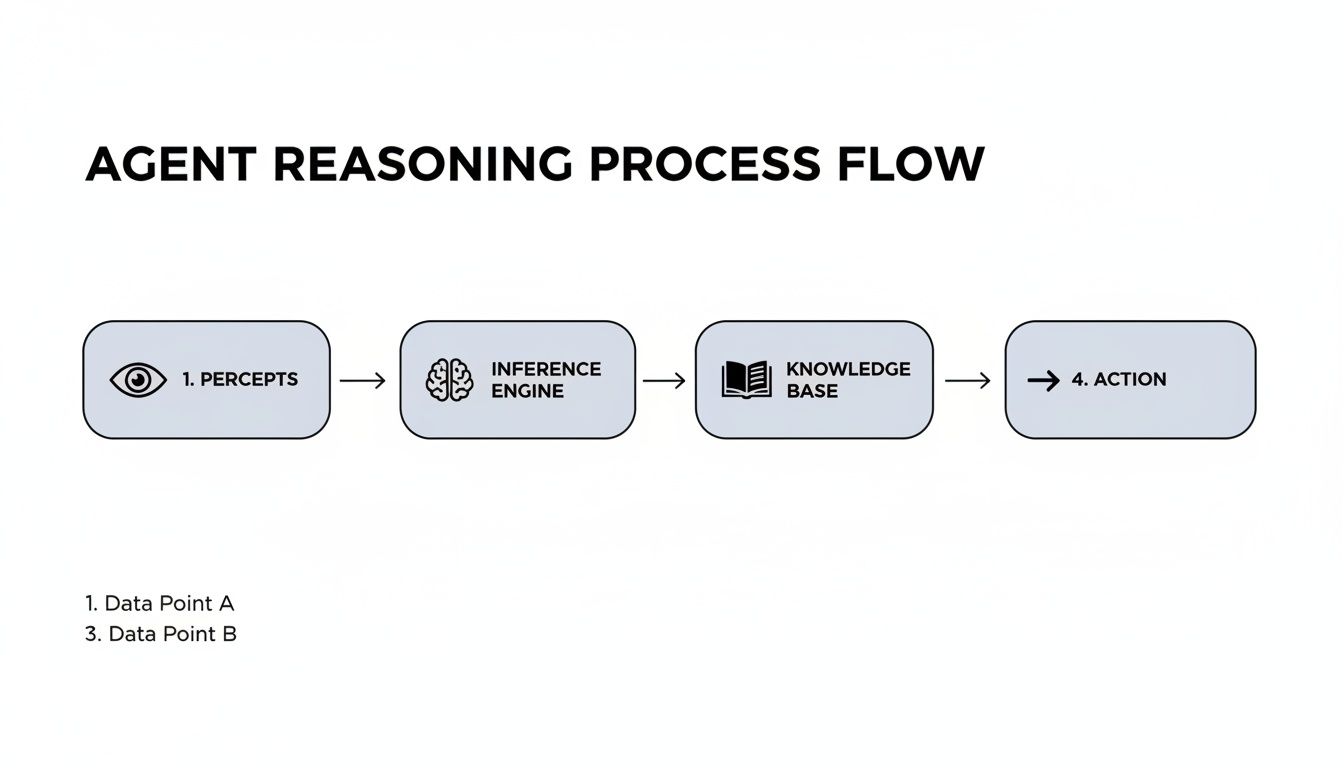
This diagram makes one thing crystal clear: every action the agent takes is the product of a structured, deliberate thought process. Nothing is random. Its decisions are guided entirely by its internal knowledge.
The Tell and Ask Mechanism
So, how does this loop actually work in practice? It all comes down to a simple but powerful communication model between the agent and its knowledge base, often called the 'Tell-Ask' mechanism. Picture it as a constant conversation between the agent's "brain" (the Inference Engine) and its internal "library" (the Knowledge Base).
- Tell: Whenever the agent encounters new information from its environment, it ‘tells’ the Knowledge Base. This action essentially updates the library with a new fact. For instance, if a support agent learns that "a shipping delay is affecting Mumbai," it tells the KB, adding that specific piece of information to its collection of truths.
- Ask: When it’s time to make a decision, the agent ‘asks’ the Knowledge Base what it should do. The Inference Engine queries the KB, which then uses its existing rules and any newly added facts to figure out the best response. Following our example, the agent might ask, "What should I tell a customer from Mumbai who is asking about their order?"
This constant cycle of telling and asking is what allows the agent to learn and adapt over time. It’s not learning in the way a machine learning model does, by spotting patterns across huge datasets. Instead, it learns by having its explicit knowledge base updated with fresh, verified facts.
The Human Element in Knowledge Engineering
This brings us to a crucial behind-the-scenes process: knowledge engineering. A knowledge-based agent’s intelligence doesn't just appear out of thin air. It’s meticulously built and curated by human experts. Knowledge engineering is the discipline of translating deep human expertise into a formal, machine-readable language that the Knowledge Base can understand.
This involves a few key steps:
- Knowledge Acquisition: This is all about extracting expertise, usually by interviewing domain specialists like senior doctors, veteran financial analysts, or top-tier engineers.
- Knowledge Representation: Once the knowledge is gathered, it needs to be structured. This means choosing a logical framework, like propositional logic or first-order logic, to organise the facts and rules.
- Knowledge Validation: Finally, the Knowledge Base is put through its paces. It's rigorously tested to make sure it’s accurate, consistent, and doesn’t have any gaps.
A knowledge-based agent is ultimately a reflection of the human expertise it was built upon. The quality of the knowledge engineering process directly determines the agent's effectiveness and reliability in solving real-world problems.
This reliance on curated human expertise is a double-edged sword. On one hand, it ensures the agent’s decisions are grounded in proven, reliable knowledge, which is perfect for critical applications. On the other, keeping the Knowledge Base up-to-date requires continuous effort. That’s why platforms like SupportGPT focus on making it easy to train agents on your own internal documents, ensuring the knowledge they use is always relevant.
Knowledge Agents vs. Language Models
It’s easy to get lost in the alphabet soup of AI terms. You hear "AI agent" and "language model" thrown around, sometimes even in the same sentence, but they’re not the same thing at all. Getting this difference is crucial if you want to build something that actually works.
Think of it this way: a knowledge-based agent is like a seasoned expert in a very specific field—a specialist who relies on a well-defined set of facts and established rules. A Large Language Model (LLM) like ChatGPT, on the other hand, is more like a brilliant, well-read generalist who can talk eloquently about almost anything, but doesn't always have their facts straight.
A knowledge-based agent operates from a curated Knowledge Base. Every decision it makes is based on an explicit fact or a logical rule you've given it. This means its reasoning is totally transparent. You can literally trace a conclusion back to the exact piece of information or rule that led to it, making it incredibly reliable for tasks where getting it wrong is not an option.
LLMs work completely differently. They don't have a rulebook; they have a universe of text data they've been trained on. From this, they learn patterns, context, and the statistical relationships between words. This is why they’re so good at generating fluid, human-like text and understanding the subtle nuances of a conversation. The catch? Their knowledge is probabilistic, not deterministic. This can lead them to generate confident but completely wrong answers—a problem we call 'hallucination'.
Comparing the Core Philosophies
The real split comes down to how each one knows what it knows. A knowledge-based agent is told things explicitly. An LLM infers things based on the patterns it's seen. This fundamental difference dictates their strengths and weaknesses.
- Reliability: In its own domain, a knowledge-based agent is rock-solid. Give it the same input, and you'll get the same answer every single time. It's consistent and dependable.
- Creativity: This is where LLMs shine. They can brainstorm, synthesise ideas, and write entirely new content. They aren't just following rules; they're creating something original.
- Explainability: If you ask a knowledge-based agent why it did something, it can show you its work—the exact rule it followed. An LLM is more of a "black box." Its reasoning is hidden inside millions of parameters in its neural network, making it nearly impossible to dissect.
To really nail down the differences, let's put them side-by-side.
Knowledge Based Agents vs. Large Language Models (LLMs)
Here's a direct comparison that cuts through the noise, showing the fundamental differences in how these two types of AI operate and where each one excels.
| Attribute | Knowledge Based Agent | Large Language Model (LLM) |
|---|---|---|
| Knowledge Source | Explicit, curated facts and rules stored in a Knowledge Base. | Implicit knowledge learned from massive, unstructured text datasets. |
| Reasoning Method | Logical deduction using an Inference Engine (e.g., IF-THEN rules). | Pattern recognition and statistical probability. |
| Explainability | High. Decisions are fully traceable and auditable. | Low. The reasoning process is opaque and difficult to interpret. |
| Key Strength | Unbeatable accuracy, consistency, and reliability within a specific domain. | Fluency, creativity, and a deep grasp of natural language nuances. |
| Main Weakness | Can be rigid; completely lost if a query falls outside its programmed scope. | Prone to "hallucinations"—making up plausible but incorrect information. |
| Ideal Use Case | Medical diagnosis, financial fraud detection, regulatory compliance checks. | Content creation, chatbots, summarisation, creative brainstorming. |
Looking at them this way, you can see they're not competitors but potential partners. Each one has a clear role to play.
The Power of Hybrid Models
While they have their differences, the most powerful and practical solutions today don't force you to choose. They combine both.
Imagine an LLM acting as the friendly, conversational front door for your users. It can chat naturally and understand what people are asking. But when a user asks a critical, fact-based question—say, about your company's refund policy—the LLM doesn't just take a guess.
Instead, it turns to a knowledge-based agent to be its "expert in the room." The agent queries its verified Knowledge Base, applies its logic, and hands a trustworthy, precise answer back to the LLM. The LLM then translates that factual answer into a helpful, conversational response for the user.
This hybrid approach gives you the best of both worlds: the creative fluency of an LLM, grounded by the factual accuracy and logical rigour of a knowledge-based agent.
This is exactly how modern platforms like SupportGPT work. They allow you to build an AI agent on top of your own specific knowledge—your help docs, internal policies, and product specs. You end up with a system that can chat like a human but provides answers that are consistently accurate and aligned with your business. This combination of structured logic and creative language is what makes an AI system not just clever, but genuinely useful.
Real-World Uses in Indian Industries

The theory is one thing, but seeing a knowledge-based agent work in the real world is where its value truly clicks. Across India, key industries are already putting these agents to work on complex problems—the kind where being accurate and able to explain your reasoning isn't just a nice-to-have, but an absolute must for success and compliance.
From the financial districts of Mumbai to remote health clinics, the clear, rules-driven approach of these AI systems is building the trust needed for widespread adoption. They aren’t just handling simple tasks; they're becoming dependable assistants in high-stakes decisions, directly contributing to India's growth story. Let's look at a few examples of how this is playing out on the ground.
A New Ally in Healthcare Delivery
In India's healthcare system, the sheer demand for expert medical advice often overwhelms the number of available professionals. This is where a knowledge-based agent can be a game-changer, acting as a reliable support tool for initial diagnostic assessments.
Picture an agent deployed in a primary health centre. Its knowledge base is packed with medical facts, symptom-to-illness rules, and official clinical guidelines. When a patient comes in and describes their symptoms, the agent can sift through this information to suggest potential diagnoses or recommend specific tests. Crucially, it does this based on transparent medical logic that a doctor can easily verify.
This fits perfectly with national initiatives like the Ayushman Bharat Digital Mission, which is focused on creating a robust digital health ecosystem. These agents can manage the flood of routine enquiries, freeing up doctors and nurses to concentrate on more serious cases. In fact, some studies suggest that up to 95% of routine patient queries could be handled by a well-designed knowledge-based agent. With enterprise adoption in the sector projected to hit 85% by 2025, their role is only set to grow. You can explore more about AI's impact on Indian healthcare on itechnotion.com.
Securing the Financial Sector
India's finance and banking industry is built on a foundation of strict regulations, where every major decision needs a clear, justifiable trail. It’s an ideal setting for a knowledge-based agent, especially for tasks like fraud detection and risk assessment.
Think about a system monitoring credit card transactions. Its knowledge base is built on a set of explicit rules that define what looks suspicious:
- IF a transaction comes from a country different to the user's last known location, THEN it gets flagged for a closer look.
- IF several high-value purchases happen in a very short span of time, THEN the card is temporarily blocked and the user is notified.
- IF a login attempt comes from an unrecognised device, THEN it triggers a request for two-factor authentication.
Because the agent simply follows these predefined rules, its decisions are completely auditable. If a transaction is blocked, the bank can point to the exact rule that was triggered, which is vital for maintaining regulatory compliance and giving clear answers to customers.
The core strength of a knowledge-based agent in finance is its deterministic nature. It eliminates ambiguity and provides a consistent, logical, and defensible approach to security in a sector where trust is the ultimate currency.
Personalising Education at Scale
The education sector in India is also starting to see how this technology can help. Adaptive learning platforms are using knowledge-based agents to move away from the traditional "one-size-fits-all" model and create truly personalised learning paths for students.
Here, the knowledge base is essentially a structured map of a curriculum. It contains facts about various topics, understands how they connect, and holds rules that guide a student's journey.
For instance, if a student is getting stuck on a particular maths concept, the agent can trace the problem back to the foundational knowledge they might be missing. It then dynamically adjusts the learning plan to serve up those prerequisite topics first, making sure the student has a solid grasp before they move forward. This simple logic makes learning far more efficient and tailored to each student's individual pace.
Your Roadmap to Building a Knowledge Agent
Building a knowledge-based agent might sound intimidating, but it's a lot more manageable when you have a clear plan. Think of it less like creating intelligence from scratch and more like systematically organising the expertise your team already has. For any business or developer diving in, the journey doesn't start with code—it starts with defining a very specific problem you want to solve.
The secret to success is to start small. Don't try to build an agent that can do everything at once. Instead, pick a narrow, well-defined domain. This tight focus makes the knowledge acquisition phase—where you gather information and expertise from your specialists—incredibly effective. Once you've captured that expert knowledge, you can decide on the best way to structure it into facts and rules that a machine can understand.
Core Implementation Steps
With your knowledge organised, you can begin building the inference engine. This is the logical brain of your agent, the part that applies the rules to the facts to make decisions. After the build comes a crucial testing phase, where you pit the agent's reasoning against real-world scenarios to see how it holds up.
A common pitfall is creating a knowledge base that’s too rigid or, even worse, forgetting about it after launch. Knowledge isn't a one-and-done deal; it changes constantly. A truly successful agent needs a living, breathing process for updating facts and refining rules to stay accurate. This is why platforms that provide AI support agents, like SupportGPT, are built around the idea of continuous improvement, giving teams simple tools to manage and refresh the agent's knowledge.
This is where India’s unique position gives it a massive advantage. The country has quickly become a global hub for AI talent.
According to NASSCOM, India ranks 1st globally in AI skill penetration with a score of 3.09. This has created a deep talent pool perfectly suited for the detailed work of knowledge engineering. This advantage has fuelled rapid adoption in key sectors, with 82% of Indian enterprises planning to integrate AI agents by 2025. Discover more about India's leading AI skills and their impact.
Best Practices for Success
If you want your project to succeed, you absolutely must involve your subject matter experts directly in the development process. Their constant feedback is the only way to guarantee the agent's decisions are not just technically sound but also make sense in the real world of your business.
Here are a few actionable best practices to keep in mind:
- Start with a Pilot Project: Pick a well-defined, low-risk problem for your first agent. A quick win is the best way to demonstrate value and get the green light for more ambitious projects.
- Prioritise Knowledge Quality: Your agent is only as good as the knowledge it's built on. Invest serious time and effort into validating every fact and rule with your domain experts. Garbage in, garbage out.
- Design for Maintenance: From day one, build a clear and simple process for updating the knowledge base. This is what turns your agent from a one-off project into a valuable, long-term asset.
Frequently Asked Questions
Let's tackle some of the most common questions that come up when people start working with knowledge-based agents in the real world.
What Are the Main Sticking Points?
The biggest hurdle with a knowledge-based agent is that it can be quite rigid. Its entire "world" is defined by the facts and rules you load into its knowledge base. If it runs into a problem that isn't covered by that pre-loaded expertise, it’s stuck. It just can't reason about things it hasn't been explicitly taught.
This makes them quite different from other AI models that can generalise from broader data. You also have to contend with the knowledge acquisition bottleneck. Getting all that specialised information out of human experts and translating it into a format the agent understands is a slow, painstaking process. It takes a lot of time and effort to get right.
How Is This Different from Machine Learning?
The fundamental difference comes down to where the "knowledge" originates. A knowledge-based agent relies entirely on an explicit, hand-crafted library of facts and rules. Its reasoning is entirely logical and predictable, following the pathways you've laid out for it.
Machine learning models, on the other hand, build implicit knowledge. They don't learn from a rulebook; they learn by finding patterns in enormous amounts of data. Think of it as learning by example, which means their reasoning is probabilistic—based on likelihoods—rather than being deterministic and absolute.
How Do You Keep the Knowledge Base Up-to-Date?
Maintaining a knowledge base isn't a "set it and forget it" task—it's a continuous cycle. If you want the agent to stay useful, you need a solid maintenance loop in place.
- Monitor Performance: First, you have to watch how the agent is doing. Keep a close eye on where it succeeds and, more importantly, where it fails.
- Identify Gaps: Look for the blind spots. Are there common questions it can't answer? Is it giving outdated or wrong information?
- Update Knowledge: This is where your subject matter experts come back in. You need to regularly feed the agent new information, update existing facts, and tweak the rules to ensure everything stays current and correct.
Ready to deploy a smart, reliable AI assistant without the hassle of building from scratch? SupportGPT provides a complete platform to build, manage, and deploy AI support agents trained on your own knowledge. Start your free trial today and deliver accurate, 24/7 assistance in minutes.