How to Handle Customer Complaints Like a Pro
Learn how to handle customer complaints with proven strategies. Turn negative feedback into loyalty by mastering communication, process, and technology.

Let's be honest, nobody enjoys getting a customer complaint. But the first step to handling them effectively is a mental shift: Listen to what the customer is actually saying, Empathise with their frustration, Solve their immediate problem, and then Learn from the feedback so it doesn't happen again.
This simple four-part approach is the foundation for turning a negative experience into a chance to build real, lasting loyalty.
Customer Complaints Aren't Problems; They're Opportunities
Most companies treat customer complaints like fires that need to be put out as quickly as possible. They’re seen as a drain on time, resources, and morale. But that reactive mindset misses the bigger picture entirely.
Complaints are one of the most valuable, unfiltered sources of feedback you will ever get. Think about it: for every one person who takes the time to complain, countless others just quietly leave and never come back.
A complaint is actually a gift. It’s a sign that someone cares enough about your business to tell you where you’ve gone wrong, giving you a chance to fix it. When you get good at this, you're not just solving a one-off issue; you're investing in customer retention. We've all seen the research—customers who have a problem resolved quickly and effectively often become even more loyal than those who never had a problem in the first place.
The Real Price of Poor Complaint Handling
On the flip side, the cost of ignoring or fumbling a complaint is steep. An unhappy customer is far more likely to share their bad experience with friends, family, and on social media. This kind of negative word-of-mouth can quietly poison your brand's reputation and scare away new business.
The real danger isn't the complaint itself. It's the silent churn and the slow erosion of trust that happens when issues are left to fester.
A smart, structured approach is non-negotiable. Here’s why:
- It builds incredible trust. When you own a mistake and offer a genuine solution, you show integrity. That single act can turn a frustrated customer into your biggest fan.
- It fuels real improvement. Complaints are a direct line to your customers' pain points. They show you exactly where the flaws are in your product, the gaps in your processes, or the areas where your team needs better training.
- It drives retention. A great resolution experience makes a customer feel heard and valued, massively increasing their lifetime value and strengthening their connection to your brand.
Before we dive into the "how," it's worth summarizing these core ideas. Think of them as the four pillars that support any successful complaint resolution strategy.
The Four Pillars of Effective Complaint Resolution
This table breaks down the essential mindset and actions needed to turn every complaint into a positive outcome.
| Pillar | Core Action | Why It Matters |
|---|---|---|
| Listen Actively | Hear the customer out completely without interruption. Focus on understanding their perspective, not just the technical details. | It validates their feelings and shows respect, immediately de-escalating the situation. You can't solve a problem you don't fully understand. |
| Empathise Genuinely | Acknowledge their frustration and show you understand how the issue has impacted them. Use phrases like, "I can see why you're upset." | Empathy builds a human connection. It tells the customer you're on their side, which is crucial for rebuilding trust. |
| Solve Efficiently | Take ownership and propose a clear, actionable solution. If you can't fix it immediately, provide a timeline and next steps. | A fast and effective solution is the most tangible proof that you care. It turns a negative experience into a positive one. |
| Learn and Adapt | Once the issue is resolved, analyse the root cause. Was it a product flaw, a process gap, or a training issue? | This is how you prevent the same problem from happening again. It turns a single complaint into a systemic improvement for all customers. |
Getting these four pillars right is what separates companies that just "handle" complaints from those that use them to get better every single day.
The biggest mindset shift is this: Stop seeing complaints as signs of failure. Start treating them as free consultations from the people who matter most—your customers.
This guide is designed to be a complete playbook for turning that valuable feedback into a powerful engine for growth. We’ll go beyond theory and get into the practical, actionable steps for building a system that not only resolves issues but also extracts the insights you need to make your entire business stronger.
Setting Up a System to Triage Complaints Effectively
Great complaint handling isn't about the occasional heroic save; it's about building a solid, reliable system that just works. Every single time. Let's be honest, complaints fly in from everywhere these days—email, social media, phone calls, review sites. Without a plan, it's a recipe for chaos. The first real step is to get all those complaints into one organised place.
If you don't centralise, you'll have one agent tackling a Twitter DM while another is trying to solve the very same issue from an email ticket. It's a classic case of wasted effort and a confusing experience for the customer. A unified system means every piece of feedback is caught, tracked, and has a clear owner. Nothing falls through the cracks, and your team gets the full picture of a customer's history.
To get started, think about the journey of a complaint. It's a process that can be broken down into a simple, powerful framework.
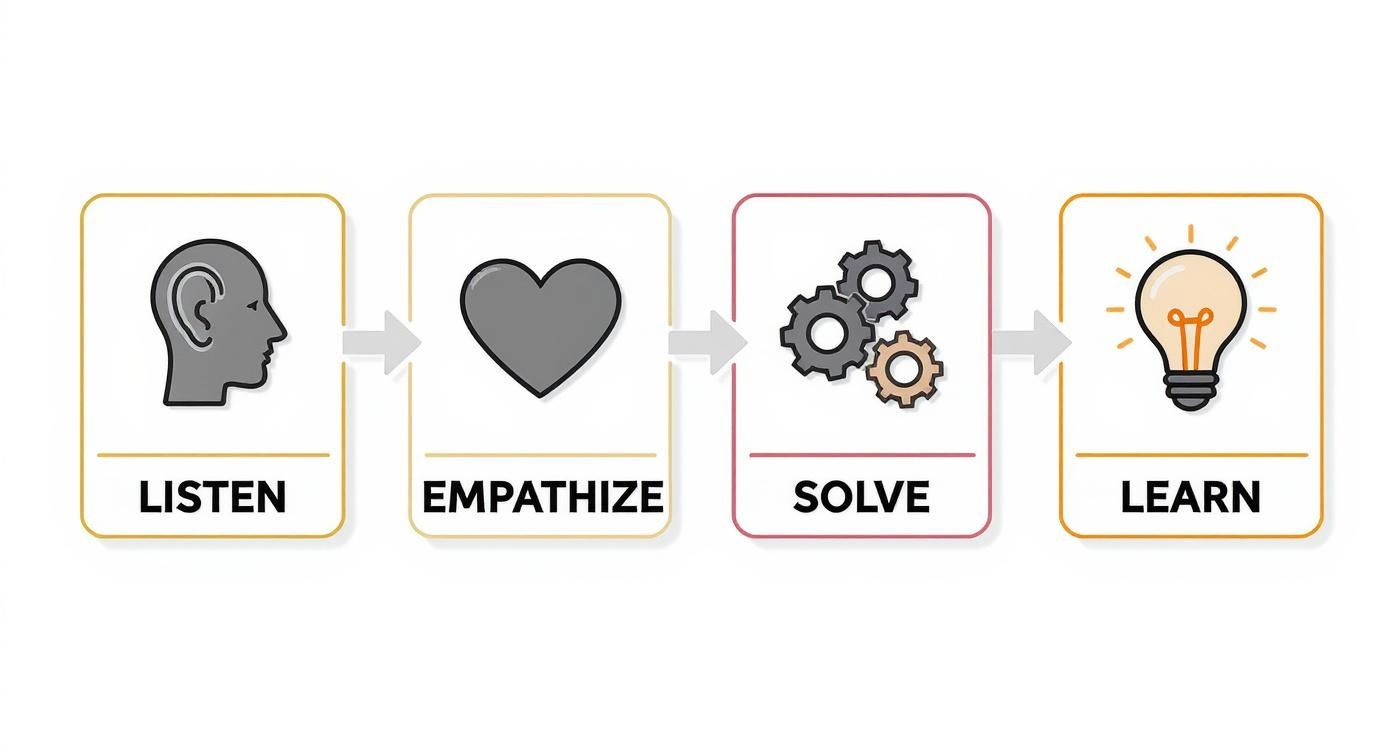
This flow—Listen, Empathise, Solve, and Learn—is your team's roadmap. It creates consistency and ensures every customer gets a quality response, no matter who they talk to.
Build a Prioritisation Matrix
Okay, so you've got all your complaints in one place. Now what? The big challenge is figuring out what to tackle first, because not all issues are created equal. A small website bug is annoying, sure, but a massive service outage affecting thousands of users is a genuine crisis.
This is where a prioritisation matrix becomes your best friend. It helps you sort incoming issues based on two simple but critical factors: Urgency and Impact.
- Urgency: How time-sensitive is this? A payment failing right at checkout is extremely urgent. A suggestion for a new feature can wait.
- Impact: How many people are affected? Is it one person, a small group, or your entire customer base?
By plotting complaints on this matrix, your team can see at a glance what needs their immediate attention. A high-urgency, high-impact issue like a data breach is obviously top priority. A low-urgency, low-impact typo on a blog post? It can wait its turn.
Categorising Complaint Severity
To really make that matrix work, you need to define clear severity levels. This takes the guesswork out of the equation and keeps everyone on the same page.
Here’s a simple three-tier system you can start with and adapt:
- Critical (P1): Think big. Major system outages, security vulnerabilities, or problems stopping a huge chunk of your customers from using your main service. These are "all-hands-on-deck" situations.
- High (P2): These are issues that seriously mess with the customer experience but aren't a full-blown outage. Maybe a key feature is malfunctioning for a group of users, or a serious bug is hitting a VIP customer.
- Normal (P3): This is your bread and butter. Minor bugs, cosmetic glitches, or individual account problems that have a limited blast radius. They need fixing, but you don't have to drop everything to do it.
Categorising complaints isn't just about fighting fires faster. It's smart resource allocation. You can have your most seasoned agents jump on P1 issues, while newer team members can cut their teeth on P3 tickets. It’s all about putting the right skills on the right problems.
The Big Idea: A structured triage system turns chaos into a calm, orderly process. It makes sure your team’s valuable time is always spent on the problems that matter most to your customers and your business.
Defining Ownership and Escalation Paths
A great triage system falls apart if nobody knows who’s supposed to do what. Once a complaint is prioritised, who owns it? And what happens when the person handling it gets stuck? You need crystal-clear escalation paths.
An escalation path is just a pre-agreed route for a complaint to travel when it can’t be solved at its current level. For instance:
- A P3 ticket about a billing question? That probably stays with the front-line support agent.
- A P2 ticket about a stubborn, recurring bug? Time to escalate it to a senior support specialist.
- A P1 ticket reporting a system-wide outage? That gets shot straight to the on-call lead for the engineering team, no questions asked.
When you document these paths, you kill the confusion and empower your team to act fast. An agent who knows exactly who to tag for a specific problem can get it resolved in a fraction of the time. This kind of systematic approach is the bedrock of handling customer complaints well—turning a bad day for a customer into a chance to prove just how reliable you really are.
Mastering the Art of the Perfect Response
Once your triage system has done its job and routed a complaint to the right person, the real work begins. This is your moment of truth. How you respond isn't just about closing a ticket; it's about mending a customer relationship that's under serious strain. A great response is a careful blend of empathy, clarity, and a solid plan for what comes next.

When a customer is upset, the last thing they want is a cold, robotic reply. They need to feel heard by a real person who genuinely cares about their problem. In these moments, that human touch becomes your most valuable tool.
The Anatomy of an Effective Reply
Think of every great response as having a few essential ingredients. It's a recipe for turning a tense situation around and rebuilding trust. Miss one of these, and you risk leaving the customer feeling ignored or misunderstood.
A solid reply should always have these four parts:
- A Sincere Apology: Lead with "I'm sorry." Even if the issue wasn't directly your company's fault, you can still apologise for the frustration and inconvenience they've experienced. A genuine apology immediately lowers their defences.
- Empathetic Validation: Show them you get it. Use phrases like, "I can completely understand why you're frustrated," or "That sounds like a really difficult situation." This proves you're listening and connecting with them on an emotional level.
- Ownership of the Problem: Make it clear you're taking the reins. Saying something like "I'm going to sort this out for you" conveys accountability and gives the customer confidence that help has arrived.
- A Clear Solution or Next Steps: This is the make-or-break part. Tell them exactly what you're going to do to fix things and give them a realistic timeline. If you need more info, ask specific questions to avoid a frustrating back-and-forth.
Nailing this structure turns the conversation from being about the problem to being all about the solution.
Tailoring Your Response to the Channel
The way you handle a complaint on social media is worlds away from a formal email exchange. The platform itself dictates the tone, length, and style of your message. You've got to meet your customers where they are.
For instance, a public tweet needs a quick, concise reply that acknowledges the problem and quickly moves the conversation to a private channel like a DM. On the other hand, an email about a tricky billing error calls for a more detailed, structured response that addresses every point the customer has made.
A great response isn't just about what you say; it's about how and where you say it. Matching your tone and format to the communication channel shows you respect the customer's time and choice of platform.
This is a massive challenge across all industries. Take the banking sector in India, which has seen customer grievances skyrocket. The State Bank of India (SBI) alone received over 6,87,000 complaints in FY25, with common issues ranging from unauthorised transactions to service delays. How a bank handles a complaint about a delayed loan over the phone versus through an online portal shows just how crucial channel-specific communication is. You can read more about the rise in banking sector complaints and see how major lenders are trying to manage the volume.
Practical Response Examples You Can Adapt
Theory is one thing, but seeing these principles in action is what makes them click. Let’s break down a common and frustrating scenario: a customer's order is delayed with zero communication.
Poor Response Example:
- "Dear customer, we are looking into your order. We are experiencing high volume. Your order will ship soon. Thanks for your patience."
This is impersonal, vague, and frankly, unhelpful. It does nothing to reassure the customer and probably makes them even more annoyed.
Excellent Response Example:
- "Hi [Customer Name], I am so sorry to hear about the delay with your order and the lack of updates—I can absolutely understand how frustrating that must be. I've just looked into it, and it seems there was an unexpected issue at our warehouse that held things up. This is not the standard we aim for, and I've personally escalated your order to ensure it ships out within the next 24 hours. You'll receive an email with the tracking number the moment it's on its way."
See the difference? This response is personal, empathetic, takes ownership, gives a brief reason for the problem, and provides a concrete, immediate next step. This is how you turn a complaint from a potential one-star review into a chance to show you genuinely care, winning back that customer's trust for good.
Using Automation to Scale Your Support
In a busy support centre, your team’s time is their most valuable asset. While it's vital to craft the perfect, empathetic response every time, that ideal just doesn't scale when you're staring down hundreds or thousands of complaints a day. This is where you bring in your most powerful ally: technology. It’s what turns a purely manual support function into a smart, efficient operation.
Automation isn’t about replacing the human element; it’s about amplifying it. The real aim is to let technology handle the predictable, repetitive work so your skilled agents can focus their brainpower on the tricky problems and high-stakes customer conversations. Think of it as giving your team a super-powered assistant who never needs a coffee break.
This shift isn't just a nice-to-have anymore. In India, for example, the government has seen a massive jump in consumer grievances handled online. The National Consumer Helpline saw monthly complaint registrations skyrocket from around 37,000 in 2017 to over 1,70,000 today, with nearly 65% filed digitally. This trend, detailed in this report on digital grievance redressal, shows that customers now expect fast, digital support as standard.
Training AI on Your Complaint History
One of the most practical ways to use modern AI is to get it to learn from your past wins. Every single resolved complaint sitting in your helpdesk is a goldmine of training data. By feeding this history into an AI model, you can teach it to spot patterns, understand the nuances of a complaint, and generate accurate, on-brand first drafts for your agents.
Let's say a new complaint about a common billing error lands in the queue. Instead of an agent typing out a reply from memory, the AI can instantly draft a response that already includes:
- A proven, empathetic opening line.
- The correct troubleshooting steps for that specific issue.
- Direct links to the most relevant help centre articles.
The agent's job then becomes a quick review, a touch of personalisation, and hitting 'send'. This single change can dramatically cut your First Response Time (FRT) and free up your team for more complex cases.
Establishing Smart Guardrails and Escalation
Of course, you can't just let an AI run wild when talking to customers. You need clear boundaries, and that’s where AI guardrails come in. These are simply pre-set rules that make sure every automated interaction aligns with your brand voice and internal policies.
Guardrails are your AI's rulebook. They prevent it from giving incorrect information, using an off-brand tone, or making promises your company can't keep, ensuring every automated touchpoint is safe and professional.
Beyond just managing responses, you can also set up smart escalation rules that automatically push complex issues to the right people. For instance, you could create a workflow that triggers whenever a customer mentions words like "legal" or "refund" more than once. The system can instantly flag the ticket, skip the frontline queue, and assign it directly to a senior agent or team lead. This ensures your most critical complaints get an expert eye on them immediately.
Leveraging AI-Powered Analytics
The final piece of the puzzle is using AI to make sense of all the complaint data you're gathering. Manually tagging and sifting through thousands of tickets to find trends is a near-impossible task. AI-powered tools, on the other hand, can do it in seconds.
An AI analytics platform can comb through all your customer conversations and pull out genuinely useful insights, like:
- Spotting emerging issues before they snowball into major problems.
- Pinpointing specific product features that are causing the most headaches.
- Analysing customer sentiment to get a real pulse on satisfaction levels.
This data-driven approach is what helps you shift from a reactive support model to a proactive one. Tools like SupportGPT provide a complete platform for building and rolling out these kinds of AI solutions. You can train the AI on your knowledge base, set up guardrails, and implement smart escalations—all without needing a team of developers. This transforms your complaint system from a simple cost centre into a powerful engine for improving your entire business.
Don't Just Solve Complaints—Learn from Them
Once you've resolved a customer's issue, the work isn't over. In fact, if you stop there, you’re leaving the most valuable part of the process on the table. Think of every complaint not as a problem, but as a crucial piece of business intelligence. It’s a bright, flashing sign showing you exactly where your products, services, or internal processes are hitting a snag.
This is the real secret to mastering customer complaints: moving from a reactive, fire-fighting mode to proactively preventing issues before they even start.
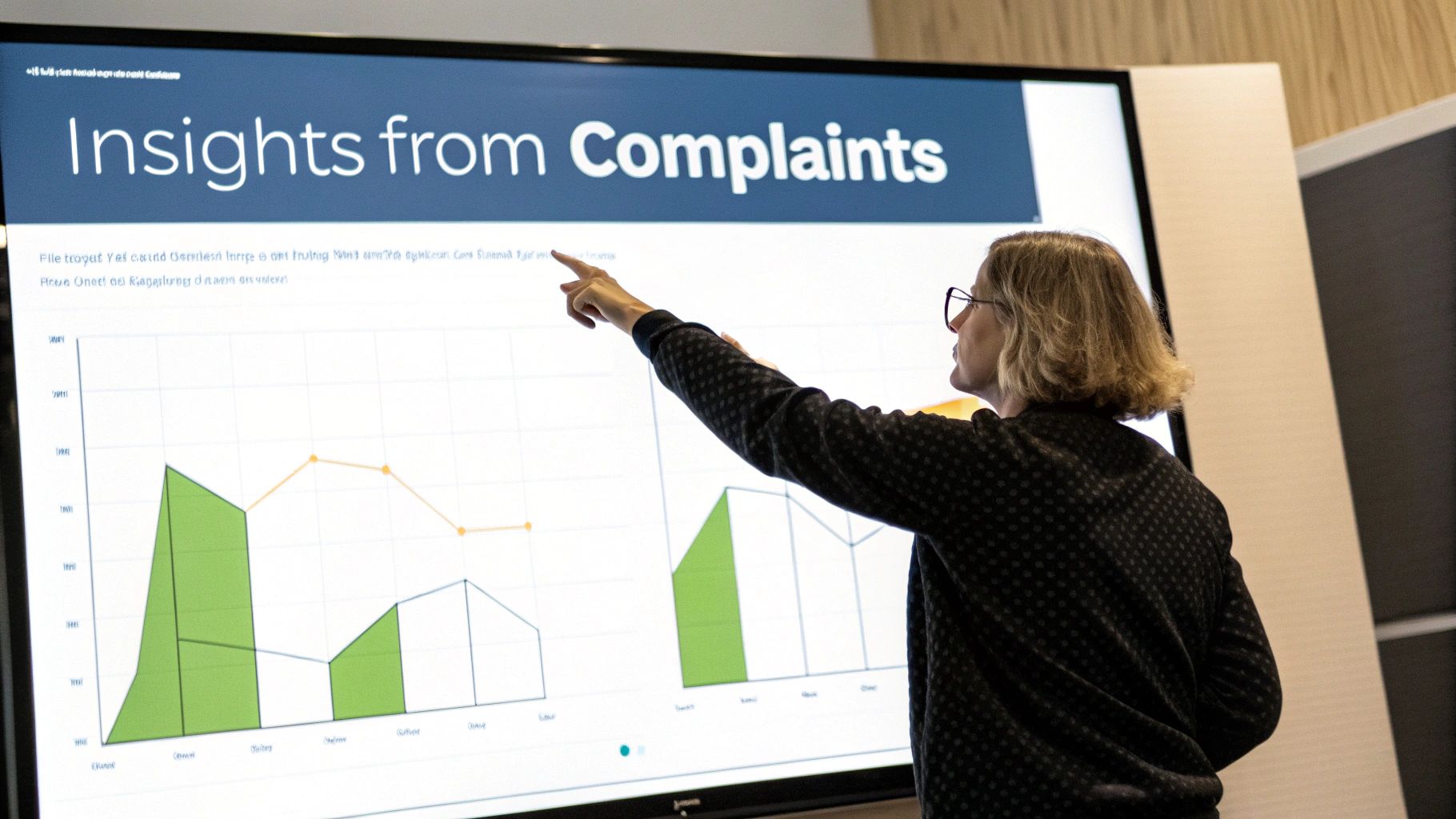
The ultimate goal isn't just to be great at handling complaints, but to build a business where fewer of them happen in the first place. To do that, you need to track the right data and make sure it gets to the people who can actually use it to make a difference. Without this last step, your support team is just stuck putting out the same fires, day after day.
What to Measure: The KPIs That Matter
You can't fix what you can't see. To turn a pile of raw complaint data into something you can act on, you need to zero in on a few Key Performance Indicators (KPIs). These numbers give you an objective look at how your support is performing and, more importantly, where the biggest friction points are for your customers.
Here are the essentials to start tracking:
- First Response Time (FRT): How long does a customer wait for that first "we're on it" message? A fast FRT isn't just a number; it’s a signal to the customer that you take their problem seriously.
- Average Resolution Time (ART): From the moment a complaint is logged to the final "it's fixed," how long does the entire process take? This is a direct reflection of your team’s efficiency and the complexity of your problems.
- Customer Satisfaction (CSAT): After it's all said and done, a simple survey asking "How did we do?" gives you instant, unfiltered feedback on the quality of the support they received.
These aren't just metrics for a manager's dashboard; they're diagnostic tools. For instance, if your ART for a specific type of issue suddenly skyrockets, it could be a red flag for a new bug or a process breakdown that your team isn't equipped to handle yet.
Closing the Loop: Getting Insights to the Right People
Data is useless if it’s locked away in the support department. The real magic happens when you create feedback loops that pipe these valuable insights directly to other teams across the business. This is how a single complaint can spark meaningful, company-wide improvements.
Your support team is your frontline intelligence unit. They need clear, established channels to share what they're hearing with teams like:
- Product: Getting a dozen complaints a day about a clunky feature in your app? That’s not noise—it’s a clear signal for your product managers to prioritise a fix in the next sprint.
- Marketing & Sales: Are customers saying a product doesn't work the way the ads promised? This is critical feedback for the marketing team to adjust their messaging and set realistic expectations.
- Operations: If late deliveries are your number one complaint category, that data is gold for your operations team. It helps them pinpoint and resolve bottlenecks in the supply chain.
A strong feedback loop ensures the customer's voice isn't just heard by support—it echoes through every department. It transforms your support team from a cost centre into a powerful engine for quality and innovation.
This systematic approach is no longer optional. In India, for example, the Ministry of Consumer Affairs has been modernising its processes. As of August 2025, its new e-Jagriti digital platform had already seen 85,531 consumer cases filed digitally. This shows a clear public demand for structured, transparent resolution processes. You can learn more about how the ministry is handling consumer complaints digitally and see the direction things are heading.
By digging into your complaint data, you're not just making customers happier. You're making smarter, more informed decisions that strengthen the entire business. That's the real payoff of learning how to handle customer complaints—turning every piece of negative feedback into a positive step forward.
Got Questions? We've Got Answers
Even the most well-oiled machine for handling complaints will hit a few bumps. Let's be real—some situations are just plain tricky. This section dives into some of the most common questions and grey areas teams run into, with advice straight from the trenches.
What if the Customer Hates the Solution?
This is a tough one, and every seasoned support professional has been there. You’ve done everything by the book, provided what seems like a fair solution, and… crickets. Or worse, another angry reply. Your first instinct might be to close the ticket or just repeat your last message. Don't.
Instead, take a breath and lean back in with genuine empathy. Acknowledge their frustration head-on. Try something like, “I can see the solution I offered hasn’t hit the mark, and I’m sorry for that. Can you tell me a bit more about what’s still not right from your perspective?”
This approach is powerful for a couple of reasons:
- It immediately validates their feelings, showing you’re still on their side.
- It asks them to clarify the sticking point, which often isn't the original problem anymore.
Sometimes, the real issue is a feeling of being rushed or misunderstood. If a second attempt still doesn’t land, it’s time to bring in backup. Escalating to a manager isn't admitting defeat; it’s a sign of a mature support system. The end goal is always a happy customer, not winning the argument.
How Can We Prepare Our Team for Really Tough Conversations?
Training for complaint management is less about software clicks and more about building emotional intelligence. Your team needs to be comfortable with empathy, active listening, and knowing how to defuse a tense situation. One of the best ways to build these skills? Role-playing.
Dig up some of your company's actual tough-to-handle complaints and create realistic training scenarios. Let one person play the irate customer while another navigates the conversation.
This isn't just a drill; it's building muscle memory. It helps your agents learn to stay cool under fire, find the right words, and manage the emotional current of a complaint without getting pulled under themselves.
Another game-changer is creating a library of approved response snippets. These aren't meant for mindless copy-pasting but as springboards. They should model the perfect tone and empathetic phrasing, giving agents a solid framework they can personalise for each customer.
Finally, make difficult ticket reviews a regular team ritual. Huddle up and talk through what went well and what could’ve been done differently. This turns individual challenges into collective wisdom and builds a culture where everyone feels supported.
We’re a Small Business. What’s the Best First Step?
If you’re a small business just starting to formalise how you handle complaints, it's easy to get overwhelmed by all the fancy tools and complex workflows out there. Don't boil the ocean.
The single most impactful thing you can do right now is create one central hub to track every single complaint.
This doesn't mean you need to drop thousands on a CRM tomorrow. Start simple:
- A dedicated email address like support@yourcompany.com.
- A shared spreadsheet logging the customer, date, issue, and status.
- A specific channel in your team chat tool, like Slack or Microsoft Teams.
The tool itself is less important than the discipline of centralisation. When you get every complaint out of personal inboxes and into a shared space, you instantly gain clarity. You'll start spotting trends, nothing will fall through the cracks, and you'll avoid the classic "two people replying to the same customer" blunder. This simple foundation is everything—you can always build a more sophisticated system on top of it as you grow.
Ready to see how smart, manageable AI can elevate your customer support? With SupportGPT, you can build, train, and launch AI assistants in minutes. We provide the enterprise-grade guardrails, seamless escalation to your human experts, and the deep analytics you need to turn support conversations into growth.
Start your free trial and see how SupportGPT can transform your customer service today.