Enterprise Security Compliance Roadmap
Master your enterprise security compliance roadmap. Learn to navigate SOC 2, ISO 27001, and GDPR while closing enforcement gaps with secure AI tools.
97% of organizations conduct at least two audits annually, while 71% of enterprise companies spend more than $100,000 on audits each year. Of particular note, 38% have lost revenue or competitive bids because they couldn't provide sufficient compliance evidence, according to a recent compliance benchmark. Enterprise security compliance has moved far beyond an annual checklist. It now affects whether procurement teams approve a vendor, whether sales teams can answer security questionnaires, and whether engineering can prove that controls operate after deployment.
The hard part isn't choosing between SOC 2, ISO 27001, GDPR, or another requirement. The hard part is enforcing access, encryption, logging, retention, incident response, and AI governance continuously, then producing reliable evidence when a buyer or auditor asks for it. A written policy that isn't reflected in system behavior won't protect a company during a difficult audit.
The Operational Reality of Modern Compliance
Enterprise security compliance becomes expensive when treated as a project instead of an operating discipline. An audit occurs on a scheduled date, but the controls under review operate every day. Employees join and leave, cloud permissions change, vendors receive access, production code is deployed, and automated systems process customer data. Each change can create an evidence gap unless the control and its record update with it.
Benchmark data cited earlier shows that organizations face recurring audits, substantial audit costs, and lost commercial opportunities when evidence is incomplete (Bright Defense compliance statistics). Given that audit frequency and cost already strain engineering capacity, the operational question is how to preserve reliable evidence continuously instead of reconstructing it before each review.
Enterprise buyers increasingly ask vendors to demonstrate how they manage privileged access, protect data in transit and at rest, respond to incidents, oversee suppliers, and review administrative activity. A certificate or completed questionnaire may open a sales conversation. Procurement teams often need evidence tied to the specific service, environment, data flow, and customer commitments covered by the deal.
Compliance changes daily engineering work
A mature program changes how teams design and operate systems. Identity and access management becomes a controlled workflow with approval records, periodic reviews, and prompt deprovisioning. Engineers connect change records to deployments. Security teams assign vulnerability findings to owners and document remediation decisions or accepted risk. Product teams identify which data an AI feature can access and define what happens when a user requests deletion.
Controls also need technical enforcement. A policy may require least privilege, but cloud roles, service accounts, and support tools must implement that requirement. An AI-use policy may prohibit sensitive prompts, yet the organization still needs permission boundaries, logging, retention rules, and escalation paths that can show whether those restrictions were followed.
Teams that prepare only before an audit create a costly cycle:
- Emergency evidence collection: Engineers search ticketing systems, cloud consoles, identity providers, and chat histories for proof that a control operated.
- Inconsistent answers: Teams describe the same process differently because no control owner maintains an authoritative record.
- Stale remediation: A gap closes for the audit, then returns when a new service, integration, or employee changes the environment.
- Sales friction: Security questionnaires wait on technical staff who are already handling production work.
An enterprise AI governance guide belongs in the operating model, not only in policy documentation. AI governance must connect acceptable-use rules to permissions, monitoring, escalation, and records that demonstrate what an automated system did.
Practical rule: If a control matters during an audit, assign it an owner, connect it to a system of record, and define the evidence that owner must produce without manual reconstruction.
Continuous compliance does not require reviewing every event manually. It requires identifying high-risk changes, automating routine checks, escalating exceptions, and preserving enough context to explain decisions later. Strong programs embed these activities in engineering workflows, procurement reviews, employee lifecycle management, and incident response. They keep policy and system behavior aligned between audits, where operational risk develops.
Navigating Major Frameworks and Legal Requirements
Framework selection should follow business scope, customer expectations, data types, and contractual obligations. SOC 2, ISO 27001, GDPR, and CCPA overlap around security and accountability, but they answer different questions. SOC 2 provides assurance about relevant controls, ISO 27001 formalizes an information security management system, and privacy laws govern how organizations collect, use, retain, disclose, and delete personal data.
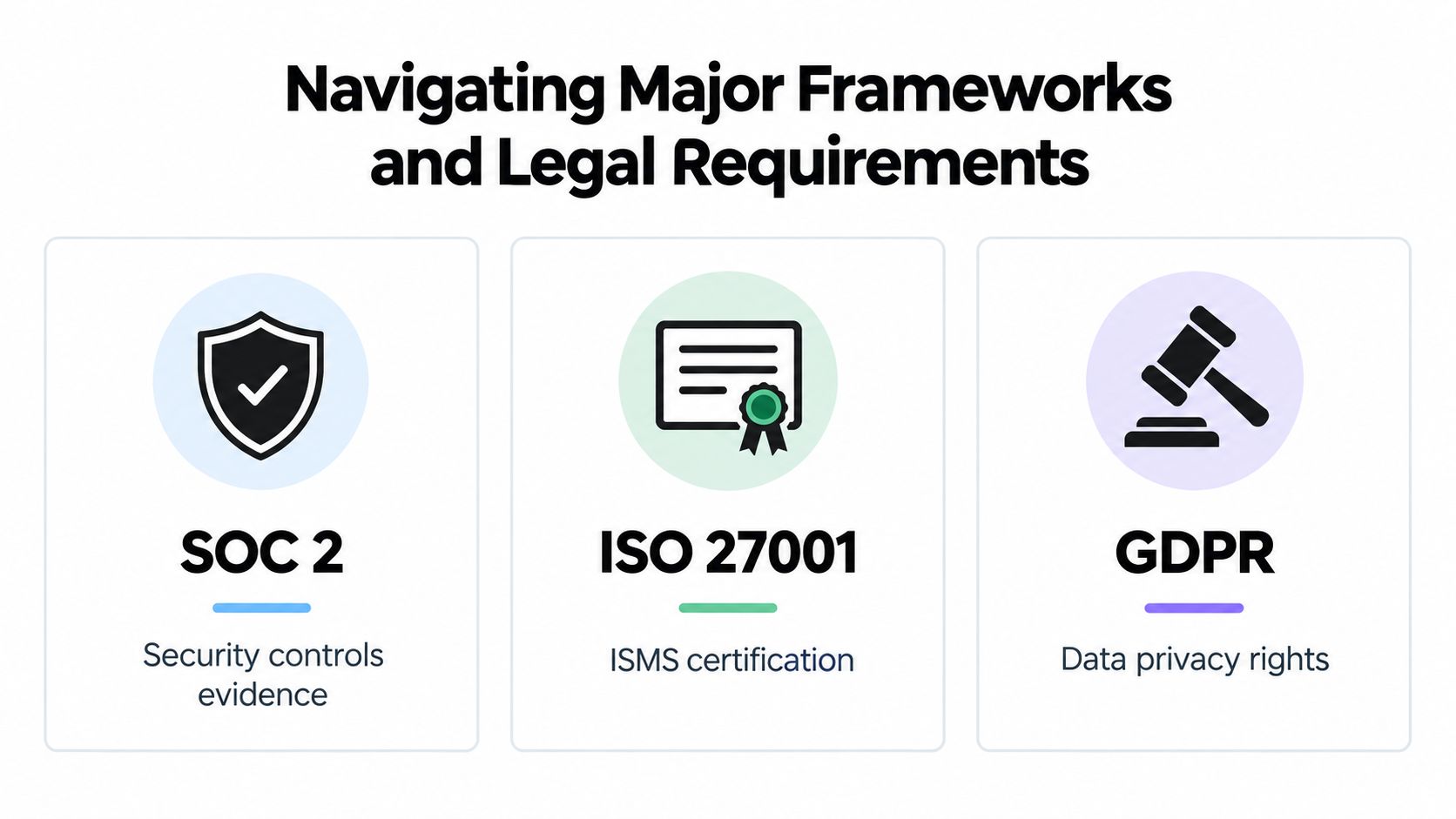
ISO 27001 has gained significant momentum among organizations selling to global enterprise buyers. In 2025, 81% of organizations reported current or planned ISO 27001 certification, up from 67% in 2024, according to Secureframe's compliance statistics. That movement reflects buyer demand for a recognized management standard, but certification alone doesn't prove that every product, region, or cloud account falls within the relevant scope.
What buyers expect from each requirement
| Requirement | Primary buyer or regulator question | Evidence teams usually need |
|---|---|---|
| SOC 2 | Do the stated controls operate effectively for the service under review? | Control descriptions, access reviews, change records, incident records, monitoring outputs, and independent examination evidence |
| ISO 27001 | Does the organization operate a risk-based information security management system? | Risk treatment decisions, policies, control applicability, internal reviews, corrective actions, and technical control evidence |
| GDPR | Does the organization process personal data lawfully and protect individual rights? | Data inventories, processing records, processor oversight, retention rules, access controls, deletion workflows, and incident procedures |
| CCPA | Can the organization handle consumer privacy requests and protect personal information? | Data discovery, request handling records, disclosure practices, retention decisions, and safeguards appropriate to the data |
SOC 2 is often attractive to SaaS companies because it gives buyers an independent view of controls relevant to a service. Its usefulness depends on the examination scope and the period covered. A report for one product or environment won't automatically answer questions about a newly launched service or a separate tenant architecture.
ISO 27001 provides a broader management structure. Its value comes from connecting risk assessment, ownership, policies, control selection, monitoring, and continual improvement. Teams pursuing this route should avoid building a separate evidence process for every customer. A shared control library can map one access review, deployment record, or incident exercise to several customer and framework requirements.
Privacy obligations require operational workflows
GDPR and CCPA create a different kind of pressure. Security teams can't satisfy privacy obligations with a security certificate alone. They need to know where personal data lives, which vendors can access it, how long the business keeps it, and how the organization responds when an individual exercises a privacy right.
A practical control model maps common technical foundations across the requirements:
- Identity and access: Limit access to the data and systems relevant to each role.
- Data discovery: Maintain an accurate view of personal, confidential, and regulated data.
- Retention and deletion: Connect policy to application workflows, backups, exports, and vendor systems.
- Incident response: Preserve evidence and define who assesses security and privacy impact.
- Supplier governance: Verify that processors and subprocessors meet contractual and technical expectations.
For teams that need a software workflow around SOC 2 evidence, a SOC 2 compliance software resource can help structure control ownership and collection. The tool won't decide the correct legal scope, but it can reduce duplicated requests when the underlying control environment is designed properly.
The Dangerous Gap Between Policy and Enforcement
A policy says what the organization expects. A control proves what the systems permit, prevent, record, or automatically escalate. Confusing those two is one of the most dangerous mistakes in enterprise security compliance.
Recent survey data illustrates the gap in AI governance. 70% of organizations have AI policies, but only 37% have purpose binding, 40% have kill-switch capabilities, and 61% have fragmented logs across systems, according to the Kiteworks data security and compliance report. A policy may prohibit an AI agent from using customer data for an unrelated purpose, but that prohibition has little practical value if the agent's tools, tokens, and data connectors don't enforce the boundary.
Test the control, not the document
Security leaders should ask concrete questions about every AI or automation policy:
- Purpose restriction: Can the system technically prevent an agent from calling a tool outside its approved purpose?
- Access boundary: Does the agent receive narrowly scoped credentials, or does it inherit a broad user or service account?
- Termination: Can an operator stop a running workflow quickly without waiting for a deployment?
- Evidence quality: Do logs capture the actor, action, resource, decision, and outcome in a form that investigators can use?
- Data handling: Are sensitive fields masked or excluded from logs, prompts, analytics, and exports?
- Escalation: Does the system route uncertain, high-risk, or sensitive requests to a human?
These questions expose whether governance is operational. A handbook can say that employees must not paste confidential information into an AI tool, but only technical restrictions, monitoring, and training can reduce the chance of that rule being ignored.
A compliance policy describes the desired behavior. An enforceable control makes the undesired behavior difficult, visible, or impossible.
Fragmented logging creates a second failure. If identity events sit in one platform, model activity in another, application actions in a third, and escalation records in a ticketing system, an auditor or incident responder may be unable to reconstruct a decision. The organization may possess many logs but still lack an audit trail.
A practical compliance support guide should help teams connect policy statements to owners, technical settings, review frequencies, and retained evidence. The test is simple: select a recent high-risk action and ask whether an independent reviewer can determine who initiated it, which permissions applied, what data the system accessed, what decision it made, and whether a human reviewed the outcome.
Building a Continuous Compliance Roadmap
Continuous compliance starts with scope discipline. Don't attempt to remediate every possible weakness at once. Define the products, cloud accounts, regions, personnel, vendors, data stores, and integrations that support the customer-facing service, then rank controls by business risk and buyer demand.
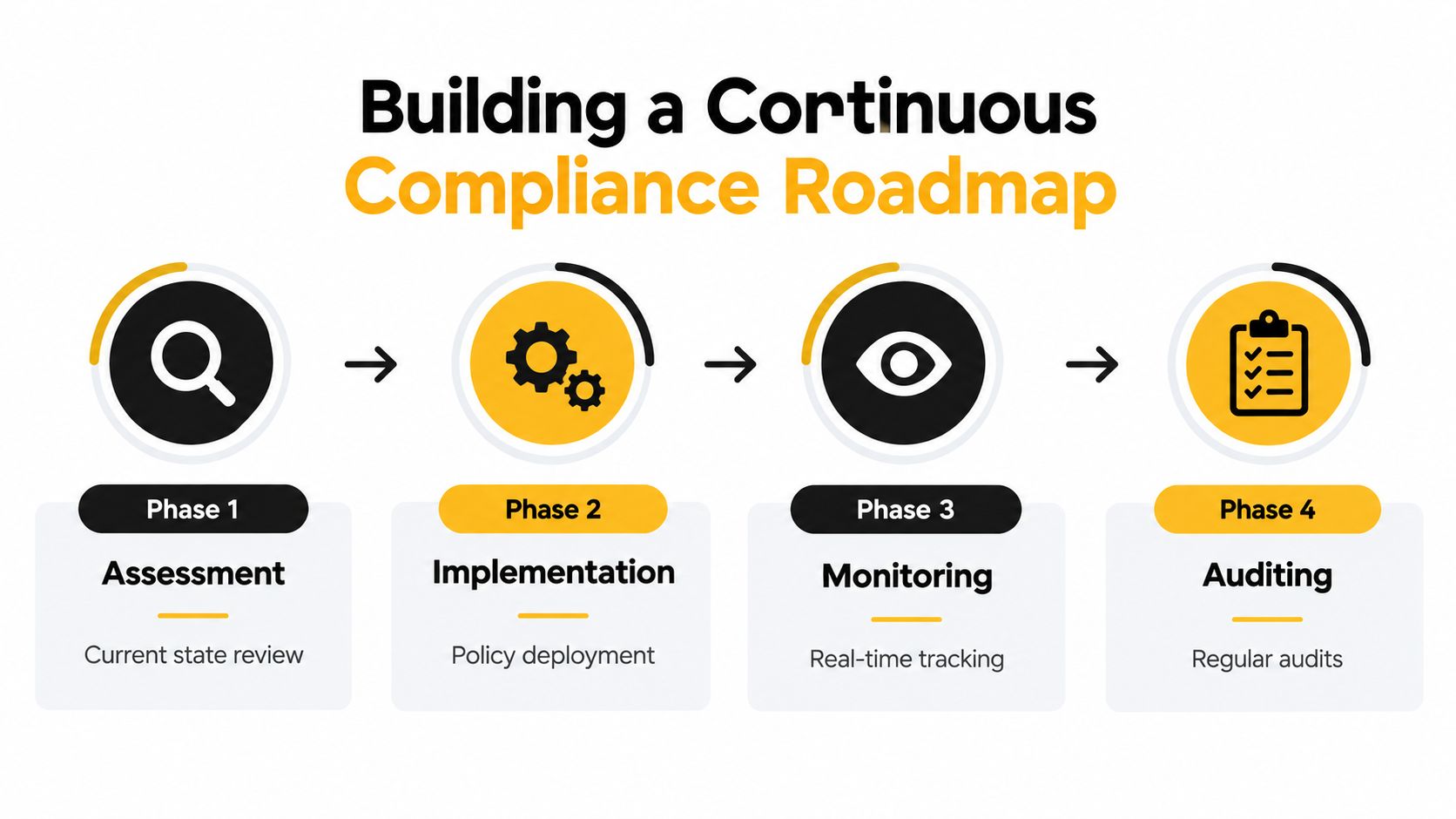
Phase one establishes the boundary
Create an authoritative inventory of production assets, administrative identities, data categories, third-party connections, and critical business processes. Record which framework or contract requirement applies to each area. If the team can't explain what falls inside the audit boundary, it can't defend the boundary when a buyer asks about a supporting service.
Then identify control owners. Ownership should sit with the person who can change the system or process, not only with the compliance manager. The infrastructure lead may own logging, the identity lead may own access reviews, and the engineering manager may own secure release evidence.
Phase two turns requirements into controls
Start with foundational controls that support multiple obligations:
- Identity: Enforce SSO where appropriate, least privilege, strong authentication, joiner and leaver workflows, and periodic access reviews.
- Cloud configuration: Define approved settings for storage, encryption, network access, backups, and administrative activity.
- Vulnerability management: Assign findings to accountable teams and document risk acceptance when remediation isn't immediate.
- Change management: Link production changes to reviews, testing, approvals, and rollback plans.
- Incident response: Preserve contact paths, severity criteria, investigation records, and post-incident actions.
Integrate these tasks into existing engineering workflows. A control that requires a separate spreadsheet and an email reminder will eventually drift. A control attached to pull requests, identity providers, cloud policy checks, and ticket states is easier to operate and test.
Phase three monitors exceptions
Monitoring should focus on changes that can invalidate an assertion. Examples include a privileged role granted outside the approved workflow, logging disabled for a production service, a backup test that fails, or an AI integration receiving a new data source. Automate the signal, assign a human owner, and preserve the resolution.
A practical 2026 security roadmap from By Design Law Firm & Legal Consultancy, PLLC can provide useful planning context for organizations aligning legal requirements with cloud security work. The legal view should complement, not replace, technical validation.
Phase four invites independent scrutiny
Before an auditor arrives, run an internal evidence test. Select representative controls and ask owners to produce current records without creating new documentation. Check whether the evidence identifies the system, period, responsible person, exception history, and review outcome.
You're ready for an external assessment when:
- The audit boundary matches the service sold to customers.
- Control owners can explain how their controls work.
- Evidence collection follows a repeatable process.
- Exceptions have documented risk decisions and remediation owners.
- Management reviews meaningful trends instead of only open checklist items.
That readiness standard is more useful than a claim that every control is perfect. Mature programs acknowledge exceptions, measure response, and show that the organization detects and corrects drift.
Meeting Guardrails and Access Requirements with SupportGPT
An AI support agent becomes part of the enterprise control boundary as soon as it can access product documentation, customer conversations, account information, or operational tools. Procurement teams will ask how the agent is authenticated, what it can retrieve, how it handles uncertain answers, and what happens when a conversation needs human review.

The platform's enterprise setup includes encryption and compliance-oriented guardrails designed to protect data in transit and at rest, control access, and support monitoring of meaningful bot actions. Those features matter because an AI system should not rely on a general employee policy to prevent misinformation, inappropriate disclosure, or unauthorized actions. Guardrails need to constrain behavior at the point where the agent generates a response or invokes a tool.
Map product controls to audit questions
A security architect should map each platform capability to a control objective rather than accepting a feature list at face value.
- Single sign-on and role-based access: These controls help administrators limit who can configure agents, review conversations, change sources, or manage users.
- Encryption and restricted storage: These protections reduce exposure when the platform stores configuration, conversation, or operational data.
- Guardrails and source grounding: These mechanisms help keep responses on topic and reduce unsupported answers, but teams should still define review and escalation criteria.
- Human escalation: Natural-language rules can route complex or sensitive requests to designated teammates instead of allowing the agent to continue autonomously.
- Analytics and conversation tracking: These records help teams identify recurring failures, investigate incidents, and assess whether the deployed behavior matches the approved use case.
- Multilingual support and lead capture: These capabilities expand service coverage, but each new language, form, or workflow should be included in the data-flow and access review.
Access governance is often weakest in growing companies because teams add administrators informally as the product expands. A practical access governance framework for SMEs can help smaller security teams formalize ownership, approvals, and review cycles without building an enterprise bureaucracy.
A compliant deployment also needs limits around AI Actions. Each action should have a defined purpose, narrow permissions, input validation, an approval path where appropriate, and a record of the outcome. If an agent can create a ticket, update a customer record, or trigger a workflow, the organization should be able to identify the initiating conversation and the authorization that allowed the action.
The following product demonstration shows how an AI support workflow can be deployed and managed in practice.
Teams should test failure paths before enabling production access. Submit ambiguous questions, request restricted information, trigger escalation conditions, revoke a user, and inspect the resulting records. A platform can provide useful security capabilities, but the customer still owns configuration, source quality, role assignment, retention decisions, and the evidence that proves those settings remain correct.
Mastering Audit Trails and Technical Evidence
Auditors don't only ask whether a control exists. They ask whether it operated, who reviewed it, what happened when it failed, and whether the evidence can be trusted. That makes audit trails a technical control, not merely a reporting feature.
NIST guidance says organizations should review, protect, and retain audit logs with controls proportional to risk. It also calls for documented encryption and log-management policies, which means teams should centralize relevant events, restrict modification rights, protect logs in transit and at rest, and define review expectations in a NIST audit and accountability reference.
Design evidence at the source
A useful event record answers five questions:
- Who acted: Capture the user, service account, agent, or administrator responsible.
- What happened: Record the action, decision, configuration change, or access request.
- Which resource was affected: Identify the application, record, environment, tenant, or data category.
- When it happened: Use consistent timestamps and preserve ordering across systems.
- What followed: Record success, failure, escalation, rollback, or remediation.
Protect the log pipeline itself. Administrators who can alter or delete the only record of their actions undermine the evidence. Use separate permissions for log generation, access, retention management, and investigation. Send critical events to centralized storage, protect them from unauthorized modification, and alert when collection stops.
ISO 27001:2022 makes this discipline especially important. Annex A contains 93 controls split across Organizational, People, Physical, and Technological themes, creating a substantial need for machine-checkable technical proof across areas such as access, cryptography, logging, backups, vulnerability management, network security, and secure development (control mapping reference).
Connect evidence to control objectives
Screenshots can show a configuration at one moment, but they rarely prove that the setting stayed correct or that someone reviewed exceptions. Prefer evidence generated by the systems that enforce the control. Export access review results, change tickets, deployment approvals, vulnerability status, backup test results, and incident records with the relevant identifiers attached.
The Beyond Surplus audit trail guide offers useful context for structuring reporting and traceability. In practice, the strongest evidence package links the control objective, system owner, collection method, review date, exception, and resolution in one chain.
Retention needs a deliberate policy. Keep enough information to investigate events and satisfy contractual or regulatory expectations, but don't retain sensitive data indefinitely just because storage is inexpensive. A practical data retention policy guide can help teams connect retention periods to data categories, business purpose, deletion workflows, and legal holds.
The final test is reproducibility. Give an auditor or internal reviewer a control assertion and ask them to trace it from requirement to configuration, event record, review, exception handling, and management decision. If the chain depends on an engineer's memory, the control isn't operating efficiently enough.
Turning Compliance into a Competitive Advantage
Enterprise security compliance creates commercial value when it shortens the distance between a buyer's question and a defensible answer. Sales teams can respond faster when the security boundary is documented, control owners are known, and evidence is already organized. Procurement teams gain confidence when the vendor explains not only which framework it follows, but how access, logging, data handling, and incident response work in the purchased service.
The strongest message isn't “we passed an audit.” It is “we can show how our controls operate, how we detect drift, and how we respond when something changes.” That position is more credible because enterprise buyers understand that certificates and reports have defined scopes, while cloud environments and business processes continue to evolve.
Use compliance evidence carefully in sales materials:
- Explain scope: Identify the service, environment, and operational processes covered.
- Describe control behavior: Show how identity, encryption, logging, retention, and escalation work.
- Answer exceptions directly: State what is outside scope or still being remediated.
- Provide traceability: Use source attribution and records that connect responses to approved evidence.
Reliable source attribution practices also matter for AI-generated support. Customers need to distinguish documented product information from an agent's interpretation, especially when the conversation involves security, contracts, or regulated data.
Compliance is a permanent operating discipline, not a finish line. Companies that automate evidence collection, enforce AI guardrails, and review control drift can turn security assurance into a sales capability instead of an obstacle that appears late in procurement.
SupportGPT provides guardrailed AI support agents with access controls, encryption-oriented protections, analytics, conversation tracking, multilingual assistance, human escalation, and AI Actions for controlled automation. Visit SupportGPT to evaluate how a managed support agent can fit into your continuous enterprise security compliance program.