Grow with ecommerce and customer service through AI-powered support
Revamp ecommerce and customer service from cost centers into a growth engine. Scale support with AI, streamlined workflows, and key metrics.
Top-tier ecommerce and customer service isn't just a nice perk anymore; it's the bedrock of a successful online business. Think of it as having the world's best shopkeeper—one who knows your customers, anticipates their questions, and is available 24/7, anywhere in the world. This means customer service has to evolve from a reactive, problem-solving department into a proactive engine for growth that builds real, lasting loyalty.
Why Traditional Ecommerce And Customer Service Is Broken

Imagine your local corner store was suddenly expected to serve the entire globe, all at once, around the clock. That’s the reality for online businesses. The classic 9-to-5 model—just a phone number and an email inbox—simply can't keep up with the sheer scale and speed of modern ecommerce. It’s an old-world approach that’s completely broken for today’s always-on, channel-hopping shopper.
The root of the problem is a huge gap between what customers expect and what traditional support teams can actually provide. People aren't just buying products anymore; they're buying an entire experience. They want instant answers and personalized help wherever they happen to be, whether that’s your website, a mobile app, or deep in their social media feed.
The New Reality of Customer Expectations
The internet has permanently raised the bar for customer service. Shoppers have endless choices just a click away, and this has created a new set of demands that older support models just can't handle. With global online retail sales projected to hit a massive $6.86 trillion in 2025, the volume is only going to grow.
This explosive growth has reshaped expectations. A staggering 52% of global shoppers now expect support to be available 24/7, and 73% of retail shoppers use multiple channels to interact with a brand before making a purchase. This means you have to deliver consistent, high-quality service everywhere—from your own online store to marketplaces like Amazon. You can dig into more of these ecommerce customer service statistics on eDesk.com.
The modern customer journey isn't a straight line. It’s a messy, fluid path that weaves across different devices and platforms. A customer might see a product on Instagram, research it on their laptop, and finally buy it on their phone, expecting seamless support at every single touchpoint.
This multi-channel reality puts immense pressure on support teams. If you’re still relying on separate tools and manual processes, you'll quickly get buried. The result? Slow responses, frustrated customers, and lost sales. Every unanswered social media comment or delayed email is a crack in the foundation of your customer experience.
From Cost Center to Revenue Driver
For decades, many businesses treated customer service as a necessary evil—a "cost center" meant to put out fires. That mindset is completely outdated. In the cutthroat world of ecommerce, fantastic support is one of your most powerful competitive advantages and a direct path to more revenue.
Great service doesn't just solve problems; it builds the business.
- It boosts conversions: Answering a pre-sale question instantly on a product page can be the final nudge a customer needs to click "add to cart."
- It increases Customer Lifetime Value (CLV): Positive support interactions build trust, which leads to repeat business and turns casual buyers into brand advocates.
- It enhances your brand reputation: Happy customers leave glowing reviews and tell their friends about you, creating the best kind of organic marketing there is.
So, the central challenge is clear: how can you meet these intense demands for instant, multi-channel support without your budget spiraling out of control? This is the very question that sets the stage for the modern, AI-powered solutions we're about to explore.
How AI Is Reshaping Customer Expectations
Artificial intelligence isn't some far-off, futuristic idea anymore. It's already here, working quietly behind the scenes of our daily lives. Think about how Netflix seems to read your mind, suggesting the perfect movie, or how Waze reroutes you around a traffic jam you didn't even know was there. This same kind of smart technology is now setting a whole new standard for ecommerce and customer service, and it’s changing what shoppers expect from every brand they interact with online.
Simply put, customers don't have the patience for slow, clunky, or generic support anymore. They’ve seen what fast and intuitive feels like in other parts of their lives, and now they expect that same level of service everywhere. This isn't about replacing people with robots; it’s about using AI to build a support experience that's smarter, faster, and more personal—one that feels completely effortless for the customer.
The New Demand for Instant and Personal Support
Today’s shoppers are always on and operate on their own time, and they expect the businesses they buy from to keep up. AI is what makes 24/7, on-the-spot support possible. Instead of firing off an email about a tracking number and waiting half a day for a reply, customers now expect to get that answer instantly from a chat widget on your site, whether it's 2 PM or 2 AM.
But it goes deeper than just speed. Shoppers want to feel understood, and that means support needs to be personal. AI allows for hyper-personalization on a massive scale, something that was just a pipe dream a few years ago. It can look at a customer's browsing history and past purchases to offer genuinely helpful advice. For example, if someone is looking at a new camera lens, an AI assistant can chime in and let them know if it's compatible with the camera they bought last year.
The numbers back this up. A massive 91% of shoppers say they are more likely to buy from brands that offer relevant, personalized recommendations. Better yet, companies using AI personalization tools report revenues up to 40% higher than their competitors. The link between intelligent support and a healthier bottom line is crystal clear. You can dig into more data by exploring these ecommerce statistics on Elementor.com.
Proactive Problem Solving Before It Happens
Truly great service isn't just about fixing problems—it's about stopping them from happening in the first place. This is where AI really shines. It gives businesses the ability to spot potential snags and sort them out before the customer is even aware there's an issue.
Picture this: your logistics system flags that a batch of shipments heading to the Pacific Northwest is delayed because of a snowstorm. Instead of bracing for a wave of "Where is my order?" tickets, an AI system can automatically send a personalized heads-up to every single affected customer. The message can include a new delivery estimate and a quick apology for the delay.
This proactive move completely flips the script. What could have been a frustrating experience becomes a moment where the customer feels taken care of. It shows them you're on top of things and that you value their business, which is how you build real, lasting loyalty.
The new gold standard in ecommerce support is a hybrid model. Customers want the lightning-fast efficiency of AI for routine tasks, but they also demand a seamless, one-click handoff to a human agent for complex or emotional issues.
This blended approach truly delivers the best of both worlds. An AI agent can field the endless stream of simple, repetitive questions—things like order status updates or return policy details. This frees up your human experts to dedicate their time to the situations that actually require a human touch: empathy, creative problem-solving, and nuanced judgment.
The result is a super-efficient system that doesn't feel cold or robotic. A customer can start a conversation with an AI, get an instant answer, and if things get tricky, be transferred to a real person who already has all the context. This is the new baseline for staying competitive.
Building Your Modern Ecommerce Support Stack
Moving from theory to action means having a solid blueprint. Building a modern support system for your ecommerce store is a lot like constructing a layered defense; each tier is designed to handle specific customer inquiries with maximum efficiency. The goal is to create a structure where simple questions get instant answers, while the truly complex issues get the expert human attention they deserve.
This isn't just about throwing a bunch of tools together. It's about creating a cohesive "support stack" that guides customers on a frictionless journey. The whole point is to resolve issues at the lowest, fastest, and most cost-effective layer possible, only escalating when you absolutely have to. This approach doesn't just make customers happier; it frees up your valuable human agents to focus on the high-impact conversations that actually build loyalty and drive sales.
The diagram below shows how AI is becoming the central nervous system of this modern stack, powering everything from speed and personalization to a powerful hybrid support model.
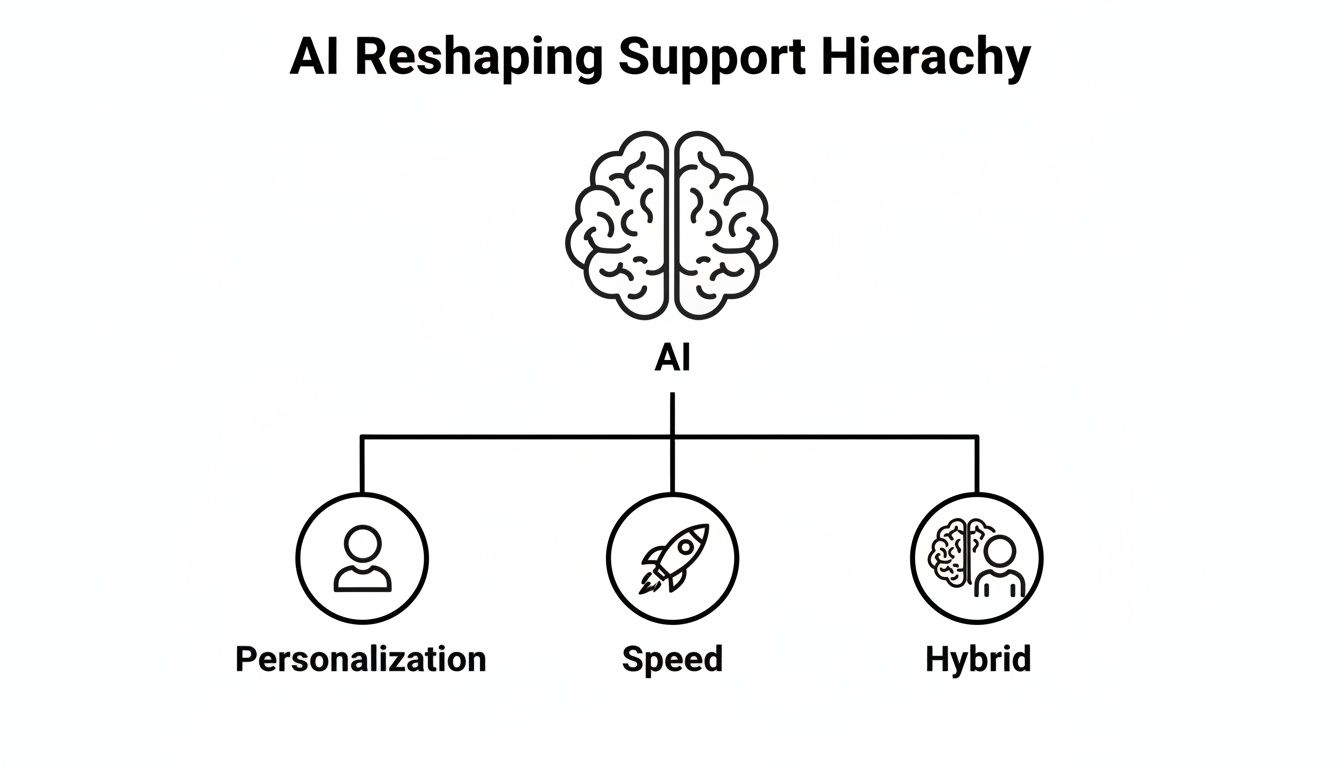
As you can see, AI isn't just one piece of the puzzle. It's the foundational brain that makes every other part of the customer experience smarter, from hyper-personalized interactions to lightning-fast resolutions.
The Self-Service Foundation
The first and most important layer is self-service. Think of this as your store's digital encyclopedia—a rich knowledge base packed with FAQs, how-to guides, and detailed product information. This foundation lets customers find their own answers on their own time, which, it turns out, is what most of them prefer anyway.
A well-built self-service portal is your first line of defense against a tidal wave of repetitive questions. We've seen that 40-60% of common support queries can be completely deflected with good self-service resources. That's a massive load off your support team and gives customers the immediate answers they expect.
The AI-Powered First Responder
Next up is your intelligent, AI-powered agent. This isn't your parents' clunky chatbot that only understands rigid, pre-programmed commands. A modern AI agent acts as a smart first responder, available 24/7 across all your channels—from your website's live chat to your social media DMs.
This AI layer has a few critical jobs:
- Instant Answers: It pulls information directly from your knowledge base to answer common questions on the spot.
- Intelligent Triage: It's smart enough to understand what a customer wants and can figure out if the issue is simple or needs a human touch.
- Data Collection: It gathers all the necessary context—like order numbers or customer details—before an issue ever gets escalated.
This layer ensures no customer is left hanging, waiting for a reply. For businesses looking to see this in action, platforms like SupportGPT show what's possible when it comes to building AI agents that can be trained on your specific business data.
The Expert Human Team
The final layer is your expert human support team. By the time a ticket lands in their queue, it’s already been filtered through the self-service and AI layers. This means your agents are no longer drowning in a sea of "Where is my order?" tickets.
Instead, they get to focus their expertise on the interactions that really count:
- Solving complex, multi-part problems that require genuine critical thinking.
- Providing empathetic, high-touch support for frustrated or high-value customers.
- Assisting with high-consideration purchases that can directly lead to a sale.
In this model, your human agents transform from reactive ticket-solvers into proactive customer success advocates. They become the heroes who handle the toughest cases, building real customer relationships along the way.
Comparing Support Stacks
Let's be clear: the difference between a traditional, human-only support model and a modern, AI-enhanced stack is night and day. The modern stack delivers a far better customer experience at a fraction of the operational cost—a true win-win for everyone.
This table breaks down the practical differences.
Comparing Traditional vs AI-Enhanced Support Stacks
| Metric | Traditional Support Stack | AI-Enhanced Support Stack |
|---|---|---|
| Availability | Limited to agent work hours (e.g., 9-to-5) | 24/7/365, instant global support |
| First Response Time | Hours or even days, depending on queue size | Seconds or milliseconds for AI responses |
| Cost Per Interaction | High, tied directly to agent salary and time | Extremely low for automated interactions |
| Scalability | Poor, requires hiring more staff for growth | Excellent, AI handles volume spikes effortlessly |
| Consistency | Varies by agent, susceptible to human error | Perfectly consistent, brand-aligned answers |
By adopting this layered approach, you’re not just answering tickets. You’re building a resilient, scalable system where ecommerce and customer service work together seamlessly to power your company's growth.
Measuring The Metrics That Actually Matter
Investing in your support stack is a smart move, but how do you actually prove it’s paying off? To show a real return, you have to look past the vanity metrics and zero in on the Key Performance Indicators (KPIs) that truly reflect customer happiness and operational muscle. When you track the right data, your customer service stops being a cost center and starts becoming a measurable engine for growth.
Think of these KPIs as the vital signs for your entire customer experience. They tell you exactly what you’re doing right and shine a spotlight on the areas that need a little more work. Combine this data with a smart AI strategy, and you can start showing a tangible impact on the bottom line.
First Response Time: The Speed That Wins Customers
First Response Time (FRT) is simple: it’s how long a customer has to wait for that first reply after reaching out. In ecommerce, speed is everything. A long wait is the digital equivalent of being ignored in a physical store, and today’s shoppers just don’t have the patience for it.
A slow FRT leads straight to frustration, and worse, abandoned carts. On the flip side, a quick response instantly shows you value your customer's time and are ready to help. This one metric is a powerful gauge of your team’s responsiveness and its ability to handle the daily flow of questions.
This is where AI gives you an almost unfair advantage. Your human team might take hours to reply during a sales rush, but an AI agent responds in milliseconds.
- Always On: AI agents don't sleep. They're available 24/7, making sure every customer gets an instant acknowledgment, day or night.
- Instant Triage: The AI can immediately ask for key details like an order number, categorizing the issue before a human agent even sees the ticket.
- Immediate Answers: Our own data shows that a staggering 40-60% of common queries can be fully resolved by a self-service or AI-powered system without any human help.
By putting an AI agent on the front lines, you can cut your average FRT from hours down to seconds, completely changing the first impression you make on every single customer.
Customer Satisfaction Score: The Voice of Your Shopper
Customer Satisfaction (CSAT) is the most direct way to find out how people feel about your service. It usually comes from a simple post-chat survey asking something like, "How would you rate the support you received?" This gives you a clear, immediate pulse on customer sentiment.
A high CSAT score is a fantastic indicator of customer loyalty and is directly tied to repeat business and glowing reviews. It answers the most important question of all: "Did we actually solve the problem and make the customer happy?"
Traditionally, getting insights from CSAT meant someone had to manually read through all the comments to spot trends. An AI-powered approach does this automatically, digging through thousands of conversations to find hidden friction points or product flaws you never knew you had.
Imagine an AI analyzing all your low-CSAT conversations and discovering that 25% of them mention a confusing step in your checkout process. That’s not just feedback; it's a data-backed directive to fix a specific problem on your site, turning customer complaints into real, actionable improvements.
Resolution Rate: Proving You Actually Solve Problems
Resolution Rate measures the percentage of customer issues your team successfully closes. While FRT is about speed and CSAT is about feelings, Resolution Rate is all about effectiveness. A fast, friendly reply means nothing if the customer's problem is still there.
A high resolution rate proves your team is well-trained and has the tools to get the job done. A low rate, however, can signal gaps in training, broken internal workflows, or even product issues that your support team can't solve on their own.
AI gives this metric a direct boost in a few key ways:
- Consistent Accuracy: By pulling answers from a single, controlled knowledge base, an AI delivers the right information every time, which means more issues are solved on the first try.
- Smarter Escalations: Before handing off a complex problem, the AI agent gathers all the necessary context, so the human agent has everything they need to solve it quickly.
By keeping a close eye on these three core metrics—FRT, CSAT, and Resolution Rate—you get a complete, 360-degree view of your ecommerce and customer service performance. This data empowers you to make smarter decisions, prove the value of your support investments, and ultimately build an experience that keeps customers coming back for more.
A Step-by-Step Guide to Implementing AI Support
Bringing AI into your support workflow doesn't mean you need a team of data scientists or a bottomless budget. With a smart, structured plan, any ecommerce business can launch a powerful AI assistant that elevates the customer experience and, just as importantly, frees up your human team to do what they do best.
Think of it like training a new, incredibly fast employee. You wouldn't just throw them in the deep end on day one. You'd start with the basics, give them clear instructions, and check in on their progress. The same logic applies when you're setting up an AI agent for your ecommerce and customer service.
Step 1: Identify and Prioritize Repetitive Queries
Before you build a single thing, you need a blueprint. Your first move is to dig into your existing support tickets and pinpoint the most common, high-volume questions your team answers over and over again. These are the perfect first targets for automation.
Start looking for patterns in your helpdesk. Are you constantly fielding questions like:
- "Where is my order?"
- "What's your return policy?"
- "Do you ship to my country?"
- "When will this be back in stock?"
These types of questions are ideal for an AI because they have clear, factual answers. By handing them off to automation, you can immediately deflect a huge chunk of your ticket volume. In fact, research shows that 40-60% of typical support queries can be handled through self-service and automation, giving your team back valuable time for more complex issues.
Step 2: Train the AI on Your Knowledge Base
Once you know what to automate, you need to teach your AI how to do it. Modern AI platforms don't require complex coding; they learn directly from the content you've already created. You just need to point them to your trusted sources of information.
This process is as simple as feeding the AI your:
- Help Center Articles: Your entire library of FAQs and how-to guides.
- Website Content: Product pages, shipping policies, and about-us sections.
- Product Documentation: Any technical specifications or user manuals you have.
The AI ingests this material to build its brain, ensuring it only provides answers based on your approved information. This creates a secure, closed loop that prevents the AI from making things up or pulling from random corners of the internet.
For example, a tool like SupportGPT lets you simply add sources like your website or upload files to train your AI agent.
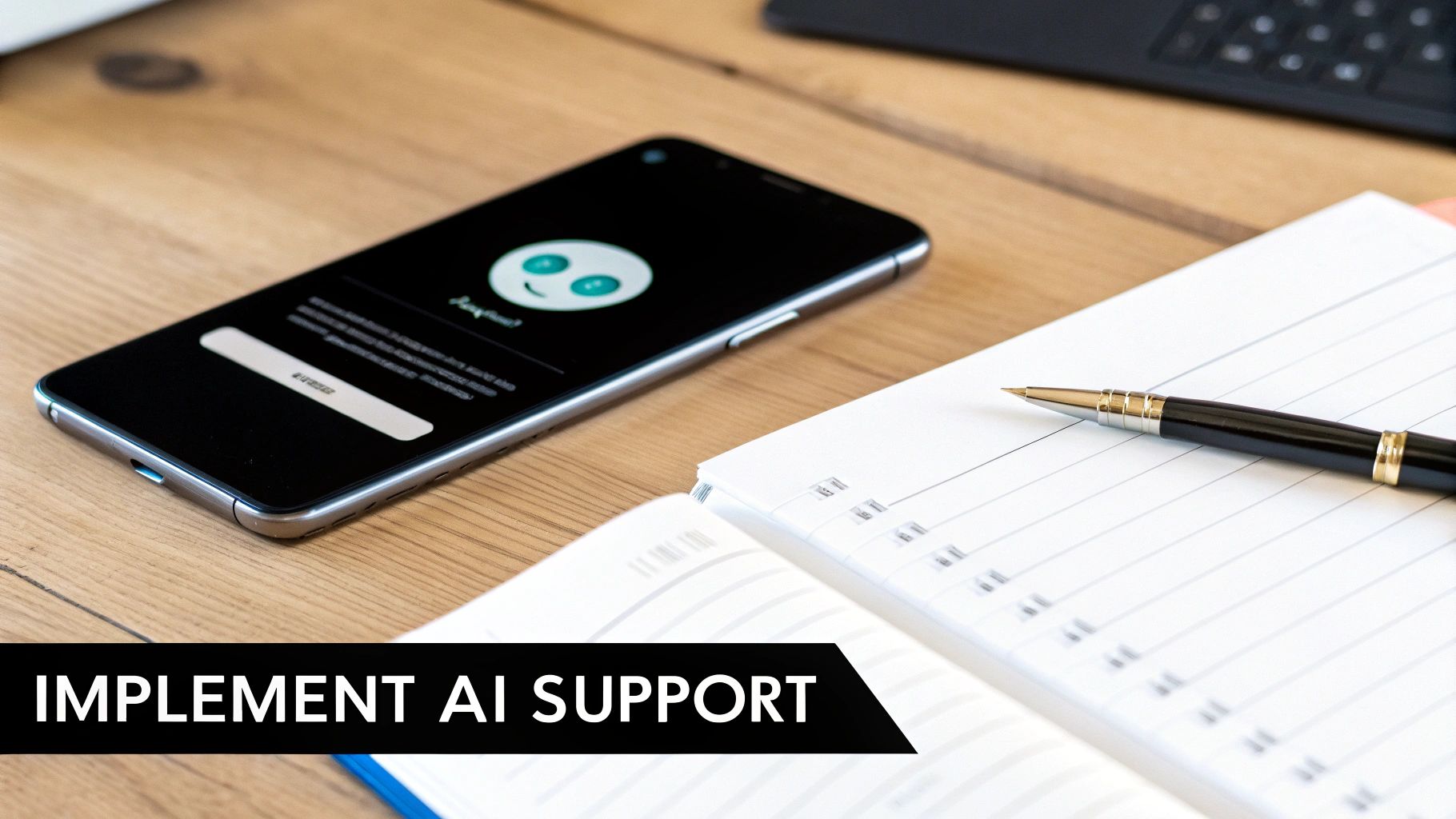
The interface makes it clear that non-technical users can build a knowledgeable AI assistant just by pointing it to their existing content.
Step 3: Define Smart Escalation Rules
Let's be realistic: your AI agent won't be able to solve every single problem, and that's actually a good thing. The goal here is to augment your team, not replace it. The trick is to define clear, intelligent rules for when a conversation should be handed off to a human agent.
Smart escalation is the bridge between AI efficiency and human empathy. It ensures customers get the speed of automation for simple issues and the nuanced understanding of a person for complex ones, creating a seamless support experience.
You can set up rules based on keywords (like "complaint" or "damaged"), customer sentiment, or if a user simply types "talk to a person." This guarantees that high-priority or emotionally charged issues are routed to your expert team immediately, with the AI providing the full context of the conversation so far.
Step 4: Deploy Across Key Customer Channels
With your AI trained and your escalation rules locked in, it's time to go live. The key is to meet your customers where they already are. Deploy the AI agent across your most important channels to provide a consistent, helpful experience everywhere.
Start with your highest-traffic touchpoints, such as:
- Your Website: A live chat widget is the most common and effective starting point.
- Mobile App: If you have one, embed the AI for in-the-moment support.
- Social Media DMs: Connect it to platforms like Facebook Messenger or Instagram.
This multi-channel presence means customers get instant answers, no matter how they choose to get in touch with your brand.
Step 5: Monitor Performance and Refine
This isn't a "set it and forget it" project. The final, ongoing step is to keep an eye on your AI's performance and use real-world data to make it smarter over time.
Track key metrics like its resolution rate, common questions it couldn't answer, and customer satisfaction scores. This feedback loop is gold—it will show you exactly where the gaps are in your knowledge base and how you can improve the AI's responses, ensuring your ecommerce and customer service only gets better.
Common Questions About AI in Ecommerce Support
Bringing any new technology into your business is a big decision, and AI is no exception. For most ecommerce leaders, the idea of an AI-powered support agent immediately brings up questions about cost, complexity, and what it means for their human team. The good news is that today's AI tools were built to solve these exact problems, making powerful automation accessible to everyone.
Let’s walk through some of the most common questions we hear from businesses, with straightforward answers to help you see where this technology fits.
Will an AI Agent Replace My Human Support Team?
This is usually the first question that comes up, and the answer is a firm no. The real goal here is augmentation, not replacement. An AI agent is designed to take on the flood of simple, repetitive questions that bog down your support team, freeing up your human experts for work that actually matters.
Think of the AI as your team’s most dedicated assistant. It’s on the front lines 24/7, fielding all those predictable questions like, "Where is my order?" or "What's your return policy?" This lets your human agents step away from putting out small, constant fires and focus on high-value conversations—the ones that need empathy, creative thinking, and real problem-solving skills.
The best support setups use a hybrid model. The AI acts as a tireless first line of defense, with a smart, seamless handoff to a human agent the moment a conversation gets complicated. This creates a more efficient team, a less frustrated customer, and a much smoother workflow.
This approach actually elevates the role of your support agents. They stop being reactive ticket-closers and become proactive customer advocates—the heroes who tackle the toughest cases, build real relationships, and turn bad situations into great experiences.
How Do I Ensure AI Provides Accurate and On-Brand Answers?
Control is another huge concern. Nobody wants an AI agent going rogue, giving out wrong information, or sounding like a robot that doesn't match their brand. Modern AI platforms are built specifically to prevent this, giving you complete command over what your agent says and how it says it.
You train the AI exclusively on your own trusted content. This can include:
- Your website pages and product descriptions
- Your official help center articles and FAQs
- Any product manuals or internal policy documents
This creates a "closed knowledge loop," which is just a fancy way of saying the AI can only pull answers from the sources you’ve approved. Enterprise-grade guardrails are built in to stop it from guessing, making things up, or answering questions outside its scope. You can even define its personality and tone of voice, ensuring every response aligns perfectly with your brand—whether you're friendly and casual or formal and professional.
Is Implementing an AI Support Solution Difficult or Expensive?
A few years ago, the answer would have been a definite yes. But things have changed fast. Today's no-code platforms are designed for simplicity, tearing down the technical and financial walls that used to keep businesses out.
Someone with zero technical experience can often build and launch a fully functional AI agent in just a few minutes. The process is usually as simple as pasting in a few links to your help docs and embedding a small snippet of code on your site.
The cost has become much more accessible, too. Many platforms, including SupportGPT, offer generous free plans for startups and small businesses, with pricing that scales as you grow. This means you don't need a huge upfront investment or a team of developers to get started.
How Does an AI Agent Handle Multilingual Support?
For any store selling internationally, offering support in a customer’s native language is a game-changer. Advanced AI agents make this incredibly easy. They are built on Large Language Models (LLMs) that have been trained on massive amounts of multilingual data, so they can automatically detect a user's language and reply in the same one—no extra setup required.
This means you can offer instant, 24/7 support to shoppers anywhere in the world. A customer in Japan can ask a question in Japanese and get an immediate, accurate answer in Japanese. It removes a major hurdle in global sales and dramatically improves the customer experience, making your brand feel local to everyone.
Ready to see how an AI agent can change your support experience? SupportGPT makes it easy to build and deploy a 24/7 assistant trained on your own content. Get started for free with SupportGPT and deliver instant, accurate answers to your customers today.