A Guide to E Commerce Customer Service That Builds Loyalty
Discover how to master e commerce customer service. This guide covers the essential strategies, metrics, and AI tools that build loyalty and drive sales.
At its core, e‑commerce customer service is how you help shoppers at every step of their journey, from the moment they land on your site to long after their package arrives. It’s more than just a help desk for when things go wrong.
Think of it as the human element of your online store. It's about creating genuinely positive, helpful interactions that build trust, close sales, and create loyal fans who keep coming back. After all, great service is what turns a one-time buyer into a lifetime customer.
Why E‑Commerce Customer Service Is Your New Sales Floor
Walk into any brick-and-mortar shop, and a good sales assistant is right there to greet you, answer questions, and point you toward the perfect item. They’re the face of the brand, making a simple errand feel like a great experience. In the online world, your customer service team fills that exact role.
Your support team is your digital sales floor. Every interaction is a chance to win over a customer or lose them for good. So, stop thinking about support as just another business expense. When a potential customer opens a live chat to ask about sizing, that's a sales conversation. When a regular emails about a return, that’s your chance to lock in their trust and set up their next purchase.
The Modern Shopper Expects Instant Gratification
Online shoppers don't keep 9-to-5 hours, and their patience for slow replies is practically zero. The standard today is instant, personalized, 24/7 support. If you can't meet that expectation, your competitors are just a click away.
Your digital storefront never closes, which means your customer service can't afford to, either. Every unanswered question or delayed response is a lost sale and a ding to your brand's reputation.
The data backs this up. A full 52% of global shoppers now expect support to be available around the clock. What's more, 64% of shoppers expect a response within an hour. For live chat—the channel with the highest satisfaction rating at 85%—anything less than an immediate reply just doesn't cut it. You can see more insights in recent e-commerce customer service trend reports.
This puts every growing online store in a tough spot. How do you deliver the exceptional, always-on service customers demand without your costs spiraling out of control? Answering that question is the key to scaling your business successfully.
Building Your Brand One Conversation at a Time
Every single support ticket, chat message, and social media comment is a building block for your brand's reputation. One bad experience can quickly turn into a scathing public review, but one fantastic interaction can create a loyal advocate who tells all their friends about you.
This is why investing in quality e‑commerce customer service is a direct investment in your brand's future. In a crowded market where products and prices look more and more alike, excellent service becomes your real differentiator. It’s your unique selling proposition, building a foundation of trust that keeps customers coming back long after that first click to buy.
From Chaos to Control: Structuring Your E-commerce Customer Service
Answering customer questions as they pop up might get you by in the early days, but it’s a recipe for disaster as your store grows. Before you know it, you're drowning in DMs, emails, and comments, and things start falling through the cracks. This is where a structured support system comes in.
Think of it as the central nervous system for your store. Instead of scattered messages and frantic searches, you have a clear, organized way to manage every single customer conversation. It’s the difference between firefighting and running a well-oiled machine, and it's the only way to deliver great e-commerce customer service at scale.
Choosing Your Core Support Channels
Your customers are everywhere, and your support needs to be too. But that doesn't mean you need to be on every single platform known to man. The key is to pick the right mix of channels that meet your customers where they are and match the urgency of their questions.
Most successful e-commerce stores build their support around a few essential channels:
- Live Chat: This is your front line. It's perfect for those quick, in-the-moment questions that can make or break a sale. Someone stuck at checkout or unsure about sizing? Live chat can solve that instantly and boost your conversion rates.
- Email Support: The reliable workhorse. Email is ideal for more complex issues that aren't time-sensitive, like handling a return request or troubleshooting a product problem. It also creates a helpful paper trail for everyone involved.
- Social Media Messaging: People will absolutely slide into your DMs on Instagram or message your Facebook page. Being responsive here is non-negotiable for managing your brand's reputation and providing quick, visible support.
To bring all this together, you need a good help desk platform. It acts as a unified inbox, pulling every chat, email, and social media message into one place as an organized ticket. No more lost messages or duplicated effort—just a single, clear view of every customer interaction.
A well-structured support system turns reactive firefighting into a proactive, streamlined operation. It ensures the most critical customer issues are always handled first, creating a calm, controlled environment even during busy periods.
Comparing Your Customer Service Channels
To build the right support mix for your business, it helps to understand where each channel really shines. This table breaks down the essentials, from live chat's instant gratification to email's thoroughness.
| Channel | Best For | Average Response Time Expectation | Key Benefit |
|---|---|---|---|
| Live Chat | Instant pre-sale questions, checkout assistance, quick product inquiries. | Under 2 minutes | Directly impacts conversion by removing purchase friction in real-time. |
| Detailed issues, return/exchange requests, non-urgent support. | Within 24 hours | Creates a documented record of the conversation for complex issues. | |
| Social Media | Quick public questions, brand engagement, reputation management. | Within 1-2 hours | Offers a public and personal way to show you're responsive and helpful. |
| Phone Support | Urgent or sensitive issues, complex troubleshooting, high-value customers. | Immediate (with hold times) | Provides a direct, human connection for resolving complicated problems. |
Choosing a blend of these channels gives customers the flexibility to contact you in the way that feels most comfortable for them, which is a huge win for their overall experience.
Designing Workflows for Common Inquiries
Once your channels are set up, it’s time to build workflows. These are just simple, repeatable recipes for handling your most common questions. For any online store, two of the biggest are "Where is my order?" and "How do I make a return?"
Creating a smooth path for these questions is a direct line to building customer trust and encouraging them to complete a purchase, as you can see here.
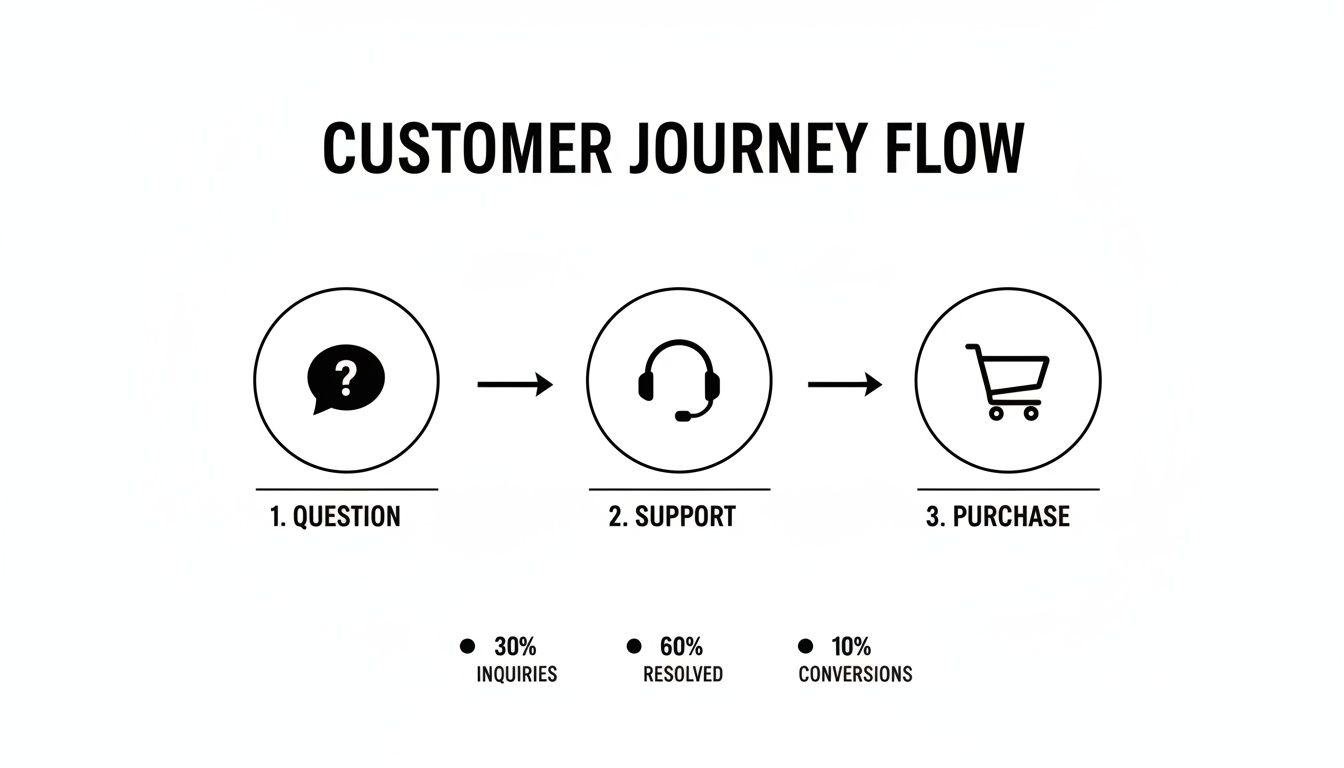
Let's walk through a real-world workflow for a classic "Where is my order?" (WISMO) ticket:
- Ticket Arrives: A customer emails asking for an order update.
- Automatic Tagging: Your help desk sees keywords like "where is my order" and automatically tags the ticket as "WISMO."
- Prioritization: It's a standard request, so it gets a normal priority. Nothing's on fire.
- Canned Response: An agent grabs a pre-written template, drops in the customer's tracking number and a link to the carrier's site, and hits send.
- Resolution: The ticket is solved in less than two minutes. The customer is happy, and your agent is free to tackle a more complex problem.
A return request might have a couple more steps, like checking the purchase date or creating a return label. By mapping out these simple processes, you make sure every customer gets the same fast, consistent, and helpful experience. This is the operational backbone that lets your e-commerce customer service grow without breaking.
Measuring the Metrics That Matter for Growth
In e-commerce, a "gut feeling" about your customer service just won’t cut it. To really get a handle on what’s working and what isn’t, you have to measure it. Without hard data, you’re flying blind—you have no way of knowing where your team shines or where customers are hitting a wall.
Tracking the right metrics is how you turn your support team from a cost center into a growth engine. These numbers tell a story. They give you concrete insights that can boost customer loyalty, make your operations more efficient, and ultimately, fatten your bottom line.
Moving Beyond Basic Definitions
It’s easy to get lost in an alphabet soup of KPIs (Key Performance Indicators). But the real magic isn't just knowing what CSAT or FCR stand for; it's understanding what they tell you about your business and how they connect to real-world results.
Think of these metrics as the dashboard in your car. A pilot wouldn't fly without checking altitude and speed, and you shouldn't run your business without monitoring these key indicators. A dipping satisfaction score, for example, is like a warning light flashing on your dashboard—it’s an early signal that you might be headed for customer churn.
Core Metrics for E Commerce Customer Service
To get a clear, actionable picture of your support performance, start by focusing on a few high-impact metrics. These three give you a balanced view, covering efficiency, immediate customer happiness, and long-term brand loyalty.
-
First Contact Resolution (FCR): This one is simple: what percentage of customer issues get solved in the very first conversation? No follow-up emails, no transfers, just a solution. A high FCR is a huge win. It means your team is efficient, well-trained, and has the authority to solve problems on the spot. Frankly, nobody likes having to explain their issue over and over again. A good target to aim for is an FCR of 70-75%.
-
Customer Satisfaction (CSAT): This is your classic "How did we do?" metric, usually asked right after an interaction. It gives you an immediate pulse check on how a customer feels about a specific support experience. A consistently high CSAT score is one of the strongest signs that you’re creating happy customers who are likely to buy again and leave positive reviews.
-
Net Promoter Score (NPS): This metric zooms out to look at the bigger picture. By asking "How likely are you to recommend us to a friend?", NPS measures long-term loyalty. It tells you if you're creating passionate brand advocates or, on the flip side, frustrated detractors who could harm your reputation with bad word-of-mouth.
Tracking these metrics isn’t about hitting arbitrary targets. It’s about understanding the story your data is telling. For example, a drop in CSAT scores after a new product launch could signal issues with product descriptions or shipping expectations.
Connecting Metrics to Business Impact
Let’s bring this down to earth. Imagine you notice your FCR for questions about returns is tanking. Customers have to start a chat, then send an email, then wait for another response just to get a shipping label. That’s not just a bad experience for them—it’s a costly problem for you.
Every extra touchpoint costs your business time and money. But if you use that data to build a self-service returns portal or give agents a one-click process to generate a label, you fix the problem at its source.
The result? Customers are thrilled because their problem is solved instantly, and your operational costs drop because agents are freed up to handle more complex issues. That’s the real power of tying metrics to action. By keeping a close eye on performance, you can pinpoint the exact friction points in your customer journey and make smart, targeted improvements. This is how you scale your e-commerce customer service effectively and build a more profitable, resilient business.
How AI Transforms Your Support Team
Let's get one thing straight: AI isn't here to replace your support team. It's here to give them superpowers. In e-commerce, AI works as the ultimate assistant, taking all the repetitive, predictable tasks off your team's plate. This frees up your people to focus on what they do best—building real relationships and solving the tricky problems that actually require a human touch.
Think of an AI-powered conversational agent like a tireless employee on your shop floor. It's on duty 24/7 and can instantly answer the most common questions customers have, like "Where's my package?" or "How do I make a return?" By automating these simple, high-volume questions, you give customers immediate answers and slash the number of tickets your team has to deal with.
It's a genuine win-win. Customers get the instant gratification they’ve come to expect, and your agents get to skip the monotonous work, dedicating their skills to the high-stakes conversations that really shape a customer's experience with your brand.
Automating the Everyday Customer Journey
The real magic of AI in e-commerce support isn't some far-off futuristic idea; it's in the practical, everyday things it can do right now. Modern AI agents are much more than the clunky chatbots of the past. They plug directly into your store's backend systems to pull real-time, personalized information for each customer.
This means they can handle a huge chunk of the customer journey without anyone needing to lift a finger.
Here are a few key tasks AI can manage on its own:
- Automated Order Tracking: The agent can instantly look up an order status and serve up a tracking link, solving the number one e-commerce question on the spot.
- Intelligent Product Recommendations: Based on what a customer asks or has looked at before, the AI can suggest relevant products—acting like a helpful digital sales assistant right in the chat window.
- Policy and FAQ Retrieval: The AI pulls exact answers from your knowledge base, making sure customers get consistent, accurate info about your shipping, returns, or product details every time.
This kind of automation is quickly becoming a non-negotiable part of the customer experience. The numbers back it up: AI is on track to resolve 30% of support cases by 2025, and that figure is expected to jump to 50% by 2027. Customers are already on board, with 51% saying they prefer using bots for quick questions. Smart, automated self-service isn't just a "nice-to-have" anymore; it's a must.
The Power of Smart Escalation
Of course, even the smartest AI knows when a problem is out of its league. This is where smart escalation comes into play. Instead of hitting a wall and telling the customer to send an email, a well-designed AI acts as an intelligent traffic cop. It gathers all the important info upfront—the customer's name, order number, and a quick summary of the problem—before seamlessly passing the conversation to a live agent.
Smart escalation means that when a human agent joins the chat, they have the full story. They can resolve the issue quickly and personally without making the customer repeat themselves. This simple handoff turns a moment of potential frustration into a smooth, efficient fix.
Here’s a look at how an AI-powered platform like SupportGPT makes this happen, providing instant answers drawn directly from a company’s own knowledge sources.

As you can see, the AI gives a direct, sourced answer, which builds trust and resolves the query right away. This process filters out the simple stuff, ensuring only the most complex or sensitive issues ever reach your human team.
This hybrid approach truly gives you the best of both worlds. You get the speed and round-the-clock availability of AI for most inquiries, combined with the empathy and critical thinking of your human experts for the moments that matter most.
Creating Customer Experiences People Talk About

While tech and automation give customers the speed they expect, it’s the human touch that builds real, lasting loyalty. A slick system is efficient, but an unforgettable experience is what gets people talking. Great e‑commerce customer service doesn't just solve problems; it actively creates positive, memorable moments that stick with people.
The secret? Treat every interaction like a conversation, not a transaction. When your support team combines empathy with the right data, they can turn a simple question into a genuine connection. This is how you go from just good service to truly exceptional service.
The Art of Meaningful Personalization
Real personalization goes way beyond plugging a customer’s first name into an email template. It’s about using what you know about them to provide smarter, more relevant support. When an agent can pull up a customer's order history, they're set up to deliver so much more than a canned response.
Imagine a customer reaches out because a shirt they bought a month ago has a loose thread. A standard reply might offer a simple return process. A personalized one is a world apart.
The agent sees this customer has a history of buying from your premium line. Instead of just offering a refund, they say, "I'm so sorry to hear that. We've already shipped you a replacement, no need to send the original back. By the way, I noticed you like our linen shirts—we have a new color dropping next week you might love."
This simple exchange accomplishes three things at once:
- It solves the immediate problem with zero hassle for the customer.
- It shows you know them by referencing their taste and past purchases.
- It builds excitement for a future product, strengthening the relationship.
Turning Proactive Support into a Superpower
The absolute best way to handle a problem is to solve it before the customer even knows it’s happening. Proactive communication completely flips the script on traditional customer service. Instead of bracing for an angry email about a shipping delay, you get out in front of it.
Let's say a logistics issue is going to delay a batch of orders by two days. A proactive team immediately sends out a personalized message: "Hi [Customer Name], we wanted to give you a heads-up that your order, #[Order Number], is running a little behind schedule and will now arrive on Friday. We’re so sorry for the delay and have added 500 loyalty points to your account for the inconvenience."
This approach transforms a potentially negative event into a positive brand interaction. You’re being transparent, taking ownership, and showing you respect the customer's time—all of which builds incredible trust.
Mastering Service Recovery
No matter how hard you try, things will go wrong. A package gets lost, a product shows up damaged, or a discount code glitches. These high-stress moments aren't just liabilities; they are your single greatest opportunity to create a customer for life. This is the art of service recovery.
When a customer is upset, they don't just want a fix—they want to feel heard. The first and most important step is to just listen with empathy. Acknowledge their frustration and validate their feelings before you jump into solution mode.
For instance, if a customer is furious about receiving the wrong item, lead with empathy:
- Acknowledge and Apologize: "I can completely understand why you’re frustrated. It’s not acceptable that you received the wrong item, and I am truly sorry for our mistake."
- Take Ownership and Act: "I'm shipping the correct item to you right now with expedited shipping, and it will be there in two days. Please, keep the other item as a small gift from us."
- Follow Up: A day later, a quick, personal email makes all the difference: "Just wanted to confirm your correct order is on its way. Please let me know if there's anything else at all I can do."
This simple process can turn a brand detractor into one of your biggest fans. By handling a bad situation with grace and generosity, you prove your commitment to customers is the real deal. The result is often a customer who is even more loyal than they were before the problem ever happened.
Scaling Support for a Global Audience
Taking your brand global is thrilling. You're opening up new markets and reaching a whole new set of customers. But with that excitement comes a massive operational challenge: How do you provide great customer service across different languages, cultures, and time zones?
Your standard 9-to-5 support window suddenly leaves entire continents waiting. And the real tricky part? Communication. A customer in Japan communicates very differently than one in Germany. Simply translating your support scripts word-for-word often backfires because it completely misses the cultural nuance that makes a conversation feel genuine. It’s a common misstep that leads to awkward, frustrating experiences.
Choosing Your Language Strategy
So, how do you bridge that communication gap? You’ve really got two main options: hire native-speaking agents or use AI-powered translation tools to help your current team. Each has its pros and cons.
-
Hiring Native Agents: This is the gold standard for quality. Native speakers just get it—the slang, the cultural subtleties, the etiquette. That kind of intuitive understanding builds trust and rapport almost instantly.
-
Using AI Translation: For a more scalable and budget-friendly approach, modern AI tools are a game-changer. They can handle real-time translation in live chats and emails, letting a smaller team field questions from all over the world.
For most brands on the rise, a hybrid model is the sweet spot. You might bring on native speakers for your biggest international markets and let AI handle the rest. It's a smart way to balance top-tier quality with operational costs.
Scaling globally doesn't mean sacrificing the personal touch. The goal is to make every customer feel like they're talking to a local who understands their specific needs, regardless of where your support team is physically located.
Navigating Global Compliance
Language is just one piece of the puzzle. Operating internationally means you have to play by a whole new set of rules, especially when it comes to data privacy.
Laws like the General Data Protection Regulation (GDPR) in Europe have very strict guidelines on how you collect, store, and handle customer information. Getting this wrong can lead to eye-watering fines and seriously damage your reputation. As you scale your e commerce customer service, you have to be absolutely certain your help desk and other tools comply with the laws in every single region you operate in. Secure data handling isn't just a good idea—it's a legal must-have for building a trustworthy global brand.
Frequently Asked Questions
When you're building out your e‑commerce customer service, you're bound to have questions. Let's tackle some of the most common ones that pop up for store owners, so you can build a support system that keeps customers coming back.
What Is the Most Important Metric to Track?
If you can only track one thing, make it Customer Satisfaction (CSAT). It’s the most direct and immediate pulse check on your service quality, telling you exactly how a customer felt about their most recent interaction with your team. High CSAT scores almost always correlate with repeat purchases and glowing reviews.
That said, for a more robust view, pair CSAT with First Contact Resolution (FCR). There's almost nothing customers love more than getting their problem solved in one go. Tracking these two metrics together gives you a powerful, at-a-glance understanding of how well you're really doing.
How Can a Small Store Offer 24/7 Support?
This used to be a massive challenge, but today, AI is the great equalizer. An AI-powered chatbot or support platform is your key to being "always on." It can handle the lion's share of common questions—from "Where's my order?" to "What's your return policy?"—any time of day or night.
Think of AI as your tireless frontline team. It manages all the routine requests 24/7, then neatly packages up the trickier issues into detailed tickets. When your human agents log in, they have everything they need to jump right into solving the most important problems.
This approach gives your customers the instant answers they expect, without you needing to hire a massive around-the-clock team. It’s a game-changer for small businesses.
Should I Use Chatbots or Live Agents?
It's not an "either/or" question. The best-in-class support systems use a smart combination of both, playing to the strengths of each.
Here’s a simple way to think about it:
- AI Chatbots for Instant Answers: Let your AI handle the first wave of questions. It's perfect for providing immediate, 24/7 help with high-volume, straightforward requests. This frees up your team and makes customers happy.
- Live Agents for Human Connection: For more complex, nuanced, or sensitive problems, ensure there's a smooth handoff from the chatbot to a person. This is where your team can really shine and build lasting customer relationships.
This hybrid model gives you the best of both worlds: the speed and efficiency of automation for common issues, and the empathy and expertise of a real person for the moments that count. It’s how you deliver a truly exceptional e‑commerce customer service experience.
Ready to provide instant, 24/7 support without overwhelming your team? SupportGPT makes it easy to build and deploy smart AI agents that deliver accurate answers and create exceptional customer experiences. Learn more and start for free at SupportGPT.