Difference between customer service and customer support: Roles & Metrics
Discover the difference between customer service and customer support, and learn how each function drives loyalty, satisfaction, and business results.
At its heart, the difference between customer service and customer support comes down to one thing: proactive relationship building versus reactive problem-solving. Customer service is the long game, a continuous effort to nurture the entire customer journey. Customer support, on the other hand, is the specialised function that swoops in to fix a specific, often technical, problem.
Think of it this way: service builds lasting value, while support resolves immediate issues.
Defining Customer Service vs Customer Support
People often use these terms interchangeably, but they represent fundamentally different philosophies and business goals. Getting this distinction right is the first step to creating a seamless customer experience where every single interaction feels valuable.
Customer service is the big picture. It covers every touchpoint a customer has with your brand, from the moment they see an ad to the follow-up they receive after a purchase. The main objective here is to cultivate a positive, long-term connection that fuels loyalty and boosts customer lifetime value.
A service agent is essentially a relationship manager. Their focus is on the customer's overall success and happiness, and their performance is measured by the health of that relationship.
On the flip side, customer support is a specialised slice of the broader customer service pie. It kicks in when a customer runs into a roadblock and needs help—usually with something technical. A support agent is a problem-solver, armed with in-depth product knowledge to troubleshoot errors, report bugs, and walk customers through solutions step-by-step. Their work is transactional and centres on one thing: resolution.
This visual captures the essence of proactive service versus reactive support perfectly.
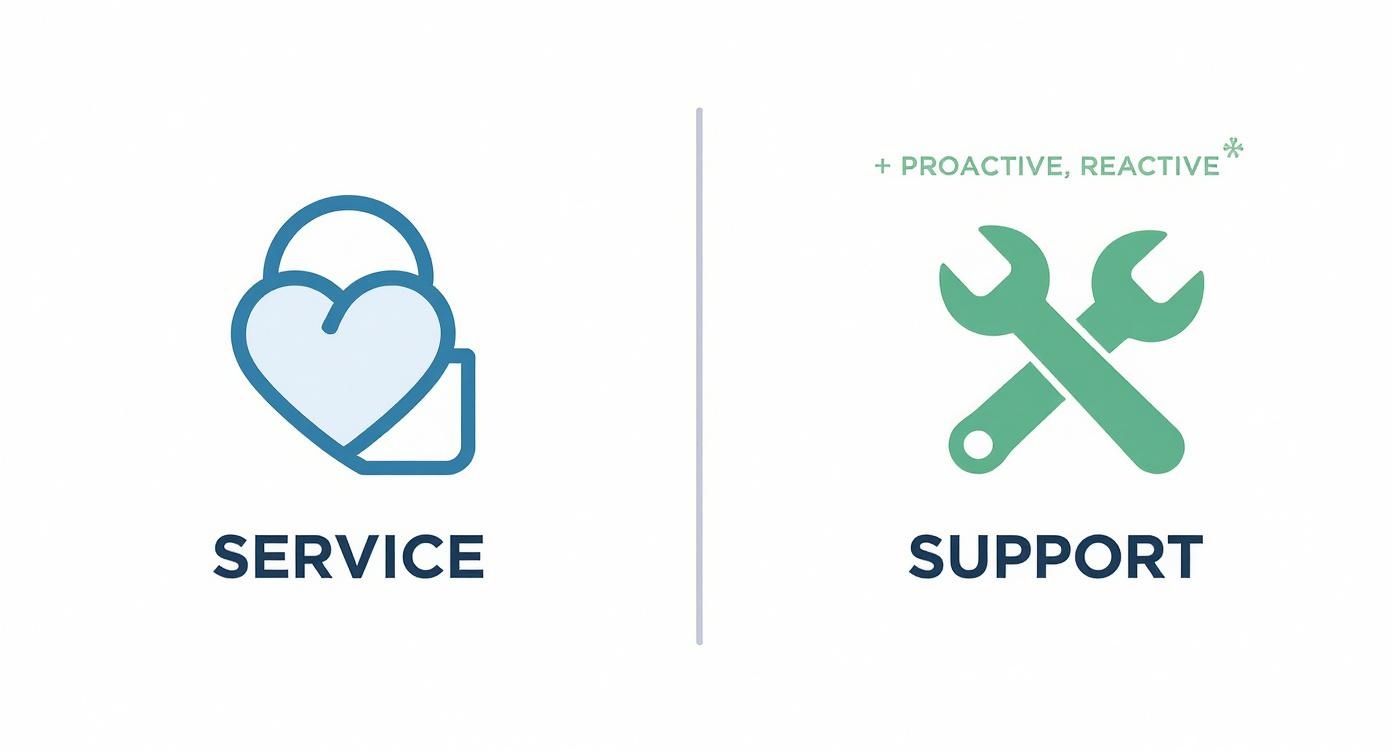
The image makes it clear: service is an ongoing, relationship-driven effort (the heart), while support is a targeted, problem-fixing function (the wrenches).
Customer Service vs Customer Support At a Glance
This distinction is becoming more pronounced in the Indian market. A recent report found that a staggering 88% of service professionals in India feel customers are more demanding than ever. This pressure is forcing businesses to sharpen both their long-term service strategies and their on-the-spot support responses. You can dig into more of these insights from the latest State of Service report from Salesforce.
To quickly see how these two functions differ, here’s a high-level summary.
| Aspect | Customer Service | Customer Support |
|---|---|---|
| Primary Goal | To build long-term relationships and enhance customer loyalty. | To resolve specific technical issues and product-related problems. |
| Nature of Work | Proactive (e.g., onboarding, check-ins, offering value). | Reactive (e.g., troubleshooting, bug fixes, ticket resolution). |
| Scope | Covers the entire customer journey, from start to finish. | Focused on post-purchase technical assistance. |
| Focus | Emotional connection and overall satisfaction. | Technical accuracy and efficient problem-solving. |
Seeing them side-by-side really highlights how service is about the why—why a customer stays with you—while support is about the how—how to get them back on track when something breaks.
Comparing Core Functions and Responsibilities
While the overarching goals of customer service and support might seem similar, the real distinction becomes crystal clear when you look at their day-to-day work. The fundamental difference lies in their approach: one is proactive and built around creating value, while the other is reactive, focusing squarely on fixing problems.

A customer service team’s efforts are threaded through the entire customer lifecycle. Their job is to build and nurture a strong, positive relationship from the moment a customer signs up.
In contrast, a customer support team springs into action when something specific goes wrong—a product glitch, a user mistake, or a technical question. Their involvement is usually short-lived, ending as soon as the issue is resolved.
The Proactive Duties of Customer Service
The main job of a customer service agent is to make sure customers get the absolute most out of what they’ve bought, and feel good about the company while they're at it. Their tasks are all about building relationships and anticipating needs before they turn into problems.
Common responsibilities often include:
- Client Onboarding: Walking new customers through the setup process to guarantee a smooth and successful start.
- Proactive Check-Ins: Reaching out to customers periodically just to see how things are going and uncover any unspoken issues.
- Value-Added Communication: Sharing helpful guides, best practice tips, or news about product updates that will help customers achieve their goals.
- Upselling and Cross-selling: Spotting opportunities where a customer might benefit from other products or services, which helps them and increases their lifetime value.
None of these tasks are about fixing something that's broken. It's all about making the relationship stronger and building the kind of loyalty that lasts.
A customer service agent's role is fundamentally strategic. They’re there to stop problems from ever happening and to cultivate the account, ensuring it stays healthy and grows. The ultimate goal? To turn happy customers into enthusiastic brand advocates.
The Reactive Responsibilities of Customer Support
Customer support teams, on the other hand, are your specialist problem-solvers. They are the technical gurus who jump in when things go sideways, equipped with deep product knowledge and sharp troubleshooting skills.
A typical day for a support agent involves:
- Troubleshooting Bugs: Identifying, confirming, and documenting product defects that users have reported.
- Resolving Technical Issues: Walking customers through specific fixes over email, live chat, or phone.
- Managing Ticketing Systems: Organising, prioritising, and resolving all incoming support requests as efficiently as possible.
- Handling Account Errors: Helping out with things like login troubles, billing mistakes, or permission issues.
The workflow is very direct and transactional: a problem comes in, a ticket is created, a solution is found, and the ticket is closed. Success here is all about speed and accuracy, getting the customer back on track with as little fuss as possible.
How Success Is Measured for Each Role
You can't use the same yardstick to measure customer service and customer support because they're playing fundamentally different games. Service teams are judged on the health of the relationship, while support teams are all about efficiency and speed. Getting this distinction right is essential for setting meaningful goals and building teams that actually deliver.

Think about it: a support agent might close a ticket in record time—a big win for their metrics. But if the customer felt rushed or unheard, that's a major loss for the service side of things. This is why tracking the right KPIs for each function is the only way to get a true picture of your customer experience.
Service Metrics Focus on Relationships and Value
When it comes to customer service, success is a long game. It's all about nurturing the customer relationship to build loyalty and increase the value they bring to your business over their entire journey with you. The metrics here aren't about speed; they're about sentiment, satisfaction, and connection.
Key customer service KPIs include:
- Customer Satisfaction (CSAT): This is your most direct pulse check on how happy a customer is with a specific interaction or your service overall.
- Net Promoter Score (NPS): This classic metric cuts to the chase, gauging long-term loyalty by asking one simple question: how likely are you to recommend us?
- Customer Lifetime Value (CLV): This is a critical business metric that projects the total revenue you can expect from a single customer. Great service has a direct, positive impact on this number.
These relationship-centric metrics are particularly powerful in the Indian market. Research from Shopify India revealed that over 59% of Indian consumers value great customer service even more than price. What’s more, 83% of customers say they trust brands more after consistently positive interactions. This proves that quality service isn't just a 'nice-to-have'; it's the foundation of trust and retention. You can find more customer service trends in India in their full report.
A high CSAT score is the North Star for a service team. It signals that agents are not just providing answers but are creating positive emotional connections that encourage customers to stay and spend more.
Support Metrics Emphasise Speed and Efficiency
Customer support, on the other hand, is measured by its ability to solve problems—quickly and completely. The KPIs are transactional, zeroing in on how efficiently the team can get a customer back on their feet when something goes wrong. The goal is to reduce friction and make the customer's effort feel minimal.
Primary customer support KPIs include:
- First Contact Resolution (FCR): This tracks the percentage of issues solved in the very first interaction, with no need for follow-ups. A high FCR is one of the strongest signs of an effective support team.
- Average Handle Time (AHT): This measures the entire duration of a support interaction, from the moment it starts to the moment it's resolved. When balanced with quality, a lower AHT points to a well-oiled machine.
- Ticket Volume: Simply tracking the number of incoming tickets is vital for resource planning and, just as importantly, for spotting widespread product bugs or issues before they spiral.
The Technology Stacks That Power Each Team
To get their jobs done right, customer service and customer support teams lean on very different sets of tools. Think of it this way: their technology stacks are specifically tailored to their core missions—one is built for building relationships, the other for fixing problems. Giving each team the right software isn't just a nice-to-have; it's fundamental to working efficiently and keeping customers happy.
Customer service professionals, whose world revolves around long-term relationships, typically live inside a Customer Relationship Management (CRM) system. A good CRM gives them a complete picture of every customer—their entire history, past conversations, and overall value. They also rely heavily on marketing automation and social media tools to keep conversations going and proactively engage with their audience.
Support Tools Are Built for Resolution
Customer support, on the other hand, is all about speed and precision. Their toolkit is geared towards one thing: solving technical issues as quickly and accurately as possible. It's less about the long-term relationship and more about getting the customer back on track, right now.
Here’s what you’ll find in their arsenal:
- Helpdesk and Ticketing Software: This is the nerve centre. It's where every technical query is logged, organised, assigned, and tracked through to resolution.
- Knowledge Bases: A well-stocked, searchable library of how-to articles and troubleshooting guides is a support team’s best friend. It helps customers help themselves and keeps ticket numbers down.
- Remote Desktop Tools: When things get tricky, these tools are indispensable. They let agents securely access a customer’s screen to see the problem firsthand and fix it directly.
To put it into perspective, here’s a quick breakdown of how their technology stacks compare.
Technology Stack Comparison
| Tool Category | Customer Service Examples | Customer Support Examples |
|---|---|---|
| Central Hub | CRM Platforms (e.g., Salesforce, HubSpot) | Helpdesk/Ticketing Systems (e.g., Zendesk, Jira) |
| Communication | Social Media Schedulers, Email Marketing | Live Chat, In-App Messaging, Remote Access Tools |
| Self-Service | Community Forums, Proactive FAQs | Technical Knowledge Bases, "How-To" Video Libraries |
| Analytics | Customer Health Scores, NPS/CSAT Surveys | Ticket Resolution Time, First Contact Resolution Rate |
This table really highlights the philosophical difference: service tools are for understanding and engaging, while support tools are for diagnosing and resolving.
The Rise of AI in Both Fields
Artificial intelligence is now playing a role in both service and support, but it shows up in very different ways. In India, for instance, technology adoption has led to 80% of consumers using AI-powered chatbots for certain services. Yet, it’s telling that 78% of those chatbot interactions still end up needing a human to take over, which shows we’re not quite ready for full automation on complex support issues. For a deeper dive, you can check out these customer service benchmarks and statistics.
For support teams, AI is a powerful force multiplier. It handles the simple, repetitive tickets, freeing up human agents to focus their brainpower on the tough problems where expertise really matters.
In customer service, AI is more of an analytical partner. It sifts through data to uncover customer sentiment, predict future needs, and flag opportunities for proactive outreach.
Platforms like SupportGPT are making it much easier for companies to build their own AI agents tailored to these distinct needs. You can learn more about creating AI support agents with SupportGPT to see how they can answer common questions and escalate the tricky ones to the right human team. This smart application of AI helps both teams do what they do best, just better.
Building Your Team With the Right Skills
Assembling the right team is critical, but you can't hire for customer service and customer support using the same blueprint. The difference between customer service and customer support becomes crystal clear when you look at the core skills required for each role. One is built on emotional intelligence, the other on technical logic.

When you hire for a customer service role, you're essentially looking for a relationship architect. Their success hinges on an innate ability to connect with people, listen deeply, and build genuine trust.
On the other hand, a customer support professional is your technical specialist. Their job is to diagnose and untangle complex problems with precision, which makes technical expertise an absolute must-have.
Hiring for Customer Service: Empathy and Connection
A fantastic customer service representative is a master of soft skills. Their primary objective is to make customers feel heard, valued, and understood, which demands a high level of emotional intelligence. Training for these teams should revolve around communication strategies, de-escalation tactics, and building positive customer experiences.
You should be looking for candidates who naturally exhibit:
- Active Listening: The skill to truly hear what a customer is saying—and just as importantly, what they aren't saying.
- Empathy: A genuine capacity to understand and share someone else's feelings, especially frustration.
- Patience and Positivity: The resilience to handle difficult conversations with a calm, constructive attitude.
- Relationship-Building Prowess: A natural talent for building rapport and making people feel at ease.
For a service role, a great interview question is: "Tell me about a time you turned an angry customer into a happy one. What specific steps did you take?" This reveals their ability to navigate emotionally charged situations and prioritise the long-term health of the relationship.
Hiring for Customer Support: Technical Aptitude and Logic
When it comes to customer support, the hiring priorities shift dramatically towards technical skill and logical thinking. While soft skills are certainly a plus, a support agent’s real value comes from their deep product knowledge and analytical approach to problem-solving. Training must be rigorous, focusing on total mastery of your product and its troubleshooting workflows.
Prioritise candidates with these traits:
- Technical Aptitude: A strong ability to grasp complex technical concepts and explain them in simple terms.
- Logical Problem-Solving: A methodical approach to diagnosing issues, testing theories, and finding the right fix.
- Deep Product Knowledge: A real curiosity and a proven ability to learn a product inside and out.
- Clear Communication: The skill to guide a non-technical user through complicated steps without causing more confusion.
A revealing interview question for a support role would be something like: "A customer reports a bug you've never encountered. Walk me through your exact process for investigating and resolving it." This tests their logical framework and troubleshooting process, not just their pre-existing knowledge.
How Service and Support Work Together
It's easy to get caught up in the definitions, but customer service and customer support aren't rivals. They're two sides of the same coin, and they absolutely must work together to create a smooth customer journey. When they don't, customers get that awful feeling of being passed from pillar to post, repeating their issue to different departments. A truly customer-focused company knows how to build a solid bridge between the two.
This partnership is at its best when information flows freely. Imagine a support agent helping a customer with a recurring technical glitch. After digging in, they realise the user is constantly hitting a wall because they're missing a key feature only available on a higher-tier plan. This is where the magic happens.
Instead of just closing the ticket, the support agent can flag the account with an internal note. They can then create a warm handoff to a service agent who can proactively reach out. The conversation shifts from "here's a fix" to "here's how we can solve this for good," turning a reactive support ticket into a proactive, value-driven discussion about an upgrade.
Creating a Unified Front
It's not a one-way street, either. A service agent might be on a routine check-in call and hear several customers mention their frustration with a new feature. They can't fix the bug themselves, but that feedback is pure gold for the support and product teams.
When service and support share insights, they create a powerful feedback loop. Service spots trends in customer sentiment and frustration, while support provides the hard data on specific bugs and usability problems. This allows the company to stop just patching issues and start fixing them at the source.
To get this right, you need clear communication channels. We're talking shared CRM notes, regular meetings between the teams, and software that integrates both functions. The ultimate goal is simple: a customer should never have to tell their story twice. Whether they're talking to a service professional or a support tech, it should feel like they're talking to one company that gets their entire history. That seamless cooperation is what truly sets a great customer experience apart.
Frequently Asked Questions
Figuring out the practical side of customer service and support often brings up a few common questions about structuring your teams and what it all means for the business. Let's tackle some of the most frequent ones to help you put these ideas into practice.
Can One Person Handle Both Service and Support?
Absolutely, especially when you're just starting out. In a small business, it’s not just common but often necessary for one person to juggle both roles.
But as your company grows, that hybrid model starts to show its cracks. The skill sets are just too different. Great service is all about proactive, relationship-focused communication, while top-tier support requires a reactive, methodical approach to solving technical problems.
Eventually, separating the roles lets your team members truly master their craft. This kind of focus leads to far better results, both in building long-term customer relationships and in getting immediate problems fixed. Think of the combined role as a great starting point, but specialisation is the key to scaling effectively.
Which Is More Important for Business Growth?
This is a classic question, but the truth is, neither one is more important. They are equal partners, both absolutely essential for healthy business growth. They just play different, complementary parts in creating a complete customer experience.
You really can't have one without the other. Think of it this way: excellent support is your defence, stopping customers from leaving when things go wrong. Excellent service is your offence, actively building the loyalty that fuels real growth. They're two sides of the same coin.
First-class support is what keeps customers from walking away when they hit a technical snag. If you can't fix their problem, you'll lose them—it's that simple. At the same time, amazing service is what builds deep, lasting loyalty, boosts customer lifetime value, and turns happy customers into brand champions who spread the word. You need your problem-solvers (support) and your relationship-builders (service) working in tandem.
How Does Investing in Both Impact ROI?
Putting resources into both customer service and customer support pays off in a big way, driving a strong and varied return on investment (ROI).
On one hand, solid customer support is a direct line to protecting your revenue. It slashes customer churn because when you solve problems quickly and competently, you give customers no reason to look for an alternative.
On the other hand, great customer service is all about actively growing your revenue. It increases Customer Lifetime Value (CLV) by nurturing loyalty and spotting organic opportunities to upsell or cross-sell. Even better, genuinely happy customers become a powerful marketing engine, leaving positive reviews and making referrals that dramatically reduce your customer acquisition costs. Together, they create a robust customer experience that drives sustainable, long-term growth.
Ready to enhance your customer support with 24/7 AI assistance? SupportGPT lets you build and deploy intelligent support agents in minutes. Start for free and see how easy it is to deliver instant, accurate answers.