Data Anonymization: The Complete Guide for AI Teams
Master data anonymization for SaaS and AI. Learn techniques, legal rules, and how to protect customer data without losing insight.
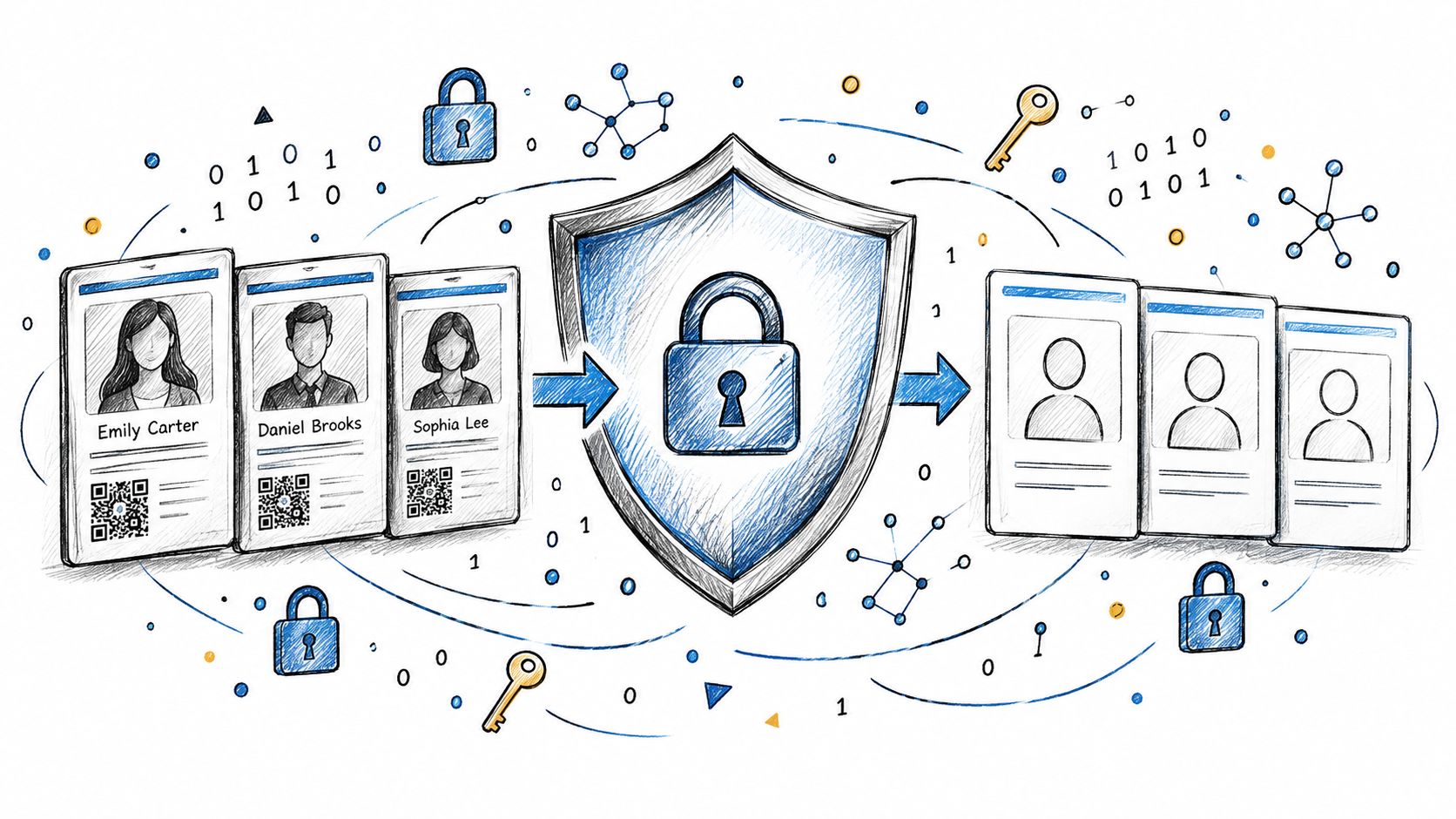
Anonymization makes data untraceable to a person, while pseudonymization replaces identifiers with codes but keeps the data linkable and personal. Removing names alone isn't enough: Latanya Sweeney's analysis estimated that 87% of the U.S. population could be uniquely identified from date of birth, sex, and ZIP code alone in research summarized by NIST.
A support team may think it has handled privacy because an export contains no names or email addresses. The file still includes a narrow age range, a city, a timestamp, a product issue, a purchase reference, and a detailed conversation about an unusual account problem. An analyst joins that export with billing data. An engineer indexes the transcript for search. An AI system learns the relationship between the customer's behavior and the support outcome. Each step can expose identity without restoring a deleted name.
That is why data anonymization is a threat-modeling discipline, not a cleanup script. It asks who could identify someone, what information they might possess, how datasets can be combined, and whether the released output still allows a person to be singled out, linked, or inferred.
Table of Contents
- Why Data Anonymization Matters for AI Support Teams
- Data Anonymization vs Pseudonymization Explained
- Core Techniques for Effective Data Anonymization
- Understanding Re-identification Risks and Attacks
- How SourceX Can Help
- Legal Compliance and Regulatory Considerations
- Implementing Anonymization in AI and SaaS Platforms
- Evaluating Effectiveness and Measuring Privacy Outcomes
- Best Practices and Common Mistakes to Avoid
Why Data Anonymization Matters for AI Support Teams
A support chat can expose a customer long before anyone sees a name. A failed delivery conversation may include an account reference, an approximate location, a product, a rare complaint, and a mention of an upcoming event. In an AI support stack, that same interaction can appear in several places: the live agent workspace, an exported analytics table, a retrieval index, and a model pipeline that stores patterns from many conversations. For teams running platforms like SupportGPT, that is the core problem to solve. Most guides stop at stripping direct identifiers. Production systems fail when the rest of the data still points to one person.
Those systems do not carry equal risk. An agent works inside an authenticated workflow with a narrow purpose. An analyst may get a wider export than the case requires. A model may absorb combinations across thousands of chats and preserve relationships no reviewer would notice in a single ticket. Remove the customer's name, and the record can still stay highly identifying.

Quasi-identifiers create the hidden join
The fields that cause trouble are often ordinary operational fields. A quasi-identifier may look harmless on its own, then become identifying once someone combines it with outside knowledge or another internal system. In AI support environments, the common examples are:
- Time patterns: An exact timestamp, sequence of messages, or unusual support window.
- Location detail: A neighborhood, branch, delivery area, or regional service point.
- Behavioral context: Search terms, product configuration, account tier, or purchase history.
- Conversation detail: A rare incident, free-text name, medical reference, or internal project description.
This is why anonymization needs threat modeling, not a one-time cleanup pass. A public post from the customer, a CRM record, a billing system, or a vendor portal can supply the missing piece. NIST treats re-identification as a testing question grounded in actual attack paths. Teams should map direct identifiers and quasi-identifiers, choose transformations field by field, estimate residual risk, and test realistic joins using NIST's de-identification guidance.
Good governance follows the data flow, not just the source table. Document what agents can view, what analysts can export, what the retrieval layer stores, what model training or evaluation jobs ingest, and what leaves the company. A practical enterprise AI governance approach ties those decisions to access controls, retention, transformation rules, and incident response.
Anonymization doesn't end at the export
A common failure pattern is simple. A team sanitizes a CSV for one use, then later copies the same records into a warehouse, notebook, vector index, or evaluation set with less protection. The original decision may have been reasonable. The derived dataset changes the context, the audience, the join options, and the exposure.
Practical rule: Treat every derived dataset as a new release. Reassess its identifiers, joinability, access pattern, and purpose.
That discipline matters because re-identification risk shifts with the attacker's knowledge. A 2025 assessment of a publicly available de-identified dataset found that more than 45% of records could be reidentified when seven quasi-identifiers were known, while four attributes were enough to reidentify over 9% of records as referenced in the European Data Protection Board's pseudonymisation guidance. The practical lesson for support teams is not that one threshold makes data safe. Safety depends on who can access the data, what else they know, and how easily they can combine both.
Schemas change. Customer behavior changes. Integrations change. Product teams add search, summaries, evaluations, and new model features. An anonymization decision that held up last quarter can fail after one new data flow adds context back in.
Data Anonymization vs Pseudonymization Explained
In an AI support stack, this distinction shows up fast. A transcript leaves the ticketing system, enters a warehouse, then gets copied into an evaluation set or prompt log. If the team can still connect that record to a customer through a token, key, lookup table, or another system field, the data is pseudonymized, not anonymous.
Anonymization aims to make identification infeasible in the actual context where the data will be used. Pseudonymization removes obvious identifiers but keeps a path back to the person. That path may be tightly controlled, but it still exists. For support products such as SupportGPT, that difference drives architecture decisions, access controls, vendor sharing, and what you can safely do with logs after the initial workflow ends.
A simple example makes the point. Replace customer@example.com with user_4821, and the email no longer appears on screen. If your systems can still resolve user_4821 to the account, the record remains linked to a person. Hashing has the same limitation when the input space is predictable or another party can reproduce the value. In practice, pseudonymization reduces exposure. It does not end identity risk.
A practical comparison
| Feature | Anonymization | Pseudonymization |
|---|---|---|
| Names and direct identifiers | Removed or transformed so identity can't reasonably be restored | Replaced with codes, tokens, or aliases |
| Link to the original person | Designed to be unavailable or infeasible | Preserved through additional information |
| Reversibility | Intended to be irreversible in the relevant context | Often reversible or linkable |
| Quasi-identifiers | Generalized, suppressed, aggregated, or otherwise assessed | May remain detailed for operational linkage |
| Use inside support operations | Suitable when individual traceability isn't required | Useful when authorized teams need continuity |
| External release | Requires evidence that people can't be singled out, linked, or inferred | Usually remains a controlled personal-data release |
| Main trade-off | Stronger privacy can reduce analytical detail | Better continuity can retain identity risk |
Choose by purpose, not by label
Use pseudonymization when the workflow still needs continuity. Support operations often need to connect a customer's recent chats, escalation history, fraud signals, or refund events without exposing raw identifiers to every team. In that case, stable tokens are useful, but only with tight access control, separated key material, retention limits, and a clear reason for keeping the linkage.
Choose anonymization when the recipient does not need to get back to the individual. That usually applies to broader analytics, model evaluation datasets, external research sharing, and some product reporting. Getting there takes more than masking one field. Teams often need to generalize dates, suppress rare cases, remove or rewrite risky free text, aggregate outcomes, and test whether a determined analyst could still isolate a person by combining attributes.
The legal distinction is also narrower than many teams assume. Under GDPR, whether data is anonymous depends on whether a person is identifiable by means reasonably likely to be used, not on whether names were stripped out, as reflected in Recital 26 of the GDPR. The European Data Protection Board also explains that pseudonymization reduces risk without usually taking data outside personal-data rules in its guidance on pseudonymisation.
The practical test is blunt. Does anyone, now or later, need to reconnect this record to a person? If yes, design for governed pseudonymization and treat the output as protected personal data. If no, remove the linkage path and examine the remaining fields the way an attacker would. That is the standard that holds up in production.
Core Techniques for Effective Data Anonymization
A support export can look harmless after the obvious fields are stripped. Then someone filters by a narrow date range, an unusual product setup, and a rare escalation path, and one customer stands out immediately. That is why anonymization work starts with how people query data in production, not with a checkbox that says names were removed.
No single technique covers that risk on its own. In practice, teams combine field-level transformations, group-based controls, protection for aggregate outputs, and attack testing that reflects actual data flows of AI support systems.
Start with quasi-identifiers
Direct identifiers are the easy part. In support transcripts and tickets, remove or rewrite names, email addresses, phone numbers, account IDs, order references, URLs, signatures, and entities extracted from free text. The harder part is tagging fields that become identifying only when combined, such as exact timestamps, narrow locations, unusual product combinations, language patterns, or a rare support topic tied to a specific workflow.
Generalization reduces precision so records stop being unique too quickly. An exact age becomes a band. A minute-level timestamp becomes a broader window. A street-level location becomes a region. That keeps some analytical value, but there is always a trade-off. If the team needs to debug queue latency by hour or compare issue rates by city, broader values may make the dataset safer and less useful at the same time.
Suppression removes values or entire records that still carry too much risk after other changes. This is often the right call for rare cases and for free-text fragments that automated redaction cannot handle with confidence. Security teams sometimes resist suppression because it creates gaps in reporting. The alternative is worse. A risky field that survives only because a dashboard looks cleaner is not a serious privacy decision.
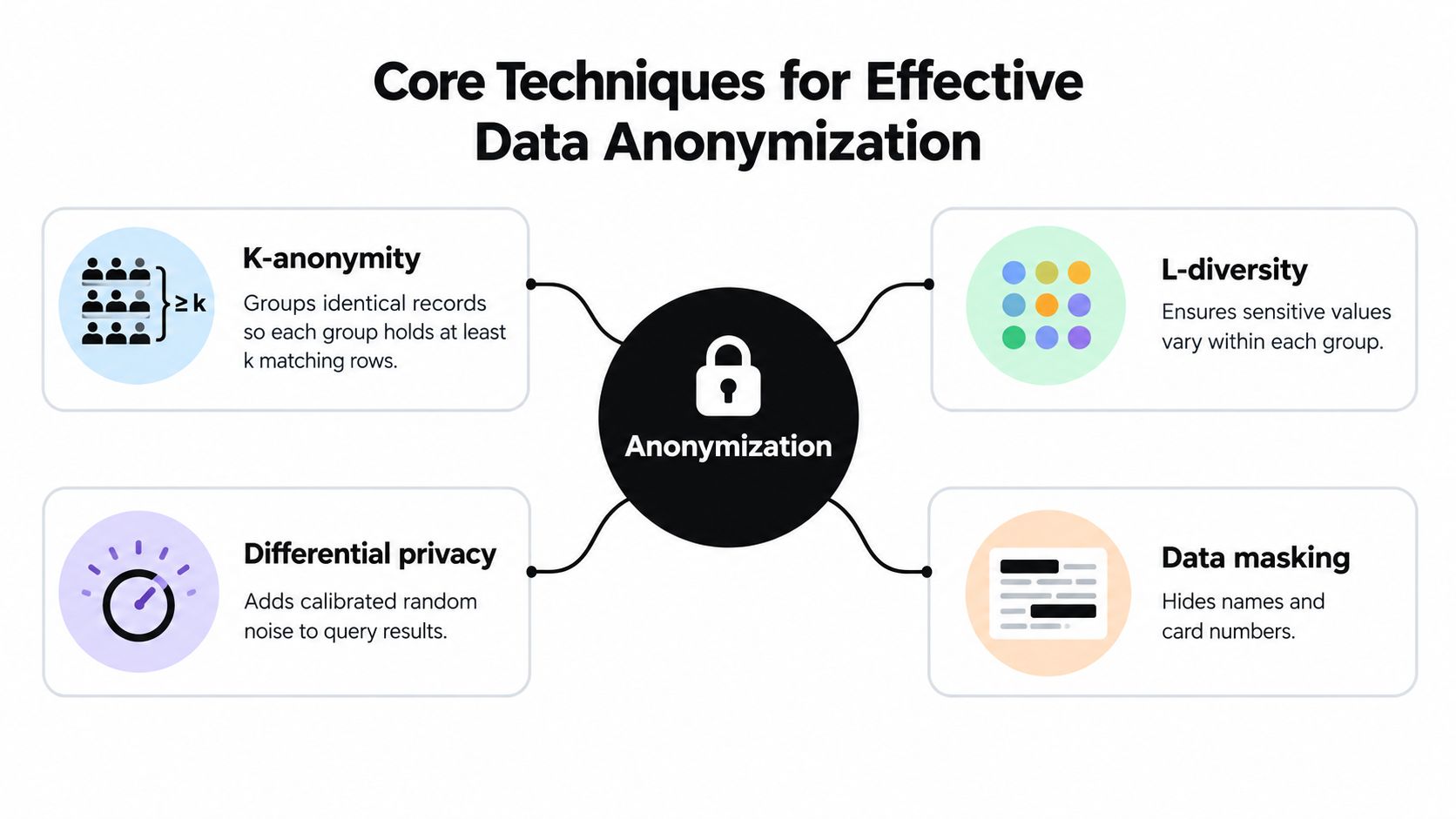
Masking and tokenization hide values while preserving format or continuity inside controlled workflows. They help with testing, role-based views, and operations that still need a stable reference. They do not create anonymity. If the token can be reversed or linked back through another system, the result is still pseudonymized data.
Use group-based controls carefully
Group-based methods make anonymization more testable. A common starting point is k-anonymity, which requires each released record to be indistinguishable from at least k others across the chosen quasi-identifiers as described in NIST material. That is useful because it forces the team to define which fields matter for linkage and to measure whether the transformed dataset still leaves people exposed.
It also has limits. A group can meet the size threshold and still reveal something sensitive if everyone inside that group shares the same outcome. l-diversity addresses that by checking whether sensitive attributes vary enough within each group. In practice, that means you do not stop after checking group size. You also inspect whether the grouped records actually differ in ways that reduce inference risk.
For support data, a workable sequence usually looks like this:
- Generalize rare combinations such as narrow region, exact time, and unusual issue.
- Suppress outliers that remain easy to isolate.
- Check group size across the selected quasi-identifiers.
- Inspect sensitive-value diversity inside each group.
- Test linkage against plausible customer or public information.
- Measure utility for the actual reporting or modeling task.
Protect aggregate outputs
Sometimes the right answer is to stop releasing records at all. Differential privacy is designed for cases where the consumer needs statistics, not row-level data. It limits how much an output can change when one person's data is included or removed. The privacy parameter ε controls that trade-off. Lower values usually mean stronger protection and more noise. Repeated queries also spend down the privacy budget.
For AI support teams, this matters in dashboards, model evaluation reports, and any analytics surface that users can query repeatedly. Set the budget before publishing the view. Track it across exports and recurring reports. Limit how much one account or one conversation can influence the result. Then check whether the noisy output is still good enough for the business question.
These techniques work best together. Masking reduces casual exposure. Generalization reduces uniqueness. k-anonymity helps address singling out. Diversity checks reduce attribute disclosure. Differential privacy protects aggregate analysis. In systems that index support content for retrieval, the same decisions must apply to what enters the index and what can be returned through vector search, not only to the source database.
Understanding Re-identification Risks and Attacks
A support team strips names, emails, and account IDs from conversation data, then sends it to an index for search, model evaluation, or analytics. It still may not be anonymous. Re-identification usually happens because the remaining details line up with something else an attacker already knows, or can get.
That is the mistake many teams make. They treat anonymization as field removal, when the true job is threat modeling across the full data flow. In AI support products, that means checking the source record, the retrieval index, logs, prompts, responses, exports, and admin tooling. A safe database can still feed an unsafe system.
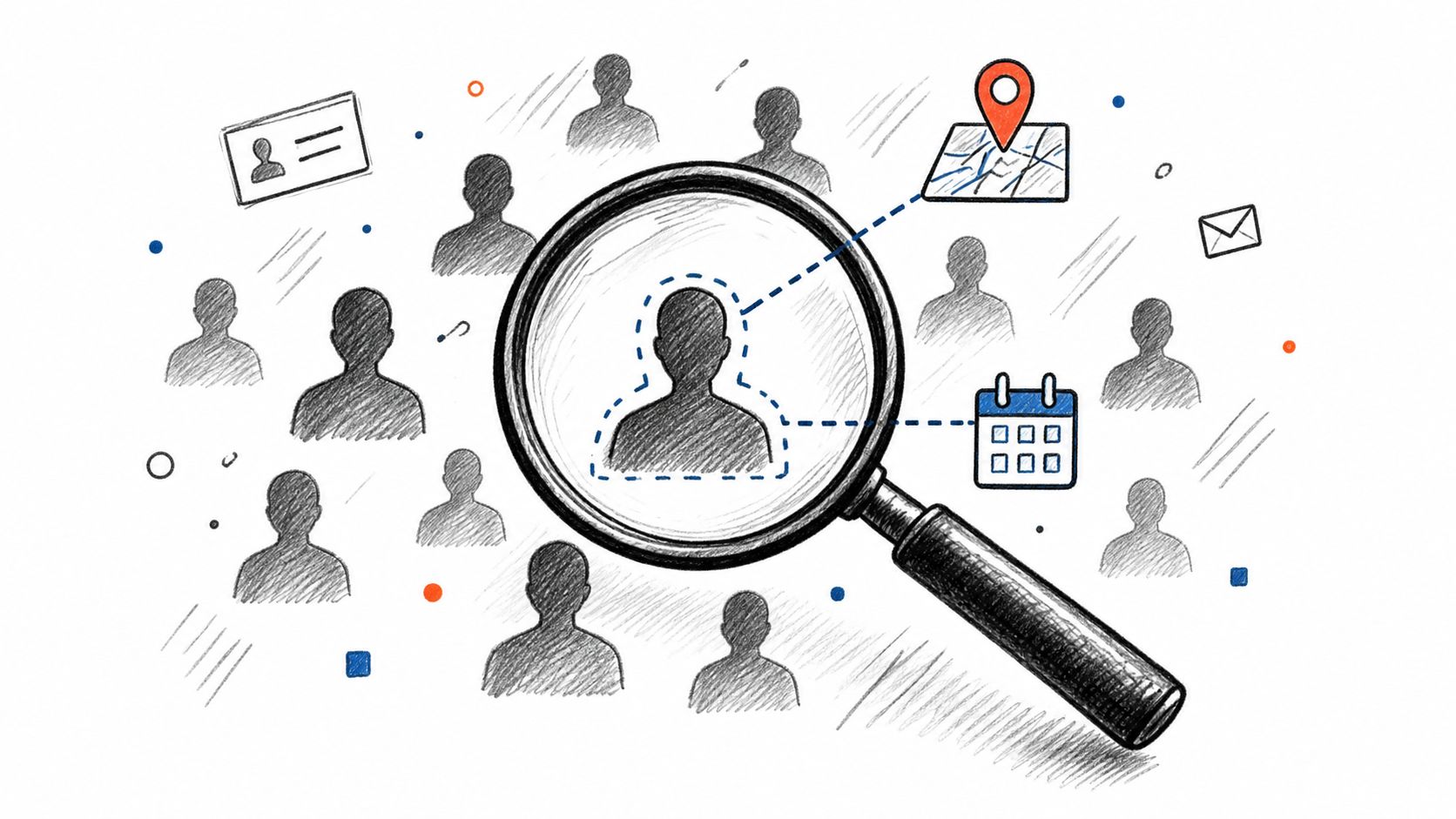
A linkage attack matches quasi-identifiers across datasets. In support data, a rare issue plus a location, time window, product setup, and purchase event can narrow the possibilities until one customer is the likely match. A singling-out attack works even earlier. The attacker only needs to isolate one record from the rest. An attribute disclosure attack follows when that isolated record sits inside a group that shares a sensitive trait, outcome, or incident.
AI systems introduce additional attack paths. A model evaluation endpoint can reveal whether a specific example affected training. Repeated prompts can expose memorized details. Retrieval can return sensitive text when chunking, metadata filters, permissions, and redaction rules do not agree. Treat the model, the index, the logs, and every export path as separate surfaces, because they fail in different ways.
Build the threat model around real access
Start with the attacker's actual view of the system.
Ask what they can see across dashboards, exports, logs, embeddings, prompts, responses, and lookup services. Check what outside information they may already have, including public customer posts, account metadata, purchase records, or data held by partners. Then test what they can do repeatedly. Query limits, joins, sampling, and model interaction all change the chance of re-identification. Rare records matter most, and schema changes often make previously low-risk records linkable.
As noted earlier, NIST frames re-identification risk as residual risk that must be assessed, not something solved by removing direct identifiers alone. That distinction matters in production, where a dataset can look clean while the surrounding system still leaks context.
For an AI support product, use a practical test. Give a reviewer plausible customer knowledge and ordinary permissions, then see whether they can isolate a conversation. Use known account traits, public product posts, likely search terms, and expected retrieval behavior. A deployment with stronger private AI chat controls can reduce exposure, but those controls still need testing against inference, logging, retrieval, and administrator access.
Treat risk as a moving result
A one-time privacy review creates false confidence. Customers change how they use the product. Public information accumulates. Vendors add integrations. Models and retrieval layers gain new behavior.
Re-run linkage and singling-out tests whenever data sources, schemas, transformations, access rules, or model workflows change. The strongest evidence is not a blanket claim that the dataset is anonymous. It is a record of assumptions, attacker capabilities, test methods, failed cases, accepted residual risk, and the person who approved release.
How SourceX Can Help
Anonymization becomes harder when the dataset is also being prepared for external licensing. A supplier must establish provenance, confirm usage rights, map systems, prepare the data, agree terms, and release only an approved package. Handling those tasks through disconnected intermediaries makes it easy to lose track of which transformation was applied to which source.
SourceX is an enterprise data transaction layer for licensing operational datasets to AI labs and other buyers. It supports fit assessment without uploads, private inventory creation, structured mapping across systems such as Zendesk, Salesforce, GitHub, Jira, SharePoint, and Google Workspace, rights review, dataset-specific deidentification, contracting, delivery, and payment.
Where the model fits
SourceX is relevant when a company has valuable operational records but lacks a controlled route to evaluate and license them. Its workflow keeps the supplier in control: nothing is shared until explicit authorization, and the agreement defines permitted use. An evidence packet can document the source system, licensing rights, purpose, preparation steps, and usage constraints before release.
That solves a specific problem in data anonymization. The supplier doesn't just need redacted rows. It needs to show where the data came from, who approved its use, what was transformed, and what the recipient may do with it. SourceX also distinguishes ownership and selection terms, supports dataset catalogs and buyer request portals, and coordinates packaging and delivery.
This isn't a substitute for a privacy assessment. SourceX's value is strongest when the dataset owner needs repeatable transaction controls, provenance evidence, buyer evaluation, and supplier-approved deidentification in one workflow. A team that only needs internal masking for a test environment may need a different tool. A company preparing rights-cleared support, sales, engineering, document, or finance data for external AI buyers has a more relevant use case.
If you need to assess whether an operational dataset can be prepared for a controlled transaction, Contact SourceX about data anonymization and ask for a dataset-specific review rather than assuming that a standard redaction recipe is enough.
Legal Compliance and Regulatory Considerations
A support team exports a cleaned ticket set for model evaluation, then learns the same conversations still sit in logs, vector indexes, and backup snapshots. That is the compliance problem in practice. Legal approval and technical de-identification have to match the full data flow, especially in AI support systems where the same conversation can pass through ingestion, search, annotation, prompt assembly, analytics, and retention workflows.
NIST's 2015 publication reviewed roughly two decades of research and defined de-identification as removing identifying information so individuals cannot be linked to specific records, while also recognizing that some de-identified datasets can later be re-identified in its publication on de-identification of personal information. That definition is useful because it frames de-identification as ongoing risk management, not a sticker you place on a dataset after names are stripped out.
Build the compliance record
For GDPR-oriented SaaS and AI teams, the record should cover the processing purpose, lawful basis, data categories, recipients, retention period, transformations, and residual risk. In production, I would also expect a clear map of where raw data enters, where transformed copies are created, and who can reach each layer. Separate the original and transformed data paths. Restrict the lookup table or other linkage data used for pseudonymization. Record the person who approved external sharing or model training use.
The legal distinction between anonymization and pseudonymization matters because engineering teams often treat tokenization or hashing as the finish line. It is not. If the data can still be linked back, directly or through controlled lookup information, it can still be personal data. An irreversible result with negligible residual risk may be treated very differently from pseudonymized records that remain linkable.
Healthcare-related support data needs the same discipline, with HIPAA obligations mapped to the actual workflow and to the organization's role. Protected health information can appear in transcripts, attachments, metadata, logs, evaluation sets, and model prompts. Decide early whether the dataset is being de-identified, pseudonymized for a controlled service, or kept as regulated data with access controls and contractual safeguards.
Make governance operational
A workable control set usually includes:
- Purpose limitation: Release only the fields needed for the stated analysis, training task, or transaction.
- Data minimization: Remove free text, narrow timestamps, and rare metadata unless the use case requires them.
- Access separation: Keep re-identification keys away from analysts, model developers, and external recipients who do not need them.
- Evidence collection: Preserve transformation rules, test results, approvals, exceptions, and release versions.
- Incident reassessment: Re-evaluate anonymity after a breach, new linkage source, model change, or access-policy failure.
- Retention enforcement: Delete intermediate exports and stale copies according to documented policy, not personal habits.
Retention needs its own control set. A data retention policy for support systems should account for raw conversations, redacted copies, embeddings, prompts, completions, analytics tables, backups, and audit logs. An anonymized derivative does not make the source data, or every intermediate artifact, safe by default.
Good compliance evidence answers practical questions fast. Which attacker was considered. Which fields could identify a person. What transformation was applied. How re-identification was tested. What utility was lost. Who accepted the remaining risk. If those answers live only in a meeting or in one engineer's memory, the control will fail when the team changes or an auditor asks for proof.
Implementing Anonymization in AI and SaaS Platforms
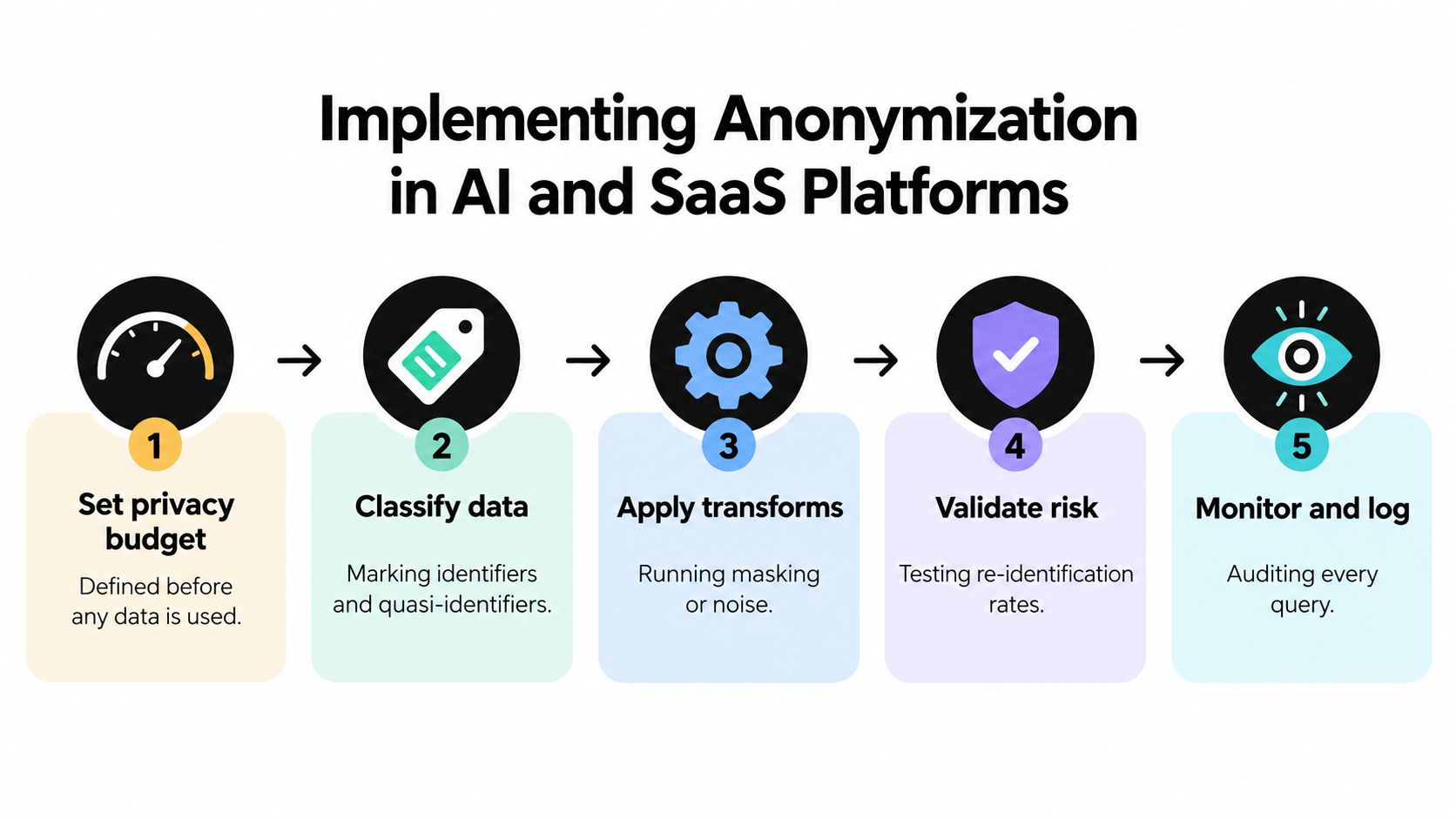
A support team exports transcripts for model tuning on Friday. By Monday, those records have reached a notebook, a vector store, an eval set, and a dashboard. If anonymization starts after that spread, the team is trying to contain copies instead of reducing risk at the source. The safer pattern is to make privacy decisions before any release, then enforce them in the same delivery path that ships analytics and AI features.
Create a release contract
Before support data leaves its source system, define a release contract. Name the recipient, the purpose, the fields allowed out, retention, permitted queries, and the privacy target. That sounds procedural, but it prevents a common production failure: one dataset gets reused for analytics, prompt evaluation, and training, even though each use needs different controls.
Contracts also need to cover more than columns in a table. Support platforms carry identity in transcript bodies, attachments, URLs, signatures, screenshots, and quoted email chains. Search terms, ticket paths, and resolution outcomes can also identify a person once they are joined with account context or time data. Most anonymization failures in AI support products happen there, inside the flow of real conversations, not in the obvious first and last name fields.
If the output is an aggregate dashboard, set a privacy budget and track query use against it. If the output is a training corpus, specify what text may remain, which entities must be removed, and how memorization or extraction will be tested.
Transform at the right layer
The right transformation depends on where data will be used. Record-level datasets usually need a combination of entity redaction, field suppression, timestamp coarsening, cohort aggregation, and rare-event handling. If a business task can run on labels or structured events, remove or isolate free text. If text must stay, redact it before indexing, embedding, evaluation, and logging, then inspect samples for misses.
For aggregate analytics, differential privacy can protect outputs more directly than name removal alone. The privacy budget has to cover repeated dashboard views and exports, because individually acceptable queries can still reveal sensitive information when combined. Clip numeric contributions so one person's activity does not dominate a result, add calibrated noise, and check whether the remaining error still supports the operational decision.
Precision and privacy pull against each other. Teams need to decide where error is acceptable for metrics like resolution rate, escalation rate, and latency, then configure transformations that preserve those decisions without carrying unnecessary identity detail.
Put controls into delivery workflows
Anonymization works best as a versioned pipeline step, not a manual cleanup task. Pull request review or release review should catch new fields, schema changes, missing redaction rules, and stale risk assessments. CI tests can use seeded records with names, account references, locations, unusual dates, and sensitive free text to verify that transformations still hold after each change.
The pipeline should also record:
- Input lineage: Which source systems and time ranges supplied the data.
- Transformation version: Which rules, models, thresholds, and privacy parameters were used.
- Risk results: Which linkage, uniqueness, and inference tests passed or failed.
- Utility results: Which analytical or model tasks remained acceptable.
- Release decision: Who approved the output and under which purpose.
Model training needs tighter controls because copied data tends to spread fast. Keep raw data out of developer notebooks, block transformed corpora from being dropped into evaluation tools without review, and inspect prompts and outputs for memorized content. Restrict retrieval by tenant and purpose, and treat embeddings as sensitive derivatives, not harmless numbers. For regulated support data, review a HIPAA-compliant AI workflow before any transcript reaches a training corpus.
SupportGPT can be one option for teams building and deploying AI support agents, including workflows with conversation tracking and analytics. Whatever product or stack is in use, platform claims about privacy do not replace dataset-specific testing, release controls, and threat modeling tied to actual support data flows.
Evaluating Effectiveness and Measuring Privacy Outcomes
An anonymization program is effective only when it demonstrates two things at once: people are harder to identify, and the remaining data still supports the intended task. Optimizing one without measuring the other produces either unsafe data or unusable analytics.
Start with a written risk statement. Define the protected population, recipient, attacker knowledge, available auxiliary datasets, access pattern, and acceptable residual risk. Then test the released data against that scenario instead of relying on a generic scanner.
Test the actual attack paths
A practical evaluation should include:
- Uniqueness analysis: Identify records that can be isolated by combinations of quasi-identifiers.
- Linkage testing: Attempt joins against plausible external or internal datasets.
- Attribute inference: Check whether group membership reveals a sensitive outcome.
- Text inspection: Search for names, account references, locations, URLs, and rare events missed by redaction.
- Query testing: Examine whether repeated aggregate queries reveal individual contributions.
- Model testing: Probe retrieval, prompts, completions, and evaluation outputs for leakage.
For customer-support data, practical controls include aggregating small cohorts, coarsening timestamps, removing free text or applying entity redaction, and testing whether an attacker with public customer information can isolate a conversation as described in research on k-anonymity and software data.
Don't report only a single risk score. Record which records failed, why they failed, what transformation fixed them, and how much utility changed. A small number of high-risk records may deserve suppression even when the dataset-level result looks acceptable.
Validate utility against decisions
Utility testing should use real business tasks. Can analysts still compare product problems? Can a support manager detect a worsening escalation pattern? Can a model evaluate answer quality without seeing a customer's identity? Can a latency report support an operational decision after noise and aggregation?
Set error margins before viewing the result. If the privacy transformation changes a metric beyond the tolerance needed for the decision, revise the aggregation or purpose. Don't weaken privacy just because a dashboard looks less precise.
Reassess after schema changes, new integrations, new model capabilities, new releases, and incidents. The risk register should name an owner and a review trigger. Continuous evaluation turns anonymization from a static label into an auditable product control.
Best Practices and Common Mistakes to Avoid
The most common mistake is treating name removal as anonymization. Names, emails, and phone numbers are only part of the identity surface. Quasi-identifiers, free text, timestamps, rare events, metadata, embeddings, and query outputs can still make a person identifiable.
Another mistake is choosing a technique before defining the trust boundary. Masking and pseudonymization can support controlled internal workflows, but they preserve linkage in different ways. External sharing, model collaboration, and public release need stronger evidence that people can't be singled out, linked, or inferred.
Synthetic data also needs testing. The European privacy position summarized in current research is that data generated by an AI model can't be presumed anonymous. Teams must assess whether the model memorized source examples, whether rare combinations survived, and whether repeated prompts or outputs can extract identifying patterns as discussed in guidance on synthetic data in research.
Keep the operating rules concrete:
- Document assumptions: Record the attacker, auxiliary data, purpose, and access path.
- Minimize early: Remove unnecessary detail before indexing, training, exporting, or logging.
- Separate keys: Protect lookup information from teams that only need analysis.
- Test failures: Use linkage, inference, query, and model-extraction scenarios.
- Measure utility: Validate the decisions the data must support.
- Reassess continuously: Review changes to data, systems, models, recipients, and threats.
Privacy belongs in product design, not only in a compliance review before launch. Make every new data flow declare its purpose, transformation, retention, and evidence requirement before it reaches production.
If your AI support platform currently removes names and stops there, map one real conversation from intake through storage, analytics, retrieval, model training, logging, and export. Classify its quasi-identifiers, run a realistic linkage test, and document what must be generalized, suppressed, aggregated, or protected with differential privacy. That exercise will give your security and product teams a concrete anonymization baseline they can improve before the next integration expands the data flow.