Customer Support vs Customer Service: Key Differences You Need to Know
Explore the essential differences between customer support vs customer service, including roles, metrics, and AI impact to elevate your strategy.
At its core, the difference between customer support and customer service comes down to focus. Customer support is reactive and transactional, zeroing in on fixing immediate, often technical, problems. Customer service, on the other hand, is proactive and relational; it's about shaping the entire customer experience to build lasting loyalty.
Think of it this way: support is the mechanic who fixes your car when it breaks down, while service is the dealership that makes sure your entire ownership experience is a positive one.
Understanding the Core Difference Between Support and Service
People often use the terms interchangeably, but customer support and customer service are distinct functions with different strategic goals. Getting this right is the first step for any business that wants to create a truly great, cohesive customer experience. It helps to think of customer support as a critical piece within the broader customer service philosophy.
Customer support is all about issue resolution and technical assistance. Its job is to provide tactical, nuts-and-bolts solutions when things go wrong. This might mean troubleshooting a software bug, walking a user through a tricky setup process, or answering a direct question about how a product feature works. It’s an essential function, especially for tech, SaaS, and e-commerce businesses.
Customer service takes a much wider view. It's a holistic, customer-first approach designed to meet broader needs, create positive feelings, and nurture long-term relationships. It covers the entire journey—from the very first marketing message a person sees to the follow-up emails they get after a purchase. This proactive strategy includes everything from personalized onboarding and gathering feedback to anticipating what a customer might need next.
Key Foundational Distinctions
A common frustration perfectly illustrates why both functions need to work in harmony. Data shows that 56% of customers get frustrated because they have to repeat themselves when they switch channels. This highlights a massive need for integrated systems that can blend transactional efficiency with genuine relationship awareness. You can find more insights from this comparative analysis on Nimble.com.
"The difference between customer service and customer support is that a customer support team can fix a technical issue in the short term, but providing good customer service helps build relationships and establish a true partnership in the long term." – Jonathan Brummel, Director of Enterprise Support at Zendesk
Ultimately, support is about the how—how do we fix this problem right now? Service is about the why—why should this customer feel valued and want to stick with our brand? You can have fantastic support agents who close tickets in record time, but if the overall journey feels impersonal or broken, you're still delivering poor customer service.
Quick Comparison: Customer Support vs. Customer Service
To put it simply, here’s a high-level look at the fundamental differences between the two.
| Aspect | Customer Support | Customer Service |
|---|---|---|
| Primary Goal | Resolve specific, technical issues | Build long-term customer relationships |
| Approach | Reactive (responds to problems) | Proactive (anticipates needs) |
| Focus | Transactional and short-term | Relational and long-term |
| Scope | Narrow (product/service issues) | Broad (entire customer journey) |
| Example | Helping a user reset their password | Sending a personalized onboarding guide |
While distinct, it's clear they aren't mutually exclusive. The best companies know that world-class support is a cornerstone of exceptional service.
Comparing Key Responsibilities and Performance Metrics
While both teams are laser-focused on the customer, their day-to-day work and how you measure their success couldn't be more different. The real distinction between customer support and customer service crystallizes when you look at what each team actually does and how their impact is tracked. Support is tactical and immediate; service is strategic and long-term.
A customer support professional’s world revolves around putting out fires. They're the technical experts, the troubleshooters who roll up their sleeves and dive into the nuts and bolts of a product to fix what’s broken.
On the other hand, customer service professionals are all about relationship management. Their job is to make sure the customer feels valued and understood at every turn, often anticipating needs to build genuine loyalty.
This visual gives a great high-level view of the reactive nature of support versus the proactive, relationship-building approach of service.
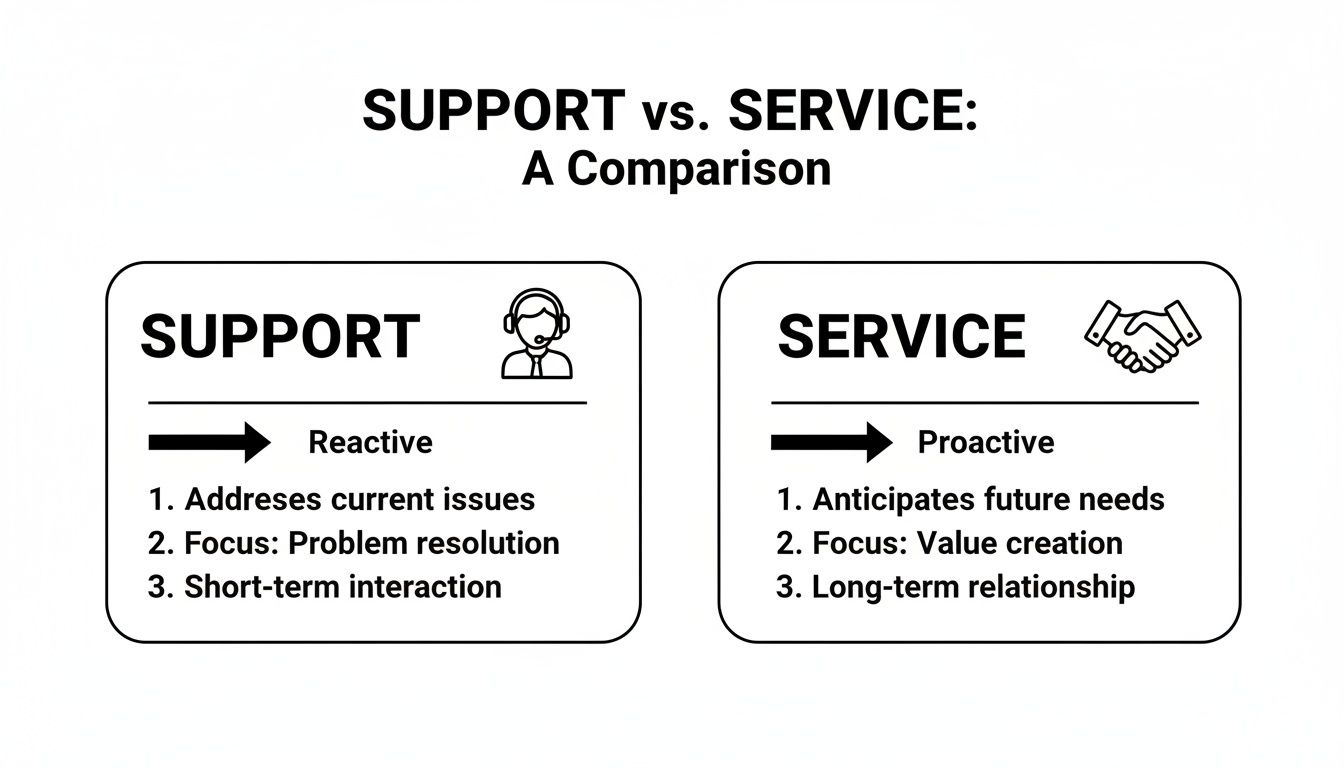
The contrast here is perfect—the headset represents the direct, functional problem-solving of support, while the handshake captures the relational core of service.
The Tactical World of Customer Support
The daily life of a support agent is defined by a queue of incoming tickets, each one a specific, solvable problem. Their responsibilities are incredibly focused and often highly technical.
Key Support Responsibilities Include:
- Troubleshooting Technical Bugs: An agent might be digging into why a software feature is crashing for one user, collecting log files, and escalating a detailed report to engineering.
- Resolving Account Issues: This is the bread-and-butter work of handling billing disputes, processing a password reset, or correcting user permissions.
- Guiding Product Setups: A support specialist often needs to walk a new customer through a tricky installation or configuration process, making sure they get off to a good start.
Since these tasks are transactional, the metrics for evaluating performance are all about operational efficiency. The goal is simple: solve the problem as quickly and effectively as possible to minimize customer frustration.
A customer support team’s success is ultimately measured by its ability to reduce customer effort. The faster and more accurately they can resolve an issue, the better they are doing their job.
This naturally leads to a heavy focus on metrics that track speed, accuracy, and throughput.
Core Customer Support Metrics:
- First Contact Resolution (FCR): What percentage of issues are solved in the very first interaction? A high FCR is gold because it means customers aren't stuck in a frustrating loop of back-and-forth emails, which can improve satisfaction by 12% on average.
- Average Handle Time (AHT): This tracks the full duration of a support interaction, from the moment it starts until it's closed. A key efficiency goal is to lower AHT without ever letting quality suffer.
- Ticket Volume: Just keeping an eye on the number of incoming requests helps managers with staffing and can be an early warning sign of a widespread product bug.
The Strategic Realm of Customer Service
Customer service plays the long game. The team operates with broader, relationship-focused goals, and their work is often proactive—designed to elevate the entire customer experience and stop problems from ever happening.
Key Service Responsibilities Include:
- Proactive Client Onboarding: A service professional might personally welcome a new high-value client, designing a custom onboarding plan to ensure the product helps them achieve their specific business goals.
- Gathering Strategic Feedback: They actively reach out to customers through surveys, calls, and check-ins to gather insights that can guide product development and improve the customer journey.
- Identifying Upsell Opportunities: By truly understanding a customer’s goals, a service agent can spot opportunities where an upgraded plan or a new feature could add more value, creating a win-win for the customer and the company.
You can't measure the success of these activities in minutes or number of tickets closed. Instead, performance metrics for customer service are all about gauging sentiment, loyalty, and long-term value. They answer the big question: "How happy are our customers, and how likely are they to stick around?"
Core Customer Service Metrics:
- Customer Satisfaction (CSAT): This is usually measured with a simple, direct survey after an interaction: "How satisfied were you with this experience?"
- Net Promoter Score (NPS): This classic metric asks customers how likely they are to recommend the company, giving you a powerful snapshot of overall brand loyalty.
- Customer Lifetime Value (CLV): A crucial business metric, CLV calculates the total revenue you can expect from a single customer over their entire relationship with you. It’s a direct reflection of how well you’re building those long-term connections.
Ultimately, support and service are two sides of the same coin. One team handles the immediate fires, while the other cultivates an environment where fewer fires start in the first place, helping you grow a truly loyal customer base.
How Communication Channels Shape Customer Expectations
The way a customer reaches out tells you a lot about what they need, right now. It's more than just a preference for chat over email; it’s a clear signal of their expectations. Getting this right is the key to delivering a great experience, whether it's a quick support fix or a more in-depth service conversation. The medium really does shape the message.
Think about it: someone who needs a password reset isn't going to compose a formal email. They're heading straight for the live chat window or a chatbot, expecting to be done in a few minutes, not a few hours. That expectation of instant problem-solving is now the default for these kinds of simple, transactional issues.
The Rise of Instantaneous Support Channels
Today's customers are wired for speed, and their choice of communication channels proves it. Live chat has shot to the top of the list for support interactions for one simple reason: it offers nearly instant gratification. This shift has completely changed the game, drawing a clear line between the channels meant for immediate support and those better suited for service.
The numbers don't lie. Live chat is the top dog, with 41% of consumers saying it's their preferred channel, beating out phone (32%) and email (23%). This preference is directly linked to results, too, as 73% of customers report being satisfied with their live chat experiences. The need for speed isn't just a chat thing, either—a staggering 52% of customers now expect a response to their email within an hour. It's pretty clear that human-only teams can't keep up with that kind of demand, which is why projections show that by 2025, 95% of customer interactions will be powered by AI. You can find more data on these customer support trends on usepylon.com.
An omnichannel presence isn't a "nice-to-have" anymore; it's a must. You have to be ready to field a quick, transactional support question via chatbot one minute, and then handle a complex, relationship-building service call the next.
This is where having the right tools makes all the difference. AI agents are built to handle the high volume of simple, repetitive support questions that come flooding in through web chat and messaging apps.
For example, a platform like SupportGPT is designed to let businesses build and launch AI agents to do exactly that.

This shows how even non-technical folks can set up an AI agent’s behavior, making sure it delivers fast, accurate help that stays on-brand and knows when to pass a conversation over to a human.
Channels for Deeper Service Conversations
While speed is king for support, some issues need a slower, more personal approach. These are the conversations that truly define customer service—talking through long-term goals, doing a strategic account review, or untangling a sensitive, complex problem. For these moments, other channels are a much better fit.
- Scheduled Phone or Video Calls: When an account manager needs to walk a client through their annual business review, a scheduled call creates the focused time and personal connection needed for a real strategic conversation.
- Detailed Email Correspondence: For complex onboarding or follow-ups that need detailed instructions and documents, email is still a fantastic tool. It allows for thoughtful, complete communication that isn’t rushed.
- In-Person Meetings: For high-value enterprise clients, you just can't beat the relationship-building power of a face-to-face meeting. This is proactive customer service at its best.
Ultimately, the core difference in the customer support vs customer service debate comes down to this: customers naturally pick the channel that fits the urgency and complexity of their problem. If you try to force a complex service issue into a rapid-fire chat window, you’ll only create frustration. By the same token, making someone schedule a call just to reset a password is a waste of everyone's time. A winning strategy is all about offering the right channels for the right job, blending automated efficiency with a human touch.
Using AI to Unify Your Support and Service Strategy
The old way of thinking about customer support (fixing problems) and customer service (building relationships) is quickly becoming obsolete. The driving force behind this shift? AI. Instead of treating these as two separate departments with different goals, modern companies are using AI to weave them into a single, cohesive strategy. This lets you stop making the tough choice between being fast and being personal—you can finally deliver both, and at scale.
At its heart, AI automation is brilliant at handling the endless stream of simple, repetitive questions that make up the bulk of customer support. Think about all the password resets, order status checks, and basic "how-to" guides your team has to handle. An AI agent can manage these tasks 24/7 with instant responses, meaning your customers get help the moment they need it, without ever sitting in a queue.
This immediate availability is a game-changer for the customer experience. When someone gets the right answer in just a few seconds, their problem is solved with zero friction, which is the whole point of great support. This also liberates your human agents from the tedious work of answering the same questions over and over, freeing them up to apply their skills to the more complex, high-value interactions that truly define exceptional service.
Bridging the Gap from Reactive Fixes to Proactive Engagement
The real magic of AI isn't just in answering questions; it's in its ability to seamlessly blend support and service within the same conversation. By automating the routine stuff and intelligently passing off the tricky issues, AI creates a system where technology and people work together. This synergy can turn a simple support ticket into an opportunity to build a stronger customer relationship.
Imagine a customer starts a chat with an AI agent to troubleshoot a software bug. The AI can walk them through the first few steps, but if the problem is complex or the customer is clearly getting frustrated, the system can automatically route the conversation to a specialized human agent. This smart escalation ensures the customer gets expert help right when they need it, preventing the all-too-common frustration of being trapped in an automated loop.
"A critical implementation gap exists: while 88% of contact centers use AI-powered solutions, only 25% have integrated automation into daily operations—a 75% gap representing significant untapped potential."
This statistic reveals a massive opportunity for businesses ready to move beyond basic chatbots. Fully integrated AI doesn't just deflect tickets; it makes the entire customer journey smoother and more intelligent with every interaction.
The Tangible Impact of an AI-Powered Strategy
Bringing a unified AI strategy to life has a direct and measurable effect on your bottom line and customer loyalty. AI can speed up issue resolution by 84%, with many companies reporting up to 25% faster resolution times. These efficiency gains lead to real cost savings, as AI-powered customer service can slash operational costs by as much as 30%.
Better yet, 72% of customers stay loyal to brands that provide faster service, turning operational excellence into a powerful tool for retention. For a deeper dive into the numbers, you can explore these support statistics on fullview.io.
A unified platform is key to managing this entire process without headaches. For instance, platforms like SupportGPT make it possible for even non-technical teams to build and deploy powerful AI agents. You can learn more about creating AI support agents that handle everything from the first "hello" to a seamless handoff, ensuring a cohesive customer experience from start to finish.
Let's look at how an AI-enhanced approach completely changes the day-to-day reality of support and service teams.
Impact of AI on Support and Service Functions
AI agents like SupportGPT aren't just a new tool; they fundamentally restructure how support and service work gets done, shifting the focus from manual repetition to strategic problem-solving.
| Function Area | Traditional Approach | AI-Enhanced Approach (with SupportGPT) |
|---|---|---|
| Initial Contact | Customer waits in a queue for the next available human agent. | AI agent provides an instant, 24/7 response to the initial query. |
| Issue Resolution | Human agent manually resolves common, repetitive questions. | AI agent instantly resolves transactional issues and automates tasks. |
| Escalation | Customer is manually transferred, often having to repeat information. | AI performs smart escalation with full context to the right human expert. |
| Agent Focus | Agents are burdened with a mix of simple and complex tickets. | Agents focus exclusively on high-value, complex, and relational issues. |
Ultimately, this integrated approach helps teams deliver better outcomes across the board. The efficiency and instant gratification provided by AI become the foundation upon which human agents can build genuine, lasting customer relationships.
In the end, AI erases the hard line between support and service. It creates a fluid system where automated efficiency handles the reactive "how" of support, which in turn empowers your human agents to focus on the proactive "why" of building a loyal customer base.
Building Your Ideal Customer-Facing Team
Knowing the difference between customer support and customer service is one thing, but actually building a team that embodies those differences is where the real work begins. Your success hinges entirely on getting the right people into the right seats. And while both roles are about helping people, the core skills you need to hire for are worlds apart.
When you're hiring for customer support, you're looking for a specific mindset: technical, methodical, and detail-oriented. These are your problem-solvers. They get a genuine kick out of digging into a complex issue, finding the root cause, and delivering a clean solution. For them, a job well done is a ticket closed with the right answer.
On the other hand, hiring for customer service means finding strategic relationship-builders. These are the people who operate on empathy and intuition. They're always thinking about the bigger picture of the customer's journey, and their success isn't just about fixing a problem—it's about strengthening loyalty for the long haul.

Defining the Core Skill Sets
To build out your team effectively, you need to attract people who are naturally wired for the demands of each role. The distinction in the customer support vs customer service skill set becomes crystal clear when you look at what they do day-to-day.
Essential Skills for Customer Support Specialists:
- Technical Aptitude: They need to be comfortable getting their hands dirty in your software, understanding its quirks, and picking up new technical skills on the fly.
- Methodical Problem-Solving: A great support agent doesn’t panic. They follow a logical, step-by-step process to diagnose and resolve an issue without getting sidetracked.
- Precise Communication: It’s all about clarity. They must be able to give instructions that are simple, direct, and accurate to get customers back on track fast.
Essential Skills for Customer Service Professionals:
- Advanced Empathy: This is more than just being nice. It’s the ability to truly grasp a customer's frustration or ambition and show them you get it.
- Strategic Thinking: They don't just see the single interaction; they see how it connects to that customer’s entire relationship with your brand.
- Relationship Building: This is about playing the long game—using active listening, proactive check-ins, and genuine rapport to build trust over time.
Of course, in smaller companies or startups, these roles often get blended. If that's you, look for "T-shaped" people—individuals with deep expertise in one area (like technical troubleshooting) but who also have solid secondary skills in the other (like empathetic communication).
Practical Hiring Examples
The way you word your job descriptions is a filter. It sends a clear signal to the market, attracting the right candidates while encouraging the wrong ones to look elsewhere.
Hiring effectively means being explicit about the outcomes you expect. A support role might be measured on resolution speed and accuracy, while a service role is measured on customer retention and satisfaction scores. Make this clear from the start.
Here are a couple of sample snippets to show you how different the focus should be.
Customer Support Specialist Snippet
Role Overview: As a Customer Support Specialist, you'll be on the front lines, helping users who are running into technical trouble. You're a natural troubleshooter who loves untangling complex software problems and explaining the solution in a way anyone can understand. Your main job is to provide fast, accurate fixes so our customers can get back to their work with as little friction as possible.
Key Responsibilities:
- Diagnose and resolve technical hardware and software issues via live chat, email, and phone.
- Carefully document bug reports and escalate them to engineering with clear, reproducible steps.
- Write and update articles for our technical knowledge base.
Customer Service Manager Snippet
Role Overview: As our Customer Service Manager, you will be in charge of crafting a world-class customer experience that builds deep-seated loyalty. You’re a strategic thinker who is passionate about building relationships and getting to the heart of what customers truly need. Your mission is to develop proactive strategies that boost customer satisfaction, improve retention, and turn our clients into our biggest fans.
Key Responsibilities:
- Design and run proactive customer onboarding and engagement programs.
- Dig into customer feedback and NPS data to spot trends and help guide our product strategy.
- Act as the voice of the customer within the company, making sure their needs are heard in every department.
Frequently Asked Questions
It's natural to have questions when figuring out the line between customer support and customer service. Let's dig into some of the most common ones that pop up as businesses build out their customer-facing teams.
Which Is More Important: Customer Support or Customer Service?
This is a bit like asking whether an engine or a steering wheel is more important in a car. The reality is, you need both working together to get where you're going. One can't function effectively without the other.
Think of it this way: great customer support is a key ingredient in an amazing customer service experience.
You can have the most technically proficient support team on the planet, zipping through tickets at record speed. But if the overall experience feels cold, transactional, or disconnected, your customers won't feel valued and won't stay for the long haul.
On the flip side, a team full of friendly, empathetic people won't do much good if they can't actually solve a technical glitch that's bringing a customer's work to a standstill. The best companies don't pick a side; they weave the two together, ensuring that quick, effective problem-solving is delivered within a framework of genuine, relationship-focused care.
Can One Person Do Both Support and Service?
Absolutely, and it's quite common, especially in startups or small businesses where everyone wears multiple hats. This usually starts out of necessity, but it can actually be a huge advantage. When one person handles both, they get an unfiltered, end-to-end view of the customer's journey.
The trick is finding the right person. You need someone with a "T-shaped" skill set—deep technical knowledge paired with broad people skills. As the company grows, however, this combined role almost always needs to be split. Specialization becomes necessary to prevent burnout and to let people truly excel in one area.
The real challenge with a hybrid role is the constant context switching. Jumping from a deep-dive into a bug report to a strategic onboarding call requires a ton of mental energy and can water down an agent's effectiveness over time.
This is where tools like AI agents can be a game-changer, even for small teams. By automating the routine support questions, they free up your human experts to focus their brainpower on the tough technical cases and the high-value service interactions that build lasting relationships.
How Does Company Size Affect This Distinction?
The line between support and service gets sharper and more formally defined as a business grows. The way teams are structured and what they need to accomplish changes dramatically with scale.
- Startups and Small Businesses: In the early days, roles are a mashup. A small, scrappy team handles everything from password resets to client onboarding. The goal is just to do whatever it takes to make the customer happy and successful, so the distinction is naturally fuzzy.
- Mid-Sized Companies: As the company scales, you start to see specialized roles take shape. A dedicated customer support team is formed, measured on efficiency metrics like First Contact Resolution (FCR) and Average Handle Time (AHT). You'll also see a separate customer success or service team pop up, focused on bigger-picture goals like retention and Customer Lifetime Value (CLV).
- Large Enterprises: At this level, everything is highly specialized. You might have tiered support teams (L1, L2, L3) for technical issues and a whole roster of distinct customer service roles—Account Managers, Onboarding Specialists, and Customer Success Managers—each with their own very specific KPIs.
The core idea of helping customers is the same at every stage, but the execution becomes more structured and departmentalized to manage the growing complexity.
What Is the Future of These Roles with AI?
AI isn't here to replace support and service teams. It's here to reshape them by automating the repetitive tasks and supercharging the human-to-human connections. The future is a partnership between human expertise and AI efficiency, which is actually helping to break down the old silos between the two functions.
For customer support, AI agents will handle the lion's share of common, high-volume questions—instantly, 24/7. This dramatically slashes resolution times and boosts satisfaction for everyday problems. This frees up human support specialists to become elite problem-solvers, focusing only on the most complex escalations that require true detective work.
For customer service, AI acts as a smart assistant, giving human agents the context they need to be more proactive and effective. By handling the data-gathering and routine check-ins, AI lets service professionals dedicate their time to what they do best: building strategic relationships, spotting growth opportunities, and delivering personalized guidance. It makes the service role more valuable than ever.
Ready to unify your support and service with a powerful AI assistant? SupportGPT is a complete platform for building and deploying AI agents that deliver fast, accurate help. Start for free and launch your first agent in minutes.