Customer Service Vs Customer Support What's The Real Difference
Explore the critical differences in the customer service vs customer support debate. Learn which team to build for retention, loyalty, and problem-solving.
Let's clear this up once and for all. People often use "customer service" and "customer support" as if they mean the same thing, but they're fundamentally different. Think of it this way: customer service is the long game, a proactive strategy focused on building a strong relationship and guiding customers through their entire journey with your brand. Customer support, on the other hand, is the reactive, specialised team you call when something breaks—they're the problem-solvers.
Understanding The Core Difference: Service Vs Support
While the terms get thrown around interchangeably, getting the distinction between customer service vs customer support right is critical. It shapes how you structure your teams, set goals, and even what technology you invest in. One is about building the bridge to your customers, while the other is about fixing the cracks that inevitably appear.
Customer service is the big picture. It’s the entire philosophy of how you treat a customer from the moment they first hear about you to long after they've made a purchase. It’s about creating a positive, helpful experience at every turn, aiming to foster loyalty and boost that all-important Customer Lifetime Value (CLV).
Customer support is a vital piece within that larger picture. Its role is tactical and reactive, zooming in on troubleshooting technical hiccups. When a customer hits a bug, gets an error message, or just can't get a feature to work, they reach out to the support team. The mission is clear: fix the problem and get the customer back on track.

To make it even clearer, let's break down the core differences in a simple table.
Quick Comparison: Customer Service Vs Customer Support
Here’s a high-level look at how these two functions stack up against each other.
| Attribute | Customer Service | Customer Support |
|---|---|---|
| Nature | Proactive & Relational | Reactive & Transactional |
| Primary Goal | Build long-term relationships and increase loyalty. | Resolve immediate technical issues and fix problems. |
| Scope | Encompasses the entire customer journey. | Focused on post-purchase technical assistance. |
| Approach | Emotional connection, guidance, and value addition. | Technical troubleshooting and product expertise. |
In short, your service team makes customers feel heard and valued, building an emotional connection. Your support team ensures the product or service actually works the way it's supposed to.
Both are absolutely essential for a great customer experience. A business that truly understands and excels at both is setting itself up for real, sustainable growth.
A Tale of Two To-Do Lists: Daily Functions and Responsibilities
While both teams share the goal of making customers happy, how they spend their days couldn't be more different. Think of one team as a relationship architect, carefully building and strengthening connections, while the other is a technical first responder, racing to put out fires. When you look at their daily tasks, the distinction between customer service and customer support becomes incredibly clear.
Customer service professionals are proactive by nature. Their world revolves around communication and managing the entire customer journey, not just a single problem. They're focused on anticipating needs and adding value long before a customer even thinks to ask for help.
On the other hand, a customer support professional operates in a more reactive, tactical environment. Their day is dictated by incoming tickets, troubleshooting sessions, and a deep, practical understanding of the product's mechanics. They are the technical experts who get their hands dirty when something breaks.
The Proactive World of Customer Service
The daily grind for a customer service team is broad and strategic, all aimed at building long-term loyalty. Their tasks are less about fixing what's broken and more about making sure the customer feels heard, valued, and successful.
A typical day might involve:
- Customer Onboarding: Walking new users through the initial setup process to help them get that crucial first "win" with the product.
- Proactive Check-ins: Casually reaching out to customers to see how things are going, offering helpful tips, and making sure they're squeezing every bit of value from their purchase.
- Gathering Feedback: Systematically collecting customer thoughts through surveys and one-on-one conversations, then feeding that intelligence back to the product and strategy teams.
- Identifying Upsell Opportunities: Spotting when a customer’s needs are evolving and they might benefit from more features or a plan upgrade, then making a natural, helpful recommendation.
For instance, a service agent at a SaaS company might see that a client is close to hitting their data limit. Instead of waiting for a system error, they'll proactively get in touch to discuss upgrade options that can support the client's growth. This turns a potential point of friction into a positive, consultative chat.
The Reactive Realm of Customer Support
In sharp contrast, the customer support team's day is built around solving specific, often technical, problems. Their work is absolutely essential for keeping the product stable and maintaining user trust. You could say they are the frontline defence against customer churn driven by technical frustration.
Here’s what you'll find a support agent doing:
- Managing Helpdesk Tickets: Responding to, prioritising, and resolving a queue of inbound queries from customers who are stuck.
- Troubleshooting Bugs and Errors: Methodically digging into issues, replicating problems, and collaborating with engineering teams to get a permanent fix in place.
- Building the Knowledge Base: Documenting solutions to common problems by creating clear, easy-to-follow self-help articles. This empowers users to solve issues themselves and reduces the overall ticket volume. In fact, research shows 91% of customers would happily use an online knowledge base if it was available and relevant to their needs.
- Escalating Complex Issues: Recognising when a problem is beyond their scope and needs a specialist, then routing it to the right internal team (like Tier 2 or Tier 3 support) to be solved.
Imagine a customer reports their API integration is failing. The support agent’s job isn't to ask about their long-term business goals. It's to jump straight into the technical logs, pinpoint the exact error code, and provide a clear, step-by-step solution to get them back up and running. This is the tactical, problem-solving heart of customer support.
Measuring Success For Service And Support Teams
If you really want to grasp the difference between customer service and customer support, just look at how their success is measured. Applying the wrong metrics to a team is like judging a fish by its ability to climb a tree—it just leads to frustration and completely misses their true value. Each function needs its own set of Key Performance Indicators (KPIs) that actually align with what they’re trying to achieve.
For a customer service team, success is all about the long-term relationship and how customers feel about the brand. They aren't just there to close tickets; their real job is building loyalty that lasts.
Customer support, on the other hand, is judged on efficiency and resolution. The goal here is to fix problems fast and get it right the first time, minimising the effort and headache for the customer.
Key Metrics For Customer Service
Service-focused KPIs are all about the health of the customer relationship. The main aim is to get a read on satisfaction levels and figure out if a customer is likely to stick around.
- Net Promoter Score (NPS): This metric boils it all down to one simple question: "How likely are you to recommend our company to a friend?" It's a direct measure of brand loyalty, which is built on a foundation of consistently positive service interactions.
- Customer Satisfaction (CSAT): Usually measured right after a specific interaction, CSAT scores give you instant feedback on how that one touchpoint went. It's a snapshot of a moment in time.
- Customer Lifetime Value (CLV): This projects the total revenue a business can expect from a single customer over their entire relationship with the company. It’s a powerful reflection of how well service efforts are retaining and growing those accounts.
This infographic does a great job of breaking down the distinct focuses of each team visually.
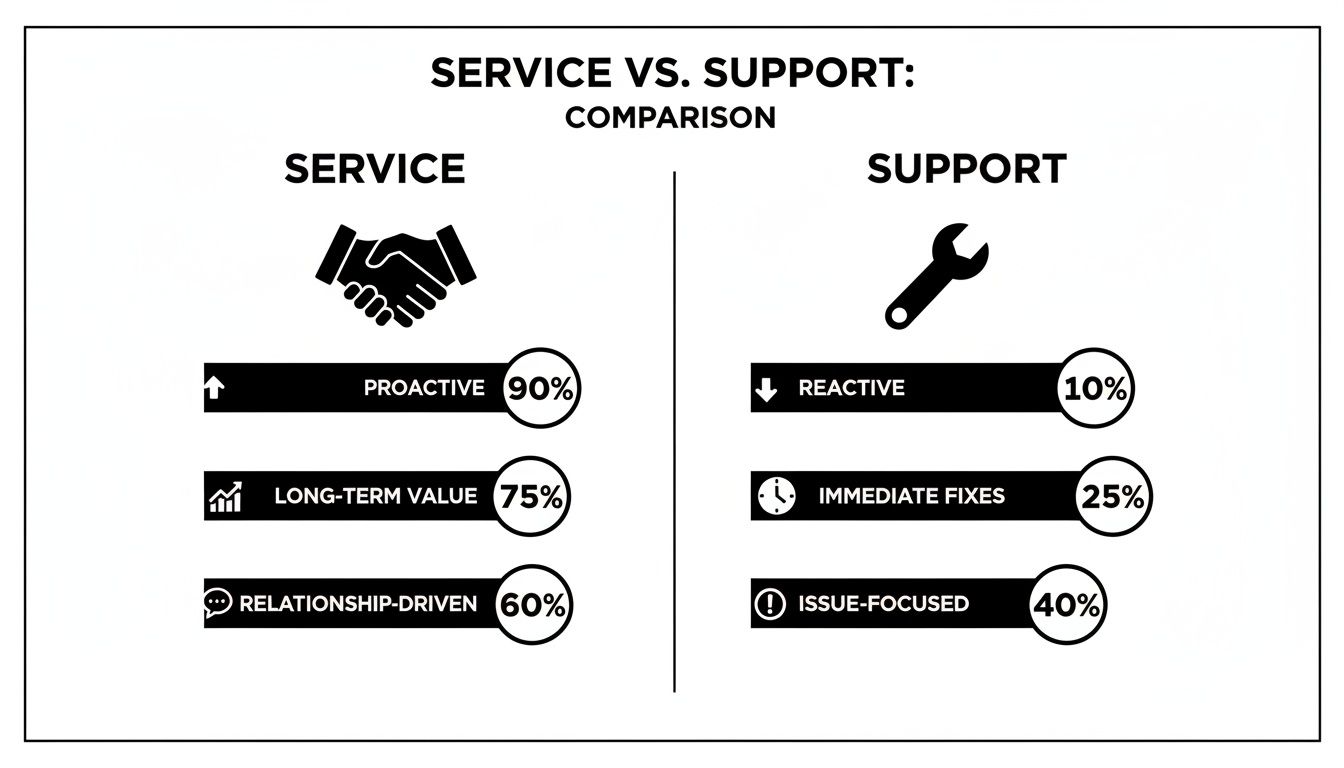
You can see how the service metrics are all about relationships (the handshake icon) while support metrics are purely functional (the wrench icon), which really drives home their different missions.
Key Metrics For Customer Support
Support KPIs are tactical. They zero in on speed, efficiency, and the ability to solve a problem correctly on the first attempt.
- First Contact Resolution (FCR): This is the percentage of issues completely solved during the very first interaction. A high FCR is a brilliant sign of an efficient support process and a knowledgeable team.
- Average Handle Time (AHT): This tracks the average time it takes to handle an interaction from beginning to end. While a lower AHT is generally a good thing, you have to balance it with the quality of the solution.
- Ticket Volume: Keeping an eye on the number of incoming support tickets helps teams spot product issues, see trends as they emerge, and make smart decisions about staffing.
Speed is absolutely critical in support. In India, for example, there's a massive gap between how quickly agents think they solve problems and the customer's reality. While 57% of Indian agents believe they resolve issues within 30 minutes, customers report waiting an average of 3.8 days. That kind of disconnect is exactly why tracking efficiency metrics is so important. You can dig deeper into these customer experience gaps in the full ServiceNow report.
The biggest mistake a company can make is penalising a service agent for a long call time. While that conversation might hurt an "Average Handle Time" metric, the rapport built could secure thousands in future revenue, perfectly illustrating why applying support KPIs to a service role is counterproductive.
Building The Right Team With The Right Skills
The difference between customer service and customer support really hits home when you start building your team. It's not about finding a generic "people person." You're actually hiring for two fundamentally different skill sets: one that's brilliant at building relationships and another that loves to solve complex, technical puzzles.

Think of your customer service team as the heart of your brand's personality. They are the ambassadors on the front lines, navigating customer emotions and building the kind of loyalty that lasts. Their most powerful tools aren't scripts or software, but empathy, patience, and genuinely clear communication.
On the other hand, customer support is a more technical game. Soft skills are certainly part of the equation, but the real non-negotiables are hard skills. These folks need to know your product inside and out, approach problems with a logical mindset, and have the technical know-how to get to the root of an issue and fix it.
Core Competencies for Each Role
To get this right, you have to hire for the right role. Your best service agent might feel completely out of their depth in a technical support position, just as a top-tier support engineer might not have the right temperament for handling general service chats all day.
Let’s break down what you should be looking for.
-
For Customer Service Professionals, you need:
- Empathy and Patience: The ability to connect with a frustrated customer and see the situation from their perspective is priceless.
- Active Listening: This is more than just hearing words; it's about understanding the real need behind the customer's query.
- Clear Communication: The skill to explain things simply and positively, making sure the customer feels heard and helped.
-
For Customer Support Specialists, you need:
- Deep Product Knowledge: They must be the undisputed experts on your product, knowing every feature, quirk, and common issue.
- Logical Problem-Solving: A systematic, methodical approach to troubleshooting is essential for untangling tricky technical problems.
- Technical Proficiency: They should be comfortable digging into the weeds, whether that means reading error logs or understanding API calls.
Team Structures Reflecting Different Goals
How you structure these teams also speaks volumes about their different functions. Service teams often align with the customer journey, with people specialising in areas like onboarding, retention, or account management. Their whole purpose is to nurture the customer relationship.
Support teams, however, are usually built around technical expertise in a tiered system. A classic setup looks something like this:
- Tier 1 (L1): The first line of defence, handling common questions and basic troubleshooting.
- Tier 2 (L2): The next level up for more complex problems that need deeper investigation.
- Tier 3 (L3): Your product experts and engineers who tackle the toughest bugs and technical challenges.
This tiered structure is all about efficiency, making sure issues get to the right person as quickly as possible. And the pressure is mounting. As customer expectations climb, these teams are feeling the heat. In India, for instance, a massive 88% of customers are more demanding than ever before, forcing companies to grow their service and support teams just to keep up. You can dig deeper into this trend in Salesforce's State of Service report.
Ultimately, building the right team means recognising that service is an art focused on human connection, while support is a science focused on technical resolution. Hiring for these distinct skill sets is the first step toward creating a truly exceptional customer experience.
Choosing The Best Tools For Each Department
Giving your teams the right technology is more than just an operational box to tick; it’s a strategic decision that directly shapes how effective they can be. The difference between customer service and customer support becomes crystal clear when you look at the software they rely on every day. Each toolkit is built to amplify their unique strengths and solve their specific challenges.
For customer service teams, who are all about building relationships, the technology stack needs to tell the full story of the customer journey. This means using platforms that offer a complete, long-term view of every single interaction.
Customer support teams, on the other hand, need tools designed for speed, accuracy, and technical problem-solving. Their software has to make the process of diagnosing and fixing issues as efficient as humanly possible.
The Service Team’s Relationship-Building Toolkit
A customer service agent's main job is to nurture loyalty, so their tools are naturally focused on communication and context.
- CRM Platforms: You can't build a relationship without knowing who you're talking to. Tools like Salesforce are the bedrock here, tracking the entire customer history—from their first visit to their most recent purchase—giving agents the context they need for truly personal conversations.
- Proactive Communication Tools: Why wait for a problem? Software for email campaigns, in-app messaging, and automated check-ins helps service teams engage customers before an issue ever comes up.
- Survey and Feedback Software: Platforms designed for sending NPS or CSAT surveys are vital. They help the team get a read on customer sentiment and gather real, qualitative feedback to improve the overall experience.
The Support Team’s Problem-Solving Arsenal
For customer support, the toolkit is geared towards managing a steady stream of technical issues and providing clear, helpful solutions. It's all about resolution.
- Helpdesk Systems: Platforms like Zendesk act as the command centre for support. They organise all incoming tickets, automate workflows, and make sure no customer query ever falls through the cracks.
- Knowledge Base Platforms: These tools let teams build out comprehensive self-service portals. This empowers customers to find their own answers, which is often faster for them and reduces the overall ticket volume for the team.
- Remote Access Tools: For tricky technical troubleshooting, software that lets an agent securely view or even control a customer’s screen can be a lifesaver. It’s often the key to resolving a complex problem in minutes instead of hours.
The right technology isn’t just about efficiency; it’s about enabling each team to fulfil its core mission. Service tools build relationships, while support tools break down technical barriers.
Generative AI is proving to be a game-changer for both departments, though it's used in different ways. For example, a platform like SupportGPT can help service teams personalise their outreach messages at scale. At the same time, it can give support teams instant, automated answers to common technical questions.
This is especially relevant in India, where AI adoption is projected to hit 80% by 2025. This shift is expected to slash issue resolution times by up to 52% and seamlessly support multiple languages, creating much smoother conversations. You can find more data about the rise of AI in Indian customer service on TailorTalk.
When To Prioritize Service Over Support
Figuring out whether to pour your resources into customer service or customer support isn't just an operational headache—it's a crucial strategic decision. There’s no single right answer; it really boils down to where your business is right now, how you stack up against competitors, and what you’re trying to achieve in the short term.
Think of it like this: an early-stage SaaS startup absolutely must get customer support right from day one. At this point, the entire game is about product stability. You need to iron out bugs, help users get value from the product, and build a reputation for reliability. Without fast, effective technical help, you won't survive long enough to worry about anything else.
On the other hand, imagine a mature company in a packed marketplace where all the products look pretty similar. For them, the real battleground is customer service. The experience is what sets them apart. Proactive check-ins, building genuine relationships, and creating positive, memorable interactions are what will keep customers from jumping ship to a competitor.
A Simple Decision-Making Framework
To figure out where your focus should be, take a step back and ask a few honest questions. The answers will point you in the right direction.
- Is our biggest challenge product stability or market differentiation? If your product is unreliable or users are getting stuck on basic features, you need better support. If your product is solid but you’re just another face in the crowd, it’s time to double down on service.
- Are we focused more on acquiring new users or retaining existing ones? A heavy emphasis on retention is often a sign that you need stronger customer service to keep your current customers happy, loyal, and feeling valued.
- Why are customers really leaving us? If they're churning because of technical glitches and tickets that go nowhere, your support is failing. If they're leaving because they feel ignored or found a company that treats them better, your service strategy is the problem.
The ultimate aim isn't to pick one and forget the other. It's to create a fluid system where excellent support stops problems before they start, and exceptional service builds relationships that last. One is about immediate problem-solving, the other is about long-term loyalty.
Remember, this balance isn't set in stone. It's dynamic. It's a good idea to review your priorities every quarter to make sure your resources are aimed at your most urgent business needs. That kind of ongoing adjustment is key to building a truly customer-focused company that can scale effectively.
Frequently Asked Questions
It's common to have a few lingering questions when you're trying to draw a clear line between customer service and customer support. Let's tackle some of the most practical ones that come up when structuring teams and aiming for a standout customer experience.
What Is The Single Biggest Difference?
If you had to boil it down to one thing, it’s about their fundamental approach. Customer service is proactive and all about the relationship. It’s focused on enhancing the customer’s entire journey with your brand to build genuine, long-term loyalty.
On the other hand, customer support is reactive and transactional. Its main job is to fix specific technical problems that pop up. Think of it this way: one builds the relationship, while the other fixes the product.
Can One Person Do Both Roles?
In the early days of a startup, sure, one person might juggle both roles out of sheer necessity. But as the company grows, splitting these functions becomes essential. The skill sets are just too different.
Service roles thrive on empathy and strategic communication, while support requires deep technical knowledge and problem-solving skills. Asking one person to master both is a recipe for burnout and inefficiency because they demand completely different mindsets.
How Does Strong Support Improve Service?
Think of excellent customer support as the bedrock for great customer service. When your support team can quickly and effectively solve technical headaches, they stop negative experiences from ever souring the customer relationship.
This frees up your customer service team to concentrate on proactive, value-adding conversations and building real rapport, rather than just putting out fires. Strong support clears the path, so service can build the superhighway to customer loyalty.
Ready to deliver instant, accurate answers 24/7? With SupportGPT, you can build and deploy powerful AI agents that resolve issues automatically, escalate complex queries to human teams, and provide a world-class support experience. Discover how SupportGPT can transform your customer support today.