Your Guide to a Winning Customer Service Strategy
Build a customer service strategy that drives loyalty and growth. This guide covers core pillars, AI integration, and metrics for exceptional experiences.

At its core, a customer service strategy is your company's game plan for handling every customer interaction. It’s the official roadmap that guides your team, making sure every customer gets the same high-quality, predictable support that reflects your business goals. This moves customer service from just solving problems as they pop up to actively building loyalty.
Defining Your Customer Service Blueprint

It’s tempting to think of customer service as just a helpline or a team that closes tickets. But a real customer service strategy is much more—it's the architectural plan for your entire customer experience. You wouldn't build a skyscraper without a detailed blueprint, and you shouldn't run your business without a clear strategy for support. Without one, you're risking chaotic, inconsistent service that will cause your customer relationships to crumble.
When you don't have a plan, even your best support agents are just winging it. Sure, they might solve a ticket here and there, but there’s no unified approach. This creates wildly different experiences for customers, leading to confusion and, ultimately, frustration. A formal strategy is what turns your support team from a reactive cost centre into a proactive engine for growth.
Why a Documented Strategy Matters
For any business that's serious about its customers, having a documented plan is non-negotiable. It brings the clarity and direction needed for smart decisions, whether you're hiring new agents, designing training programmes, or choosing new software. This blueprint ensures everyone, from frontline agents to the C-suite, is on the same page about the mission.
This alignment is more important than ever. In India, for example, the expectations for customer service are shifting dramatically. A recent study found that 49% of Indian customers say speed is the most important part of good service. Yet, there’s a massive gap between what they expect and what they get. This disconnect led to Indian customers spending a collective 15 billion hours waiting for help last year alone. You can dig into this customer experience gap in the full ServiceNow report.
A strategy isn't just a document; it's a commitment. It signals to your customers that their experience is a priority, not an afterthought. It aligns your people, processes, and technology toward a single, unified goal: making every customer feel valued.
From Reactive Firefighting to Proactive Engagement
Ultimately, a solid customer service strategy lets you move beyond just putting out fires. It gives your organisation the tools to anticipate what customers need, spot recurring problems, and build systems that stop issues before they even start.
Here’s what that shift feels like in practice:
- Clarity over Confusion: Every agent knows the right tone to use, the correct procedure to follow, and who to escalate a problem to in any given situation.
- Consistency over Chaos: Customers get the same excellent standard of care no matter which agent they speak to or what channel they use to get in touch.
- Data-Driven Decisions: You can actually measure what’s working and what isn’t, which allows you to constantly refine and improve your approach.
This guide will give you the framework to build a strategy that delivers on these promises. We’ll walk through its core components, the steps for putting it into action, and the metrics you should be tracking.
The Four Pillars of an Unbeatable Service Strategy
A powerful customer service strategy doesn't just appear out of thin air. It's carefully constructed on a foundation of four interconnected pillars, all working together to create a stable, scalable framework for excellence. Think of it like building a house: without strong supports in each corner, the entire structure is at risk of collapse.
These four pillars are People, Process, Technology, and Feedback. Each one plays a vital role in how you deliver service, and if you neglect even one, you'll find your best efforts falling short. Let's dig into how each pillar contributes to a strategy that actually works.
Pillar 1: People – Your Frontline Advocates
Your support team is the human face of your company. You can have the slickest processes and the most advanced technology in the world, but if the people interacting with your customers lack empathy or product knowledge, the entire experience crumbles. This pillar is about more than just hiring friendly staff; it's about building a team of empowered brand advocates.
This all starts with hiring for core traits like empathy, patience, and clear communication skills. From there, continuous training is absolutely essential. This shouldn't just be a one-off product demo; we're talking about ongoing coaching on how to navigate difficult conversations, when to escalate an issue, and how to embody the company's unique tone of voice consistently.
Investing in your people is a direct investment in your customer relationships. A well-trained, motivated team doesn't just solve problems—they build loyalty and turn frustrating moments into opportunities for delight.
Pillar 2: Process – The Blueprint for Consistency
If your people are the heart of your strategy, then your processes are the skeleton that gives it structure. Without clear, documented processes, your team is left to improvise, which inevitably leads to inconsistent service and frustrated customers. A solid process ensures every customer gets the same high standard of care, no matter which agent they speak to.
Well-defined processes take the guesswork out of the equation and make your whole operation more efficient. Key elements include:
- Standardised Workflows: Step-by-step guides for handling common requests, from billing queries to technical troubleshooting.
- Clear Escalation Paths: A defined protocol for when an issue needs to be passed to a senior agent or another department, ensuring no customer gets stuck in a support loop.
- Service Level Agreements (SLAs): Concrete targets for response and resolution times that create accountability and manage customer expectations.
For example, a simple but effective process might state that all high-priority tickets must get a first response within 30 minutes and be resolved within four hours. This one rule provides clarity for your agents and predictability for your customers.
Pillar 3: Technology – The Tools That Empower
Technology acts as a force multiplier for your people and processes. The right tools can automate repetitive tasks, give agents the customer context they desperately need, and streamline communication across all your channels. Using technology wisely frees up your team to focus on what humans do best: building relationships and solving complex, nuanced problems.
The modern customer service tech stack often includes:
- CRM Systems: A central hub for all customer data, giving agents a 360-degree view of a customer's history and past interactions.
- Helpdesk Software: A platform to manage, track, and respond to customer queries from multiple channels like email, chat, and social media.
- AI Assistants: Tools like chatbots and AI-powered agent assists (such as those from SupportGPT) can handle common questions 24/7, draft responses for agents, and summarise long conversations, giving your team a massive efficiency boost.
When used strategically, technology ensures your team isn’t bogged down by manual work and has the information they need at their fingertips to provide fast, accurate support.
Pillar 4: Feedback – The Compass for Improvement
The final pillar, feedback, is what turns your strategy from a static document into a living, breathing system. A systematic feedback loop allows you to understand what's working, what isn't, and where you need to adapt. It’s your compass, constantly guiding you towards continuous improvement.
This means you need to be actively collecting, analysing, and, most importantly, acting on customer insights. You can gather this data from all sorts of places:
- Customer Satisfaction (CSAT) Surveys: Quick, in-the-moment surveys sent after an interaction to gauge immediate satisfaction.
- Net Promoter Score (NPS): A measure of long-term customer loyalty and how likely they are to recommend your brand to others.
- Direct Feedback: Unsolicited comments from emails, chats, or social media that offer raw, incredibly valuable insights.
By regularly reviewing this feedback, you can spot recurring pain points, refine your processes, and make data-driven decisions that genuinely enhance the overall customer experience.
To bring it all together, here’s a quick overview of how these pillars function within a unified strategy.
Key Pillars of a Customer Service Strategy
| Pillar | Primary Focus | Key Activities & Tools |
|---|---|---|
| People | Building a skilled, empathetic, and empowered support team. | Hiring for soft skills, continuous training on product and communication, performance reviews, and fostering a positive culture. |
| Process | Creating consistent, efficient, and scalable workflows. | Documenting SOPs, defining escalation paths, setting clear SLAs, and mapping the customer journey. |
| Technology | Equipping the team with tools that boost efficiency and insight. | Implementing a CRM, helpdesk software, knowledge base, and AI-powered assistants like chatbots or agent-assist tools. |
| Feedback | Using customer insights to drive continuous improvement. | Collecting CSAT, NPS, and CES surveys; analysing support tickets and social media comments; closing the loop with customers. |
Ultimately, these four pillars aren't separate initiatives—they are deeply intertwined. Great people can’t succeed without clear processes, smart processes are amplified by the right technology, and feedback is the glue that helps you refine all three over time.
How to Build Your Strategy from the Ground Up
Putting together a solid customer service strategy isn't about creating a dusty, formal document that sits on a shelf. It’s about building a living, breathing system that truly serves your customers and empowers your team. Think of it like an architect designing a house; you need a solid foundation, a clear structure, and the right tools to bring it to life.
Let’s walk through a step-by-step process that turns those high-level goals into concrete actions your team can actually execute.
Step 1: Define Your Service Vision and Goals
Before you lay the first brick, you need a blueprint. Your service vision is just that—a simple, powerful statement that captures the kind of experience you want to deliver. It answers one core question: "How do we want our customers to feel after they talk to us?"
Maybe your vision is to provide "effortless, expert support that makes customers feel confident." Great. But a vision without goals is just a dream. You need to connect that vision to measurable outcomes. Vague targets like "improve customer satisfaction" won't cut it.
Get specific with KPIs that tie directly to business results.
- Goal Example 1: Boost our Net Promoter Score (NPS) from 35 to 45 within the next six months.
- Goal Example 2: Hit a First Contact Resolution (FCR) rate of 80% by the end of Q3.
- Goal Example 3: Slash the average First Response Time (FRT) on all email tickets to under two hours.
These concrete targets give your team something to aim for and make it easy to see if your strategy is actually working.
Step 2: Understand Your Customers Deeply
You can’t design a great experience if you don’t know who you’re designing it for. This goes way beyond basic demographics. You need to map out the entire customer journey, identifying every single touchpoint and potential snag. Where do people get stuck? What questions pop up over and over? What makes them frustrated?
Build out detailed customer personas that capture their goals, pain points, and even how they prefer to communicate. A busy startup founder has completely different needs and expectations than a support manager at a massive corporation. Getting these nuances right helps you tailor everything, from the tone of your emails to the support channels you offer.
When you truly understand the customer journey, you can shift from just reacting to problems to proactively preventing them. You start fixing issues before customers even realise they have them—and that's the mark of a world-class service experience.
Step 3: Empower Your Team with Tools and Autonomy
Your support agents are the heart and soul of your strategy. Giving them what they need to succeed comes down to two things: the right tools and the freedom to make decisions. Throwing a dozen disconnected apps at them just creates chaos and slows everyone down. The key is an integrated tech stack.
Typically, this means a central helpdesk, a CRM that gives them rich customer context, and a solid knowledge base for self-service. These days, many teams are also bringing in AI assistants, like those from SupportGPT, to handle the repetitive, easy questions. This frees up your agents to focus their brainpower on the complex, high-value conversations that really need a human touch.
This is where the core elements—your people, processes, tech, and feedback—all come together.
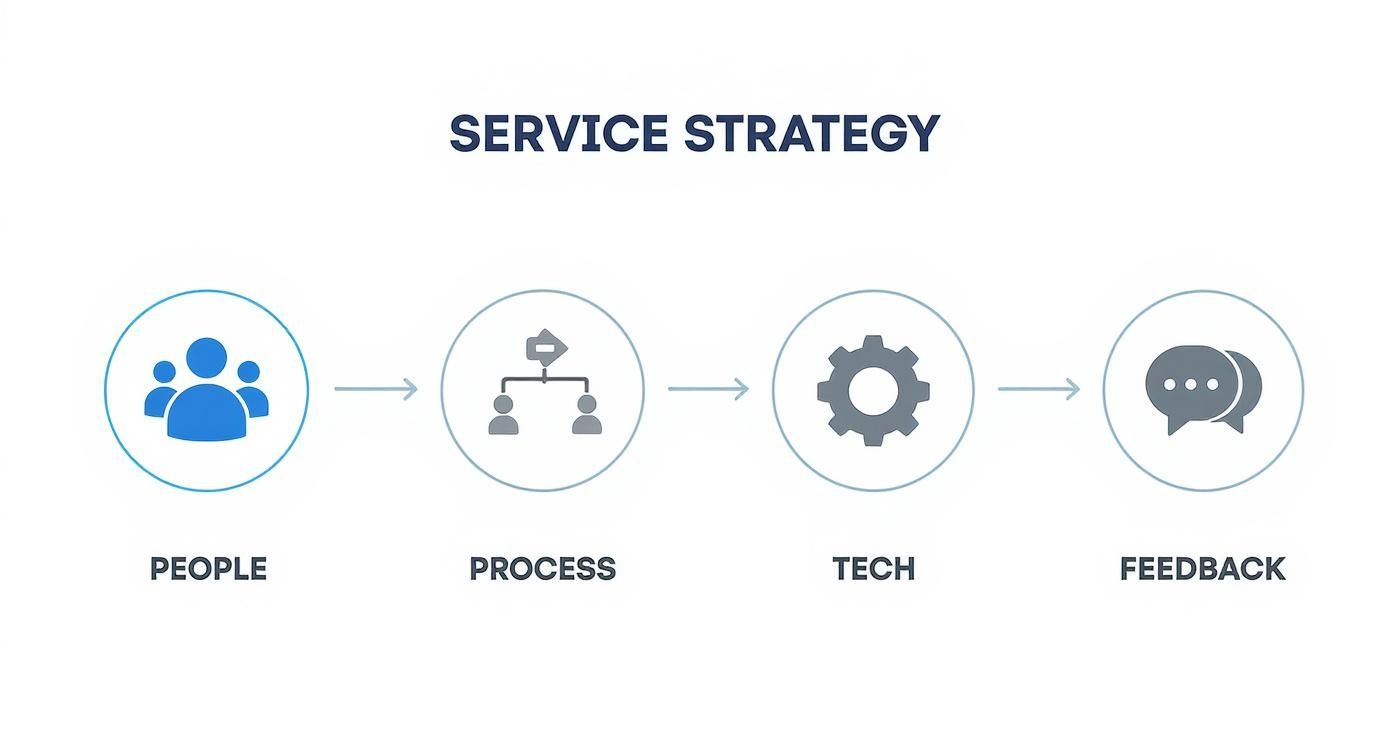
As you can see, it’s not about perfecting any one element in isolation. Success lies in how they all work together in harmony.
Step 4: Create a Culture of Continuous Refinement
A customer service strategy is not a "set it and forget it" project. It’s a living thing that has to evolve as your customers and business change. The final piece of the puzzle is building a culture where you are constantly learning and improving.
Set up dashboards to keep an eye on your key metrics in real time. Hold regular meetings to review performance, dig into customer feedback trends, and pinpoint recurring issues that might signal a deeper product flaw or a broken process.
Most importantly, listen to your agents. They’re on the front lines and are often the first to spot new problems. By creating this constant feedback loop—measure, analyse, adapt, repeat—you ensure your strategy stays sharp and effective. This is how you turn customer service from a cost centre into a powerful engine for loyalty and growth.
How AI Is Reshaping Customer Support
https://www.youtube.com/embed/FwOTs4UxQS4
Let’s get one thing straight: AI isn’t here to make your support team obsolete. It’s here to make them better. A truly effective customer service strategy doesn't replace people with bots; it uses AI as a powerful assistant to handle the routine, repetitive stuff. This frees up your human agents to tackle the complex issues where their skills truly shine.
Think of AI as a triage nurse in a packed A&E. It can instantly greet incoming queries, dish out answers to common questions, and gather all the basic information. By the time a ticket reaches a human agent—the "doctor" in this scenario—they already have all the context needed to diagnose the problem and find the right solution, fast.
This approach is perfect for offering 24/7 support for simple things like password resets or checking an order status. Customers love this because they can get instant answers without waiting for business hours.
Smart Automation and Intelligent Routing
Modern AI does far more than just power basic chatbots. It's the engine behind intelligent routing systems that can read a customer's query, understand the intent, and send them to the perfect agent on the very first try. Gone are the days of customers being bounced between departments.
For instance, if a customer’s message contains "billing error" and "enterprise plan," the AI knows to route them straight to a senior agent who specialises in corporate accounts. That simple, automated step slashes resolution times and makes customers feel understood from the get-go.
This isn’t just theory; it’s already happening. In India, 88% of CX leaders say they’re seeing a positive return on their AI investments. With AI adoption expected to hit 80% across all industries by 2025, it’s projected to cut down resolution times by up to 52%. What’s more, customer attitudes are shifting—51% of consumers now actually prefer dealing with AI bots for quick help. You can discover more insights about AI in Indian customer service here.
AI Guardrails and Smart Escalation
One of the biggest worries with AI is trapping a customer in a frustrating loop with a bot that just doesn’t get it. This is where AI guardrails and a smart escalation plan are absolutely crucial. The whole point is to build a system that knows its own limits.
A well-designed AI doesn’t try to solve every problem. It excels at solving the right problems and knows exactly when to hand off the conversation to a human. This blend of automation and human touch is the future of exceptional support.
Smart escalation means setting up simple, natural-language rules that tell the AI when to pass the baton. These triggers could be based on:
- Keywords: Simple phrases like "speak to a person," "annoyed," or "complaint" can automatically trigger a handoff.
- Sentiment Analysis: The AI can pick up on a customer's frustrated tone and escalate the chat before things get heated.
- Repeat Queries: If a customer asks the same question three times in a row, the system should recognise it's stuck and seamlessly transfer them to a live agent.
Platforms like SupportGPT are built to help teams deploy AI agents with these kinds of enterprise-grade guardrails already baked in. This ensures your AI stays on track, gives accurate answers, and follows your escalation rules to the letter. You end up with a customer service experience that combines the speed of AI with the empathy and problem-solving skills of your human team—the best of both worlds.
Measuring the Metrics That Actually Matter

A brilliant customer service strategy on paper means nothing if it doesn't deliver in the real world. To know if your plan is actually hitting the mark, you need to look past the surface-level numbers and focus on the Key Performance Indicators (KPIs) that truly signal customer happiness, team efficiency, and overall business health. The right data turns gut feelings into a clear, actionable roadmap.
This isn't just about internal box-ticking; it’s a direct response to sky-high customer expectations. In India, companies are pouring more resources into their service operations, with 85% of service professionals expecting bigger budgets. Why? Because 88% of them say customers have become more demanding than ever. The pressure is on, especially when a staggering 70% of Indian consumers would walk away from a brand after just one bad experience. You can learn more about this strategic shift in customer service to see just how critical this has become.
To get a clear picture of your performance, you need to track a balanced set of KPIs across three core areas: customer sentiment, operational effectiveness, and business impact.
How Do Your Customers Really Feel?
First and foremost, you need to measure how your customers perceive your service. Are they genuinely satisfied? Are they turning into loyal fans? These metrics are the most direct feedback you'll ever get on your strategy's effectiveness.
-
Customer Satisfaction (CSAT): Think of this as an instant pulse check. The classic CSAT survey asks, "How satisfied were you with this interaction?" usually on a 1-5 scale. It’s perfect for measuring in-the-moment happiness with a specific conversation or solution.
-
Net Promoter Score (NPS): While CSAT measures a moment, NPS aims to gauge long-term loyalty. It asks the ultimate question: "How likely are you to recommend our company to a friend?" on a 0-10 scale. This helps you identify your biggest advocates (Promoters) and your most at-risk customers (Detractors).
Are Your Operations Running Smoothly?
Happy customers are the goal, but you also need an efficient machine to make that happen consistently. These operational KPIs reveal how effectively your team is working, helping you spot bottlenecks, resource gaps, and opportunities for coaching.
A focus on efficiency isn't about rushing agents. It's about removing internal friction so they can deliver high-quality, thoughtful solutions to customers faster.
Here’s what to watch:
-
First Response Time (FRT): How long does a customer have to wait for that first "we're on it" reply? A speedy FRT shows you're listening and immediately builds trust.
-
Average Resolution Time (ART): This tracks the entire lifecycle of an issue, from the moment it's raised until it's completely solved. It's a core indicator of issue complexity and your team's problem-solving prowess.
-
First Contact Resolution (FCR): What percentage of problems are solved in a single touch? A high FCR is a powerful sign that your agents are well-trained, empowered, and have the tools they need to get the job done right the first time.
Tying It All Back to the Business
Finally, customer service can't exist in a silo. It needs to prove its value to the wider business. These metrics connect your support efforts directly to the bottom line, demonstrating that great service is a revenue driver, not just a cost centre.
-
Customer Churn Rate: This is the percentage of customers who leave you over a certain period. Exceptional service is one of your most powerful weapons in the fight against churn.
-
Customer Lifetime Value (CLV): This forecasts the total revenue you can expect from a single customer over their entire relationship with you. Great service encourages repeat business and loyalty, directly boosting CLV.
To help you get started, here's a quick breakdown of some of the most essential KPIs you should consider tracking.
| Metric Category | KPI | What It Measures |
|---|---|---|
| Customer Sentiment | Customer Satisfaction (CSAT) | Short-term happiness with a specific interaction. |
| Customer Sentiment | Net Promoter Score (NPS) | Long-term customer loyalty and brand advocacy. |
| Operational Efficiency | First Response Time (FRT) | The speed at which your team initially responds to a customer. |
| Operational Efficiency | Average Resolution Time (ART) | The total time taken to completely resolve a customer's issue. |
| Operational Efficiency | First Contact Resolution (FCR) | The percentage of issues solved within the first interaction. |
| Business Impact | Customer Churn Rate | The rate at which customers stop doing business with you. |
| Business Impact | Customer Lifetime Value (CLV) | The total predicted revenue a single customer will generate. |
By tracking a balanced scorecard of metrics from each of these categories, you’ll have a holistic view of your customer service performance—knowing not just what is happening, but why.
Common Strategy Pitfalls and How to Avoid Them
Drawing up a solid customer service strategy is a massive step, but even the best plans can go sideways if you fall into a few common traps. Frankly, learning from where others have stumbled is one of the smartest ways to make your own strategy more resilient. A lot of organisations get into trouble not because their vision is wrong, but because they miss the small, yet crucial, operational details.
These pitfalls can slowly but surely chip away at your team's efforts, leaving you with unhappy customers and burnt-out agents. By spotting them early, you can build in safeguards to make sure your strategy actually delivers what it promises. Let's walk through the most common missteps and how you can steer clear of them.
Ignoring the Dangers of Departmental Silos
One of the fastest ways for a great strategy to crumble is when your teams work in their own little bubbles. A customer doesn't see your company as a collection of departments; they see one brand. When your sales, marketing, and support teams aren’t talking to each other, it’s the customer who feels the pain, forced to repeat their story again and again.
To fix this, you have to actively build bridges between teams.
- Get everyone on a shared CRM: Make sure every team sees the same customer history. This creates a single source of truth for every single interaction.
- Hold regular sync-up meetings: Get leaders from different departments in a room (virtual or otherwise) to talk about customer feedback and agree on what’s important.
- Create shared goals: Link team objectives to bigger customer experience wins, not just narrow departmental KPIs.
Underinvesting in Your Team and Tools
A strategy is only as good as the people and the tech behind it. A classic mistake is skimping on agent training, which leaves your frontline team struggling without the product knowledge or people skills they need to tackle tricky situations. A well-trained team is a confident team, one that can turn a frustrated customer into a loyal fan.
On the flip side, picking technology because it’s trendy, not because it’s useful, is just asking for trouble. That shiny new AI tool is worthless if it doesn’t play nicely with your existing systems or solve a real problem for your customers.
The right technology should feel like an extension of your team, not another obstacle. Focus on tools that genuinely simplify workflows, give agents the context they need, and solve specific customer pain points.
Becoming Complacent and Ignoring Feedback
Perhaps the most dangerous pitfall of all is treating your strategy like a one-and-done project. Customer expectations are always on the move, and what worked last year might be completely outdated today. This often goes hand-in-hand with plugging your ears to negative feedback. It can be tough to hear, but complaints are a gift—they point you directly to where you need to get better. A business that only listens to praise has stopped growing. Actively seek out, analyse, and act on criticism to fuel a cycle of continuous improvement and keep your service a cut above the rest.
Got Questions About Your Service Strategy? We've Got Answers.
Even the most well-thought-out plan can leave you with a few lingering questions. It’s completely normal. Let’s tackle some of the most common ones that pop up when teams start building or refining their customer service strategy.
How Should a Small Business Approach This?
If you're a small business, don't feel like you need a massive budget to create an amazing customer experience. The key is to start with what you already have: a direct connection to your customers. Talk to them. Really understand what they need.
From there, focus on doing one or two things exceptionally well. Instead of trying to be everywhere at once, master a couple of core channels, like email and live chat. Give your small, dedicated team clear guidelines but also the freedom to solve problems on the spot. A simple, affordable helpdesk tool can be a game-changer, giving you just enough structure to keep things organised.
Why Is a Documented Strategy So Important?
Putting your strategy down on paper is all about one word: consistency. It’s the difference between a customer getting stellar service one day and a confusing, frustrating experience the next. A documented plan ensures everyone on your team is working from the same playbook, aiming for the same goals.
Without it, your support becomes a series of one-off, improvised interactions. This turns your support team into a reactive cost centre when it could be a proactive engine for building genuine customer loyalty.
Think of your documented strategy as your north star. It guides who you hire, what technology you invest in, and how you train your team. It’s what ensures every single piece of your service operation is pulling in the same direction—making things better for the customer.
What Are the Core Components of a Strategy?
A truly solid service strategy stands on four pillars. If one is shaky, the whole thing can wobble.
- People: This is about more than just hiring. It's about finding people with genuine empathy and then continuously investing in their growth and training.
- Process: You need clear, repeatable workflows and well-defined escalation paths. Everyone should know what to do when a problem gets tricky.
- Technology: The right tools, like a CRM and a modern helpdesk, don't just fix problems—they make your team faster, smarter, and more efficient.
- Feedback: You have to build a system for listening. That means actively collecting customer insights, digging into what they mean, and, most importantly, acting on them.
Get these four elements working together, and you'll have a foundation strong enough to deliver incredible service, even as you grow.
Ready to supercharge your support? With SupportGPT, you can build and deploy smart AI agents that provide instant answers and seamlessly escalate complex issues to your human team. Start for free at https://supportgpt.app and see how easy 24/7 support can be.