Elevate customer service in retail to transform your business
Learn proven tactics for customer service in retail that boost loyalty, drive sales, and elevate your team's performance.
Let's move past the tired old phrase, 'the customer is always right'. In today's retail world, fantastic customer service is all about creating a smooth, positive, and memorable journey for every person, at every single touchpoint. It’s what turns a simple transaction into a lasting relationship.
What Great Retail Customer Service Really Means Today
Picture your retail business as if you're hosting a brilliant party. Your job isn't just to sell tickets; it's to make sure every single guest feels welcome, understood, and valued from the moment they get the invitation until long after they've gone home. Modern customer service works the same way, shifting from simply fixing problems to proactively building real connections.
This is a massive change in how businesses operate. Service is no longer just a department you call when something goes wrong. It's now the very heart of the entire customer experience (CX), influencing everything from how someone first discovers your brand online to the follow-up they receive after a purchase.
The Foundation of a Memorable Experience
A top-notch customer experience isn't just a nice-to-have; it delivers real business value. The best experiences are built on a few core pillars that shape how people see your brand and whether they'll stick around. In fact, when retailers get this right, it creates powerful brand loyalty—a whopping three out of four consumers say they spend more with businesses that provide good customer service.
These foundational elements are what truly define a great experience. We've summarised them in the table below.
The Six Pillars of Retail Customer Experience
| Pillar | Description in a Retail Context |
|---|---|
| Personalisation | Making the customer feel seen as an individual, not just another order number. This could be anything from personalised product recommendations to remembering their previous purchases. |
| Expectations | Clearly communicating what customers can expect and then consistently delivering on that promise. This includes accurate delivery times and transparent return policies. |
| Time and Effort | Making it incredibly easy for customers to get what they need. A streamlined checkout process, simple navigation, and quick access to support are all key here. |
| Integrity | Being trustworthy and transparent. This means being honest about product availability, pricing, and company values. |
| Resolution | Solving problems quickly and effectively when they do arise. A great resolution can turn a negative experience into a positive one. |
| Empathy | Genuinely understanding and acknowledging the customer's feelings and situation. It's about showing you care. |
By focusing on these six areas, retailers can build a service model that not only satisfies customers but truly delights them. You can dive deeper into these concepts and find more insights in this comprehensive customer experience report from KPMG.
The image below really brings to life how these ideas come together to form the core of an excellent customer experience strategy.
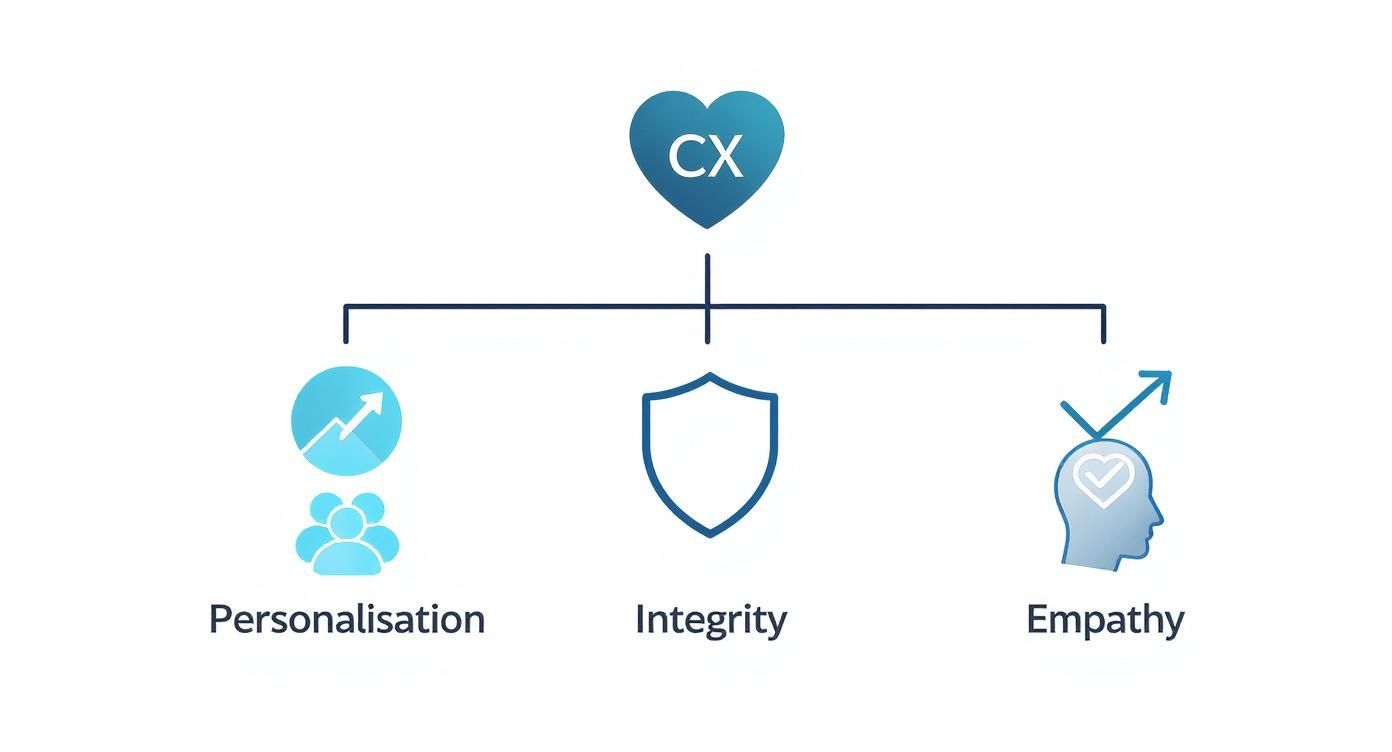
As you can see, making interactions personal, acting with integrity, and showing genuine empathy are the supports that hold up the entire structure.
From Departmental Task to Business Strategy
Looking at customer service through this wider lens is essential for growth. Every single interaction—whether it’s with a chatbot, a sales assistant, or a support agent—is a chance to build up your brand’s reputation and secure future sales.
A great customer interaction doesn't just solve a problem; it reinforces the customer's decision to choose your brand over a competitor. It transforms a one-time buyer into a lifelong advocate.
Ultimately, investing in world-class customer service in retail is an investment in your brand’s future. It lays the groundwork for creating a service that customers will not only remember but also reward with their loyalty and vocal support, turning your service team into a powerful engine for growth.
Why World-Class Service Is Your Ultimate Competitive Edge

Let's be clear: excellent customer service in retail isn't just about being polite. It's a rock-solid business strategy. When you really get down to it, happy customers are the fuel for a healthy bottom line, making top-tier service one of the most reliable ways to stand out in a ridiculously crowded market.
Every single positive interaction is a chance to build your brand and your revenue. When customers feel genuinely seen and valued, they do more than just come back—they spend more. In fact, an incredible seven out of ten consumers admit they'll open their wallets wider for a company that delivers great service. Suddenly, your support team isn't a cost centre; it's a profit driver.
Boosting Revenue and Building Loyalty
The most obvious financial win from amazing service is its effect on customer lifetime value (CLV). Think of CLV as the total worth of a customer over their entire relationship with you. By delivering consistently helpful and personal support, you give people every reason to stick around.
This repeat business is what sustainable growth is all about. It's simple, really. Finding a new customer is tough work. But keeping an existing one happy? That’s like tending to a plant that's already bearing fruit. It takes far less effort for a much greater reward.
This is where great service shines. It directly tackles customer churn—the percentage of customers who leave you—and keeps your hard-won relationships intact.
The True Cost of Poor Service
On the flip side, neglecting customer service is like having a hole in your pocket. A single bad experience creates a ripple effect that can be surprisingly costly. You don't just lose a sale; you can lose a customer for life and tarnish your reputation in the process.
U.S. companies lose over $62 billion a year because of poor customer service. This isn't just about lost transactions. It's the total hit from trashed reputations, scathing reviews, and the massive cost of trying to win back trust.
The financial damage from bad service piles up fast. Here’s a look at the fallout:
- Lost Future Sales: A staggering 86% of customers will walk away for good after just one negative interaction. That's a huge amount of future revenue wiped out in a single moment.
- Negative Word-of-Mouth: Unhappy customers shout louder than happy ones. Negative reviews and social media rants can scare off countless potential new customers before they even think about buying from you.
- Higher Acquisition Costs: When you're constantly losing customers, you have to spend a fortune on marketing just to stand still. It costs so much more to find a new customer than to keep one, so high churn sends your operational costs through the roof.
Turning Customers into Brand Advocates
The endgame here is to create an army of brand advocates. These are the customers who don't just buy from you, but who go out of their way to tell their friends, family, and online followers how great you are. This kind of authentic word-of-mouth marketing is priceless, and it’s born directly from world-class service.
When a support interaction exceeds expectations, it becomes a story people want to share. That story builds a level of trust and credibility that no paid ad campaign can ever hope to match. Every helpful chat and every solved problem adds another brick to a reputation that pulls in new business all on its own. This is why investing in quality customer service in retail isn't just a nice-to-have; it's essential for any brand that wants to win long-term.
Measuring What Matters in Your Service Strategy
You can't improve what you don't measure. If you want to genuinely lift your customer service in retail, you need a solid way to track performance and see its actual impact. It’s about ditching the guesswork and using real data to understand what’s working, what’s falling flat, and where you can make changes that count.
Think of it like a fitness plan. You wouldn't just work out randomly and hope for results; you'd track things like how far you ran or how much you lifted. Key performance indicators (KPIs) do the same for your service strategy—they turn fuzzy goals into hard numbers, showing you just how healthy your customer relationships are.
Unpacking the Core Service Metrics
While you could track dozens of different numbers, a few core KPIs give you the clearest window into customer sentiment and how efficiently your team is operating. These are the foundational metrics that every retail business ought to have on their dashboard.
Here are the three big ones to get you started:
-
Customer Satisfaction (CSAT): This is your classic "How did we do?" metric. Usually measured on a simple scale (like 1-5 stars), CSAT gives you an immediate snapshot of how a customer felt after a specific interaction, whether it was a support chat or a checkout in-store. It’s brilliant for pinpointing moments of frustration or delight.
-
Net Promoter Score (NPS): NPS takes a longer view, measuring loyalty by asking one simple question: "On a scale of 0-10, how likely are you to recommend us to a friend?" This sorts your customers into Promoters (9-10), Passives (7-8), and Detractors (0-6). Your score—the percentage of Promoters minus Detractors—offers a high-level look at your overall brand reputation.
-
Customer Effort Score (CES): This metric gets right to the point: how easy was it for a customer to get help? The question is usually something like, "How much effort did you have to put in to get your issue resolved?" A low-effort experience is one of the strongest predictors of loyalty because, let's be honest, people value their time and hate hassle.
Insight: Making things easy for your customers is a game-changer. Research shows that a staggering 96% of customers who have a high-effort experience become more disloyal. That number drops to just 9% for those who had an easy time.
Navigating Common Retail Service Challenges
Of course, tracking numbers is only half the story. Retail teams today are juggling a unique set of challenges that can make delivering great service a real grind. Knowing what these hurdles are is the first step to clearing them.
One of the biggest is managing sky-high customer expectations. Shoppers now want instant, personalised, and seamless help on every channel, from your website’s chatbot to the person behind the counter. This "always-on" expectation puts a ton of pressure on teams to be both quick and genuinely empathetic.
Then there’s the balancing act of integrating new tech without losing the human touch. Tools like the AI agents offered by SupportGPT are fantastic for handling routine questions 24/7, but you have to ensure there’s a smooth handoff to a human for more complex or emotional situations. The goal is to use technology to empower your team, not to replace the critical connection only a person can provide.
Putting Metrics into Action
Gathering all this data is useless if you don't do anything with it. The real magic happens when you use these KPIs to drive meaningful change.
For instance, a consistently low CSAT score after live chats might tell you that your agents need more training or better tools. A diving NPS could be a red flag for a bigger problem with your product or delivery process that needs urgent attention.
By regularly checking in on these metrics, you can spot trends, celebrate what’s going well, and jump on problems before they snowball. This data-driven mindset turns customer service from a reactive cost centre into a proactive, strategic part of your business that builds loyalty and drives real growth.
Mastering the Omnichannel Service Experience

Today's customers don't see channels; they just see your brand. Whether they're scrolling through Instagram, talking to a chatbot, or walking into your shop, they expect a single, coherent conversation. That’s the heart of a true omnichannel service strategy.
It’s all about making the jump between your digital and physical worlds feel effortless. A customer might ask a question on social media, get a quick answer, and then pop into a store to buy the item. A great omnichannel approach makes sure every one of those steps is connected, making the customer feel seen and valued, no matter how they reach out.
In-Store Excellence: The Human Touch
Even in our digital-first world, the power of a face-to-face interaction can't be overstated. Physical retail is still a powerhouse, driven by strong consumer turnout and the simple joy of taking a product home immediately. Recent festive seasons have shattered records for India’s retail economy, a success largely built on the backs of millions of small traders and local manufacturers. This just goes to show that great customer service in retail is still very much about the in-person experience. You can read more about the strength of India's retail growth over at Retail Insight Network.
To make those in-person moments truly memorable, you have to empower your frontline team. They aren't just staff; they're the living, breathing embodiment of your brand.
- Create Empowered Problem-Solvers: Give your team the authority to make things right on the spot. When an employee can offer a small discount for a damaged box or process a return without calling a manager, a moment of friction is transformed into a feeling of delight.
- Practise Active Listening: Train your staff to hear what's not being said. A customer asking, "Is this durable?" is often really asking, "Is this worth my money?" A team member who can pick up on that cue can offer reassurance and build genuine trust.
The goal of in-store service is to create a human connection that a website simply can't. It's about making people feel so welcome and understood that they leave with a positive memory, not just a product.
Digital Mastery: Your Online Front Door
Your online channels are your digital storefront, and the service there needs to be just as polished and personal as what customers find in your physical locations. That consistency is non-negotiable. The friendly, helpful person behind your counter should have the same voice as the agent in your live chat.
Of course, each digital channel has its own rhythm and rules for great service.
- Live Chat Best Practices: This is all about speed and personality. You need to respond quickly, but not at the expense of a human touch. Use real names, show you understand their frustration, and avoid sounding like a robot reading from a script. It should feel like a helpful conversation.
- Social Media Care: Remember, social media is a public stage. Responses have to be fast, professional, and empathetic. Acknowledge complaints publicly to show you're listening, then immediately suggest moving to a private channel (like a DM) to sort out the specifics. This protects customer privacy while showing everyone else you're on the ball.
- Effective Email Support: Email gives you the space for more detailed, thought-out replies. Structure them for easy reading with short paragraphs and bullet points. Before you close that ticket, always double-check: "Have I completely solved their problem?"
A cohesive omnichannel strategy means applying the same core service principles across different environments. The technology and timing might change, but the goal—making the customer feel heard and helped—remains the same. Here’s how those principles translate from the shop floor to the screen.
Omnichannel Service Strategies In-Store vs Online
| Service Principle | In-Store Application Example | Online Application Example |
|---|---|---|
| Personalisation | A sales assistant remembers a customer's past purchases and suggests a new, complementary product. | The website displays product recommendations based on the customer's browsing history and past orders. |
| Problem Resolution | An employee is empowered to offer an immediate exchange for a faulty item without managerial approval. | A support agent uses screen sharing to walk a customer through a technical issue with their account. |
| Proactive Assistance | A staff member notices a customer looking confused and approaches them to offer help finding an item. | A proactive chat pop-up appears on a high-value checkout page asking, "Do you have any questions before you buy?" |
| Seamless Handoff | A customer returns an online order in-store, and the staff can instantly pull up the order details to process the refund. | A customer starts a chat on mobile and can continue the exact same conversation on their desktop without repeating themselves. |
Ultimately, whether a customer is clicking a mouse or walking through a door, they should feel like they're having one continuous, positive conversation with your brand.
Unifying the Customer Journey
True omnichannel excellence isn't just about being everywhere; it's about connecting everything. A customer's history and context should follow them from one touchpoint to the next, creating a single, unbroken experience.
Think about it this way: a customer uses your website's live chat to ask if a specific product is in stock at their local store. The online agent confirms it is and offers to put it on hold for them. When the customer arrives an hour later, the in-store team is expecting them, and the item is waiting at the counter.
That’s what a brilliant omnichannel experience looks like. It removes all the little annoyances and shows customers that you see them as one person, not a series of disconnected interactions. This kind of coordinated customer service in retail doesn't just solve problems—it builds the kind of loyalty that lasts.
How AI and Automation Are Shaping Retail's Future
Think of technology in retail not as a replacement for your team, but as a way to give them superpowers. Artificial intelligence (AI) and automation are genuinely changing the game for customer service in retail. They tackle the repetitive, predictable tasks, offer instant support, and free up your people to focus on what they do best: building relationships and solving tricky problems.
This shift lets your team deliver faster, smarter, and more personal service. By automating routine questions, you ensure customers get immediate answers any time of day. Meanwhile, your staff can pour their expertise into those high-value interactions that really need a human touch.
Smarter Support with AI Chatbots
One of the most obvious ways AI is showing up is through chatbots. Forget the clunky, frustrating bots from a few years ago. Today’s AI agents can understand conversational language, pull up order information, and give accurate answers to common questions, 24/7.
A customer wondering about your return policy at 2 AM can get an instant, correct answer from a bot instead of waiting for your team to clock in. This kind of immediate help is a massive win for the customer experience and cuts down the number of simple tickets your human team has to sift through.
Tools like AI agents can make a huge difference for businesses aiming for that always-on level of support without burning out their teams. Platforms like SupportGPT make it straightforward to build and launch intelligent assistants that can handle a wide range of questions efficiently. Learn more about how an AI support platform can help you.
Personalisation Through Predictive Analytics
But AI's power goes way beyond just answering questions. Predictive analytics is another brilliant tool that digs into customer data—like browsing history and past purchases—to figure out what they need before they even have to ask.
Imagine a customer is looking at hiking boots on your website. AI can see they've previously been interested in waterproof gear and proactively suggest a durable pair of boots, maybe even with some high-performance socks to match. This isn't just a random upsell; it's a thoughtful recommendation that feels genuinely helpful.
By understanding customer behaviour on a deeper level, AI allows retailers to create hyper-personalised experiences at scale, making each shopper feel like they have their own personal assistant guiding them.
This proactive approach to customer service in retail transforms a standard shopping trip into a custom-built journey. It builds real loyalty and makes a sale much more likely because it shows customers you get them, which is what great service is all about.
The Smart Escalation Strategy
A common worry is that automation will make everything feel cold and robotic. The best strategies, however, use a smart escalation model where technology and people work together seamlessly. The trick is to design a system that knows exactly when to pass a conversation over to a person.
For example, an AI chatbot can easily handle "Where is my order?". But when a customer says, "My delivery arrived damaged and I'm really upset," the system should immediately route that to a human agent. The AI handles the logistics, while your team member provides the empathy and creative problem-solving needed for an emotional situation.
This blended approach is vital, especially in a booming digital market. The Indian e-retail market, for example, has rocketed to around US$60 billion in gross merchandise value. This kind of growth depends on exceptional service that's fast, reliable, and consistent, shifting from face-to-face chats to snappy digital support and logistics. You can read more about the growth of India's e-retail market on bain.com. Smart escalation makes sure that efficiency never comes at the cost of making a customer happy.
At the end of the day, AI and automation aren't about creating a human-free service model. They're about building a more efficient and intelligent system where technology handles the routine stuff, allowing your team to deliver exceptional, empathetic service when it truly matters.
Putting Your New Service Strategy into Action
Knowing what great customer service in retail looks like is one thing; actually delivering it day-in and day-out is another entirely. This is where the rubber meets the road, turning a solid plan into real, measurable results for your business. It's not about flipping a switch overnight. Instead, think of it as a series of smart, deliberate steps that build on each other to create meaningful change.
The very first move is to get an honest look at where you stand right now. You need to conduct a full audit of your current service performance. That means diving into the metrics we’ve talked about—CSAT, NPS, and CES—to get a clear-eyed view of your starting point.
But numbers only tell half the story. You also need to gather the human side of the equation. Chat with your frontline staff. What are their biggest headaches? What do they hear from customers all day? Listen to call recordings. This blend of hard data and real-world stories will quickly show you exactly where the friction is in your customer journey.
Set Meaningful Goals and Empower Your Team
Once you have that baseline, you can start setting goals that actually mean something. A vague target like "improve customer satisfaction" isn't going to cut it. A much stronger goal is something like, “Increase our CSAT score by 10% this quarter by cutting our first-response time in half.” Now that's a target your team can sink their teeth into.
With clear goals set, the next step is all about empowerment. This really comes down to two things:
- Invest in Training: Your team needs the right skills to win. This goes beyond just product knowledge. We're talking about active listening, empathy, and knowing how to navigate tough conversations. A well-trained employee is a confident one, ready to solve problems on the spot.
- Provide the Right Tools: Give your team technology that helps, not hinders. A unified customer dashboard that brings all conversations into one place, or an AI assistant that handles repetitive questions, frees up your people to focus on the complex issues where a human touch makes all the difference.
A well-trained team armed with the right tools doesn't just stick to a script—they create genuinely positive experiences for your customers. That investment comes back to you in spades through higher loyalty and greater efficiency.
Real-World Examples of Service Transformation
So, what does this look like in the wild?
- E-commerce Success: An online fashion retailer saw its CSAT scores dipping because of sluggish email support. They rolled out an AI-powered system to instantly answer common questions like "Where's my parcel?". This freed up their human agents to give detailed styling advice and help with tricky sizing issues, which boosted their CSAT by 30% in just six months.
- Brick-and-Mortar Loyalty: A local bookshop decided to train its staff to be more than just cashiers; they became community curators. They were encouraged to host small reading groups and give personalised recommendations based on a customer's reading history. This focus on human connection built a fiercely loyal customer base that chose them over massive online retailers every time.
These examples make it clear: a thoughtful approach to customer service in retail, supported by the right training and tools, is a powerful engine for growth. The journey begins with that first step—auditing where you are today and setting a clear goal for where you want to be tomorrow.
Frequently Asked Questions
Even with a great plan, you're bound to run into some specific hurdles when you're working to level up your customer service in retail. Let's tackle some of the most common questions that pop up, giving you practical answers to get you through the tough spots.
What Is the Most Important Customer Service Skill?
If I had to pick just one, it would be active listening. Honestly, it's the bedrock of everything else.
Active listening is about truly hearing what a customer is saying—and what they're not saying. It’s the key to grasping their actual problem, feeling out their frustration, and finding a solution that genuinely helps. Without it, your most experienced team member can completely miss the point, leading to more frustration. It's how you make someone feel heard and valued.
How Can Small Retailers Compete on Service?
This is where being small is your superpower. You can create a personal, community-focused vibe that the big box stores can only dream of.
Forget trying to beat them at their own game. Instead, focus on building real relationships. Learn your regulars' names. Remember what they bought last time. Give your staff the freedom to solve a problem right then and there, without needing to climb a corporate ladder for approval. That’s how you build the kind of loyalty that money can't buy.
The key for small retailers is not to copy the giants, but to lean into what makes them different. Personal touches, flexibility, and a deep connection to the local community are powerful competitive tools that technology alone cannot replace.
How Should I Handle Public Social Media Complaints?
The golden rule here is to act fast and take it private.
Your first move should always be a quick, professional, and public reply. Acknowledge the person's frustration with something simple like, "We're so sorry you had this experience, and we'd like to make it right." Then, immediately ask them to send you a direct message (DM) with the specifics. This shows everyone watching that you're on top of it, while letting you sort out the messy details behind the scenes.
Ready to provide instant, 24/7 answers and empower your team? SupportGPT makes it easy to build and deploy intelligent AI support agents that your customers will love. Discover how SupportGPT can transform your customer service.