Understanding Customer Orientation Meaning and Its Impact on Growth
Discover the true customer orientation meaning. Learn how this business philosophy drives loyalty, revenue, and sustainable growth with real-world examples.
Let's be clear: customer orientation is much more than just good customer service. It’s a complete business philosophy where every single decision, from the boardroom to the front lines, is filtered through the customer's perspective.
Think of it as your company's true north—a compass that always points towards understanding, anticipating, and solving your customers' real-world needs.
So, What Exactly Is Customer Orientation?
To really get it, you have to see customer orientation as the DNA of your business, not just another department's job. It's a proactive mindset that bakes the customer’s point of view into every team, whether it's product development, marketing, or even finance.
This approach completely flips the script from "What can we sell them?" to "What does our customer actually need to succeed?". Instead of just reacting to support tickets, a genuinely customer-oriented organisation is out there, actively trying to understand the customer’s world. This deep empathy then shapes the entire company strategy, ensuring that you’re delivering real value. That's how you build loyalty and turn happy customers into your biggest fans.
The Core Principles of This Approach
A customer-oriented strategy isn't just about being polite. It stands on a few key pillars that guide every decision and interaction.
Here's a quick breakdown of what a customer-oriented approach is truly built on. These aren't just buzzwords; they're the active ingredients that make the strategy work.
| Principle | Description |
|---|---|
| Empathy | Genuinely understanding your customers' feelings and seeing challenges from their perspective. |
| Proactivity | Anticipating future needs and pain points, often before the customers themselves have realised them. |
| Value Creation | Focusing on delivering outcomes customers find truly valuable, not just pushing features or services. |
This philosophy has a massive impact, especially in crowded markets. Take India's fast-moving retail sector, where a business's survival is directly tied to its customer orientation. A recent study confirmed that employee behaviour, store efficiency, and overall service quality are the critical factors for winning consumer trust and repeat business. You can dive into the full findings on the paradigm shift in Indian retail.
A truly customer-oriented company doesn't just listen to customers; it structures its entire operation around the insights it gathers, making customer success a shared, company-wide mission.
Ultimately, this is all about building lasting relationships, not just chasing one-off sales. It’s a deep commitment to making sure every single step of the customer journey feels seamless and supportive.
Customer Orientation Versus Customer Centricity
In the business world, you’ll often hear “customer orientation” and “customer-centricity” thrown around as if they’re the same thing. They’re definitely related, but they’re not interchangeable. Getting the distinction right is key to building a strategy that actually works, because confusing them can muddle your company’s core beliefs with its day-to-day actions.
Let’s break it down with a simple analogy. Think of customer orientation as your company’s constitution. It's the foundational philosophy, the deeply ingrained belief that every single decision, from the boardroom to the front line, should start and end with the customer. It’s the ‘why’ behind everything you do.
From Belief to Action
Customer-centricity, on the other hand, is the active execution of that philosophy. If orientation is the constitution, then centricity is all the laws, processes, and specific tactics you put in place to live by that constitution. It’s how you apply your customer-first beliefs in the real world.
This hierarchy really helps visualise how the core philosophy of customer orientation underpins the tangible parts of your business, like your service and product development.
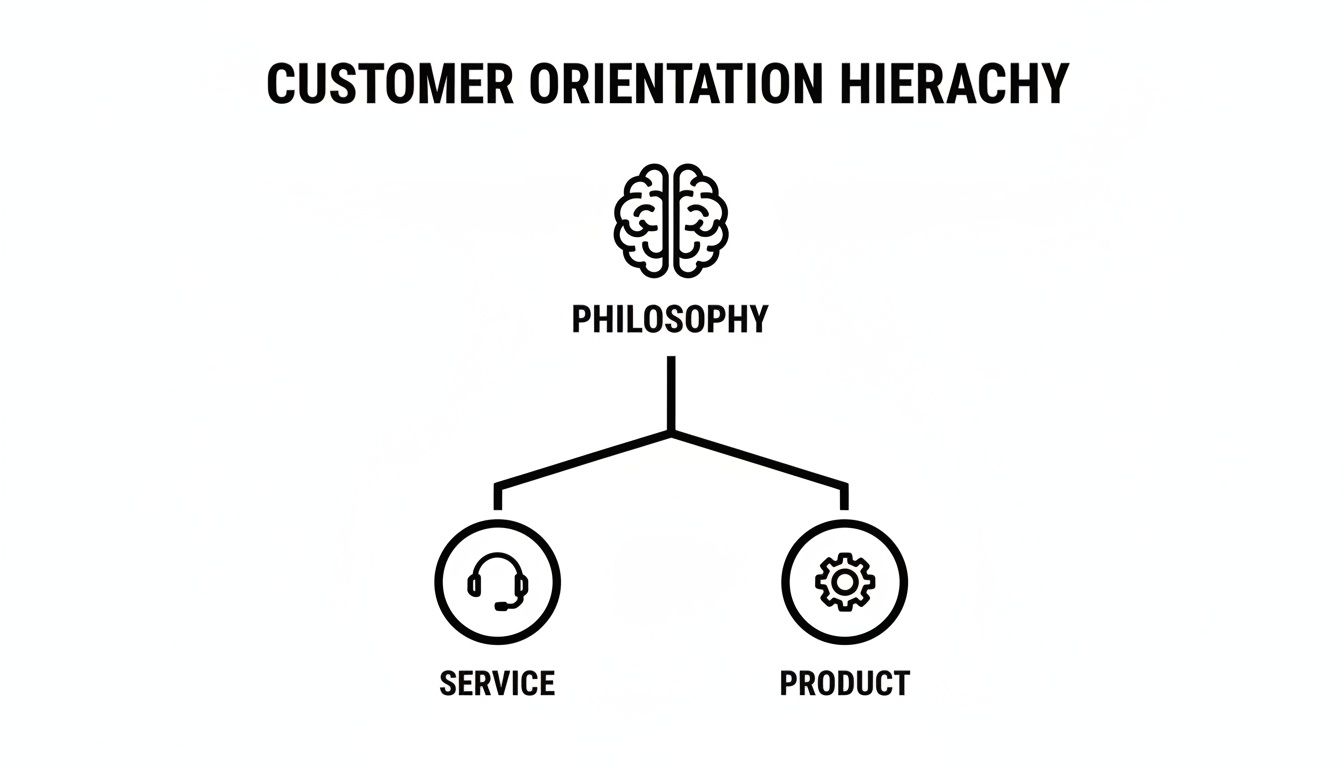
As you can see, a strong philosophical foundation is what holds up every customer-facing part of your operation. Without that guiding belief system, your service and product efforts are just a collection of disconnected tasks without a unified purpose.
A business can have customer-centric processes like a loyalty programme or a feedback survey, but without a genuine customer orientation, these actions become hollow tactics rather than part of a cohesive, heartfelt strategy.
For instance, a company might rush to launch a new feature because it was a popular request—that’s a customer-centric action. But a truly customer-oriented company would first dig deeper to understand the underlying problem that many customers are facing. They’d focus on solving the root cause, not just treating a symptom.
Why This Distinction Matters
So, why get hung up on the terminology? Because it helps you accurately diagnose where things might be going wrong in your organisation. Are you struggling because your teams don’t genuinely buy into the customer-first mindset (a philosophical gap)? Or is the problem that you lack the right tools and processes to act on those beliefs (an execution gap)?
Pinpointing the real issue is half the battle. You can't fix a broken process by just repeating your mission statement, and you can't build a strong culture with processes that your team sees as pointless. Nailing both the belief and the execution is the only way to create an experience that builds real, lasting customer loyalty.
Why Customer Orientation Is Your Greatest Competitive Edge
In a market flooded with products and services that all look and feel the same, what really makes a business stand out? It’s not about cramming in the most features or slashing prices to the bone anymore. The real, lasting advantage comes from a deep, company-wide commitment to your customers.
This isn't just a feel-good idea; it’s a hard-nosed business strategy. When every team is aligned around solving real customer problems, you start seeing real results. We’re talking about a higher customer lifetime value (CLV) and a serious drop in your churn rate. Why? Because happy customers don’t just stick around—they spend more.
Think about it. A competitor can copy your software's features or undercut your prices tomorrow. But they can't easily replicate the trust and loyalty you build by genuinely putting your customers first. That’s a powerful, sustainable advantage.
Turning Buyers into Your Biggest Fans
Let's be honest, your best marketing team isn't on your payroll. It’s your customers. When you consistently make their success your priority, you transform them from simple buyers into passionate advocates for your brand. These are the people who will sing your praises, defend you online, and give you the brutally honest feedback you need to get better.
This is especially true in the cut-throat worlds of SaaS and e-commerce. One bad experience can send a customer running to your competitor, but one amazing interaction can spark a wave of word-of-mouth referrals. This is what customer orientation means in practice: creating an experience so good that people can't help but talk about it.
We're seeing this play out in a big way in the Indian retail market, where a seamless, personalised experience is no longer a "nice-to-have" but a core strategy. Recent data shows that a massive 72% of Indian shoppers are more likely to buy from brands that personalise their communication. This proves it's not just about the transaction; it’s about building a genuine relationship. You can read more about the customer experience in the Indian retail landscape to see just how critical this has become.
Building a Moat Around Your Business
Think of customer orientation as digging a deep, protective moat around your castle. Every positive interaction, every problem you solve with a bit of empathy, makes that moat wider and deeper. It makes it that much harder for competitors to lure your customers away.
This focus gives you some very concrete benefits:
- You keep more customers: It’s simple. Happy customers don’t have a reason to shop around. One study even found that a single bad experience is enough to make more than half of customers jump ship to a competitor.
- You make more money: Keeping a customer is far cheaper than finding a new one. On top of that, loyal customers tend to buy more often and are more willing to try your premium products or services.
- Your brand shines: Companies known for their incredible customer focus build a powerful reputation that naturally attracts top talent and new business.
At the end of the day, customer orientation isn't a quick tactic to boost quarterly numbers. It's a long-term strategy for building a resilient business. It ensures that no matter how the market shifts or technology changes, you’re always anchored to the one thing that truly matters: a loyal customer base.
How Winning Companies Put Customers First
It’s one thing to talk about theories, but the real meaning of customer orientation comes to life when you see it in action. The best companies don't just pay lip service to the idea of putting customers first; they engineer their entire business around it. Their strategies provide a fantastic blueprint for what actually works.
Let's look at how a couple of leading brands from totally different industries live and breathe this philosophy. These aren't just clever marketing campaigns; they're deep-seated cultural norms that fuel their long-term success.
The Ritz-Carlton: A Masterclass in Empowerment
The Ritz-Carlton hotel group is legendary for its devotion to guest experience. What truly sets them apart isn't just the plush rooms or fancy lobbies—it's the incredible autonomy they grant their employees. This is where their customer orientation really shines.
Every single staff member, from the general manager to the housekeeping team, has the authority to spend up to $2,000 per incident to solve a guest's problem on the spot. No need to wait for a manager's approval. That policy sends a crystal-clear message: a guest's immediate happiness trumps short-term costs and bureaucratic red tape every single time.
But this isn't just about fixing what’s broken. It's about empowering the team to proactively create "wow" moments. Imagine a concierge overhearing a couple mention their anniversary. That employee can use their budget to arrange a surprise bottle of champagne, turning a pleasant stay into an unforgettable memory.
Being customer-oriented isn’t just about knowing your customers; it’s also about empowering your employees to act on that knowledge immediately and without friction.
Harley-Davidson: Building a Community from the Inside Out
You might not think of a motorcycle company first, but Harley-Davidson’s approach is a brilliant case study in deep customer connection. They understand their brand is much more than a machine; it represents a lifestyle, a tight-knit community, and a shared passion.
To keep that culture authentic, they make a point of hiring people who are already part of the Harley world. During interviews, candidates aren't just evaluated on their professional skills; they're also asked about their genuine passion for and knowledge of Harley-Davidson motorcycles.
This creates a powerful, self-sustaining loop.
- Authentic Advocacy: When employees are genuine fans, they can talk to potential buyers with an enthusiasm and product knowledge that simply can't be faked.
- Customer Empathy: They instinctively grasp the values, desires, and frustrations of their audience because they are their audience.
- Product Insights: Their own experiences riding and living the brand provide priceless feedback for the product development and marketing teams.
By hiring from within its customer base, Harley-Davidson ensures the entire organisation is perfectly in sync with the people it serves. It's a profound commitment to customer orientation, weaving the customer's voice directly into the company's DNA.
Building a Truly Customer-Oriented Culture
Becoming a genuinely customer-oriented organisation isn't a task you can hand off to a single department. It’s a profound cultural shift that has to run through the veins of the entire company, from the C-suite right down to the front lines. This kind of change doesn't just happen; you have to build it, brick by brick, through deliberate and consistent action.
It all starts at the top. The journey kicks off when the executive team doesn’t just talk the talk, but walks the walk. Leaders need to champion this mindset, modelling customer-first behaviour in every single strategic decision they make. When the entire company sees that putting the customer at the centre of the universe is a shared purpose, individual teams feel empowered to pull together and make it happen.
Weave Empathy into Your Company DNA
A customer-oriented culture runs on empathy. It's that simple. It’s the ability to step into your customer's shoes, understand their frustrations, and see the world from their point of view. Nurturing this skill across your organisation is the secret to building relationships that actually last.
Empathy is what turns a transaction into a connection. Instead of just jumping to a solution, an empathetic team takes a moment to acknowledge the customer's frustration and let them know they’ve been heard. It’s a small shift, but it can transform a negative support ticket into a moment that builds incredible loyalty.
"Customer service can't always deliver solutions, but it can always deliver empathy." - Gareth Goh, InsightSquared
Practising empathy means learning how to cushion a "no" with a thoughtful conversation. It’s about proving you care about the person, not just the problem they’re bringing you.
Empower Your Teams to Act Decisively
For a customer-first mindset to mean anything, your people have to be empowered to act on what they know without getting tangled in red tape. Your team members are the ones on the ground, closest to the customer. More often than not, they know exactly how to solve a problem quickly and creatively.
So, what does that empowerment look like in practice?
- Trust and Autonomy: Give your support agents the authority to make decisions on the spot—like issuing a refund or offering a discount—without needing to climb a ladder of approvals. It shows you trust their judgement.
- Cross-Functional Teams: Pull people from different departments (think support, engineering, and marketing) to focus on specific parts of the customer journey. This approach smashes down silos and ensures the customer's voice is heard everywhere.
- Invest in Training: You can't expect people to perform without the right tools. Arm your employees with deep product knowledge, sharp problem-solving skills, and de-escalation training so they can handle tough situations with confidence.
Align Incentives with Customer Success
Your company’s incentive structure tells the real story about what you value. If the only things you reward are hitting sales quotas or shipping new features, you’re sending a clear message that those things matter more than customer happiness. A truly customer-oriented company ties its rewards directly to customer success.
Start thinking about metrics that actually reflect the customer’s experience:
- Customer Satisfaction (CSAT): A direct pulse check on how happy a customer is with a specific interaction.
- Net Promoter Score (NPS): A measure of overall loyalty and how likely customers are to recommend you.
- Customer Effort Score (CES): This tells you how easy—or difficult—it was for a customer to get their problem solved.
When you link bonuses, promotions, and recognition to these customer-focused KPIs, every single person in the company has a concrete reason to put the customer first. It ensures that everyone, from product development to the finance team, is rowing in the same direction, using the customer as their North Star.
Measuring the Impact of Your Customer Orientation Strategy
A commitment to your customers is a great starting point, but how do you know if it's actually working? Without measuring its impact, "customer orientation" is just a nice phrase. To turn this philosophy into a real, tangible strategy, you need to track the right numbers—the ones that tell you how happy your customers are and how healthy your business is as a result.
This isn't about collecting data for the sake of it. Tracking key performance indicators (KPIs) transforms the very meaning of customer orientation from a vague goal into a data-driven mission. It shows you what’s resonating with customers, shines a light on areas that need work, and helps you prove the value of a customer-first mindset across your entire organisation.
Key Metrics to Monitor
To get a complete picture, you need a balanced view that covers loyalty, immediate satisfaction, and long-term value. Think of it as a health check-up for your customer relationships.
Here are a few essential KPIs to get you started:
-
Net Promoter Score (NPS): The classic "how likely are you to recommend us?" question. Measured on a 0-10 scale, NPS is a powerful pulse-check on customer loyalty and tells you how many genuine advocates you have.
-
Customer Satisfaction (CSAT): This is your in-the-moment feedback. Usually asked after a specific interaction, like a support call or a purchase, CSAT scores reveal how well you're meeting immediate expectations.
-
Customer Lifetime Value (CLV): CLV forecasts the total revenue you can expect from a single customer over their entire relationship with you. A rising CLV is a fantastic indicator that your customer orientation efforts are building profitable, long-term bonds.
In a competitive market, you can’t just guess what customers want. This is where analytics comes in. For example, the use of retail data analytics in India has become fundamental for creating personalised experiences. By understanding buying habits, companies can craft offers that genuinely connect with customers, boosting both engagement and sales. You can find more on how retail data analytics unlocks business strategies on economictimes.indiatimes.com.
By consistently measuring these KPIs, you create a feedback loop that transforms customer insights into actionable improvements, ensuring your customer orientation strategy evolves and strengthens over time.
Frequently Asked Questions
What’s the First Step to Becoming More Customer-Oriented?
It has to start at the top. The single most important first step is getting genuine, unwavering commitment from your company's leadership. A customer-oriented mindset isn't a departmental project; it's a cultural shift that needs to be championed from the very top.
Leaders must do more than just pay lip service to the idea. They need to weave customer happiness into the company's core goals, and then back that up by investing in the people, training, and tools needed to make it a reality. Once that's in place, the real work begins: listening. Truly listening to what your customers are telling you through surveys, conversations, and feedback forms.
How Is Customer Orientation Different from Just Good Customer Service?
This is a great question, and the distinction is crucial. Think of it this way: good customer service is usually reactive. It’s about expertly solving a problem after it has already happened.
Customer orientation, on the other hand, is a deeply proactive strategy. It's a company-wide philosophy that tries to anticipate customer needs before they even arise. This perspective gets baked into everything you do—from how you design a new feature to the language you use in your marketing emails.
Excellent customer service is one of the most important outcomes of a customer-oriented culture. But customer orientation is the bigger, foundational mindset that makes consistently great service possible across the entire business.
Can a Small Business Really Afford to Be Customer-Oriented?
Not only can they afford it, but it's arguably their greatest competitive advantage. Being customer-oriented isn't about having a giant budget for fancy initiatives; it’s a way of thinking and operating.
For a startup or small business, it starts with simple, powerful actions that don’t cost a fortune:
- Actively listening to every piece of feedback from your early customers.
- Using that feedback to quickly iterate and improve your product or service.
- Making your communication personal, showing customers you see them as individuals, not just numbers.
For a new business, building a loyal customer base through a genuine, customer-oriented approach is one of the most powerful and cost-effective ways to grow sustainably and build resilience in a tough market.
Ready to provide instant, 24/7 assistance that your customers will love? SupportGPT makes it easy to build and deploy smart AI agents trained on your own knowledge base. Start your free trial and enhance your customer support today.