Chatbots in hr: Transform Hiring, Onboarding, and Employee Support
Discover how chatbots in hr automate hiring, onboarding, and support to boost efficiency. Learn practical steps to implement them.
Picture this: an HR team member who's always on, never takes a break, and can instantly answer questions about payroll or guide a new hire through their first day. That’s essentially what an HR chatbot is—a digital assistant built to handle the constant stream of routine queries, 24/7. This frees up your human team to focus on work that requires a human touch.
Meet Your New Digital HR Assistant

Let's be honest, in most companies, the HR department is swamped with administrative work. Fielding the same questions about leave policies, hunting for old payslips, and chasing onboarding paperwork—it all eats up time that could be spent on people and culture. This constant backlog doesn't just bog down HR; it also leads to frustrated employees waiting for answers.
This is where AI chatbots come in. Think of them not as just another piece of tech, but as dedicated digital assistants. They help shift HR from being a reactive, paper-chasing function to a proactive, strategic partner. By automating the simple stuff, they make the entire experience better for everyone involved.
The Modern Workforce Challenge
Today’s employees expect information on demand. When they have a simple question, they don’t want to log a ticket and wait two days for a response. This expectation for instant support puts a real strain on HR teams.
- HR Burnout: Being constantly pulled away to answer repetitive questions makes it nearly impossible for HR professionals to concentrate on high-impact work like talent development, employee relations, or strategic planning.
- Employee Frustration: Whether it's a new hire or a long-time employee, nothing feels more disengaging than being unable to get a quick, straight answer to a basic question. It chips away at the overall employee experience.
- Operational Inefficiency: Manual processes are not only slow but also prone to human error. Plus, they simply don't scale as the company grows.
An AI chatbot offers a practical, accessible solution. It acts as the first point of contact, resolving the vast majority of queries instantly and accurately, which takes a significant load off the human team.
This isn't just a passing trend; it's a major shift in how companies manage their workforce. The Indian HR technology market, for instance, is projected to hit USD 2.3 billion by 2033. This explosive growth is fuelled by the adoption of tools like AI chatbots that automate employee support and onboarding. You can discover more insights about HR software adoption in India to see just how profoundly technology is reshaping the industry.
How Chatbots Are Changing Daily HR Tasks
It’s one thing to talk about a digital assistant in theory, but its real value clicks when you see how it overhauls daily HR work. Chatbots in HR aren't some far-off concept; they are practical tools that get to work right away, handling tasks across the entire employee journey—from their very first application to their final payslip.
This shift does more than just save time. It lets your HR team step away from the mountain of repetitive admin and focus on what people do best: building culture, nurturing talent, and handling the complex human issues that no bot can solve.
Let's break down where these digital assistants are already making a tangible difference.
Making Recruitment and Candidate Screening Effortless
Think about the old way of hiring. Recruiters would drown in a sea of CVs, spend hours answering the same basic questions from candidates, and get stuck in endless email loops just to schedule one interview. It was a manual grind.
Now, imagine an HR chatbot as your tireless front-line recruiter. It instantly screens applications against your key criteria, answers candidate FAQs day or night, and even books interviews directly into a hiring manager’s calendar. This doesn't just speed things up; it makes sure a great candidate never slips through the cracks because someone was too busy to reply.
Creating a Flawless Onboarding Experience
A new hire’s first few days are everything. But traditionally, onboarding could be a mixed bag. The experience often depended on a manager’s availability, paperwork would go missing, and new starters were often left with a dozen questions after everyone had gone home.
With a chatbot, every new joiner gets a consistent, well-structured welcome. The bot walks them through submitting documents, explains company policies in plain English, and is always there to answer questions about benefits or who’s who on the team. It ensures every new employee feels supported and ready to go from day one.
Giving Employees the Power of Self-Service
The HR team's inbox is a notorious bottleneck. It's constantly flooded with routine questions: "How much leave do I have left?" "Where can I find the new travel policy?" "How do I update my address?" Each one is a small interruption that adds up, pulling HR professionals away from more important work.
An employee self-service chatbot solves this almost completely. By connecting to your core HR systems, it gives staff immediate, accurate answers to their most common questions. Employees get what they need without waiting, and your HR team reclaims hours of their day.
By automating routine interactions, chatbots empower employees to find information independently while allowing HR teams to dedicate their expertise to situations that genuinely require a human touch.
This isn't just a trend; it's becoming standard practice. In India, for instance, digital initiatives have accelerated the adoption of AI in the workplace. Today, an estimated 92% of Indian HR departments point new employees toward chatbots for information. Better yet, 62% of employees are actively using them for their HR needs, showing a clear shift in how people expect to get support at work. You can discover more about the rise of AI chatbots in India and see how this technology is reshaping corporate HR.
Taking the Confusion Out of Benefits and Payroll
Questions about benefits, insurance, and payslips are often sensitive and complicated. Staff need clear, personalised answers but are often faced with a dense benefits handbook or a long wait for an email reply.
A chatbot can be trained on all your company's documentation and integrated directly with your payroll systems. It gives employees a secure, confidential way to get information about their own plans, understand what a specific deduction on their payslip is for, or compare benefits. This not only empowers employees but also significantly lightens the load on your HR and finance teams.
To see the full picture, let's compare the 'before' and 'after' across these key HR functions.
Chatbot Impact Across Key HR Functions
The table below shows just how much changes when a chatbot takes over the repetitive, time-consuming tasks that used to bog down HR teams.
| HR Function | Manual Challenge | Chatbot Solution |
|---|---|---|
| Recruitment | Manually screening hundreds of CVs; answering repetitive candidate queries. | Instantly screens candidates based on criteria; provides 24/7 answers to FAQs. |
| Onboarding | Inconsistent process; paperwork delays; new hires left with unanswered questions. | Delivers a structured, consistent experience; automates document collection. |
| Employee Self-Service | HR inbox flooded with simple, recurring questions about leave, policies, etc. | Provides instant, 24/7 answers, freeing up HR professionals for strategic work. |
| Benefits & Payroll | High volume of sensitive, complex queries requiring manual look-up and response. | Offers secure, personalised information on-demand about plans and payslips. |
Ultimately, integrating chatbots isn't about replacing the human element of HR. It's about automating the administrative burden so your team can focus more on the people themselves.
Measuring the True Business Impact of HR Chatbots
So, you’re thinking about bringing an HR chatbot on board. How do you prove it’s not just another shiny tech toy, but a genuine investment that pays off? The good news is, the impact is very real and very measurable. You can see it in your budget, your team's output, and even in how happy your employees are.
When you're building the business case, it's helpful to think about the return on investment (ROI) in a few key areas. This approach helps shift the conversation from a 'nice-to-have' gadget to a core strategic tool.
First and foremost, you'll see significant cost savings. Every time an HR team member has to stop what they're doing to answer a routine question—like "How much PTO do I have left?" or "Where's the expense policy?"—it costs the company money. A well-implemented chatbot can automatically handle up to 70% of these common queries. This instantly frees up hundreds of hours that can be poured back into work that actually moves the needle.
Key Performance Indicators for Tracking ROI
To make sure your chatbot is delivering, you need to track the right metrics right from the start. These numbers will give you the hard data to show its value.
- Query Resolution Time: How long does it take for an employee to get an answer? A chatbot can shrink this from hours (or even days) down to just a few seconds. That’s a direct boost to employee productivity.
- Cost Per HR Interaction: Work out what it costs for a human HR professional to handle a single query, factoring in their salary and time. Then, compare that to the incredibly low cost of a chatbot interaction. The difference is your direct financial saving.
- Employee Satisfaction Score (ESAT): After an employee uses the chatbot, pop up a quick survey asking them to rate the experience. If your ESAT scores start climbing, you know the tool isn't just efficient—it's genuinely helpful and appreciated by your staff.
By focusing on these metrics, you can start changing how the business sees the HR function. Instead of just being a cost centre, HR becomes a data-backed, value-driving part of the company. The numbers prove that automation is about creating a better, more supportive workplace for everyone.
Beyond Cost Savings to Productivity Gains
The next big win is the massive productivity gain for your HR team. When the chatbot takes over the constant barrage of repetitive questions, your skilled HR professionals can finally concentrate on the work that actually needs a human touch.
Suddenly, they have more time for complex, strategic projects like designing new career development paths, planning for future leadership needs, or tackling tough employee relations issues. They're no longer buried in admin. They become proactive, strategic partners in the company's growth. It's a shift that not only elevates the HR department's impact but also makes their own jobs more fulfilling. You're basically giving your best people the space to do their best work.
Implementing AI with Confidence and Ethics
Bringing a chatbot into your HR function is about more than just a tech upgrade. It’s a serious commitment. When you put an AI in front of your employees, you’re taking on a new level of responsibility for their data, ensuring fairness, and keeping a close watch on how the technology behaves. These aren't just tick-box exercises; they're fundamental to building trust and making sure the bot actually helps your team.
The most immediate concern is protecting sensitive employee data. Your HR chatbot will be handling everything from leave balances and payslip queries to potentially sensitive performance feedback. It's absolutely critical that any platform you choose is fully compliant with data protection laws like India’s Digital Personal Data Protection Act (DPDPA). That means digging into the details: checking for strong encryption, clear data retention policies, and airtight access controls.
Building Ethical Guardrails
Beyond the letter of the law, you need to be proactive about building ethical guardrails. AI models are only as good as the data they learn from, and they can easily pick up and even amplify the hidden biases in that information. Imagine using a chatbot for initial recruitment screening. If it’s trained on your company’s historical hiring data, it might unintentionally start favouring candidates from specific backgrounds, creating a process that’s anything but fair.
To get ahead of this, a responsible AI rollout needs:
- Regular Bias Audits: You have to regularly check the chatbot’s responses and decision-making patterns to catch and correct any skewed results.
- Diverse Training Data: Make sure the data used to train the bot represents a wide mix of people, situations, and demographics. This is key to promoting fairness.
- Clear Transparency: Be upfront with your people. Let them know when they're talking to a bot and be crystal clear about how their data is being used.
The Human in the Loop Model
Let's be clear: using chatbots in HR isn't about replacing people. The smartest and most ethical way to do this is with a human-in-the-loop model. It’s a system designed to blend the speed of AI with the irreplaceable oversight of a human expert.
Think of the chatbot as an intelligent front desk. It’s the first point of contact, perfectly capable of handling the high volume of routine questions. It can instantly pull up an employee's leave balance or point them to the right policy document, which saves a massive amount of time for everyone.
The goal is seamless collaboration, not total automation. The chatbot manages the routine, freeing up human HR professionals to handle the complex, sensitive, and high-empathy issues where their expertise is irreplaceable.
But the system has to know its limits. When a conversation gets complicated, becomes emotionally charged, or touches on a serious issue like a workplace grievance, the bot must be designed to pass the baton immediately. It should recognise the sensitivity and seamlessly hand the employee over to the right HR business partner. This hybrid approach ensures every employee gets the right kind of support: quick and automated for the simple stuff, and thoughtful and human for everything else. It makes the entire HR function more responsive, efficient, and, most importantly, trustworthy.
Your Practical HR Chatbot Implementation Guide
Bringing an HR chatbot into your organisation is a fantastic move toward modernising how you support your people. But for it to be a genuinely helpful team member—and not just another piece of software—you need a solid plan. It all starts with being crystal clear about what you're trying to accomplish.
Instead of trying to solve every single HR challenge at once, zero in on your biggest headaches. Is your HR team drowning in the same questions about leave policies day after day? Is your onboarding process a bit disjointed? Pinpointing these specific pain points gives your project a laser focus and helps you show value right out of the gate.
Defining Your Goals and Choosing a Vendor
Once you know what problem you're tackling, you can set clear, measurable goals. Think in concrete terms, like aiming to cut down HR support tickets by 40% or boosting the onboarding satisfaction score. These metrics aren't just for show; they'll guide your decisions and help you build a compelling business case for the project.
With clear goals in hand, you can start looking at vendors. The key is to find a solution that not only solves today's problems but can also grow with your company.
- Integration Capabilities: Can the chatbot plug straight into your core HRIS and payroll systems? It needs to in order to give accurate, personalised answers.
- Ease of Use: Look for a platform with a no-code interface. This empowers your HR team to manage and update the bot themselves, without needing to call in the IT cavalry.
- Security and Compliance: Make sure the vendor complies with data protection laws, like India’s DPDPA. You're dealing with sensitive employee information, so this is non-negotiable.
The right platform should feel less like a tool and more like a partnership. You want a vendor who provides excellent support and will walk you through the setup, making sure your chatbot is ready for success from day one.
The Phased Rollout Approach
A "big bang" launch where you flip the switch for everyone at once can be tempting, but it’s risky. A much smarter strategy is a phased rollout. Start with a pilot programme for a specific department or a single use case. This lets you test the waters in a controlled environment, gather real-world feedback, and fix any kinks before going company-wide.
You could, for instance, launch the bot just for your sales team to handle their commission queries. When they start raving about it, you’ll build momentum and create internal champions who will advocate for a broader rollout. A versatile platform like SupportGPT is perfect for this, as it lets you easily manage and deploy these AI support agents step by step.
Continuous Improvement and Training
Getting your chatbot live is just the starting line. The real value comes from continuous learning and refinement. Dive into the analytics to see what questions employees are asking most. Are there gaps in its knowledge? Are some of its answers causing more confusion than clarity?
This data is pure gold. Use it to train your chatbot with company-specific information, sharpening its responses and expanding what it can do over time. Interestingly, while many Indian HR teams use AI chatbots for routine tasks, some strategic areas are still catching up. Only 9% of Indian organisations currently use AI for succession management, despite 78% having formal frameworks in place. This points to a huge opportunity to go beyond basic self-service. You can explore more talent readiness findings to see where the smart money is going with AI applications.
This diagram breaks down the key ethical considerations you need to have on your radar when implementing AI, from protecting data to mitigating bias and keeping humans in the driver's seat.
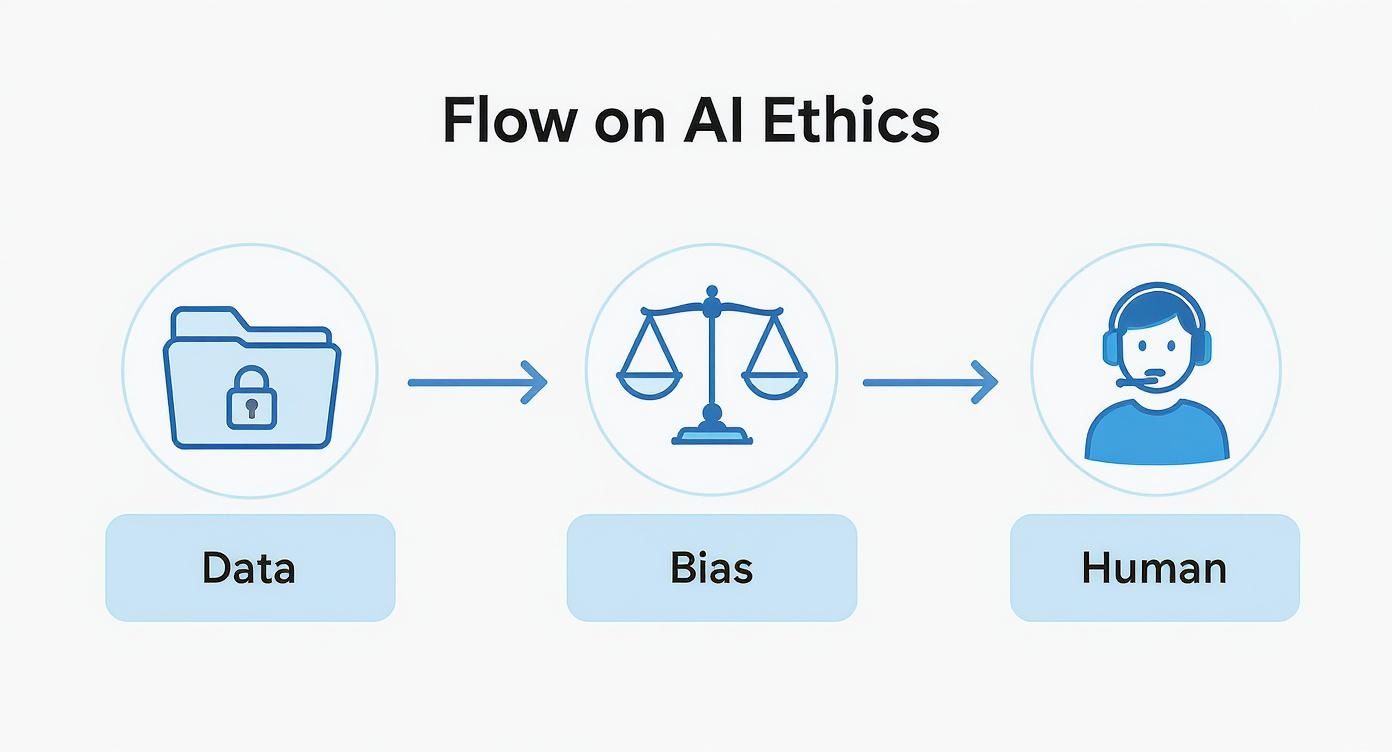
This flow really drives home the point that responsible AI isn't a one-and-done task. It's an ongoing cycle of safeguarding information, actively checking for fairness, and always having a human expert ready to step in.
When you're ready to start vetting potential partners, it helps to have a structured way to compare them. A clear checklist ensures you're not just wowed by a slick demo but are looking at the features that will actually make a difference for your team and employees.
Key Criteria for Selecting an HR Chatbot Vendor
| Evaluation Criterion | Why It Matters | Questions to Ask |
|---|---|---|
| Integration with HRIS/Payroll | The chatbot needs real-time access to employee data to give accurate, personalised answers about leave balances, pay slips, etc. | "Which HRIS and payroll systems do you integrate with out-of-the-box? What does a custom integration process look like?" |
| Natural Language Processing (NLP) | A strong NLP engine means the bot can understand and respond to employees' questions, even with typos or slang. | "Can you show me examples of how the bot handles complex or ambiguous queries? What languages does it support?" |
| Security & Data Privacy | You're handling sensitive employee data. The vendor must meet strict compliance standards (like DPDPA, GDPR). | "Where is our data stored? What are your security certifications? How do you ensure compliance with data protection laws?" |
| No-Code Customisation | Your HR team should be able to update conversation flows and knowledge bases without needing developers. | "Can our HR team build and modify conversation flows with a drag-and-drop interface? How easy is it to add new FAQs?" |
| Analytics & Reporting | You need data to see what’s working and where the bot needs improvement. | "What kind of analytics dashboard do you provide? Can we track common questions, resolution rates, and user satisfaction?" |
| Human Escalation Path | The bot won't know everything. A seamless handoff to a human HR agent for complex issues is essential. | "How does the chatbot escalate a conversation to a human? Does it create a support ticket or offer a live chat option?" |
| Scalability & Future Roadmap | The solution should be able to grow with you as your needs evolve. | "What is on your product roadmap for the next 12 months? How does your pricing model support company growth?" |
Using a checklist like this helps you cut through the marketing noise and focus on what truly matters. It ensures you select a partner who will not only meet your immediate needs but will also be a valuable asset for years to come.
Your Top Questions About HR Chatbots, Answered
Bringing any new tech into your HR function is a big deal, and it’s only natural to have a few questions. When something impacts your people this directly, you need to feel confident you're making the right move. Let's tackle some of the most common worries we hear from HR leaders and business owners looking into HR chatbots.
We'll keep the answers practical and straightforward. The goal here is to show you how this technology works as a powerful ally for your HR team, not as a replacement for the human touch that really matters.
Will an HR Chatbot Replace Our Human HR Team?
This is easily the number one question we get asked, and the answer is a definite no. An HR chatbot is designed to supercharge your human team, not make them redundant.
Think of the bot as your most reliable HR assistant. It’s brilliant at handling the high-volume, repetitive stuff that eats up so much time—instantly answering questions about the leave policy, helping an employee find their latest payslip, or walking someone through a standard benefits enrolment process. This frees up your HR professionals to focus on the work that truly requires their expertise: navigating complex employee relations, shaping career development paths, and strengthening your company culture.
How Hard Is It to Connect a Chatbot with Our Existing HR Software?
You’ll be pleased to hear that modern HR chatbot platforms are built for easy integration. Most of the top vendors provide pre-built connectors that use APIs to link up with popular HRIS, payroll systems, and applicant tracking software.
This connection is what allows the chatbot to pull real-time information securely—like an employee's exact leave balance—or kick off an action, such as submitting a time-off request directly into your core system. The key takeaway? Before you commit to a provider, make sure they can connect smoothly with the specific tools you already use.
A well-integrated chatbot should feel like a natural part of your HR world. It pulls live data to give accurate, personalised answers, so your team doesn't have to juggle multiple logins just to get a simple answer.
Can We Trust a Chatbot with Sensitive Employee Information?
Absolutely, but you need to choose the right partner. Any reputable HR chatbot provider puts security at the very top of their list. They use serious measures like end-to-end encryption, strict access controls based on roles, and must comply with data privacy regulations like India's Digital Personal Data Protection Act (DPDPA).
A properly designed chatbot is programmed to be discreet. It only accesses the bare minimum of information needed to answer a query and doesn't hold onto sensitive data longer than necessary. Always do your homework and check a vendor’s security certifications and data policies to make sure they align with your own company's standards.
What Happens When the Chatbot Gets Stumped?
Even the smartest bots don't have all the answers, and a great one knows when to ask for help. This is called an 'escalation path,' and it’s a non-negotiable feature.
When a question is too complex, too sensitive, or just plain confusing, the chatbot should seamlessly hand the conversation over to the right person on your HR team. This "human in the loop" approach guarantees that employees get the support they need without hitting a dead end. It’s the perfect partnership: technology handles the routine queries, while your experts handle the exceptions. No one gets left behind.
Ready to provide instant, 24/7 support to your team? SupportGPT is a complete platform for building, managing, and deploying AI support agents that deliver fast, accurate assistance. With enterprise-grade guardrails and smart escalation to human teammates, you can automate with confidence. Build your first HR assistant for free with SupportGPT.