Chatbots for Ecommerce A Guide to Boosting Sales and Support
Discover how chatbots for ecommerce can transform your business. This guide covers benefits, types, implementation, and choosing the right AI solution.
Picture this: it's 11 PM, and a potential customer is on your site, hesitating over a purchase. They have one last question, but your support team went home hours ago. Do they take a chance and buy, wait until morning, or simply click away? This is the exact moment an ecommerce chatbot proves its worth, stepping in as a tireless digital assistant to provide instant answers and nudge that customer towards the checkout, anytime, day or night.
The New Face of Online Shopping: Why Chatbots Are Essential
In the hyper-competitive world of online retail, speed and convenience aren't just perks—they're the entire game. Today's shoppers expect the same immediate, personal service they’d get in a physical store. Forcing them to wait for an email reply or dig through a dense FAQ page is a recipe for frustration and lost revenue. This is precisely where chatbots for ecommerce come in, completely changing the customer experience from start to finish.
Don't think of a chatbot as just another pop-up window. Think of it as your most dedicated employee. It’s always on, never gets tired, and can juggle thousands of customer conversations at once without ever compromising on quality. Its main job is to close the gap between what customers want (instant help) and what businesses can realistically provide, offering on-demand support around the clock.
Solving E-commerce’s Toughest Problems
Every online store grapples with nagging issues that eat into profits. High cart abandonment rates, painfully slow support responses, and the struggle to offer personalised advice are all too common. A well-designed chatbot tackles these challenges directly.
- Instant Support: By fielding common questions about shipping times, return policies, or product details on the spot, chatbots remove friction and build the trust needed to make a purchase.
- Proactive Engagement: Instead of just sitting there, a smart chatbot can initiate a conversation, offer a timely discount code, or point a browsing visitor toward products they'll love.
- Scalable Operations: When a big sale or marketing campaign causes a flood of customer queries, chatbots handle the extra volume effortlessly. You get to maintain top-notch service without scrambling to hire temporary staff.
This change is especially powerful in rapidly growing markets. Take India's e-commerce scene, for example, which is fuelled by over 800 million internet users. A staggering 89% of companies there are already using or piloting AI chatbots. By offering support in local languages like Hindi, Tamil, and Bengali, these bots are breaking down communication barriers and have boosted customer satisfaction by 47%. You can discover more insights about how AI is reshaping customer engagement in India.
In the end, using chatbots for ecommerce isn't just a trend anymore. It's a fundamental strategy for building a responsive, customer-first online business that can keep up with the demands of the modern digital marketplace.
How Chatbots Drive Real Business Growth
Let's move past the theory. The real worth of a chatbot for ecommerce isn't in what it is, but in what it does for your bottom line. Think of a chatbot less like a piece of software and more like your most efficient team member—one that works 24/7, never needs a coffee break, and can handle thousands of personalised conversations at once. This digital assistant drives growth by fundamentally improving three core areas: customer experience, sales, and operational efficiency.
The most immediate change you'll see is in the customer journey. We live in an age of instant gratification, and making a customer wait for an answer is a surefire way to lose a sale. Chatbots erase that waiting time, offering instant, around-the-clock support. This constant availability makes customers feel heard and valued, building the kind of loyalty that turns first-time buyers into lifelong fans.
Elevating the Customer Experience
A great experience is what keeps customers coming back. When a shopper has a question about sizing at midnight or needs to check an order status on a Sunday, a chatbot is right there to help. This isn't just about answering basic questions; it's about providing a smooth, stress-free interaction that builds trust in your brand.
The relationship between user growth, chatbot adoption, and customer satisfaction is particularly clear in India's booming e-commerce market.
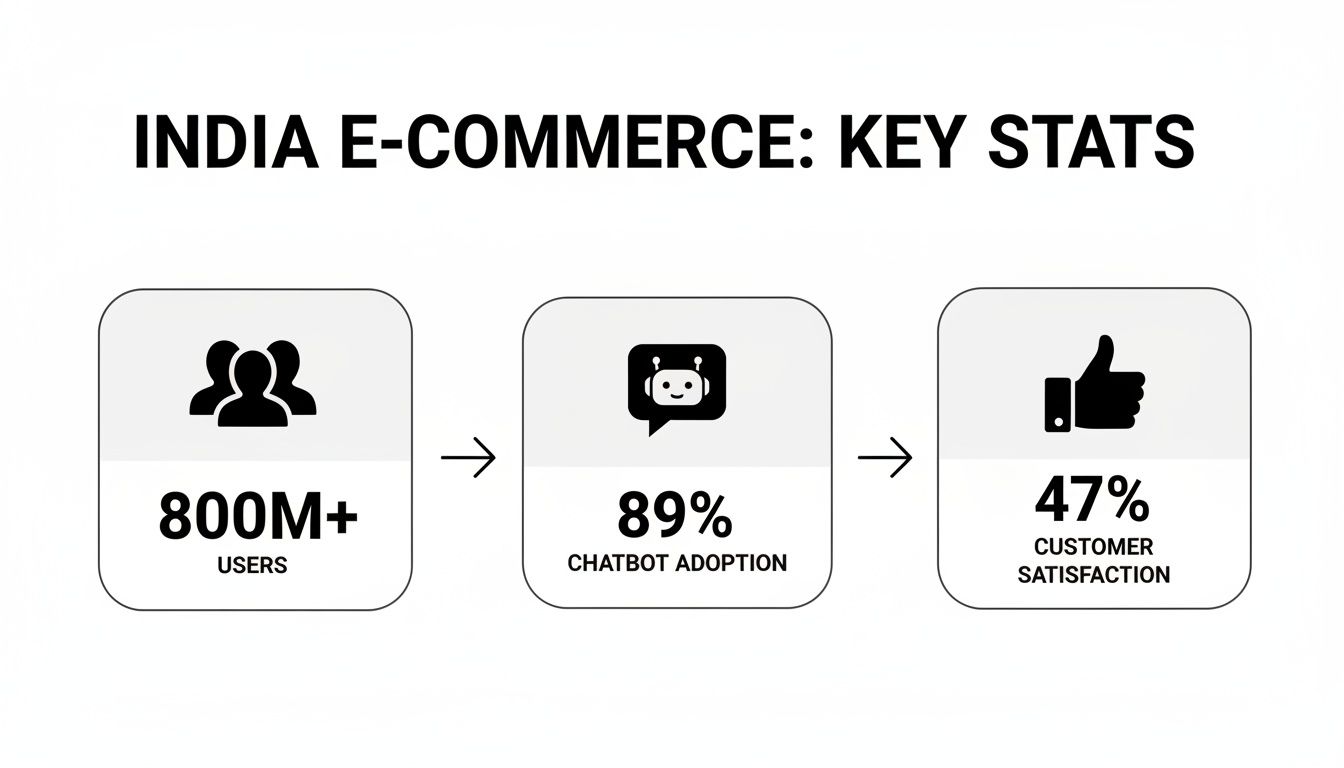
As the data shows, the massive user base is matched by high chatbot adoption, which directly fuels a significant rise in overall customer satisfaction.
Directly Boosting Sales and Revenue
Beyond making customers happy, chatbots are serious sales engines. They actively work to increase conversions and average order value by engaging people at just the right moments. When someone hesitates on a product page, a chatbot can proactively pop up with a discount or highlight key features, giving them that final nudge to click "buy."
They're also brilliant at smart upselling and cross-selling. For example, if a customer adds a camera to their basket, the bot can suggest a compatible memory card or a carrying case. This doesn't feel like a generic, annoying pop-up; it's a relevant, timely recommendation that feels genuinely helpful and increases the total sale value.
By engaging customers intelligently, chatbots transform passive browsing into an active shopping experience. They guide users from discovery to checkout, recovering potentially lost sales and maximising every interaction.
The financial impact is hard to ignore. In India's e-commerce market, 54% of organisations now use chatbots in customer-facing roles. These bots resolve an incredible 93% of queries on their own, leading to a 4X conversion uplift. Users who interact with a chatbot convert at 12.3%, a massive jump from the 3.1% for those who don't. This has helped businesses recover 35% of abandoned baskets and increase spending among returning customers by 25%. You can find out more about the future of AI in ecommerce and its statistical impact in recent industry reports.
The following table breaks down how these improvements translate into tangible business results.
Chatbot Impact on Key Ecommerce Metrics
| Metric | Improvement with Chatbot | Business Outcome |
|---|---|---|
| Conversion Rate | Up to a 4X increase | More browsers become buyers, directly increasing revenue. |
| Cart Abandonment | Recovers up to 35% of abandoned carts | Lost sales are reclaimed, boosting overall transaction volume. |
| Customer Lifetime Value | 25% increase in repeat customer spend | Happier customers return and spend more over time. |
| Resolution Time | 93% of queries resolved instantly | Faster support leads to higher satisfaction and less friction. |
These numbers paint a clear picture: implementing a chatbot isn't just a tech upgrade; it's a strategic business decision that pays for itself.
Streamlining Business Operations
Finally, chatbots deliver huge operational wins that go straight to your bottom line. By automating the answers to all those frequently asked questions—like "Where is my order?" or "What's your return policy?"—they free up your human support agents.
This automation means your team can stop typing out the same answers all day and start focusing on the complex, high-value problems that actually require a human touch. This doesn't just improve team morale; it makes your entire support operation more efficient and cost-effective. The end result is smarter resource allocation, lower operational costs, and a support system that can scale effortlessly during your busiest sales periods.
Understanding the Different Types of Ecommerce Chatbots
Diving into the world of chatbots for ecommerce can feel a bit overwhelming at first. You'll hear a lot of buzzwords like "AI," "NLP," and "LLM," but don't let the jargon intimidate you. In reality, figuring out the different types is pretty straightforward once you break them down. Each one is just a step up in intelligence, from simple scripts to genuinely creative conversations.
The best way to think about it is like a ladder. Each rung gives you more power to solve more complex customer problems. By getting to grips with the technology at each level, you can pick the right tool for the job—whether that's answering basic questions or creating a full-blown digital shopping assistant.
Let's start at the bottom rung, with the most common and foundational type of chatbot.
The Foundation: Rule-Based Chatbots
A rule-based chatbot is the most basic form of automated chat. If you've ever used an automated phone menu—you know, "Press 1 for sales, Press 2 for support"—you've already seen this logic in action. The bot works off a predefined script, a bit like a flowchart or a decision tree. It shows users a few options or buttons and follows a fixed path based on what they click.
These bots are fantastic for simple, predictable tasks. They are incredibly reliable because there's no guesswork involved. If a customer clicks "Track My Order," the bot knows to ask for an order number and then provide the delivery status. It’s a structured, no-nonsense conversation that’s perfect for handling a high volume of repetitive queries.
The catch? Their rigidity. A rule-based bot can't really understand questions written in plain English. If a customer types "Where's my stuff?" instead of clicking a button, the bot will probably throw its hands up and say, "I don't understand." It only knows the specific paths you've programmed.
The Next Level: AI-Powered Chatbots
This is where things start to get really clever. AI-powered chatbots use Natural Language Processing (NLP), a branch of artificial intelligence that gives computers the ability to read, interpret, and respond to human language. Instead of just relying on buttons, these bots can actually understand what a customer is typing.
Think of an NLP chatbot like a sharp retail assistant who can read between the lines. A customer might type "I need to return this shirt," "My order arrived damaged," or "Can I swap this for a different size?" An AI bot understands that all three queries are about post-purchase support. It doesn't need an exact keyword; it gets the intent behind the words.
AI-powered chatbots break free from rigid scripts to have flexible, intent-driven conversations. They learn from every interaction, getting smarter over time and solving a much wider range of issues without needing a human to step in. This adaptability is what makes them so powerful for scaling customer support.
These bots are trained on massive amounts of data—things like past customer service chats, product guides, and your FAQ page. This helps them recognise patterns and give accurate answers. They can handle typos, different ways of phrasing a question, and even a bit of slang, which makes the conversation feel much more natural for the user.
The New Frontier: LLM-Powered Chatbots
The most advanced bots you'll find today are powered by Large Language Models (LLMs)—the same groundbreaking tech behind tools like ChatGPT. If NLP bots are like skilled employees, then LLM bots are your creative problem-solvers. They don't just understand what you're asking; they can generate entirely new, context-aware, and surprisingly human-like responses from scratch.
An LLM-powered chatbot goes way beyond just answering questions. It can:
- Create personalised product recommendations: "Find me a durable, waterproof jacket that would be good for trekking in the Himalayas."
- Draft empathetic support replies: It can sense a customer's frustration and write a response that is both helpful and genuinely reassuring.
- Act as a personal stylist: "I just bought these blue trousers. What kind of shirt and shoes would go with them for a casual weekend outing?"
This ability to "think" and create on the fly allows LLM bots to handle the kind of complex, open-ended conversations that were once impossible to automate. For an ecommerce business, this opens the door to a truly dynamic and personal shopping experience—one that guides, advises, and supports customers in a way that feels genuinely intelligent.
Putting Your Chatbot to Work With Key Use Cases
Knowing the different types of chatbots for ecommerce is a great start, but the real magic happens when you see them in action. A chatbot isn't just a one-trick pony; think of it as a versatile assistant you can place at different points in the customer's journey to solve problems, boost sales, and keep people happy. When you strategically position your chatbot at these key touchpoints, you can turn passive browsing into an active, engaging shopping experience.
Let's dive into four of the most impactful ways chatbots deliver immediate results for online stores. These examples show how a simple Q&A tool can evolve into a proactive salesperson, a personal shopper, and a support specialist who never sleeps.
Acting as a Proactive Sales Agent
Imagine a customer looking at a product page, hesitating. A smart chatbot can spot this pause and jump in, just like a helpful salesperson would in a real shop. Instead of sitting back and waiting for a question, it can start a conversation to offer help or give a gentle nudge toward the 'buy' button.
This proactive style is brilliant for generating leads and closing sales. For instance, you could set up a bot to pop up after someone has been on a page for 30 seconds, offering a limited-time discount or pointing out a key product feature. That small interaction can be the very thing that stops a visitor from leaving and convinces them to add an item to their cart.
- Example Conversation:
- Bot: "Hi there! I see you're checking out our new running shoes. For the next 15 minutes, you can get 10% off with code RUN10. Can I help you find the right size?"
Becoming a Personal Shopper with Guided Selling
Shoppers often feel swamped with too many options. This is where a chatbot can step in as a personal shopping assistant, using a technique called guided selling to help customers find precisely what they're looking for. By asking a few targeted questions, the bot can quickly filter your entire catalogue and show only the most relevant items.
This creates a super-personalised and stress-free shopping trip. It’s a game-changer for stores with big or complicated inventories, like those selling electronics, fashion, or beauty products. The chatbot essentially becomes an on-demand expert, building the customer's confidence and making a sale far more likely.
This approach is already paying off big time. The Indian AI market for retail and e-commerce is booming, and chatbots are expected to drive growth at an incredible 35.9% CAGR through 2030. Big names like Reliance Industries and Zomato have seen AI chatbots handle 41% of their sales interactions, leading to an average sales bump of 67%. For the small and medium businesses that are the heart of India's retail scene, chatbots are slashing operational costs and increasing the average order value by 25% for returning customers. You can discover more insights about AI statistics in ecommerce.
Providing 24/7 Post-Purchase Support
The customer journey doesn't stop once the payment goes through. In fact, some of the most crucial moments happen after the purchase. Questions about order status, shipping times, and returns are extremely common and customers want answers fast. A chatbot can handle these queries instantly, any time of day or night.
By connecting directly to your order management system, a chatbot can give real-time delivery updates. It can also walk customers through your returns process, gathering the needed info and even generating a return label automatically. This frees up your human support agents to tackle more complex problems, all while your customers get the quick, efficient service they crave.
Automating post-purchase support with a chatbot doesn't just cut costs—it builds serious brand trust. When customers know they can get immediate help with their order, they're far more likely to come back and buy again.
Reducing Friction at Checkout
Cart abandonment is one of the biggest headaches in ecommerce. A customer might ditch their purchase for all sorts of reasons, from surprise shipping costs to confusion over payment options. Placing a chatbot on your checkout page is a powerful way to smooth over these last-minute bumps in the road.
For example, if a user hesitates on the payment screen, the chatbot can pop up to ask if they need help or to clarify shipping details. It can answer questions about security, offer different payment methods, or even slide in a last-minute free shipping code to seal the deal. By tackling these friction points as they happen, the chatbot saves sales that would otherwise have been lost for good.
Your Blueprint for a Successful Chatbot Launch
Jumping into a chatbot launch without a solid plan is a bit like setting sail without a map. Sure, you might stay afloat for a while, but you’re unlikely to end up where you want to be. A successful rollout isn’t just about the tech; it's about a clear strategy that solves real business problems and makes life easier for your customers.
Let's walk through the essentials to make sure your chatbot becomes a valuable asset, not just another technical headache.
The first, and frankly most critical, step is to nail down your "why." What specific problem are you actually trying to solve? Vague goals like "improving customer service" won't cut it. You need to get specific. Are you trying to slash support ticket volume by 20%? Or maybe your focus is on cutting down cart abandonment during checkout by 15%? Perhaps the goal is to generate 10% more qualified leads every month.
These concrete, measurable goals become your North Star. They'll inform every decision you make, from the platform you choose to the conversations you design, and ultimately, they’ll be how you prove the chatbot was worth the investment.
Choosing Your Path: Build Versus Buy
Once you’re clear on your goals, you’ll hit a major fork in the road: do you build a custom chatbot from the ground up, or do you go with an off-the-shelf platform like SupportGPT? Each approach has its place, and the right choice depends entirely on your business.
Building a chatbot gives you total control and customisation. You can tailor every last feature to your unique workflows. The catch? This path is a massive resource drain. It requires a skilled development team, a long timeline, and a serious commitment to ongoing maintenance for bugs and updates. It’s a powerful option, but usually best suited for massive enterprises with highly specialised needs.
Buying a platform, on the other hand, is the faster and more cost-effective route for most ecommerce businesses. These tools are built for non-technical users, letting you deploy a sophisticated bot in a fraction of the time. They usually come packed with pre-built integrations, analytics dashboards, and professional support, freeing you up to focus on strategy instead of getting lost in code.
The Importance of High-Quality Training Data
Whether you build or buy, your chatbot is only as smart as the information you feed it. Think of your training data as the textbook your AI studies to learn everything about your business, products, and policies. To get helpful answers out, you have to put accurate, comprehensive, and well-organised data in.
Some of the best sources for training data include:
- Your FAQ Page: This is the low-hanging fruit and the foundation for answering the most common questions.
- Past Support Tickets: Digging into historical conversations shows you what customers really ask about and the exact words they use.
- Product Descriptions: Rich, detailed product info empowers the bot to act like a knowledgeable sales assistant on the digital shop floor.
- Policy Documents: Shipping details, return policies, and warranty information are must-haves for handling those crucial post-purchase queries.
A chatbot trained on messy or incomplete data will only create frustration. Investing time in curating high-quality information is the single most important step to building a chatbot that customers trust and find genuinely useful.
Creating a Seamless Human Handover
Let’s be realistic: no chatbot can solve every single problem, and it shouldn't be expected to. One of the biggest mistakes businesses make is failing to design a clear and graceful escape hatch to a human agent. When a query gets too complex, emotionally charged, or involves a high-value customer, the bot needs to know when to tap out.
A seamless handover process is absolutely vital for maintaining customer trust. The transition should feel effortless, with the chatbot passing the entire conversation history to the agent. This means the customer never has to repeat themselves, turning a potential point of frustration into a moment of excellent, collaborative service. This hybrid approach gives you the best of both worlds—the relentless efficiency of automation and the empathetic, creative problem-solving of your human team.
How to Choose the Right Chatbot Platform
Picking the right chatbot platform is a make-or-break decision for your ecommerce business. It’s not just about adding a widget to your site; this choice directly shapes your customer experience and how efficiently your team operates. The market is crowded with options, but the best chatbots for ecommerce all share a few common threads that set them apart.
Think of it less like buying software and more like hiring a new, very important member of your team. You wouldn’t just check if they can do one task. You’d want to know how smart they are, how quickly they learn, if they’ll work well with your existing staff, and if they have room to grow. That’s the exact mindset you need here.
Core Capabilities and Ease of Use
First things first, look under the bonnet. What's actually powering the chatbot? Is it a rigid, old-school system that just follows a script, or is it running on modern AI and Large Language Models (LLMs) that can actually understand what a customer is asking? A genuinely intelligent bot won't get tripped up by typos or unusual phrasing.
But all that power is useless if you can't control it. Usability is just as critical. Your marketing manager or head of customer support should be able to jump in and tweak conversations without needing to file a ticket with the IT department. If every little change requires a developer, you'll never be able to move fast enough.
Key Features Checklist
As you start comparing vendors, keep this checklist handy to make sure you’re not missing anything crucial:
- Seamless Integrations: The platform has to play nicely with your existing tools. This is non-negotiable. Look for out-of-the-box integrations with Shopify, WooCommerce, Magento, and whatever CRM or inventory software you rely on.
- Customisation and Branding: Your chatbot is a digital ambassador for your brand. You need full control over its look, feel, and personality to make sure it sounds like you.
- Powerful Analytics: You can't improve what you don't measure. The right platform will give you clear data on everything from conversation volume and resolution rates to customer satisfaction scores and how many sales the bot influenced.
- Multilingual Support: If you sell to a diverse audience, this is a must-have. For businesses in India, for instance, the ability to communicate in multiple regional languages can be a huge competitive advantage.
The sweet spot is a platform that balances seriously powerful AI with a user-friendly interface. It should give your team the tools to build genuinely helpful, on-brand experiences without needing a computer science degree.
Ultimately, you’re not just buying a tool for today; you're investing in a partner for tomorrow. Look for a vendor with a solid reputation for support, great documentation, and a roadmap that shows they’re constantly improving. Platforms like SupportGPT are built with this in mind, giving businesses a robust foundation to deploy, manage, and scale their AI support agents. A platform that can grow with you is an asset, not just an expense.
Frequently Asked Questions About Ecommerce Chatbots
Diving into chatbots for ecommerce always brings up a few practical questions about cost, how it affects your team, and how long it takes to get one up and running. Getting straight answers to these questions is key to figuring out how this technology can actually work for your business, not just in theory.
Let's break down what business owners usually ask before they decide to bring a chatbot onto their online store.
How Much Does an Ecommerce Chatbot Cost to Implement?
The price tag for an ecommerce chatbot can swing wildly depending on what you need it to do. For a simple, rules-based bot that just answers common questions, you can get started for very little. Some platforms even offer free plans, which are perfect for dipping your toes in the water.
When you start looking at smarter, AI-powered platforms, you're typically looking at a monthly subscription. The cost is usually based on how many conversations you have each month and which features you need—things like connecting to your CRM or supporting multiple languages. This could be a few hundred pounds a month for a smaller shop or a more significant investment for a large-scale operation. The real trick is to look past the upfront cost and think about the return you'll get from more sales, better conversion rates, and lower support costs.
Can a Chatbot Completely Replace My Human Support Team?
Honestly? No, and that shouldn't be the aim. Think of it as a partnership, not a replacement. Chatbots are brilliant at handling the repetitive, high-volume questions that eat up your team's time. We're talking about the endless "Where's my order?" or "What's your return policy?" queries.
By automating the routine stuff, you free up your human agents to focus on what they're truly great at: tackling the complex, tricky, or high-value customer problems that need a real person's empathy and creative thinking. A good chatbot setup always has a smooth hand-off to a human, creating a hybrid team that gives customers the best of both worlds.
How Long Does It Take to Set Up a Chatbot?
The setup time really depends on how complex your bot is. You could get a basic FAQ bot live in just a couple of hours. Just grab a template, feed it your knowledge base, and you've got an instant win.
On the other hand, if you're building a more advanced AI chatbot that needs to pull product information, check stock levels, and look up customer details in your CRM, it's going to take longer. For a fully customised and integrated chatbot, you should plan for a few weeks of work. That time is crucial for getting the setup right, training the AI properly, and testing everything thoroughly so it works flawlessly from day one.
Ready to provide instant, 24/7 support and boost your sales? SupportGPT makes it easy to build and deploy intelligent AI agents for your ecommerce store. Start for free and launch your first chatbot in minutes.