Chatbot for Ecommerce Guide to Boosting Sales
Discover how a chatbot for ecommerce can increase sales and improve customer support. Our guide covers key benefits, features, and implementation tips.
Think of an e-commerce chatbot as your store's most dedicated employee. It's the ultimate personal shopper, available 24/7 for every single person who visits your website. These aren't just basic Q&A bots anymore; they’re a fundamental part of a modern sales and support strategy, turning a static website into a dynamic, conversational shopping experience that builds trust from the very first click.
The New Shopping Assistant Changing E-commerce

Let's face it, today's online shoppers have incredibly high expectations. They want answers now, recommendations that feel like they were picked just for them, and support that doesn't involve waiting in a queue. The old self-service model, where customers are left to browse and search on their own, just doesn't cut it anymore.
This is exactly where a chatbot for e-commerce comes into its own. It’s like having that friendly, clued-up shop assistant from a physical store, but they're online, always on, and ready to help every customer at once. It’s the missing link between passive browsing and genuinely engaged shopping.
Meeting Modern Customer Expectations
Modern e-commerce chatbots are perfectly built to handle the demands of the impatient, always-online consumer. They offer a direct line to help, saving visitors from getting lost in complex FAQ pages or waiting hours for an email reply. The real value is in providing immediate, relevant support right when it's needed.
- Instant Gratification: Shoppers get answers to questions about products, shipping, and returns in seconds. This stops them from getting frustrated and leaving your site.
- Personalised Journeys: By asking a few simple questions, the bot can guide a user to the perfect product, acting like a personal stylist or tech guru.
- Proactive Engagement: Good chatbots don't just wait to be asked. They can start conversations, offer a discount to someone about to abandon their cart, or announce new arrivals, making the whole experience feel more interactive.
This move towards conversational commerce isn't just a fleeting trend; it's happening everywhere. In India, for instance, a booming digital consumer base and government pushes like the Digital India initiative have made AI chatbots an essential tool. Big players like Flipkart and Amazon India rely on them for everything from customer queries to order tracking. They even support multiple regional languages to connect with the country's diverse population, improving the customer experience and cutting down on operational costs. You can read more on how AI is reshaping Indian e-commerce on dev.to.
A well-implemented chatbot does more than just answer questions; it actively participates in the customer journey, turning potential friction points into opportunities for conversion and brand loyalty.
Ultimately, adding a chatbot is about changing your website from a simple digital catalogue into a responsive, helpful, and intelligent place to shop. It’s the key to delivering the seamless, on-demand service that modern customers don’t just appreciate—they now expect it from every online brand they deal with.
How Chatbots Drive Real Business Growth

An ecommerce chatbot is much more than a trendy gadget; it's a genuine engine for growth. By taking over key customer interactions, these digital assistants do more than just solve problems—they create real, measurable value for your business. The benefits go far beyond just answering simple questions, influencing every step of the customer journey, from their first click to long after they’ve made a purchase.
The most obvious impact is on sales. A chatbot acts like a personal shopping assistant, guiding customers through your product catalogue to help them find exactly what they’re looking for. This proactive help turns aimless browsing into a focused buying journey, which naturally pushes conversion rates up.
They’re also brilliant at tackling cart abandonment. A chatbot can pop up and start a conversation with someone who's about to leave your site with items still in their basket. A simple message offering a discount or asking if they need help can be all it takes to rescue a sale and significantly lift your revenue.
Boosting Sales and Customer Loyalty
Picture this: a customer lands on your site looking for new running shoes, but they're completely overwhelmed by the choices. A chatbot can jump in and ask a few simple questions to narrow things down:
- "What kind of surface will you be running on?"
- "Are you looking for a shoe for long-distance or short sprints?"
- "Do you have a favourite brand or colour in mind?"
Based on their answers, the chatbot can pull up a tailored list of products, complete with reviews and key features. This kind of personalised guidance makes the buying process incredibly simple and makes a purchase far more likely. It’s like having an expert salesperson on hand for every single visitor, 24/7.
This instant, helpful service is a huge driver of customer loyalty. When shoppers know they can get immediate help with order tracking, return requests, or product info, they're much more likely to shop with you again. That reliability is what turns a one-time buyer into a lifelong fan.
By providing instant, round-the-clock support, an ecommerce chatbot doesn’t just increase sales—it creates a frictionless customer experience that fosters trust and encourages long-term brand loyalty.
This effect is particularly strong in fast-growing markets. For example, the Indian AI-powered e-commerce market is projected to reach approximately $8.65 billion by 2025. A big part of this growth comes from consumers demanding better service and personalised recommendations, especially during busy festival seasons. It's no surprise that e-commerce stores using chatbots to prevent cart abandonment have seen revenue jump by 7% to 25%. You can learn more about the future of AI in Indian e-commerce and its growing influence.
Reducing Operational Costs
Beyond bringing in more money, an ecommerce chatbot is also a fantastic way to cut down on costs. Your customer support team is one of your biggest assets, but their time is precious. It should be spent on complex issues that truly need a human touch, not on answering the same basic questions all day.
Automating these repetitive queries frees up your human agents to focus on what they do best. A chatbot can handle a huge volume of common questions at once, without ever getting tired or making a mistake.
Just think about the questions your team probably answers over and over again:
- "Where is my order?"
- "What’s your return policy?"
- "Do you ship to my country?"
A chatbot can answer all of these in a heartbeat by plugging directly into your shipping, inventory, and CRM systems. This automation slashes the number of support tickets, leading to big savings in staffing and operational costs. The end result is a more efficient support team that can focus on building meaningful customer relationships instead of just putting out fires.
Choosing the Right Chatbot for Your Store
Picking a chatbot for your e-commerce store is a big decision. Think of it less like buying software and more like hiring a key member of your team. You wouldn't bring on a new sales lead without vetting their skills, and the same principle applies here. You need a digital assistant that won’t just answer questions, but will actively help your business thrive.
This is about more than finding a tool that can follow a script. It’s about finding a partner that can navigate tricky customer queries, fit perfectly into your current tech stack, and ultimately, help you sell more. A top-tier e-commerce chatbot has to be intelligent, adaptable, and a genuine asset to your customer experience.
Getting the Conversation Right
At its heart, a good chatbot has to be a great conversationalist. This all comes down to its Natural Language Processing (NLP) capabilities—the tech that lets it figure out what a customer really means, even with typos, slang, or awkward phrasing. A chatbot with strong NLP can understand customer intent, which is the secret sauce that separates a helpful, human-like chat from a frustrating, robotic dead-end.
Imagine a customer types, "got any cheap red tops?" A basic bot might just throw up an error. But one with solid NLP gets it. It understands "cheap" means a lower price point, "red" is a colour, and "tops" is a clothing category. It then serves up exactly what the customer asked for, making the shopping journey feel effortless.
Another must-have is multilingual support. If you're selling across borders or in a diverse country like India, your chatbot absolutely has to speak your customers' language. This simple feature tears down communication walls and makes your brand feel instantly more familiar and welcoming to a global audience.
Does It Play Well with Others?
A chatbot can't be an island. To be genuinely useful, it must plug directly into the e-commerce platform your store runs on, whether that’s Shopify, WooCommerce, BigCommerce, or another major player. This is a non-negotiable.
Here’s why that connection is so vital:
- Live Product Info: A connected chatbot can pull real-time data on stock levels, new arrivals, and pricing straight from your product catalogue. No more telling customers something is available when it just sold out.
- Pinpoint Order Tracking: When linked to your order management system, the bot gives customers instant, accurate updates on where their package is.
- A Single Customer View: Syncing with your Customer Relationship Management (CRM) software lets the bot see a customer's purchase history, allowing it to offer smart, personalised recommendations.
Without these integrations, your chatbot is little more than a glorified FAQ page. With them, it becomes a powerful, clued-in assistant that makes life easier for everyone.
A chatbot’s true power isn't just in what it can say, but in what it can do. Seamless integration with your core e-commerce systems is what transforms a simple conversational tool into an indispensable business asset.
Advanced Features That Actually Move the Needle
Once you’ve nailed the basics, it's time to look at the features that will directly boost your bottom line. Proactive messaging is a brilliant example. Instead of just waiting for a customer to ask a question, the bot can jump in at just the right moment—like when it looks like someone is about to abandon their cart. A quick, friendly message offering help or a small discount can be all it takes to rescue that sale.
Secure payment processing is another game-changer. Letting customers complete their entire purchase right there in the chat window removes a ton of friction. It creates a smooth, conversational checkout experience that can do wonders for your conversion rates.
Finally, think about the platform behind the bot. The best solutions give you both simplicity and serious, enterprise-level security. For example, some platforms now let non-technical teams build powerful AI agents that come with built-in guardrails, smart escalation paths to human agents, and deep analytics. To see how these features work together, you can learn more about building secure AI support agents at a platform like SupportGPT. Choosing a solution with these advanced capabilities makes your chatbot a strategic asset, not just a support tool.
Your Guide to a Smooth Chatbot Implementation
Putting a chatbot on your ecommerce site isn't the daunting technical nightmare it used to be. Think of it less as a complex coding project and more as a clear, manageable roadmap that starts delivering value almost immediately.
The best part? Modern tools have made this incredibly accessible. Many platforms now offer no-code or low-code builders, which means you can design powerful, intelligent conversation flows without ever touching a line of code. This puts the power right where it belongs: in the hands of business owners and marketing teams.
Laying the Foundation for Success
Before you jump into designing witty chatbot responses, you need a solid plan. A successful launch starts with pinning down exactly what you want the chatbot to do. It's a common mistake to rush this part, and the result is often an unfocused bot that doesn't really solve problems for your customers or your team.
Start by setting one primary goal. Are you trying to:
- Slash support tickets? If so, your first priority should be automating answers to your top 10 most frequently asked questions.
- Boost sales conversions? Then you'll want to focus on building product recommendation quizzes and cart recovery flows.
- Improve customer satisfaction? Design journeys that give customers instant gratification, like order tracking and return status updates.
Once you’ve got your main objective, map out the customer journeys that lead to it. What steps does a customer take to find a specific product, check an order, or ask about your shipping policy? These paths become the literal blueprint for your chatbot’s conversations.
The diagram below nails the three core pillars of a solid implementation: understanding your business needs, ensuring the tech integrates smoothly, and keeping everything secure.
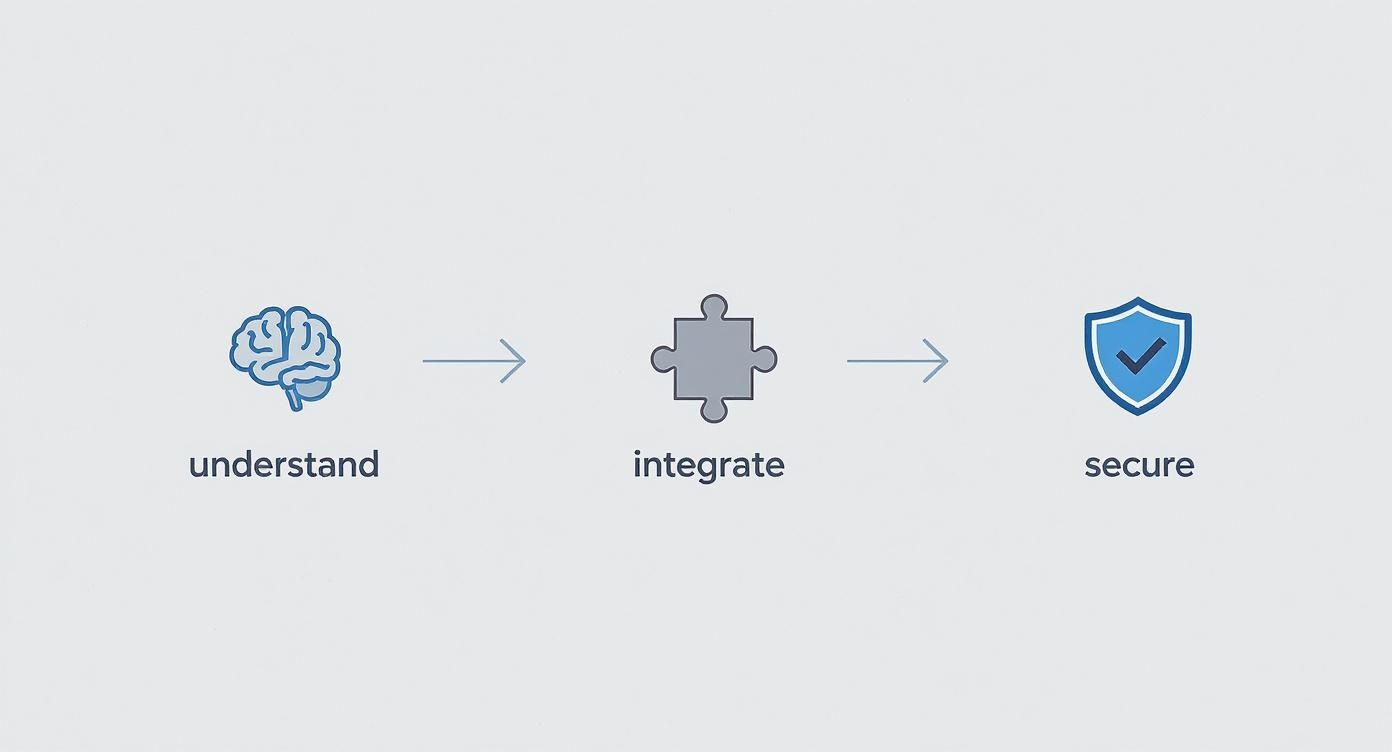
This visual is a great reminder that a successful project is a balancing act. You have to consider what your customers want right alongside the technical realities of integration and security from day one.
Designing Conversations That Actually Work
With your goals and journeys mapped out, it’s time for the fun part: designing the actual conversations. This is your chance to let your brand’s voice shine. The goal is to create interactions that feel natural and genuinely helpful, not robotic and infuriating. A great starting point is to use pre-built templates for common ecommerce tasks.
These templates give you a proven structure for interactions like:
- Answering FAQs: Handling all the usual questions about shipping, returns, and product specifics.
- Tracking Orders: Instantly giving customers an update when they provide their order number.
- Guiding Product Discovery: Acting as a personal shopper by asking a few questions to help users find the perfect item.
Don't be afraid to inject some personality. A friendly, casual tone might be perfect for a fashion brand, while a more direct, professional voice could be better for a store selling high-end electronics.
The best chatbot conversations are a blend of automation and empathy. They guide users efficiently to a solution while maintaining a helpful, on-brand tone that builds trust with every interaction.
Crucially, a well-designed conversation also knows when to get out of the way. An intelligent escalation path is non-negotiable. This means programming the chatbot to recognise when a question is too complex or a customer is getting frustrated, and then seamlessly handing the chat over to a human agent. This ensures no one ever hits a dead end.
Tying It All Together: Integration and Launch
The final step is connecting your chatbot to the other systems that run your business. To be truly useful, a chatbot for ecommerce must be able to talk to your core platforms. This is what allows it to pull real-time, accurate information instead of just guessing.
The key integrations you'll need are:
- Your Ecommerce Platform: Connections to Shopify or WooCommerce let it pull product info and check stock levels.
- Your CRM System: This gives the bot access to customer history for truly personalised recommendations.
- Inventory Management Software: So it can confirm if a hot-ticket item is actually available.
- Payment Gateways: To allow for secure purchases right inside the chat window.
Thankfully, many modern chatbot platforms offer one-click integrations for these major systems, turning what used to be a major development headache into a simple task. Once everything is connected, test it all thoroughly before you go live. A phased rollout is always a good idea to ensure a smooth launch and a great first impression.
Measuring Your Chatbot's Performance and ROI
Bringing a chatbot into your ecommerce business is more than just a tech upgrade; it’s a strategic investment. And like any smart investment, you need to know if it's actually paying off. Tracking the right key performance indicators (KPIs) is the only way to see its true value, justify the cost, and figure out where to make it even better.
It’s not enough to just “have a chatbot.” You need to know if it’s genuinely helping your customers and adding to your bottom line. This means looking past simple stats like conversation volume and digging into the data that shows its real impact on customer happiness, engagement, and sales.
Defining Your Core Success Metrics
To get a clear picture of how your chatbot is doing, it helps to sort your KPIs into a few key areas. This approach lets you see its performance from different angles, from customer support efficiency to its role in driving sales.
Here are the essential metrics every ecommerce store should have on its dashboard:
- Customer Satisfaction (CSAT) Scores: This is the most direct way to find out if customers are happy with the bot. A quick survey after the chat asking for a rating gives you priceless feedback.
- First-Response Time: How quickly does the chatbot jump in with an answer? A massive advantage of a chatbot for ecommerce is providing instant help, and this metric proves it’s working.
- Resolution Rate: What percentage of issues does the chatbot solve all on its own, without needing a human agent? A high resolution rate means your bot is efficient and capable.
But it’s not just about solving problems. You also have to measure how the bot is actually influencing sales and keeping customers engaged.
A chatbot’s real worth is measured by its ability to not only solve problems but also create value. By tracking conversion rates and revenue per conversation, you can clearly see its direct contribution to your financial success.
Tracking Business Impact and Engagement
While keeping customers happy is crucial, your chatbot also needs to prove its financial contribution. These metrics connect the bot’s actions directly to your store's performance, making it simple to calculate its return on investment.
Here are the key business metrics to watch:
- Conversion Rate: This tracks the percentage of chatbot chats that lead to a sale. It’s the ultimate measure of how effectively your bot guides shoppers from just looking to actually buying.
- Revenue Per Conversation: By dividing the total sales generated through the bot by the number of conversations, you can put a direct monetary value on every single interaction.
- Interaction Rate: What percentage of your website visitors actually start a conversation with the chatbot? A high interaction rate tells you the bot is visible, inviting, and seen as a helpful tool.
Keeping a close eye on these KPIs is quickly becoming standard practice. For instance, investment in AI for retail has shot up in India, with businesses pouring significant funds into AI-powered tools like chatbots. This confidence is backed by strong consumer interest, with 59% of Indian shoppers expecting AI to reshape how they interact with brands. To dive deeper into this trend, you can read the full report on AI's impact on Indian e-commerce.
By consistently monitoring these metrics, you get a complete view of your chatbot’s performance. This data-first approach empowers you to make smarter decisions, continuously improve your conversation flows, and prove the undeniable ROI of your ecommerce chatbot.
Common Questions About Ecommerce Chatbots
It's completely normal to have a few questions before diving into new technology, even with all the obvious upsides. Most store owners I talk to have similar concerns, usually boiling down to cost, complexity, and how customers will react. Let's tackle those head-on.
This section gets straight to the point, answering the most frequent questions we hear about using chatbots for ecommerce. The idea is to clear up any confusion and help you decide with confidence.
Will a Chatbot Feel Too Robotic for My Brand?
This is probably the biggest worry I hear, but modern AI chatbots are a world away from the clunky bots of the past. You can actually fine-tune their personality to perfectly match your brand’s voice, whether you're fun and informal or a bit more buttoned-up and professional. The trick is to design conversations that are genuinely helpful, not just a script.
A great chatbot blends AI efficiency with a human touch. I always recommend being upfront that customers are talking to a bot, but make sure there’s a smooth, easy way to pass complex issues to a real person.
This hybrid approach gives customers the quick answers they crave while ensuring trickier problems get the attention they need. It’s the best of both worlds, keeping your brand helpful and human at every step.
Is Setting Up a Chatbot Too Technical?
Not anymore. While the AI technology humming away in the background is incredibly sophisticated, the tools you use to build them are anything but. Most top-tier chatbot platforms are designed for people who don't write code, offering simple drag-and-drop interfaces and ready-made templates for common ecommerce situations.
This means you can get a powerful chatbot for ecommerce up and running without hiring a developer. You can easily build out automated flows for everyday queries like:
- Where is my order?
- Do you have this in blue?
- How do I start a return?
These no-code solutions put the power in your hands, letting you build, test, and launch a bot with very little technical know-how.
How Much Does an Ecommerce Chatbot Cost?
The price tag can swing quite a bit depending on how smart and feature-rich you want your bot to be. Simple, rule-based bots are often incredibly cheap, and some platforms even have free starter plans that are perfect for smaller businesses just getting their feet wet.
The more advanced AI-powered chatbots usually work on a subscription basis, with costs tied to the number of conversations it handles each month. It's best to think of this as an investment, not just an expense. When you weigh the cost against the potential ROI from more sales, better conversion rates, rescued abandoned carts, and a much lower support team bill, it often makes perfect sense.
Can a Chatbot Handle Multiple Languages?
Absolutely. This is one of the most powerful features of a modern AI chatbot. They are built on sophisticated language models that can automatically figure out what language a customer is using and reply just as fluently.
This is a game-changer for any business with a diverse customer base or international ambitions. You can offer a consistently great experience to everyone, everywhere, without needing to build out a massive, multilingual support team.
Ready to build a smart, secure AI assistant for your store? SupportGPT lets you create personalised support agents with enterprise-grade guardrails, smart escalation, and deep analytics. Start for free and deploy your chatbot in minutes.