Crafting the Perfect Apology Email to Customers
Learn how to write a sincere apology email to customers. Our guide offers proven frameworks and templates to rebuild trust and retain loyalty.
Mistakes are inevitable. It’s a simple truth of doing business. But a carefully written apology email to a customer can do more than just smooth things over—it can actually turn a bad experience into a moment that builds serious loyalty. This isn't just about saying you're sorry. It's about strategic communication that rebuilds trust, takes ownership of the problem, and shows what your brand is really made of.
A genuine and effective apology can be the difference between a customer walking away for good and one who sticks around for the long haul.
Why a Great Apology Email Matters More Than Ever
Let's face it, things go wrong. A product shows up damaged, a delivery gets delayed, or a service outage throws a customer's whole day off track. The initial slip-up is the problem, but how you respond is what truly defines the relationship.
Ignoring the issue or sending a cold, cookie-cutter reply is a fast track to disaster. In an age where a single bad review can go viral, a poor response can easily escalate a minor hiccup into a major headache for your brand.
A powerful apology email is your chance to prove your company’s values mean something. It shows you're listening, you genuinely care, and you’re ready to step up and make it right. That human touch is what makes a brand memorable.
The Real Impact on Customer Loyalty
Here's something interesting: when you fix a problem exceptionally well, you can actually create a stronger bond with that customer. This is often called the service recovery paradox. The idea is that a customer who has a problem resolved in a satisfying way can end up more loyal than a customer who never had an issue in the first place.
Think about the impact:
- Rebuilding Trust: Owning a mistake shows you're transparent, and transparency is the bedrock of trust. Customers are far more willing to forgive a company that doesn't hide from its failures.
- Reducing Negative Word-of-Mouth: A quick and empathetic apology can stop a frustrated customer in their tracks before they head to social media or a review site. Remember, 88% of clients now say the experience a company provides is just as important as its products.
- Reinforcing Brand Integrity: Your response is a direct reflection of your brand’s character. A thoughtful apology proves you're a customer-first organisation committed to quality and satisfaction.
A sincere apology isn’t a sign of weakness. It’s a sign of strength and a deep commitment to the customer relationship. It transforms a moment of friction into an opportunity for connection.
Ultimately, a great apology email goes beyond fixing one isolated issue. It’s an investment in the long-term health of your customer relationships, with the power to turn frustrated users into your biggest fans.
What Goes Into an Apology Email That Actually Works?
Forget generic, copy-paste templates. A truly effective apology email is a carefully constructed message designed to rebuild trust. Think of it less as a single block of text and more as a series of essential parts working together. When you understand the framework, you can adapt it to pretty much any screw-up, ensuring your message lands with sincerity and offers a real solution.
This isn't just about damage control; it's an opportunity. A well-handled mistake can, surprisingly, make a customer more loyal.
This chart shows that simple but powerful journey: a mistake happens, you apologise thoughtfully, and the customer relationship actually strengthens.
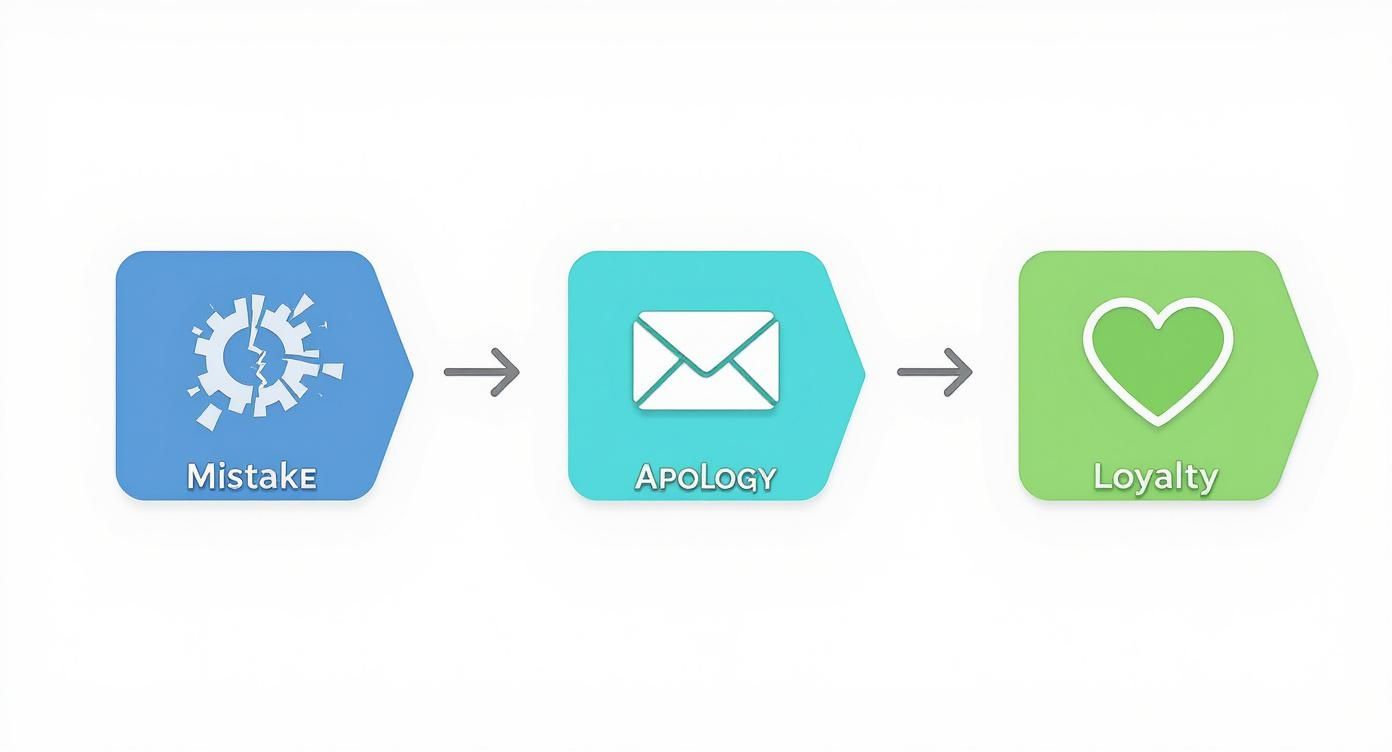
The apology is the critical bridge that turns a service failure into a moment of connection.
First, Write a Subject Line They’ll Actually Open
The subject line is your first (and sometimes only) chance to get this right. It needs to be direct, honest, and signal that you're addressing a problem they're already aware of. If it's too vague, like "An Update," it's getting ignored or deleted.
You need to be specific and professional.
- Good: "An Apology Regarding Your Recent Order [#12345]"
- Even better: "We're Sorry About the Delay with Your Order [#12345]"
The second option works better because it immediately shows you know what's wrong and you're already apologising. It sets the right tone before they’ve even clicked.
The Five Key Ingredients of a Sincere Apology
Once they've opened the email, the content has to deliver. A high-impact apology email to a customer follows a logical flow that tackles their frustration head-on.
-
Acknowledge the Specific Problem. Start by saying exactly what went wrong. Don't use vague language. If a shipment was late, a product was faulty, or your site went down, say so. It shows you’ve been paying attention to their individual problem.
-
Say You're Sorry. And Mean It. This is the heart of the email. Use clear, direct language like, "We sincerely apologise for..." or "I am truly sorry that...". Avoid weasel words like "if" or "but," as they completely undermine the apology.
-
Give a Brief, Honest Explanation (Not an Excuse). People appreciate a little context, but they don't want to hear excuses. "A technical glitch in our warehouse caused a system-wide shipping delay" is transparent and professional. "Our system was acting up" just sounds lazy.
A genuine apology focuses on the customer's experience, not your company's internal challenges. Keep the explanation concise and focused on the facts, then quickly pivot to the solution.
-
Offer a Clear Solution. This is how you make things right. The fix should match the scale of the problem. It could be a full refund, a replacement product, a discount on their next purchase, or a service credit. Whatever it is, make it incredibly easy for the customer to claim it.
-
Reaffirm Your Commitment. End by reassuring the customer you value their business and are already taking steps to make sure this doesn't happen again. This isn't just about fixing one error; it's about showing you're committed to improving your service for good.
Here's an interesting tidbit: who sends the apology can make a massive difference. In the Indian market, research on service recovery found that when an apology comes from senior management, it can reduce customer churn by a staggering 27%. It can even lead to those customers spending more later on. You can discover more insights about these service recovery findings from the original research.
Right, let's move from theory to practice. Knowing the what and why of a good apology email is one thing, but actually writing one when a customer is upset is a whole different ball game.
To make things easier, I've put together a few go-to templates for some of the most common—and trickiest—situations you'll face. Think of these as a solid foundation, not a copy-paste script. The real magic happens when you inject your own brand's voice and a genuine human touch into them.
An apology email to a customer has to feel like it came from you, not from a dusty old manual. So, take these, tweak them, and make them your own.

Sometimes, knowing which approach to take can be half the battle. This quick selector can help you match the situation to the right kind of apology.
Apology Email Template Selector
Choose the right template based on the specific customer issue you are addressing.
| Scenario | Key Objective | Recommended Tone | Template Focus |
|---|---|---|---|
| Delayed Shipment | Manage expectations, restore confidence | Proactive, reassuring, clear | Providing a new timeline and a small gesture of goodwill |
| Defective Product | Fix the problem fast, minimise hassle | Empathetic, efficient, apologetic | Immediate replacement/refund with no hoops for the customer to jump through |
| Billing Error | Rebuild trust, show accountability | Serious, transparent, professional | Immediate correction and reassurance of system integrity |
| Negative Experience | Validate feelings, show you're listening | Personal, sincere, empathetic | Acknowledging the emotional impact and demonstrating action |
Getting the right starting point makes it much easier to write an apology that not only solves the problem but also strengthens the customer relationship.
For a Delayed Shipment
Shipping delays happen. They’re a frustratingly common part of e-commerce, but what separates a good experience from a bad one is communication. The golden rule? Get ahead of it. Don't make the customer chase you for an update.
Subject: An important update on your order [#{{order.number}}]
Hi {{customer.first_name}},
We're writing to sincerely apologise. Your recent order, [#{{order.number}}], has been delayed, and we know this is disappointing news. We truly are sorry for the inconvenience this has caused.
An unexpected issue at our fulfilment centre created a backlog. Our team is working around the clock to catch up, and we now expect your order to ship by [New Expected Date].
We know this is frustrating, so we've applied a 15% discount to your next purchase as a small token of our apology. You can use the code APOLOGY15 at checkout.
Thank you so much for your patience and understanding.
Sincerely, The [Your Company Name] Team
For a Defective or Damaged Product
There’s nothing quite like the disappointment of opening a package to find a broken item. Your response needs to be fast, empathetic, and, most importantly, hassle-free. The customer is already let down; don't make them work to fix your mistake.
Subject: Regarding your recent order – we're here to help
Hi {{customer.first_name}},
I am so sorry to hear that the [Product Name] you received was defective. That is absolutely not the quality standard we aim for, and I completely understand your disappointment.
We've already processed a replacement for you, which will be shipped out within 24 hours at no additional cost. There's no need to return the original item; please feel free to dispose of it.
We're also looking into how this happened to ensure it doesn’t affect anyone else.
We deeply value your business and hope you'll give us a chance to make this right.
Best regards, [Your Name/Team Name]
For a Billing Error or Unexpected Charge
Mistakes involving money can instantly erode trust. When you’ve made a billing error, your apology must be crystal clear, the fix must be immediate, and you need to reassure the customer that you’ve got things under control.
Subject: Correction and Apology Regarding Invoice [#{{invoice.number}}]
Dear {{customer.first_name}},
Please accept our sincerest apologies. We've identified a billing error on your recent invoice [#{{invoice.number}}], where you were incorrectly charged [Amount].
This was due to a system miscalculation on our end, and we take full responsibility. We have already issued a full refund for the incorrect amount, which should reflect in your account within 3-5 business days.
We have audited our billing system to prevent this from happening again. We are deeply sorry for the concern this must have caused.
Thank you for your understanding.
Sincerely, The [Your Company Name] Finance Team
Pro Tip: When you offer a fix like a discount or refund, make it effortless for the customer. Automatically applying a credit or shipping a replacement shows you respect their time and are genuinely committed to resolving the issue, no strings attached.
For a Negative Service Experience
This one is different. It’s not about a broken product; it’s about a broken interaction. When a customer feels disrespected or unheard, your apology has to come from a place of genuine empathy. Acknowledge their feelings first and foremost.
Subject: We're sorry about your recent experience with us
Hi {{customer.first_name}},
Thank you for taking the time to share your feedback. I was very concerned to read about your experience with our support team on [Date], and I want to offer my personal apology.
The interaction you described doesn't meet the standard we set for our team, and we are sorry for the frustration and disappointment we caused. Your feedback is being used in our next team training session to ensure we learn from this.
We'd appreciate the opportunity to properly resolve your original issue. Please let me know if you're available for a brief call, or I can connect you directly with one of our senior specialists.
We are committed to doing better.
Regards, [Your Name] [Customer Support Manager/Head of Support]
Common Apology Mistakes and How to Avoid Them
Even when you have the best intentions, a customer apology email can sometimes fall flat. A few poorly chosen words can twist a genuine attempt to make things right into something that sounds dismissive or, even worse, insincere. Knowing what not to do is every bit as important as knowing what you should do.
Getting an apology right means steering clear of the common traps that can completely undermine your message. It's all about making sure your words actually rebuild trust instead of accidentally pouring more fuel on the fire for an already unhappy customer.
The Non-Apology Apology
Probably the most damaging mistake you can make is using conditional language. I’m talking about phrases like, "We are sorry if you felt..." or "We apologise for any inconvenience this may have caused." These aren't real apologies. They subtly suggest the problem is the customer's perception of the issue, not the company's actions.
A real apology takes full ownership. It's direct, clear, and leaves no room for doubt.
- Instead of: "We're sorry if our delayed shipment was frustrating."
- Try: "We are truly sorry for the frustration our delayed shipment has caused."
See the difference? The second one validates the customer’s feelings and accepts responsibility without any hesitation. It directly acknowledges the impact, which is a massive step toward mending the relationship.
Making Vague Excuses
Another common pitfall is blaming some faceless "system error" or giving an overly generic explanation. While a little context can be helpful, excuses just sound cheap. Honestly, customers don't care about your internal processes; they just want to know that their problem is being taken seriously.
Being transparent is great, but try to avoid getting bogged down in technical jargon or pointing fingers internally.
An effective apology keeps the focus squarely on the customer's experience, not your operational headaches. Keep the explanation brief, honest, and pivot quickly to what you're doing to fix it.
A simple, clear reason for the mistake shows respect for your customer's time and intelligence. It tells them you’ve found the root of the problem and are taking steps to fix it for good, which is far more reassuring than a flimsy excuse.
Overlooking the Emotional Impact
Too often, businesses jump straight to the practical fix—the refund, the replacement, the discount code. While those things are absolutely necessary, this approach can miss the human element completely. A customer might be more upset about the frustration, the time they wasted, or the sheer disappointment than they are about the faulty product itself.
Your apology needs to acknowledge this emotional toll. A few simple phrases can make a huge difference here:
- "We realise how frustrating this situation must be."
- "We understand this has been a major inconvenience for you."
- "We are sorry for the disappointment this has caused."
Validating their feelings shows genuine empathy. It proves you see them as a person, not just an order number. This small act of connection can be incredibly powerful in rebuilding that broken trust. If you skip this part, your solution, no matter how generous, can feel cold and transactional.
Using AI to Scale Your Apology Process
Let's be realistic. When your business starts to grow, keeping that personal, empathetic touch in every single apology email gets tough. Really tough. Once you're handling dozens, or even hundreds, of customer issues a day, it’s easy to slip into rushed, copy-paste responses. That’s where AI can be a game-changer, acting as a co-pilot for your support team.
The point isn't to replace your people with robots. It's about empowering them. Think of it this way: AI tools can do the heavy lifting by drafting a solid, context-aware apology. Then, your human agent can step in to review, personalise, and send it off. This frees them up to focus their brainpower on the really tricky, high-stakes problems that need a human touch.

With this approach, you can ensure that common issues get a quick, consistent, and well-written response, all while your team saves their energy for the interactions that matter most.
How AI Can Draft Better First Responses
Instead of staring at a blank screen or fumbling with a rigid template, imagine your team using AI to get a great first draft instantly. An AI assistant that has been trained on your company’s knowledge base and has learned from your best past customer interactions can produce a response that already sounds like you.
For instance, a platform like SupportGPT can read a customer's complaint and draft an apology email that nails the key elements right away:
- It can pinpoint the specific issue, like a "delayed shipment for order #5678."
- It automatically adopts the right tone, whether that’s deeply empathetic or simply professional.
- It can even suggest a relevant solution, like offering a 10% discount code for the trouble.
I always tell teams to think of AI as a collaborator. It gives you a high-quality, consistent starting point, which allows your agent to add that final, crucial layer of genuine empathy and emotional intelligence. That’s something only a human can do.
Blending Automation with Authenticity
This kind of blended workflow is the sweet spot. You get the speed of automation combined with the irreplaceable value of human oversight. The agent’s job evolves from being a writer to being an editor and an empathiser, ensuring every apology email to a customer feels real. This balance is absolutely key to scaling your support without letting quality slip through the cracks.
Interestingly, the whole idea of an apology has even been used as a unique marketing tool. In the Indian market, for example, there was a fascinating trend where brands used ironic 'public apologies' as a clever advertising tactic to connect with younger consumers through humour. You can see how this viral marketing trend worked and the impact it had. It just goes to show that the delivery and context of an apology can completely change how it’s received, reinforcing the need for a thoughtful approach, whether it's crafted by a human or assisted by AI.
Your Apology Email Questions, Answered
Let's wrap up by tackling some of the most common questions that pop up when you're staring at a blank screen, trying to write that perfect apology. Getting these details right can make all the difference.
How Quickly Should I Send an Apology Email?
The short answer? Fast. Really fast. Speed is everything here because a quick response tells your customer you're on the ball and you actually care.
You should aim to acknowledge the problem and send that initial apology within 1-12 hours of finding out about it. If you wait too long, the customer feels ignored, and the original problem just gets worse.
If you're dealing with a bigger problem, like a site-wide outage, don't wait for the support tickets to pile up. Get a proactive apology out the door within the first hour. It calms nerves, sets expectations, and saves your support team from a flood of repetitive queries.
Does Every Apology Need Compensation?
Not necessarily. You have to match the solution to the size of the screw-up. A minor hiccup, like a small shipping delay, often just needs a sincere apology and a clear update on what's happening.
But when the failure is more serious—say, a product arrives broken or a critical service goes down for hours—that’s when offering something tangible really helps. It's a gesture that goes beyond words.
- For minor issues: A genuine, well-written apology is usually enough.
- For major issues: Think about a discount on a future purchase, a partial refund, or a free replacement. This is how you start to rebuild trust.
The goal is to show you value their business. Sometimes, the most powerful thing you can do is ask them directly, "What can we do to make this right for you?"
Here's a good way to think about it: consider the customer's wasted time, money, and frustration. If your mistake cost them more than just a fleeting moment of annoyance, some form of compensation is a smart investment in keeping them as a customer.
Who Should Send the Apology Email?
Who the email comes from can change its entire tone and impact. For everyday mix-ups, an email from your customer support team is standard and shows you have a process in place.
However, if it's a really big deal or a problem that's happened before, having the apology come from a manager or even the company's founder carries a lot more weight. It signals serious accountability and shows the issue has visibility at the highest levels. That personal touch can be incredibly powerful in turning a bad situation around.
Ready to deliver faster, more empathetic customer support without overwhelming your team? SupportGPT empowers you to build and deploy AI agents that can draft the perfect apology, answer questions, and escalate issues when needed. Learn how to scale your support with SupportGPT.