A Complete Guide to AI Powered Customer Support
Discover how AI powered customer support transforms your business. This guide covers benefits, implementation, and best practices for success.

At its core, AI-powered customer support uses smart technology to handle repetitive tasks, give human agents a helping hand, and provide customers with quick, personalised assistance any time of day. It turns the old-school support queue into an instant, smooth, and highly efficient experience that’s completely changing what customers have come to expect.
The New Standard in Customer Service

Imagine your customer support team going from a long, frustrating line to an instant, personal concierge service that’s always available. This isn't science fiction anymore; it's a critical tool for any business that wants to grow. The big move towards AI-powered customer support is happening for one simple reason: today’s customers want effective solutions, and they want them now.
This guide cuts through the noise to show you how technologies like conversational AI are genuinely changing the game. We'll lay out a clear path to help you understand, implement, and get the most out of AI-driven solutions.
Why This Shift Is Happening Now
The need for better, faster support isn't just a "nice to have"—it's a fundamental expectation that directly influences whether a business succeeds or fails. When customers are stuck waiting or get unhelpful responses, their loyalty quickly disappears. This is where AI comes in, offering a speed and consistency that human-only operations just can't keep up with.
This change is especially noticeable in markets where people are quick to adopt new technology. For example, recent reports show that around 80% of Indian consumers already use chatbots for important services. On top of that, 82% say these new AI tools have raised their standards for what good customer service should be. This points to a much bigger global trend: intelligent automation is fast becoming the new normal for keeping customers happy. You can dive deeper into these findings about AI's impact on customer expectations in India on newsroom.servicow.com.
AI doesn't just answer questions; it redefines the entire service relationship. It’s about creating a system that is always on, always learning, and always ready to help, making every customer feel prioritised.
Building a Foundation for Success
Bringing AI into your support process is about more than just plugging in a new piece of software. It’s a strategic decision to build a more adaptable and customer-focused operation. By taking care of routine questions automatically and giving your human agents powerful data to work with, AI helps create a much smarter support system. In this guide, we'll walk through:
- Core Concepts: What really makes these AI support systems work?
- Business Benefits: How will this affect your bottom line and ROI?
- Practical Implementation: A step-by-step roadmap to get you started.
- Common Pitfalls: How to sidestep the usual mistakes during rollout.
Getting a handle on these key areas is the first step toward delivering the kind of intelligent, seamless service that gives you a real, lasting edge over the competition.
How AI Support Systems Actually Work

To really get what makes an AI-powered customer support platform tick, you need to lift the bonnet and see what’s inside. It’s not some single, magical black box. Instead, it’s a carefully orchestrated system where several specialised technologies work in concert to deliver a seamless experience.
Let's break down the three main pillars. Think of it like assembling a top-tier digital support team, where each member has a specific, crucial role in solving customer problems with speed and precision.
The Diligent Learner: Machine Learning
At the very core of any intelligent system, you'll find Machine Learning (ML). Picture ML as a brand-new team member. They start with the company’s training manual but get progressively better and smarter with every single customer interaction they observe or handle.
ML algorithms are constantly sifting through conversation data, spotting patterns in customer questions, and figuring out which responses actually solve problems. For instance, if customers keep asking about "delivery status," "where my package is," or "shipping updates," the ML model quickly learns to treat all these different phrases as the exact same request. This is how the system refines its accuracy over time, much like a human agent develops a sixth sense for common issues.
The Universal Translator: Natural Language Processing
Next up is Natural Language Processing (NLP), which is the team's communication expert. NLP is the magic that allows the AI to understand human language—not just the words on the screen, but the actual intent and feeling behind them.
When a customer writes, "I'm really frustrated, my order hasn't arrived," NLP gets to work on multiple levels:
- Intent Recognition: It figures out the customer's goal is to track their package.
- Sentiment Analysis: It picks up on the frustration, flagging the conversation as one that needs a bit more care and empathy.
- Entity Extraction: It identifies and pulls out crucial data like an order number or product name mentioned in the message.
Without NLP, you’d just have a clunky, keyword-based bot. With it, the conversation flows naturally because the system truly understands what the customer is trying to achieve.
By combining intent, sentiment, and key data, NLP bridges the gap between human language and machine logic. It’s what makes an AI feel less like a robot and more like a helpful assistant who actually listens.
The Creative Problem-Solver: Generative AI
The final, and most dynamic, member of our digital crew is Generative AI. If ML is the one who learns and NLP is the one who listens, then Generative AI is the creative expert who crafts the perfect reply. This is the technology that fuels advanced solutions like SupportGPT.
Instead of just picking from a rigid list of pre-written answers, Generative AI creates new, context-aware responses from scratch. It can instantly summarise a complex ticket for a human agent, draft a comprehensive troubleshooting email, or even suggest a personalised product recommendation based on the conversation. It synthesises information from your knowledge base, past tickets, and the live interaction to generate a truly unique and helpful response every time.
This ability to create original content is what unlocks genuinely personalised and sophisticated AI-powered customer support that can operate at a massive scale.
To see how these technologies come together, let's look at their specific roles.
Key AI Technologies in Customer Support
The table below breaks down these core components, showing how each one contributes to building a smarter, more responsive customer support experience.
| AI Technology | Core Function | Practical Application Example |
|---|---|---|
| Machine Learning (ML) | Learns from data to identify patterns, predict outcomes, and automate decisions without being explicitly programmed. | An ML model analyses thousands of past support tickets to automatically route a new ticket about "billing issues" to the finance team. |
| Natural Language Processing (NLP) | Enables computers to understand, interpret, and respond to human language (both text and speech). | A chatbot uses NLP to understand a customer's frustrated tone and offer to connect them with a human agent immediately. |
| Generative AI | Creates new, original content (text, images, code) based on the patterns and information it has learned. | An AI assistant drafts a personalised, empathetic email apology for a shipping delay, including a unique discount code. |
Each of these technologies plays a vital part. ML provides the intelligence, NLP provides the understanding, and Generative AI provides the articulate and helpful voice that your customers interact with.
Measuring the Real Business Impact of AI
It’s one thing to understand the tech behind AI-powered customer support, but what really matters is seeing what it can do for your business. Bringing AI into your support team isn't just a tech upgrade; it's a strategic move with a real, measurable financial payoff. The magic happens when you see how AI adoption directly boosts the KPIs that drive your bottom line.
By taking over routine tasks and simplifying workflows, AI immediately tackles some of the biggest costs in any support department. Think of it as an infinitely scalable team member that works around the clock, handling the repetitive questions that would otherwise bog down your human agents. This jump in efficiency is the first and most obvious return you'll see.
Lowering Costs and Boosting Efficiency
The most immediate financial win from AI in customer support is a serious drop in operational costs. Just think about how much time your team spends answering the same questions over and over—password resets, order tracking, and basic product info. AI bots can handle these instantly, for a fraction of what a human-led conversation costs.
This automation creates a powerful ripple effect:
- Reduced Agent Workload: When AI handles up to 80% of common questions, your team is freed from the daily grind.
- Smarter Resource Allocation: Your skilled support professionals can finally focus on the complex, high-value problems where their expertise truly shines.
- Lower Training Overheads: New agents get up to speed much faster when an AI assistant is there to guide them with real-time suggestions and knowledge base articles.
AI fundamentally changes your support centre from a necessary expense into a lean, efficient operation. The goal isn't just to cut costs, but to reinvest your team's valuable time into building stronger customer relationships and solving trickier issues.
Driving Revenue and Uncovering Opportunities
Beyond saving money, a smart AI system can actually become a revenue-generating engine. Customer service chats are no longer just about fixing problems; they’re goldmines for understanding what customers need and guiding them to the right solutions.
An AI assistant that’s connected to your CRM or e-commerce platform can spot these opportunities in real-time. For example, if a customer asks about a product feature, the AI can provide the answer and then suggest a relevant add-on or a premium plan that fits their needs. It turns a simple support query into a natural, helpful sales conversation.
This approach is already delivering big results for businesses in India, where AI-powered support has made a major impact. Early adopters are reporting huge gains in both revenue and efficiency. A 2024 analysis revealed that companies using AI in their service teams saw an average sales bump of around 25% and cost reductions of up to 30%. With 88% of Indian CX leaders confirming positive returns from AI, the technology has proven it’s a revenue driver, not just a cost-cutter. You can learn more about how AI is shaping customer service trends in India on tailortalk.ai.
A Clear Before-and-After Picture
The difference AI-powered customer support makes becomes crystal clear when you look at the numbers side-by-side. The data consistently shows dramatic improvements across the board, shifting businesses from just putting out fires to proactively engaging with customers in a way that’s fast, efficient, and satisfying.
To really see the contrast, let's compare the old way with the new.
Traditional Support vs AI-Powered Customer Support
This table gives you a snapshot of how core metrics transform when you introduce AI into your customer service operations.
| Metric | Traditional Support | AI-Powered Support |
|---|---|---|
| First Response Time | Hours or days | Instant (seconds) |
| Resolution Rate | Varies by agent and shift | Consistently high, 24/7 |
| Customer Satisfaction (CSAT) | Often average, depends on agent | Higher due to speed and availability |
| Operational Costs | High labour and training costs | Significantly lower operational spend |
| Agent Productivity | Limited by manual tasks | Augmented by AI, focused on high-value work |
| Upsell Opportunities | Inconsistent and manual | Identified and actioned automatically |
As you can see, this is more than just a minor improvement. AI doesn't just make your existing processes a little faster; it rewires the entire operational model of customer support. It creates a system that’s smarter, quicker, and perfectly aligned with both what customers want and what your business needs to grow.
Your Practical Roadmap to AI Implementation
Bringing AI-powered customer support into your business might seem like a monumental task, but it doesn't have to be. Breaking the journey down into manageable steps is the key. Think of it as a clear roadmap that helps you integrate smart automation smoothly, empowering your team and making your customers happier along the way.
The first step, as with any major project, is to look inwards. Before you can even think about choosing AI tools, you need a painfully honest picture of what your support operations look like right now. A thorough audit isn't just a good idea—it's essential.
Assess Your Current Support Operations
Start by getting into the weeds of your team's daily grind. What are the common, repetitive tasks that eat up their time? Maybe it's endless password resets, order tracking requests, or answering the same three product questions over and over. These high-volume, low-effort tickets are prime real estate for automation.
Dig into your helpdesk data to find these goldmines. Look for patterns in ticket tags, recurring keywords in customer messages, and how long it takes to resolve different types of issues. This data-first approach makes sure you're aiming your AI efforts where they'll make the biggest, fastest difference.
The goal isn't to automate everything overnight. It's about securing those "quick wins"—the tasks that, once automated, free up the most human brainpower for more complex, valuable work. Nailing this first builds the confidence and momentum you need for the whole project.
Once you know what to automate, it’s time to find the right tools for the job and get your house in order for a smooth launch.
Choose Your Technology and Prepare Your Data
Picking the right AI platform is a make-or-break decision. You'll want a solution that your non-technical team members can actually use and manage, one with rock-solid security, and something that can grow with you. For instance, platforms like SupportGPT are built so you can create and launch a capable AI assistant in minutes, no developers needed. That kind of accessibility is a game-changer for getting off the ground quickly.
At the same time, you need to feed the machine. An AI is only as good as the information it learns from. It's time to organise and spring-clean your knowledge base. Make sure your help articles are up-to-date, accurate, and written in a way that’s easy to understand. This library of information will become the "brain" of your AI assistant, so the effort you put in here pays huge dividends later on.
This diagram shows how these foundational steps connect directly to the results you care about.
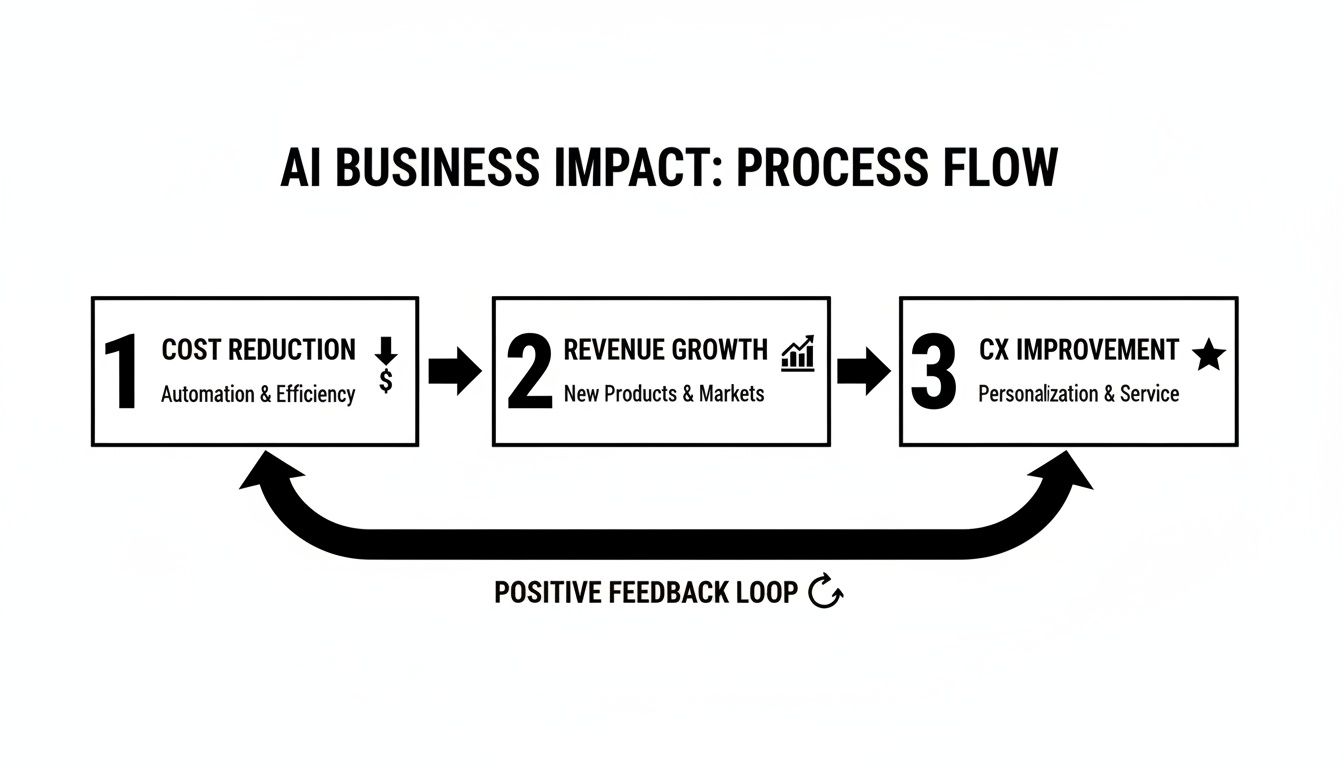
As you can see, a well-thought-out plan translates directly into lower costs, higher revenue, and a much-improved customer experience.
Plan a Phased Rollout and Train Your Team
Whatever you do, don't attempt a "big bang" launch. A phased rollout is your best friend—it minimises chaos and lets you learn as you go. Start with an internal pilot program, letting your own support agents kick the tyres on the AI assistant first. They are your best critics and will spot knowledge gaps and awkward phrasing before a single customer does.
Once you've got their feedback, deploy the AI on a single, low-traffic channel, like a specific help page on your website. This controlled environment lets you watch its performance in the wild and tweak things. As you build confidence, you can slowly roll it out across all your customer touchpoints.
Training your team is every bit as important as training the AI itself. This isn't about replacing people; it's about making them better. Show your agents how the AI will take the boring, repetitive queries off their plate, freeing them up to be the expert problem-solvers for the really tough cases.
- Elevate Agent Roles: Frame the AI as a new teammate—a helpful assistant that gives agents quick context, ticket summaries, and response suggestions.
- Focus on New Skills: Train your team on how to seamlessly take over escalated chats from the AI and how to use the new insights the system uncovers.
- Encourage Collaboration: Set up a simple process for agents to flag wonky AI answers. This turns them into trainers who help make the system smarter every day.
This hybrid approach, blending automation with a human touch, is driving huge growth. In India, for example, the call centre AI market is set to grow by 28.1% each year between 2025 and 2030 as businesses modernise. We already have data showing that combining automation with human agents can slash call handling times by up to 45% and boost resolution times by nearly 50%.
By following this roadmap—assess, prepare, and roll out thoughtfully—you can bring AI-powered customer support into your operations so it feels like a natural step forward, not a jarring overhaul.
Avoiding Common AI Implementation Pitfalls
Rolling out any new technology has its share of "gotchas," and bringing AI-powered customer support into your workflow is no exception. For all its massive potential, a few common stumbles can easily trip you up and derail the whole project. The trick is to know what they are ahead of time so you can sidestep them.
One of the biggest mistakes we see is treating AI like a new appliance you just plug in and walk away from. That’s just not how it works. A great AI assistant is a living system that needs regular care and attention to stay sharp.
Another classic trap is getting a little too excited about automation. In the race for efficiency, it's surprisingly easy to automate the humanity right out of your customer experience, which is the very thing that builds loyalty. It’s all about striking that perfect balance between the speed of a bot and the warmth of a person.
Neglecting Continuous Training and Maintenance
The day you launch your AI assistant isn’t the finish line; it’s the starting block. An AI that isn’t constantly fed new product details, policy changes, and real-world customer conversation data will go stale—fast. Before you know it, it'll be giving out wrong answers, frustrating customers, and chipping away at the trust you've built.
Think of your AI as a new hire who needs ongoing coaching to get better at their job. You need to build a simple feedback loop where your human agents can flag wonky or unhelpful AI responses with a click. This simple process transforms your team into a training crew, constantly teaching the AI to learn from its real-world mistakes.
A well-maintained AI system becomes an asset that grows in value over time. An ignored one becomes a liability that damages your brand's reputation with every inaccurate answer it provides.
To keep your AI on its A-game, you need to make these activities a regular habit:
- Review conversation logs to spot patterns where the AI gets confused or misses the customer's real question.
- Update its knowledge base the moment you roll out new features, adjust pricing, or change a company policy.
- Analyse escalation patterns to see what kinds of questions always end up with a human agent. This is a goldmine for figuring out where your AI’s training needs to be beefed up.
Overlooking the Human Element
The whole point of AI in customer support is to help your team, not replace it entirely. A major misstep is automating so much that customers feel trapped, with no clear path to a real person. When someone has a complicated, sensitive, or just plain frustrating problem, being stuck in an endless loop with a bot is a one-way ticket to losing them for good.
A smart AI-powered customer support strategy is all about the seamless handoff. The AI should be clever enough to recognise signs of frustration, complex questions, or high-stakes issues (like a security worry) and proactively say, "It looks like you need to speak with one of our specialists. Let me connect you."
This hybrid model gives you the best of both worlds:
- Instant answers for simple queries handled by the AI.
- Empathetic, expert help for complex problems from your talented human team.
When the conversation is passed over, the AI should also act as the agent’s personal assistant, serving up a clean summary of the chat so the customer never has to repeat themselves. This way, you keep the efficiency gains of AI while making sure a human touch is always there when it counts.
Ignoring Data Privacy and Transparency
People are more aware than ever about how their data is being handled. A massive—and potentially brand-killing—mistake is to be cagey about your use of AI or to have weak data privacy measures. If your customers suspect their information isn't safe or don't know how it's being used to train your models, that trust evaporates instantly.
Building and maintaining trust is everything. Be crystal clear with customers when they're talking to an AI. Even more importantly, partner with an AI vendor that takes security seriously, with enterprise-grade protections built-in. Make sure they comply with regulations like GDPR and provide essential features like end-to-end data encryption. By putting security and transparency first, you can bring AI into your business responsibly and build even stronger, more trusting relationships with your customers.
The Future of Customer Relationships with AI
As we look to the future, it's clear what AI-powered customer support is really all about. The goal isn't to replace your experienced team. It’s about elevating them into a crew of ‘super-agents’. This is a genuine shift in perspective, where the combination of human empathy and AI efficiency creates a service model that’s far greater than the sum of its parts.
The real magic happens when AI augments what your people can do. By taking over the repetitive, everyday queries and serving up critical information in an instant, AI frees up your agents to tackle the complex, high-stakes problems that require a human touch. This partnership is the bedrock of building lasting customer relationships today.
Emerging Frontiers: Proactive and Personalised Support
The next evolution of AI in customer service is already on the horizon, and it’s about more than just reacting faster. The next big leap is about getting ahead of problems before they even start.
Welcome to the world of proactive support. Here’s what that actually looks like:
- Anticipating Customer Needs: Imagine an AI noticing a customer struggling with a new feature based on their click patterns. Instead of waiting for a support ticket, it could proactively push a helpful tutorial video to their screen.
- Identifying Potential Issues: The system might flag an unusual spike in login failures from a certain area, giving your technical team a heads-up about a potential outage before customers even notice.
At the same time, we're moving into an age of hyper-personalisation. AI can now shape every interaction based on a customer’s entire history, their stated preferences, and maybe even their sentiment in the current chat. Forget rigid, one-size-fits-all scripts; every conversation feels like it was designed for that one person, making them feel seen and heard.
The future of customer service isn't just automated; it's anticipatory and deeply personal. AI will allow businesses to solve problems their customers haven't even articulated yet, turning support from a reactive necessity into a proactive, loyalty-building asset.
Ultimately, bringing AI-powered customer support into your business is much more than a simple tech upgrade. It’s a strategic decision to build stronger, more empathetic, and more meaningful connections with the people you serve. The companies that lean into this shift won’t just work smarter—they’ll redefine what exceptional service truly means.
Frequently Asked Questions About AI Support
Diving into AI-powered customer support naturally brings up a few questions. Let's tackle some of the most common ones I hear from teams making this shift, giving you the clear, straightforward answers you need to move forward with confidence.
Will AI-Powered Customer Support Replace Human Agents?
Not a chance. The real magic happens when AI augments your human team, not when it replaces them.
Think of AI as your tireless first line of defence. It’s brilliant at handling the high-volume, repetitive questions that flood your inbox, giving customers instant answers. This frees up your human agents to apply their skills where they matter most: on the complex, sensitive issues that demand a human touch, critical thinking, and genuine empathy.
What you end up with is a powerful hybrid model. The AI handles the routine stuff, allowing your human team to operate as specialists. They can use the context and data from AI interactions to solve tougher problems faster and more effectively, making their work more strategic and, frankly, more rewarding.
Is Implementing AI Support Too Complex for a Small Business?
It's a common misconception, but getting started is far more straightforward than you might think. Modern AI platforms, especially no-code solutions like SupportGPT, are built for everyone, not just developers. A small business can get a simple FAQ chatbot live on its website in an afternoon and start seeing results right away.
The trick is to start small with a clear goal. Pick a provider that offers an intuitive setup and solid support.
Even a small-scale AI implementation can deliver a surprisingly big return. Automating just a handful of your most common questions can slash response times and give your team back precious hours to focus on growing the business.
How Does AI Handle Customer Data Privacy and Security?
This is a critical question, and the answer is that any reputable AI platform builds security in from the ground up—it's never an afterthought. We're talking about essentials like end-to-end data encryption, strict access controls for your own team, and full compliance with major data protection laws like GDPR.
When you're evaluating a solution, make sure you dig into its security protocols and data policies. Quality AI models are trained to work within strict privacy guardrails, often using anonymised data to improve without ever exposing sensitive customer information. This is fundamental to building the trust you need for a successful rollout.
Ready to see how simple and effective AI support can be? SupportGPT provides a complete, secure platform to build and deploy an AI assistant in minutes. Start for free and transform your customer support today.