Ai for Customer Service: Elevate Support with AI-Driven Results
Explore ai for customer service insights: transform support into a growth engine with practical steps to implement AI, pick tools, and drive measurable results.
When we talk about AI for customer service, we're really talking about using smart technology to give customers fast, efficient, and personalised support. It's about automating the simple, repetitive stuff, guiding human agents when they need it, and being available 24/7. This approach does more than just make customers happy—it significantly cuts operational costs and lets support teams stop just putting out fires and start driving growth.
The New Reality of AI-Powered Customer Support

Picture your customer service team transforming from a reactive crew that only deals with problems to a proactive engine that actually fuels business growth. That’s the real promise of AI for customer service. We're moving past the buzzwords to show you how this technology takes the old manual switchboard of customer problems and turns it into an intelligent network that often knows what a customer needs before they even ask.
Today's customers expect answers now, not later. They want personalised help, and they want it around the clock. The days of waiting on hold or having to explain the same problem to three different people are over. AI hits these frustrations head-on by providing instant, automated help for common questions. This frees up your human agents to handle the truly complex issues where their expertise makes a difference.
Turning Support into a Growth Opportunity
This isn't just about being more efficient. It's about reframing every service interaction as a chance to build the business. An AI-powered system can spot opportunities to upsell or cross-sell during a support chat, offering suggestions that actually feel helpful rather than like a sales pitch.
By resolving simple issues instantly and empowering agents with data-driven insights, AI turns every customer touchpoint into a chance to build loyalty and drive business growth. It’s a fundamental change from a cost centre to a value generator.
This guide is your roadmap to getting it done. We’ll break down how AI meets modern consumer demands and why it’s become an essential tool for any business that wants to stay competitive. Some of the key benefits you’ll see are:
- Drastically Reduced Response Times: AI chatbots and virtual assistants give immediate answers, cutting out those frustrating queues for your customers.
- Lower Operational Costs: When you can automate up to 80% of routine inquiries, you can handle more customers without needing to hire more people.
- Enhanced Agent Productivity: With AI taking care of the repetitive queries, your skilled agents can focus their brainpower on solving tricky problems, leading to better job satisfaction and results.
- Greater Customer Satisfaction: Fast, accurate, and personalised support available anytime leads to happier customers who stick around.
It all starts with understanding the basic ideas and seeing how they work in the real world. We'll help you move from theory to practice and show you exactly why AI for customer service isn't some far-off idea anymore—it's a must-have for doing business today.
Understanding How AI Customer Service Works

To really get what makes AI for customer service tick, it helps to peek under the bonnet. We're not talking about mind-bending algorithms, but a set of practical tools working in harmony to create a smarter support experience. Think of it like a digital toolkit, with each tool designed for a specific job.
The most familiar tools are AI chatbots and virtual agents. These are your tireless, 24/7 front-line responders. Using Natural Language Processing (NLP), they can understand what a customer is asking and reply in a natural, conversational way. They're perfect for instantly handling common questions like "Where is my order?" or "How do I reset my password?".
This first line of defence filters out a massive volume of simple, repetitive queries. The result? Customers get instant answers, and your human agents are freed up to focus on the tricky stuff that genuinely needs their expertise.
The Smart Dispatcher: Intelligent Routing
But what happens when a query is too complex for a chatbot? That's when the next tool in the kit, intelligent routing, steps in. Picture a master dispatcher who knows the skills of every agent on your team and sends each customer to the perfect person.
Instead of just assigning tickets in a queue, this AI-powered system analyses the customer's issue in real time. It looks at the topic, urgency, language, and even the customer's past interactions to route them to the right expert on the first try. This means no more frustrating transfers and much faster, more accurate solutions.
Reading the Room with Sentiment Analysis
Another incredibly useful component is sentiment analysis. This technology is like having a built-in empathy reader for your team. By analysing the specific words and phrases a customer uses in a chat, email, or social media post, the AI can figure out how they're feeling.
Is the customer happy, a bit annoyed, or genuinely furious? This context is gold. It allows you to:
- Prioritise urgent cases: An angry customer can be flagged and escalated immediately.
- Spot churn risks: A pattern of negative feedback can trigger a proactive call from a senior team member.
- Coach your agents: Managers can review sentiment trends to see where agents are excelling or might need a bit more support.
Being able to understand emotion at scale adds a deeply human touch to your entire support operation.
The Strategic Advisor: Predictive Analytics
Finally, think of predictive analytics as a strategic advisor sitting over your whole support system. This AI capability dives into huge amounts of historical data—past tickets, chat logs, and customer feedback—to spot patterns and predict what might happen next.
It might, for example, notice a spike in customers mentioning a specific bug long before your engineering team is aware of it. By catching these trends early, you can fix the root cause of problems, which reduces the number of support tickets you'll get in the future and makes for a much better customer experience.
Predictive analytics shifts your support from being reactive to proactive. Instead of just solving problems as they arise, you start to anticipate customer needs and prevent issues before they happen, building deeper trust and loyalty.
In India's fiercely competitive market, these tools deliver real, measurable results. While 81% of consumers say they want more human-like interactions, AI is actually helping businesses deliver on that. A friendly, efficient bot can be incredibly effective, as 63% of customers are more likely to trust one that shows a bit of personality. This focus on quality is critical when 70% of consumers are willing to switch brands after just one bad service experience. You can discover more insights about the Indian CX landscape and how AI is making a difference.
The Real Business Impact of AI Integration
So, what happens when you actually bring AI for customer service into your business? This is where the rubber meets the road, moving from interesting tech concepts to tangible results you can see in your bottom line. Integrating AI isn’t just about adding another tool; it’s about fundamentally rethinking how your support team works and how it contributes to the entire organisation.
The first thing most businesses notice is a major drop in operational costs. It makes sense, right? When you automate the common, repetitive questions, your team can handle a much higher volume of issues without needing more people. In fact, studies show that AI agents can successfully automate up to 80 percent of routine customer interactions, which directly slashes your cost per contact.
This automation also frees up your human agents from the grind of password resets and order tracking. They can finally focus their skills on the tricky, high-stakes conversations that actually build customer relationships and solve unique problems. That’s not just a win for efficiency; it’s a huge boost for team morale.
Enhancing Customer Satisfaction and Loyalty
Let’s be honest, nobody likes to wait. Faster response times are the bedrock of a great customer experience. With AI, you can offer 24/7 support, giving customers instant answers whenever they need them, no matter the time zone. This simple change drastically reduces frustrating hold times and makes for happier customers.
On top of that, a well-trained AI delivers consistent and accurate information every single time. There’s no risk of a new agent giving out the wrong details. This kind of reliability builds trust, and trust is what keeps customers coming back. A satisfied customer is far more likely to stick around and tell their friends about you.
The real power of AI integration is its ability to transform customer support from a reactive cost centre into a proactive value generator. It's not just about saving money; it's about creating happier customers who stay longer and spend more.
When people feel like you’ve heard them and solved their problems quickly, their entire perception of your brand improves. That positive feeling is what builds real loyalty, cuts down on churn, and creates a more stable, predictable revenue stream.
Quantifiable Impact of AI in Customer Service
Looking at the hard numbers really drives home the impact. It's one thing to talk about improvements, but another to see the data from businesses that have already made the switch.
| Metric | Average Improvement with AI |
|---|---|
| Response Times | Up to 90% faster first response |
| Resolution Rates | 30% increase in first-contact resolution |
| Agent Productivity | 20-40% improvement in efficiency |
| Operational Costs | 25-45% reduction in cost-per-contact |
| Customer Satisfaction (CSAT) | Average increase of 10-15 points |
These aren't just minor tweaks; they represent a significant operational upgrade. The data clearly shows that AI isn't just about efficiency—it directly contributes to a better customer experience and a healthier bottom line.
From Support Queries to Revenue Opportunities
A truly smart AI for customer service platform doesn’t just stop at solving problems—it spots opportunities to grow the business. By connecting to your other systems, like your CRM or e-commerce platform, the AI can make incredibly relevant suggestions right in the middle of a support chat.
Imagine this: after an AI helps a customer resolve an issue with their product, it could recommend a compatible accessory based on their purchase history. Because it’s perfectly timed and genuinely helpful, it doesn't feel like a pushy sales pitch. This kind of contextual selling is incredibly effective and can lead to a serious increase in upsells and cross-sells.
Some companies using this approach have reported a 25% boost in sales coming directly from AI-driven recommendations made during support chats. It’s a perfect example of turning a support interaction into a direct revenue driver.
A Data-Driven Approach to Improvement
Finally, one of the most powerful benefits is the treasure trove of data AI provides. By analysing thousands of conversations, it can spot emerging trends, identify common frustrations, and show you exactly where your products or services could be better. This gives you the power to make strategic decisions based on what your customers are actually telling you, not just what you think they want.
This creates a continuous feedback loop. You can proactively fix issues before they become widespread problems, refine your help articles, and improve agent training based on real-world insights. Over time, your entire support operation just gets smarter and more effective. It’s this data-driven approach that helps you stay ahead of the curve.
How Leading Companies Are Putting AI to Work in Customer Service
Theory is one thing, but seeing AI for customer service out in the wild is where you really grasp its power. Let’s move past the concepts and look at how smart businesses in different industries are actually using this technology to solve real problems and keep their customers happy.
These companies aren't just adding another piece of software to their toolkit. They're fundamentally rethinking their support strategies with AI at the core. The game plan is simple but effective: automate the routine so human experts can focus on the exceptional.
E-commerce Giants Taming Ticket Volume
Imagine the flood of questions a huge online retailer gets every single day. "Where is my parcel?", "How do I return this?", "Is this in stock?" The sheer volume of these predictable queries is overwhelming. This is exactly where AI chatbots step in as the first line of defence.
Top e-commerce brands have deployed smart AI agents that plug directly into their order and logistics systems. This means the bot can give you an instant, accurate update on your order status or walk you through a return—no human required. For the customer, it's the difference between getting an answer in five seconds versus waiting on hold for five minutes.
The payoff for the business is huge:
- Ticket Deflection: Millions of simple tickets are handled automatically, freeing up the human team.
- Always-On Support: Customers get help 24/7, which is a lifesaver during big shopping rushes like Diwali or Black Friday sales.
- Lower Operational Costs: They don't need a massive team just to answer the same handful of questions over and over.
With the basics handled, the human agents can focus their brainpower on the tricky stuff—a damaged delivery, a complicated payment issue, or helping a customer pick out the perfect gift.
Fintech Innovators Balancing Speed and Security
In the world of finance and tech, customers have two non-negotiable demands: speed and security. Whether you're applying for a loan, checking a transaction, or reporting a lost card, you need things to happen fast, and you need to know your money is safe. Fintech companies are using AI for customer service to deliver on both fronts.
AI-powered bots can smoothly guide users through loan applications or answer questions about interest rates. But behind the scenes, something even more critical is happening. AI algorithms are constantly scanning for unusual activity, often flagging potential fraud before the customer even knows there’s a problem.
In finance, AI isn't just a support tool—it's a core part of building trust. It delivers the instant gratification customers expect while adding a crucial layer of security that protects them.
This double-duty role helps fintech brands earn a reputation for being both efficient and reliable, which is everything in an industry built on trust.
Travel Platforms Personalising the Journey
Travel is another industry where AI is a game-changer. Travellers often have complex, time-sensitive needs, like changing a flight at the last minute or finding out if a hotel is pet-friendly. AI helps travel companies handle these situations without breaking a sweat.
For instance, if a flight is cancelled, an AI system can automatically rebook all affected passengers on the next available flight and send them their new itinerary. It turns what could be a complete nightmare into a minor inconvenience.
It doesn't stop at just solving problems, either. AI analyses your search history and past bookings to offer up travel ideas you'll actually like. If you're chatting with a bot about a trip to Goa, it might suggest a popular local food tour or a hotel upgrade it knows you'd appreciate.
This kind of proactive, personal touch makes the entire experience feel more thoughtful and less transactional. It's how you build real loyalty. In India, businesses that have embraced AI in their customer service have seen an incredible 25% boost in sales. E-commerce leaders have found that by having AI recommend relevant products during a support chat, they can turn a problem into a new purchase. You can read the full analysis on AI's impact on sales to see just how it’s driving revenue.
Your Roadmap to Implementing AI Customer Service
Jumping into an AI-powered support model can feel like a huge undertaking, but it's much more manageable when you break it down. Think of it less as a giant leap and more as a series of deliberate, well-planned steps. This roadmap will guide you from the drawing board to a fully functional AI for customer service system that actually works for your team and your customers.
The journey starts with knowing where you're going. Before you even glance at a single AI tool, you need to define what success looks like for your business. What are the biggest headaches in your current customer service operation? Are customers getting frustrated with long wait times? Are your agents buried under a mountain of repetitive questions?
Nailing down these specific challenges is the most important first step. Your goal isn't just to "implement AI" for the sake of it. It's to solve a real, tangible business problem, like slashing first-response times or fully automating all those password reset requests.
Setting Your Goals and Choosing the Right Tools
Once you have a crystal-clear objective, you can start looking at AI solutions. The market is flooded with options, but the right one for you is the one that directly addresses your goals. It's easy to get distracted by flashy features, so stay focused on the fundamentals.
Here’s what really matters when picking a tool:
- Ease of Integration: How smoothly does the platform plug into your existing CRM, helpdesk, or other core systems? A tool that plays nice with your current tech stack will save you a world of pain down the line.
- Scalability: Can this solution grow with you? You need a platform that can handle a surge in customer queries without breaking a sweat.
- Usability: Remember, your customer service team will be in the driver's seat every day, not a squad of developers. Look for a clean, intuitive interface that lets non-technical users build and manage the AI. For instance, platforms like SupportGPT are built specifically to make creating and deploying AI agents a straightforward process for any team.
This whole process is a cycle: you find a problem, apply an AI solution, and measure the results to keep getting better.
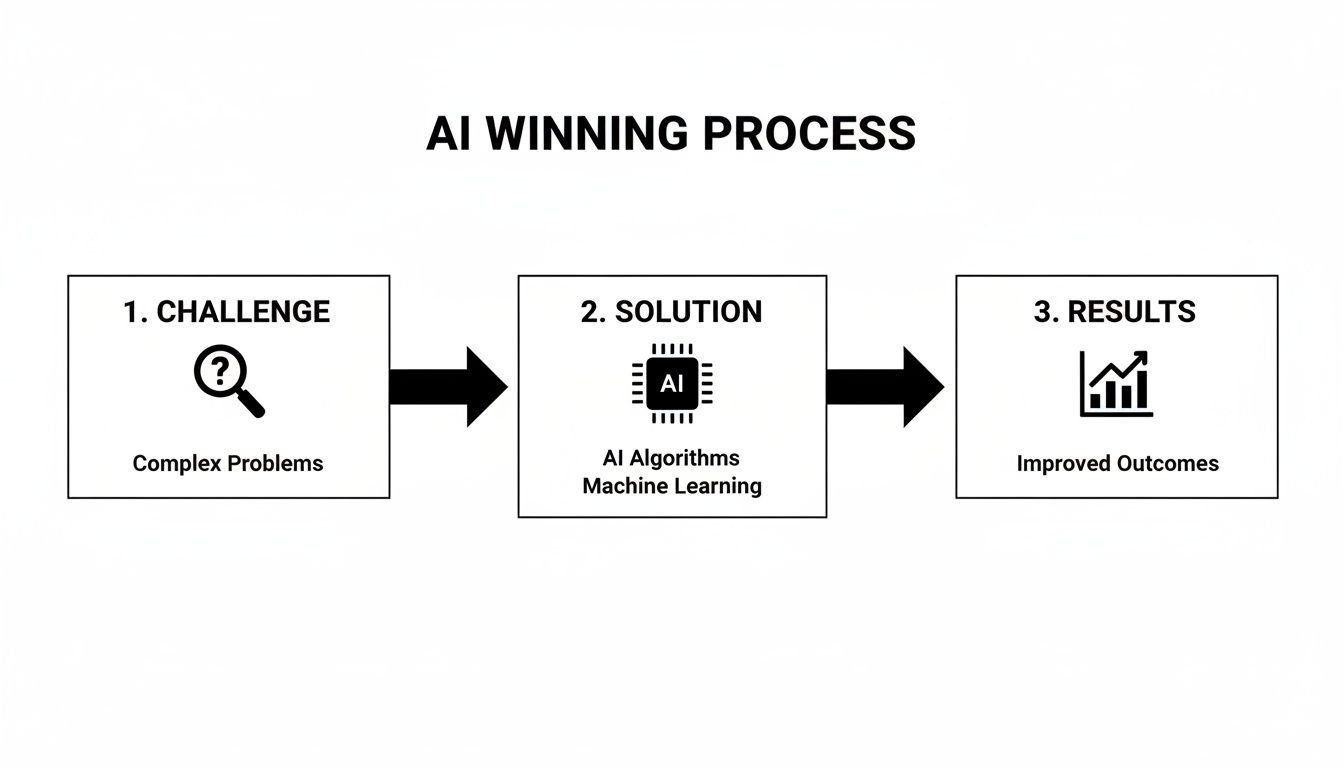
As you can see, successful AI implementation isn't just about the tech itself—it's about having a smart strategy for solving problems.
Preparing Your Data and Launching a Pilot Project
Your AI is only as good as the data it learns from. So, the next critical step is to get your knowledge base in order. This means cleaning up and organising your help articles, sifting through past customer chats, and tidying up internal documents. Think of it this way: high-quality, accurate, and comprehensive data is the fuel that powers an effective AI agent.
Your data is essentially the textbook for your new digital employee. A well-written and organised textbook means the AI can answer questions correctly and confidently right from the start.
Instead of trying to boil the ocean with a full-scale launch, start small. Pick one specific, high-volume, low-complexity issue—like order tracking—and build a pilot AI to handle just that. A pilot project lets you test the technology in a controlled environment, gather real feedback, and show some quick wins without disrupting your entire operation. It's the best way to minimise risk and build momentum for a wider rollout.
Integrating and Training Your Team
The final piece of the puzzle is weaving the AI into your daily workflows and—this is crucial—getting your human team on board. This is not about replacing agents; it's about giving them superpowers. The AI takes care of the repetitive, predictable stuff, freeing up your human experts to tackle the complex, high-value conversations where empathy and critical thinking really shine.
Good training makes all the difference. Show your team how the AI works, how it will make their jobs easier, and exactly how the handoff process works when a customer needs to escalate to a person. When your team views the AI as a helpful sidekick rather than a threat, adoption will be a breeze. This collaborative model, where humans and AI work hand-in-hand, is truly the future of great customer service.
Finding the Right Balance: Common Challenges and Best Practices
Rolling out AI for customer service isn't as simple as flipping a switch. It takes a thoughtful approach to get it right. One of the biggest hurdles is keeping that human connection alive. Even when customers know they're talking to an AI, they still need to feel understood and valued, not like just another ticket in a queue.
The trick is to design AI interactions that feel natural and empathetic. This means ditching the robotic, jargon-heavy replies for a helpful, conversational tone that genuinely reflects your brand. A well-designed AI also knows its own limits; it doesn't try to fool anyone into thinking it's human.
Another major challenge? The handover from AI to a human agent. Nothing torpedoes a good customer experience faster than a clunky or frustrating escalation. When a customer needs a person, the transition has to be completely seamless, with the human agent getting the full chat history and context right away.
Best Practices for a Smooth Handoff
To sidestep these issues, you need a solid game plan. Following a few key best practices will ensure your AI actually helps your customers and your team, rather than creating new problems.
First, map out a crystal-clear escalation protocol. These are the rules of the road for when and how a conversation moves from AI to a person.
- Flag complex issues immediately: If the AI can't figure out a query after two tries, it should automatically offer to connect the customer to a team member.
- Keep an eye on customer sentiment: Train the AI to spot signs of frustration—like angry language or repeated phrases—and proactively escalate the conversation before things get worse.
- Always offer an 'out': Customers should have an obvious, easy-to-find option to speak with a human at any point. No dead ends.
This approach ensures the technology empowers your team instead of creating friction for your customers.
Staying Sharp with Continuous Training
Here’s a secret: an AI model is never really "done." Your customers' needs change, your products get updated, and new problems pop up. Your AI has to keep up. If you just set it and forget it, its accuracy and helpfulness will slowly degrade, leading to some pretty frustrating customer interactions.
Think of your AI as a new employee. It needs ongoing coaching to stay on top of its game. Regularly reviewing its conversations and updating its knowledge is the only way it remains a valuable part of your support team.
Make it a routine to go over unhelpful AI responses and pinpoint gaps in its knowledge. Use that feedback to update your help centre articles and retrain the model. This creates a powerful improvement cycle. And of course, never forget about data privacy and compliance. Make sure your AI platform meets all data protection standards to build and maintain the trust you've worked so hard to earn. Following these practices will help you turn potential challenges into a genuinely superior customer service operation.
Your Questions About AI in Customer Service, Answered
It's smart to have questions before making a big change to how you support your customers. Bringing AI into the mix is a significant step, and we find that leaders often wonder about the same things: costs, brand voice, and what it all means for their team. Let's tackle some of those common questions head-on.
Will AI Replace Our Human Customer Service Agents?
This is the big one, and the answer is a firm "no." The real goal here isn't replacement; it's teamwork. Think of AI as the ultimate assistant for your support team. It’s brilliant at handling all the repetitive, straightforward queries that eat up so much of an agent's day.
This frees up your people to focus on the tricky, emotionally-charged, or high-stakes problems where human empathy and expertise truly shine. It's about making your team more powerful, not smaller. In the end, your agents get to do more meaningful work, and your customers get a higher level of care.
How Do We Make Sure the AI Sounds Like Our Brand?
A good AI platform isn't some generic chatbot you just plug in. It’s trained from the ground up on your company's data to learn your unique voice.
You feed it your past support chats, your knowledge base articles, and your brand style guides. From there, it learns your lingo, your tone, and the way you talk to customers. This custom training ensures that whether a customer is talking to a bot or a person, the experience feels consistent and genuinely you.
The AI becomes an extension of your brand, not a robot impersonating it. That consistency is absolutely vital for building customer trust.
What Is the Typical ROI on AI for Customer Service?
While the exact numbers can change depending on your business, the return on investment usually comes from three key areas.
- Serious Cost Savings: When you automate the simple stuff, your operational costs naturally go down and your whole team becomes more efficient.
- More Revenue: AI can spot upselling opportunities, and a better, faster support experience keeps customers around longer. Both of these directly boost your bottom line.
- Supercharged Productivity: With AI handling the basics, your agents can solve more complex tickets in less time, making your support team far more valuable.
The upfront cost of an AI for customer service platform is often paid back surprisingly quickly by these concrete gains, helping to shift your support centre from a cost centre to a real growth engine.
Ready to see how a purpose-built AI can change your support experience? SupportGPT offers a complete, easy-to-use platform for building and deploying smart AI agents that deliver fast, accurate, and on-brand assistance 24/7. Start building your AI support agent for free.