Ai Customer Service Platform: ai customer service platform for scalable support
Discover how ai customer service platform automates responses, boosts satisfaction, and scales support operations for faster, smarter customer care.
Imagine you could build a customer support team that never sleeps, speaks every language fluently, and has perfect knowledge of your entire business. That's essentially what an AI customer service platform brings to the table. It’s a specialized type of software that uses artificial intelligence—specifically, powerful large language models (LLMs)—to automate and elevate how you interact with your customers.
Redefining Customer Support Beyond Chatbots
At its heart, an AI customer service platform is a massive leap beyond the simple, rule-based chatbots of the past. Older bots were stuck on rigid scripts, easily confused by questions that didn't fit their pre-programmed paths. Modern AI platforms, however, can hold natural, human-like conversations. They grasp the context of a discussion, pick up on the customer's sentiment, and navigate complex problems that used to require a human agent.
Think of a traditional chatbot like an old-school automated phone menu: "Press one for billing, press two for technical support." It's a frustrating, limited experience. An AI platform is more like talking to a seasoned expert who gets your problem right away and knows exactly how to fix it, no matter how you word your question.
To really see the difference, a quick comparison helps.
Traditional Support versus AI Platform Capabilities
| Capability | Traditional Support | AI Customer Service Platform |
|---|---|---|
| Availability | Limited to business hours | 24/7/365, instant responses |
| Response Logic | Follows rigid, pre-defined scripts | Understands intent, context, and nuance |
| Scope | Handles basic, repetitive questions | Manages complex, multi-step resolutions |
| Personalization | Generic, one-size-fits-all answers | Tailors responses to user history and data |
| Agent Role | Answers every incoming query | Focuses on high-value, complex cases |
This table really highlights the shift from a reactive, limited model to a proactive, intelligent one that can handle a much wider range of customer needs.
The Brains Behind the Operation
The secret sauce is the Large Language Model (LLM)—the same kind of technology that powers tools like ChatGPT. This is what gives the platform its intelligence.
Because of the LLM, the platform can:
- Understand Nuance: It can decipher slang, typos, and convoluted sentences to figure out what the user really wants.
- Maintain Context: The AI remembers what was said earlier in the conversation, which makes for a much smoother and more logical interaction.
- Generate Human-Like Responses: It doesn't just spit out canned answers. It crafts replies that are genuinely helpful, empathetic, and match your brand’s unique voice.
A good way to think about it is to see an AI customer service platform as a highly advanced piece of workflow automation software built specifically for customer conversations. It automates the entire flow: understanding the request, finding the right answer, and delivering the solution.
These systems aren't here to replace your human agents—they're here to make them superstars. By handling up to 80% of the routine, repetitive questions, the AI frees up your skilled team to focus on the tricky, high-value customer issues that truly need a human touch.
From Answering to Resolving
This evolution from just answering questions to actively resolving issues is what it's all about. An advanced AI platform won't just send a customer a link to a help article. It can walk them through troubleshooting steps, process a product return, or update their account details right there in the chat.
This ability turns your support department from a necessary expense into a powerful driver of customer happiness and loyalty. By offering instant, accurate support around the clock, businesses can finally meet modern customer expectations without having to constantly hire more people.
What's Really Under the Hood of a Modern AI Platform?
When you look at a top-tier AI customer service platform, what you see on the surface is just the beginning. Beneath that clean chat interface is a sophisticated engine built from several key parts, all working in harmony. These aren't just a random list of features; they're the core functions that deliver that instant, smart, and surprisingly human-like support.
Getting a handle on these capabilities shows you exactly how these platforms go way beyond simple, scripted chatbots. They become genuine partners in creating a better customer experience. Let's pull back the curtain and look at the essential building blocks.
The Brains and the Voice: LLM Support and Conversational UI
At the very heart of any modern AI platform is its ability to tap into a Large Language Model (LLM). You can think of the LLM as the system's brain. It's the part that actually understands human language, picks up on context, and deciphers nuance. This is the single biggest leap from the clunky, keyword-based bots of the past. Your customer can have typos or ask a complicated question, and the LLM still gets what they really mean.
But all that brainpower needs a way to talk to people. That’s where the Conversational User Interface (UI) comes in. It’s the friendly face of the AI—the chat widget on your site or the interactive prompt in your app. A great UI makes the whole experience feel less like you’re navigating a clunky phone menu and more like you're texting a friend who happens to know everything about the product.
These two work hand-in-glove. The LLM supplies the raw intelligence, and the UI makes that intelligence feel approachable and easy to use.
From Data to Decisions: Analytics and Smart Escalation
An AI platform's job doesn't end when it answers a question. It’s also learning from every single conversation. This is why powerful analytics dashboards are so important—they turn those thousands of daily interactions into real-world business insights. You get a clear window into what customers are asking, where they're getting stuck, and how well the AI is actually performing.
Your analytics should give you a quick look at things like:
- Conversation Tracking: The ability to review chat logs to spot common problems or see where the AI could be improved.
- Resolution Rates: A simple metric showing how often the AI solves an issue completely on its own.
- Topic Analysis: Automatically grouping conversations by subject to identify emerging trends or catch widespread issues early.
Of course, some problems just need a human. That's where smart escalation takes over. This isn't just a generic "talk to an agent" button. It’s an intelligent handoff that sends the customer—along with the entire chat history—to the right person or department. No more making customers repeat their story five times.
A great AI platform acts as your ultimate "Tier 1" support agent. It fields all the common, repetitive questions, freeing up your human experts to focus on the complex, high-value problems that truly need their touch.
The map below gives you a great visual of how these pieces fit together to solve problems, automate tasks, and deliver critical insights.
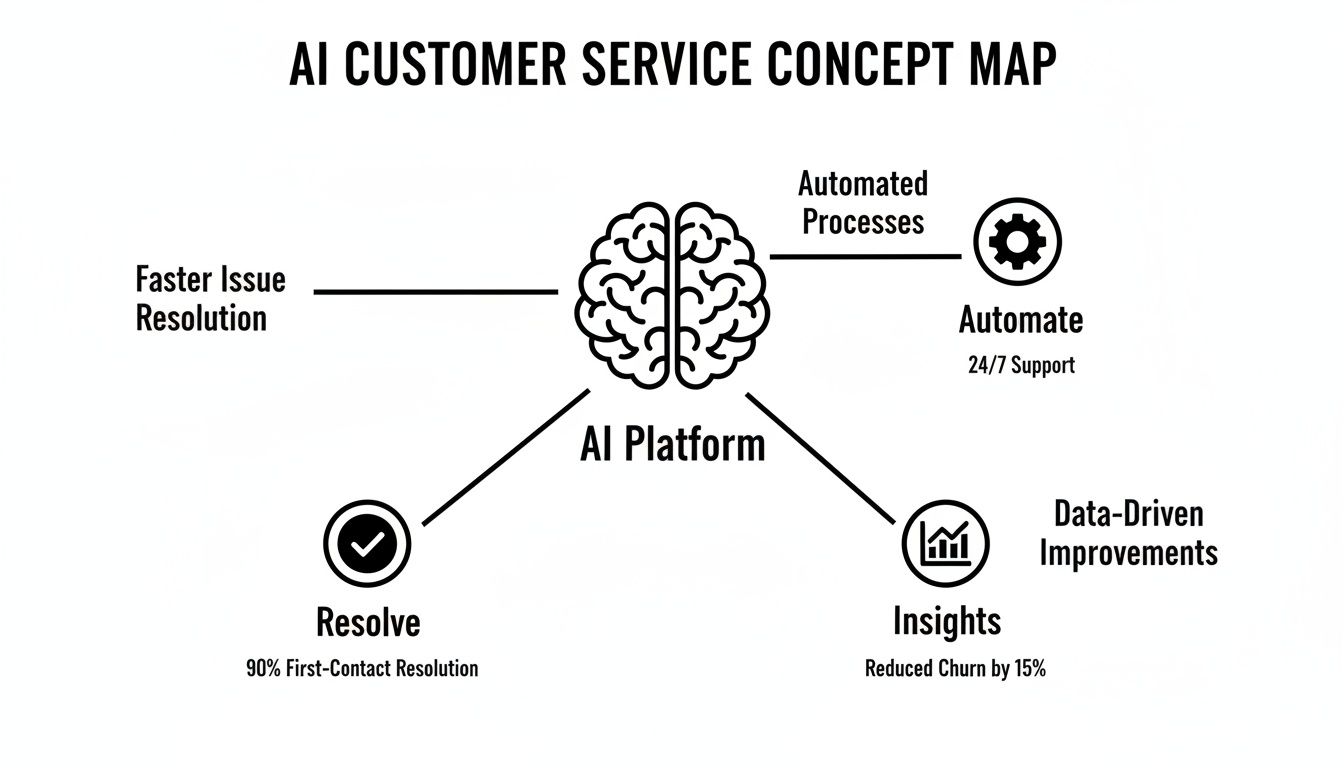
As you can see, the platform becomes the central hub, transforming your support from a simple cost center into a smart, efficient operation.
The Rules of the Road: Guardrails and Integrations
As smart as LLMs are, they can't be left to their own devices. That's why you need guardrails. Think of these as the company policy manual for your AI. They're the rules and boundaries you set to make sure every response is accurate, on-brand, and helpful. Guardrails stop the AI from guessing, giving bad advice, or wandering off-topic. They’re absolutely critical for building trust with your customers.
Just as important are integrations. An AI tool becomes ten times more useful when it can talk to the other systems you already use. When your AI can connect to your CRM, help desk, or e-commerce platform, it moves from just answering questions to actively solving problems.
- CRM Integration: Lets the AI pull up a customer's history for truly personalized help.
- Help Desk Integration: Allows for a smooth handoff where a ticket is automatically created for a human agent.
- E-commerce Integration: Empowers the AI to check on an order status or even start a return.
Integrations are what turn your AI from an isolated information source into a fully-fledged member of your support team. A huge part of this is the platform’s ability to drive better self service portals, giving customers the power to find answers and fix things on their own time.
This isn’t just a niche trend; it’s where the entire industry is headed. Projections show that by 2025, a massive 95% of all customer interactions will be touched by AI in some way. We’re seeing a fundamental shift away from purely human-led support. It’s why so many businesses are looking at platforms that let even non-technical people build and train their own AI agents, connecting them directly to their knowledge bases for precise, in-context answers.
The Real Business Impact of AI-Powered Support
Knowing what an AI customer service platform is and seeing what it can do for your bottom line are two very different things. Let's move past the technical jargon for a minute. The real story here is about the tangible, measurable results these platforms deliver. Adopting AI isn't just a tech upgrade; it's a strategic move that fundamentally changes your efficiency, customer loyalty, and capacity for growth.
The most immediate win? A serious drop in operational costs. Traditional support models are expensive because they scale in a straight line—more customers mean hiring more agents. This locks you into a painful cycle of recruiting, training, and overhead that just eats away at your margins. AI completely shatters that model.
Think about it: a single AI agent can manage thousands of conversations at once, for just a fraction of what a human agent costs. Your cost-per-interaction plummets. You stop paying for every minute of an agent's time and start investing in a system that resolves issues automatically. It turns a major operational expense into a predictable, scalable asset.
Fueling Growth Through Scalability and Availability
One of the toughest constraints with human-only support is that your team can't be everywhere at once. Customers today expect answers now, whether that's 3 PM on a Tuesday or 3 AM on a Sunday. If you can't deliver, you’re not just creating frustration—you're losing sales and tarnishing your brand.
An AI customer service platform delivers true 24/7/365 availability. This constant presence means no question goes unanswered. You’re capturing leads and solving problems the moment a customer needs you, allowing your business to operate on a global clock without having to staff brutal overnight shifts.
This leads right into effortless scalability. Imagine you launch a new product or a marketing campaign goes viral, doubling your website traffic overnight.
- Without AI: Your support team is instantly swamped. Wait times skyrocket, customers get angry, and you miss out on a massive opportunity.
- With AI: The platform just scales to meet the demand. It handles the huge influx of questions without missing a beat or sacrificing service quality.
This ability to absorb massive volume means your business can finally grow without the usual support-related growing pains.
Boosting Satisfaction and Agent Productivity
It's a simple formula: faster responses lead to happier customers. When people get instant, accurate answers, they feel better about your brand. An AI platform provides that consistency every single time, serving up on-brand, correct information that builds trust and loyalty.
But the magic doesn't stop with the customer. This automation has a huge impact on your human agents, too. By taking on all the routine, repetitive questions, the AI acts as a frontline filter. This frees up your skilled agents to focus on what they do best: handling the complex, high-value problems that require a human touch.
Instead of drowning in a sea of password resets and "where's my order?" tickets, your agents become expert consultants. This shift doesn't just make their jobs more fulfilling; it turns your support team into a powerful retention engine.
The market data confirms this isn't just a theory; it's a massive trend already in motion.

This explosive market growth shows just how many businesses are turning to AI to meet modern service demands. Customer support applications already own a staggering 42.4% of the chatbot market, proving that AI is now central to how companies scale their service. In fact, some businesses are already using this tech to build stronger customer relationships while cutting related costs by up to 40%. You can dive deeper into the numbers by checking out the AI customer service market outlook to see just how widespread this shift has become.
How to Choose the Right AI Customer Service Platform
Picking the right AI customer service platform can feel like a huge task, but it doesn't have to be. The key is to shift your mindset. Don't think of it as just buying software; think of it as hiring a digital team member who will be the face of your brand 24/7.
Your goal is to find a true partner—one that fits your specific needs, can grow with your business, and actually makes your human team's life easier, not harder. By focusing on a few critical areas, you can cut through the marketing hype and find a platform that delivers real, lasting value.
Start with Simplicity and Usability
The most technically advanced platform in the world is completely useless if your team can't actually use it. Your first and most important checkpoint should always be how easy the platform is to manage, especially for the non-technical folks on your team. Your support managers, not just your engineers, should be able to build, train, and tweak your AI agents with confidence.
Look for a clean, intuitive interface that makes complex tasks feel simple. A platform that lets you train an AI on your existing help docs or website in just a few minutes is a massive advantage. This focus on usability means the platform will get adopted quickly and become a core part of your workflow, instead of gathering digital dust.
The best AI customer service platform feels less like a complex coding environment and more like a simple content management system. If your team can write a help article, they should be able to train your AI.
This approach puts the power directly into the hands of the people who know your customers best, allowing them to shape the support experience firsthand.
Evaluate Core Technical Capabilities
While usability is king, the technology powering it all has to be solid. Not all AI is created equal, and the platform’s underlying architecture will dictate its performance today and its relevance tomorrow.
Here’s a practical checklist to help you compare the nuts and bolts of different platforms.
AI Platform Evaluation Checklist
A quick-reference checklist to help you compare platforms and make sure you're getting the capabilities that truly matter.
| Feature/Criteria | What to Look For | Why It Matters |
|---|---|---|
| LLM Flexibility | Does it support multiple top-tier models (OpenAI, Gemini, Anthropic)? Or are you locked into their proprietary model? | The AI world moves fast. Flexibility ensures you can always switch to the best-performing model without changing your entire platform. |
| Data Customization | How easily can you connect your own knowledge bases, help docs, and other internal data sources? | Generic answers don't cut it. The AI must be trained on your information to give accurate, brand-specific responses. |
| Seamless Human Handoff | Is the escalation path to a human agent smooth? Does it transfer the full chat history and context? | No AI can solve every problem. A clunky handoff frustrates customers and forces them to repeat themselves, defeating the purpose. |
| Analytics & Insights | Does the platform provide clear dashboards on conversation topics, resolution rates, and customer satisfaction? | Without data, you're flying blind. Good analytics help you identify knowledge gaps and continuously improve your support. |
| Enterprise-Grade Security | Look for SOC 2, GDPR, or other relevant compliance certifications. Is data encrypted both in transit and at rest? | You're handling sensitive customer information. Non-negotiable security and compliance protect your customers and your business. |
| Integrations | Does it offer pre-built integrations with your existing CRM, help desk (e.g., Zendesk, Salesforce), and communication tools (e.g., Slack)? | The AI platform should fit into your current workflow, not force you to build a new one. Seamless integrations are key to efficiency. |
These technical pillars are the foundation of a reliable AI support system. As you get more comfortable, you might want to explore building more advanced automations. Learning how to create and deploy AI support agents on a flexible platform will give you a serious competitive edge.
Focus on Scalability and Commercials
Finally, think about the future. How will the platform support your business as it grows? A pricing model that looks like a bargain today can quickly become a budget-breaker as your ticket volume increases. Look for transparent, scalable pricing that makes sense for your growth trajectory.
A good vendor will offer a clear path from a free or starter plan all the way up to an enterprise solution. This lets you start small, prove the ROI, and then scale your investment with confidence. Pay close attention to what’s included in each tier—features like single sign-on (SSO), dedicated support, and higher usage limits often become critical as you grow. Choosing a platform with a predictable cost structure ensures your AI remains a cost-effective asset, not a runaway expense.
Your Roadmap for a Successful Implementation
Bringing a powerful AI customer service platform into your business isn't a massive, all-at-once project. At least, it shouldn't be. A successful launch is all about starting smart, focusing on a clear, achievable goal, and building momentum from there.
This roadmap breaks the process down into manageable phases. The whole point is to get value quickly without overwhelming your team.
The journey starts with strategy, not technology. The most common mistake I see is teams trying to boil the ocean—automating everything right out of the gate. A far better approach is to find one specific, high-impact pain point and have the AI solve that first. This approach takes the risk out of the project and delivers a tangible win that builds confidence across the entire organization.
Phase 1: Define Your Initial Goal
Before you build anything, you have to know what success looks like. The best way to do this is to pick a clear, narrow use case to tackle first.
For most businesses, a fantastic starting point is automating the answers to your top 5-10 most frequently asked questions. "Where's my order?" or "How do I reset my password?" are perfect candidates.
This strategy just plain works. Why?
- It's High-Impact: You're immediately addressing the questions that eat up most of your agents' time.
- It's Low-Risk: The answers are already well-documented and straightforward, which makes them perfect for training an AI.
- It's Measurable: You can easily track the drop in ticket volume for these specific topics and show a clear return on investment.
Once you’ve locked in your target, it's time to gather the raw materials your AI will learn from. This just means compiling your existing knowledge base articles, saved email replies, and any product docs related to those FAQs.
Think of your AI as a new employee on their first day. You wouldn't expect them to know everything instantly. You’d start by giving them the employee handbook and FAQ sheet—this is the exact same principle.
Phase 2: Build and Test Your First AI Agent
With your goal set and your knowledge sources gathered, you can finally start building. Modern platforms are designed to be simple, letting you create your first agent in minutes. You just connect your data sources—like a public help center or uploaded documents—and the AI gets to work training itself.
After this initial training comes the most critical step: internal testing. Think of this as your "friends and family" round. Get your support team to throw questions at the AI. Have them ask the target questions in different ways, use slang, and try to trip it up. See how it responds.
This internal feedback loop is absolutely vital. It helps you find knowledge gaps, fine-tune answers, and adjust the AI's guardrails before a single customer ever sees it. Iteration is the name of the game here. Small, frequent tweaks will make a huge difference in performance.
Phase 3: Deploy, Monitor, and Iterate
Once your team feels good about how the AI handles that core set of questions, it's time to go live. But deployment isn't the finish line. It's really the starting line for ongoing improvement. From this point on, the platform's analytics dashboard becomes your best friend.
Keep a close eye on these key metrics:
- Resolution Rate: What percentage of queries is the AI handling all by itself? This is your main success indicator.
- Escalation Rate: How often are conversations passed to a human agent? Digging into these chats will show you exactly where the AI needs more training.
- Conversation Topics: What are customers actually asking about? This data gives you a perfect roadmap for the next set of FAQs to automate.
This data-driven approach turns implementation from a one-time setup into a continuous cycle of improvement. By starting with a focused goal and using real-world data to guide your next steps, you can steadily expand your AI's skills, turning that small initial win into a massive operational advantage.
Got Questions About AI Customer Service? We’ve Got Answers.
Jumping into AI for your customer service can feel like a big step, and it's natural to have a few questions before you commit. We get it. Let's tackle some of the most common things business leaders ask when they're on the fence.
One of the first questions we often hear is, "Is my business the right size for this?" The short answer is yes. These platforms are built to scale. A small startup can finally offer 24/7 support without the massive overhead of a round-the-clock team. On the other end of the spectrum, a global enterprise can use the same kind of tool to manage huge ticket volumes and slash operational costs.
What’s the Real Cost of an AI Platform?
It's easy to get fixated on the subscription price, but that’s only looking at one side of the ledger. The real story is about the return you get on that investment. Sure, pricing models vary, but many of today’s platforms offer incredibly flexible plans, some even starting with a free tier. The smart way to look at it is to weigh the monthly cost against what you’re saving—fewer repetitive tickets for your agents, a lower cost for every customer interaction, and better customer retention because people aren't waiting for answers.
Think of it this way: a single, well-trained AI agent can handle the workload of several human agents, but for a tiny fraction of the cost. When you frame it like that, the financial case isn't just strong; it's a no-brainer. It's an investment in pure efficiency that pays for itself.
And don't forget the indirect financial wins. Happier customers stick around longer, and that loyalty is gold for your long-term revenue. Plus, the AI is constantly collecting data on what your customers are struggling with, giving your product team a treasure trove of insights to make improvements.
How Long Until I Actually See Results?
This isn't one of those massive software projects that takes a year to get off the ground. You can see the impact of an AI customer service platform almost right away. The trick is to start small and smart. For instance, focus on automating the top ten questions your team gets every single day. You could have that up and running in a few days, not weeks.
Here’s what you can realistically expect:
- In the first week: You’ll see a noticeable dip in the number of easy, repetitive tickets landing in your agents' inboxes.
- Within a month: Your analytics dashboard will show you the proof—solid data on resolution rates and a big drop in how long customers have to wait for help.
This fast turnaround is a huge reason the market is booming. The global AI customer service space, valued at USD 13,012.4 million just a year ago, is expected to skyrocket to USD 83,854.9 million by 2033. You can dig into the trends fueling this growth to see why so many businesses are jumping on board. The technology is mature, reliable, and ready to deliver real value from day one.
Ready to see this in action? SupportGPT lets you build and launch smart AI agents trained on your own help docs and knowledge base. Start giving your customers instant, accurate answers, anytime. Explore SupportGPT and start for free today.