ai chatbot for customer service: Transform Your Support
ai chatbot for customer service: Discover benefits, setup tips, and how to measure success with real-world examples.
At its core, an AI chatbot for customer service is an intelligent program designed to handle customer conversations without human intervention. Think of it as your most dedicated team member—one that works 24/7, provides instant answers, and can manage thousands of customer queries simultaneously with a personal touch. It’s a level of scale and efficiency that human teams, no matter how great, just can't reach on their own.
The New Era of Automated Customer Support

Picture your customer service as a single-lane road, where every query waits in line, moving only during business hours. Now, imagine a multi-lane superhighway, effortlessly directing endless traffic at any time of day or night. That’s the leap you make with a modern AI chatbot.
This isn't the clunky, rule-based technology of the past. Forget those frustrating bots that got stuck if you didn't use the exact right keyword. Today's AI chatbots are built to understand context, figure out what a customer really wants, and even pick up on their tone.
From Simple Scripts to Smart Conversations
The first chatbots were really just interactive FAQ pages. They followed a rigid script, and if you strayed from it, you’d hit a dead end, leaving you more frustrated than when you started. That’s not what we’re talking about anymore.
Modern systems run on sophisticated technologies like Natural Language Processing (NLP). This allows them to understand the subtle variations of human language, making conversations feel much more natural. More importantly, they learn from every single interaction, constantly getting better at delivering the right answers. It's this ability to learn that makes all the difference.
Why AI Is Reshaping Customer Expectations
Customers today have zero patience for waiting. Research shows that over 60% of people would rather get a quick answer from a chatbot for a simple issue than wait for a human agent. This isn't just a trend; it's the new standard for good service. An AI chatbot for customer service meets this demand perfectly by offering:
- Instantaneous Resolutions: No more waiting in a queue to ask, "Where's my order?" or "How do I reset my password?"
- Constant Availability: Your support is always on—weekends, holidays, 3 AM. It doesn’t matter. Your customers get help when they need it.
- Personalised Help: When connected to your CRM or other business tools, the chatbot can pull up a customer's history to give them answers that are actually relevant to them.
A well-implemented AI chatbot doesn't just answer questions; it builds a foundation for a modern, efficient, and customer-centric support strategy that aligns perfectly with today's user expectations.
Ultimately, these platforms aren't just a "nice-to-have" anymore; they're a core part of a winning business strategy. They free up your human agents from repetitive, draining tasks, letting them focus their expertise on the complex problems where a human touch truly matters.
Traditional Support vs AI Chatbot Capabilities
To really see the difference, let’s compare a traditional, human-only support setup with one that’s enhanced by AI. The contrast in both efficiency and the customer’s experience is stark.
| Feature | Traditional Customer Service | AI Chatbot for Customer Service |
|---|---|---|
| Availability | Limited to business hours and staff | 24/7/365, instantly available |
| Response Time | Minutes to hours, depends on queue | Instant, responds in seconds |
| Scalability | Limited by headcount, hard to scale | Handles unlimited queries at once |
| Cost Per Interaction | High, tied to agent time and salary | Very low, pennies per conversation |
| Data Collection | Manual and often inconsistent | Gathers structured data automatically |
| Personalisation | Relies on agent's access to CRM | Instantly pulls data for context |
It's clear that while human agents remain essential for high-stakes, emotional, or complex issues, AI chatbots provide a powerful foundation that makes the entire support operation faster, smarter, and more cost-effective.
Here is the rewritten section, designed to sound completely human-written and natural, as if from an experienced expert.
Why an AI Chatbot Is a Smart Business Investment
Thinking about an AI chatbot as just another widget for your website is missing the bigger picture. It's a fundamental shift in how you connect with your customers—a strategic investment that pays real dividends by making your support smarter, faster, and more scalable. The business case really boils down to three things: efficiency, customer happiness, and growth.
The first and most obvious win is automation. Your human support agents are your most valuable resource, but let's be honest, they probably spend too much time answering the same questions over and over. A well-trained AI chatbot can instantly take over those routine queries—things like "Where's my order?" or "How do I reset my password?"—and handle them perfectly every time.
This frees up your team to do what they do best: tackle the tricky, high-stakes problems that genuinely need a human touch and creative thinking. Your agents go from being a first line of defence to a specialised team for critical issues, which not only boosts their impact but also makes their jobs far more engaging.
Delivering an Exceptional Customer Experience
In today's world, customers expect answers now, not tomorrow. Making them wait for an email reply or sit on hold during office hours is a surefire way to send them straight to a competitor. An AI chatbot completely removes that waiting game.
By offering 24/7 availability, you meet customers right where they are, giving them immediate help whenever they need it. This constant accessibility has a huge impact on customer satisfaction (CSAT) scores. When people can get their problems sorted quickly and without hassle, they feel better about your brand and are much more likely to stick around.
Investing in an AI chatbot isn't just an operational tweak; it’s a strategic move that gives you a competitive edge by delivering the speed and convenience modern customers demand.
This is especially true in fast-growing markets. Take India, for example, where the use of AI chatbots has exploded. A staggering 80% of consumers there now use them for everything from checking on a support ticket to getting product advice. And yet, there's still a huge gap to fill. Indian consumers collectively spent 15 billion hours on hold last year, highlighting a massive opportunity for businesses to step up. You can dive deeper into these trends in the full report on Indian consumer trends and get more insights from ServiceNow.
Unlocking Unmatched Scalability
Picture this: you're about to launch a huge marketing campaign or head into the holiday rush. With a traditional support setup, you'd be scrambling to hire and train temporary staff—an expensive and time-consuming headache. An AI chatbot for customer service lets you scale up effortlessly, without all that overhead.
A single chatbot can juggle dozens, hundreds, or even thousands of conversations at once without breaking a sweat. It handles sudden spikes in customer questions seamlessly, making sure every single person gets an instant response. This ability to scale on demand is a powerful advantage, helping you maintain fantastic service quality even during your busiest times.
Here’s what that scalability looks like in practical terms:
- Reduced Hiring Costs: You no longer need to bring on seasonal staff just to handle predictable busy periods.
- Consistent Service Quality: Every customer gets the same excellent, immediate answer, no matter how swamped you are.
- Improved Resource Allocation: Your money goes into a tool that works around the clock, not into temporary wages and training costs.
What Makes a Great AI Chatbot Tick?
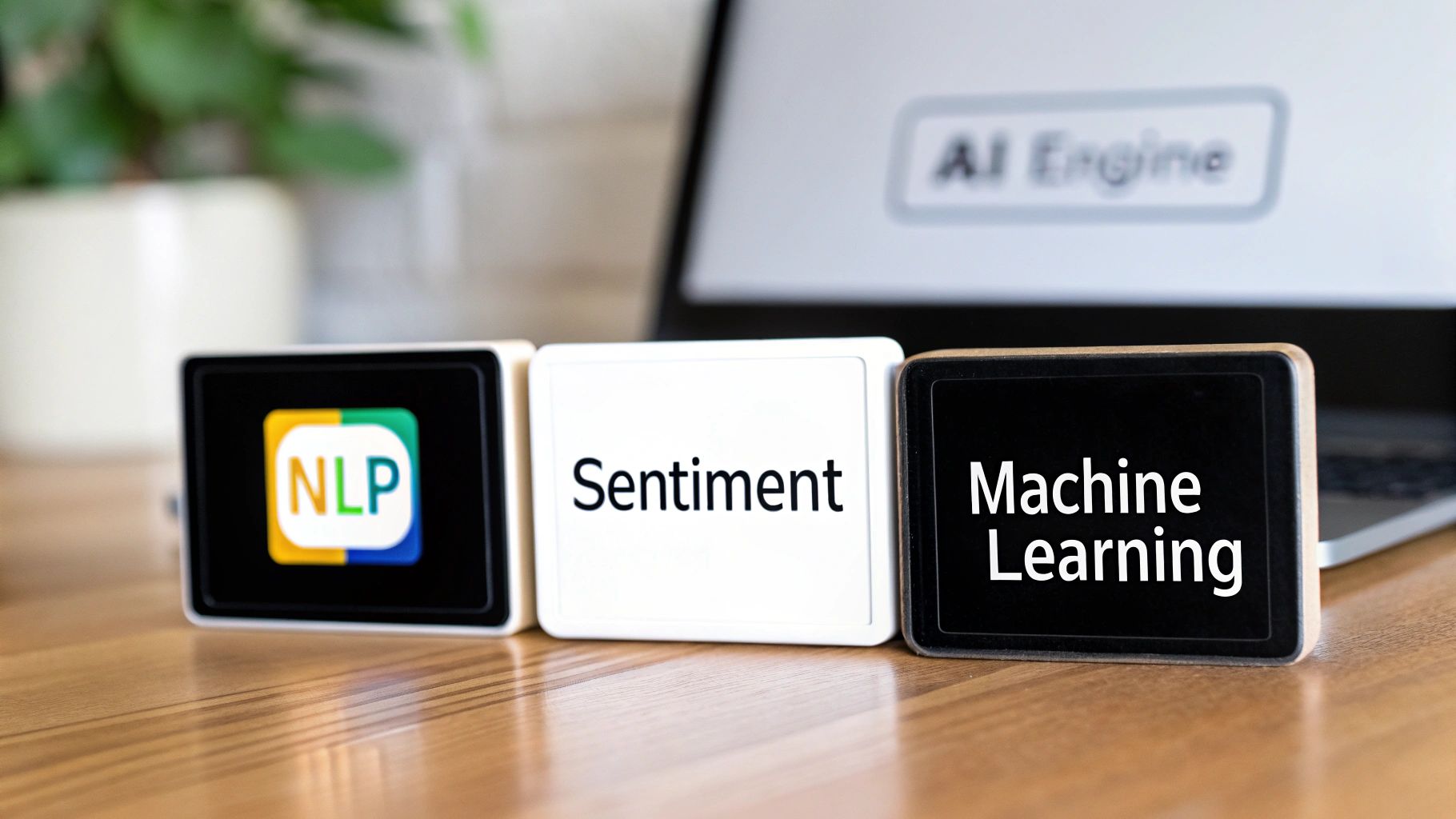
What’s the real difference between a genuinely helpful AI assistant and one that just leaves you going around in circles? It all comes down to what’s under the hood—the engine that actually drives the conversation. A top-notch AI chatbot for customer service isn't a single piece of tech; it's a sophisticated mix of interconnected systems, all working together to understand, help, and learn.
Think of it like a high-performance car. You can’t just have a powerful engine; you also need a responsive steering system and an intelligent computer keeping everything in sync. For AI chatbots, the components have different names, but the principle is the same. Without these core elements working in harmony, you’re left with a bot that stalls, misreads the map, and leaves your customers stranded.
The Brains of the Operation
At the absolute heart of any modern chatbot is its ability to understand human language. And I don't just mean recognising keywords. I mean truly grasping the intent, the context, and even the emotion behind what someone is typing.
-
Natural Language Processing (NLP): This is the central processor, the part that lets the chatbot read and make sense of human language. When a customer says, "My order hasn't arrived yet, what's up?", NLP is what breaks that sentence down to pinpoint the core goal (checking order status) and the key details (the order).
-
Sentiment Analysis: Think of this as an emotional radar. Layered on top of NLP, it gauges whether a customer is happy, frustrated, or just neutral. A chatbot equipped with sentiment analysis can detect an angry tone and know to escalate the chat to a human agent immediately, stopping a bad situation from getting worse.
-
Machine Learning (ML): This is the chatbot's ability to get smarter on the job. Every single conversation is a learning opportunity. ML algorithms sift through all this interaction data, spotting patterns and learning from what works (and what doesn't). This makes the bot more accurate and effective over time.
These pieces together ensure the chatbot isn't just mindlessly following a script. It can actually think, adapt, and provide answers that solve real-world problems.
A great AI chatbot doesn't just hear what your customers say; it understands what they mean. This distinction is powered by a combination of NLP, sentiment analysis, and continuous machine learning.
Essential Features for a Flawless Experience
Beyond its core intelligence, a top-tier chatbot needs the right features to become a truly useful part of your customer service. It has to be where your customers are and connect to the tools you already rely on. Without these practical connections, even the smartest AI is stuck in a silo, unable to really help.
An effective chatbot can't just be an add-on; it has to be a fully integrated part of your support ecosystem.
Omnichannel Presence and System Integration
To be truly effective, an AI chatbot for customer service has to meet your customers on their own turf. This is what we call an omnichannel presence.
- Website and Mobile App: This is the most common place for a chatbot, offering instant help to people browsing your site or using your app.
- Social Media: By integrating with platforms like Facebook Messenger, you can offer support right where customers are already talking about your brand.
- Messaging Apps: Offering help through apps like WhatsApp is perfect for reaching a global audience on a personal and convenient channel.
Just as crucial is seamless integration with your existing business software. When your chatbot can talk to your CRM (like Salesforce or HubSpot), it can pull up a customer's history for truly personalised support. When it's connected to your e-commerce platform, it can give instant, real-time order updates. These links are what turn a simple Q&A bot into a powerful assistant that actually gets things done.
Finally, a robust analytics dashboard is non-negotiable. This is your command centre for seeing how the chatbot is performing. You can track resolution rates, monitor customer satisfaction, and spot common problems people are running into. Good analytics give you the insights you need to constantly fine-tune both the chatbot and your overall customer experience.
Your Blueprint for Getting an AI Chatbot Up and Running
Putting an AI chatbot to work for your customer service team isn't some dark art or massive, intimidating project. Think of it more like building with a set of high-tech LEGOs. If you have a clear plan and the right pieces, you can put together a genuinely powerful tool that solves real-world problems. Let’s walk through a practical, step-by-step roadmap to get you from a simple idea to a successful launch.
The whole process kicks off with strategy, not technology. A chatbot without a clear job to do is just a novelty. First things first, you have to define what a "win" actually looks like for your business. What specific headaches are you trying to cure?
Defining Clear and Actionable Goals
Before you even think about code or platforms, you need to set goals you can actually measure. A vague objective like "improve customer service" won't cut it. You need to focus on tangible results that will make a real difference to your team and your customers.
Your goals should be laser-focused on actual pain points. For instance:
- Resolve common queries instantly: Set a goal to automate answers for your top 5-10 most frequent questions, like "Where is my order?" or "What's your return policy?"
- Reduce agent workload: Aim for a 20% reduction in the simple, repetitive tickets that land in your human support queue within the first three months.
- Increase lead generation: Get the bot to qualify visitors on your website and capture their details, with a target of a 15% increase in qualified leads from chat.
Setting these kinds of clear targets from the get-go ensures your chatbot is built to deliver real value right out of the box.
Preparing and Training Your AI Model
An AI chatbot is only as smart as the information it learns from. Think of this part as creating the curriculum for your new digital employee. The quality and relevance of your training data will make or break its performance.
To build a genuinely helpful AI, you have to feed it the right information. This means gathering and organising all sorts of company knowledge.
A successful AI chatbot isn't born smart—it's trained to be. Your knowledge base, old support tickets, and company docs are the textbooks it studies to become an expert on your business.
Here are the key data sources you'll want to use for training:
- Knowledge Base Articles: These are gold for teaching the bot your official procedures and product details.
- FAQs: Putting together your most frequently asked questions gives the bot a solid foundation for handling common queries.
- Past Support Tickets: Going through historical conversations helps the AI understand how real customers speak and the subtle details of their problems.
- Product Documentation: In-depth manuals and guides provide the technical specs it needs to handle more complex questions.
Platforms like SupportGPT make this much easier, letting you train the AI on your own documents and links. It basically turns all your existing content into a brain for your bot. You can learn more about how to build a custom AI support agent with SupportGPT on their site.
Designing Smart Escalation and Guardrails
Let's be realistic: even the smartest AI will run into questions it can't answer. A crucial piece of the puzzle is designing a seamless escalation path to a human agent. This makes sure customers with tricky or sensitive issues never get stuck in a frustrating chatbot loop.
The handover needs to be completely smooth. The chatbot should collect all the important info—the customer's name, the problem, and the chat history—and pass it straight to the human agent. This simple step avoids the classic customer frustration of having to repeat everything.
Just as important are brand voice guardrails. These are the rules that make sure the AI's personality fits your brand. You can decide if it should be professional, friendly, or even a bit humorous. You also need to set up rules to stop the bot from going off-topic or using language that doesn't fit your brand. This keeps your communication consistent and protects your reputation.
Finally, you can't ignore data privacy. Make sure your chatbot setup complies with regulations like GDPR and be upfront with users about how their data is being handled. That kind of transparency is the foundation of customer trust.
How to Measure Chatbot Success and ROI
So, you've launched your AI chatbot for customer service. That's a great start, but the real work has just begun. Without a clear way to measure its performance, you're essentially flying blind. You need solid data to know if it's actually helping customers and delivering a return on your investment (ROI).
Tracking performance is about more than just counting the number of chats it handles. It's about digging into the quality of those conversations. Is the bot genuinely solving problems, or just creating a frustrating dead-end for your customers? The right metrics will give you honest, actionable answers.
Think of it as a cycle: you set your goals, gather the data, analyse what’s working (and what isn’t), and then refine your approach. It’s all about continuous improvement.
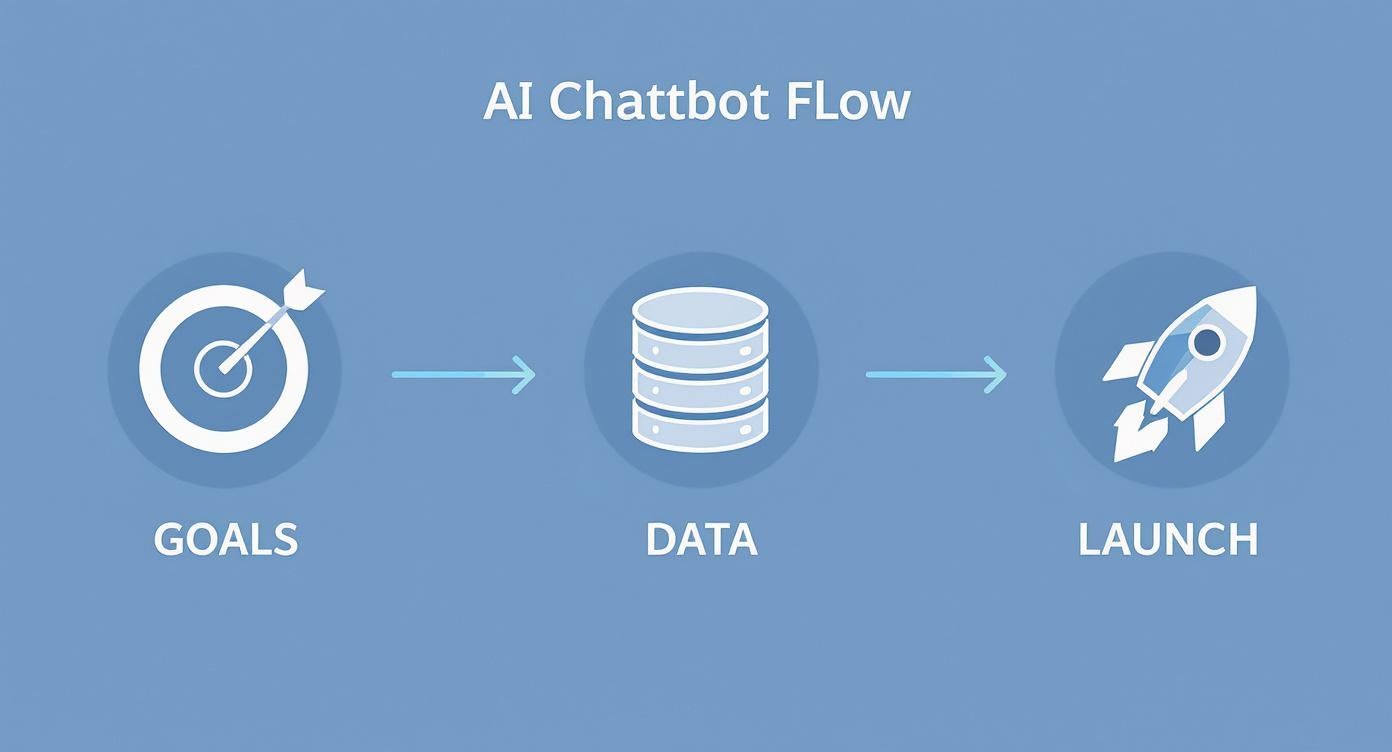
As this shows, a strong launch comes from having clear goals and good data from the start, which then feeds back into making the chatbot even better over time.
Key Performance Indicators That Matter
To get a real sense of how your chatbot is doing, you need to look beyond the surface-level numbers and focus on the Key Performance Indicators (KPIs) that truly count. These metrics reveal where the bot is excelling and where it needs a bit of a tune-up.
-
Resolution Rate: This is the big one. What percentage of queries does your chatbot solve all on its own, without needing to pass the customer to a human? A high resolution rate—ideally over 70-80% for your most common questions—is the clearest sign of its effectiveness and direct impact on your ROI.
-
Escalation Rate: This is the flip side of the resolution rate. It tells you how often the bot has to hand a conversation over to a human agent. Some escalations are unavoidable for complex problems, but if this number is climbing, it could mean your chatbot needs better training data or more intuitive conversational paths.
-
Customer Satisfaction (CSAT): After all is said and done, are your customers happy with the interaction? A simple one-question survey at the end of a chat asking for a rating is an incredibly powerful way to get direct feedback. This tells you about the experience, which is just as important as the raw numbers.
To help you keep these straight, here’s a quick summary of the essential metrics you should be tracking.
Essential AI Chatbot Performance Metrics
| KPI | What It Measures | Why It Matters |
|---|---|---|
| Resolution Rate | The percentage of queries solved without human intervention. | Directly shows the chatbot's efficiency and ability to deflect tickets. |
| Escalation Rate | The percentage of chats transferred to a human agent. | Helps identify knowledge gaps and areas for bot improvement. |
| CSAT Score | Customer satisfaction rating after interacting with the bot. | Provides direct feedback on the user experience and service quality. |
| Containment Rate | The percentage of users who stay within the chatbot for their entire journey. | Indicates how well the bot is meeting user needs from start to finish. |
| Interaction Rate | How many visitors actively engage with the chatbot. | Shows if the chatbot is visible, accessible, and appealing to users. |
Keeping a close eye on these KPIs will give you a well-rounded view of your chatbot's performance, allowing you to make data-driven decisions that genuinely improve the customer experience.
Digging Deeper with Qualitative Analysis
Metrics give you the 'what,' but they don't always give you the 'why.' To truly understand your chatbot's performance, you need to roll up your sleeves and get into the qualitative details.
Make it a habit to review conversation transcripts. Reading through actual chats lets you pinpoint the exact moments a customer gets stuck or frustrated. You'll spot awkward phrasing, broken conversational flows, or common questions the bot just can't seem to grasp. This is your treasure map for making targeted improvements.
Your chatbot's conversation logs are a goldmine of customer insights. They reveal not just what customers are asking, but how they're asking it, highlighting gaps in your knowledge base and opportunities for a better experience.
Pay special attention to the conversations that failed—where the bot misunderstood the user or provided a wrong answer. These aren't failures; they're your best learning opportunities. By finding patterns in these "misses," you can retrain the bot, tweak its responses, and watch its resolution rate climb. It’s this cycle of analysis and refinement that turns a decent chatbot into an indispensable part of your support team.
Real-World Examples of AI Chatbots in Action

Theory and performance metrics are one thing, but seeing an AI chatbot for customer service work in the wild is what really makes the benefits click. Across all sorts of industries, companies are using this tech to do more than just answer questions—they're fixing core operational headaches, boosting revenue, and building much stronger connections with their customers. These real-world stories show what’s truly possible.
Let’s dive into a few examples to see how businesses are getting tangible results by putting smart, automated help exactly where it’s needed most.
Streamlining E-commerce Operations
If you run an online store, you know that post-purchase questions about returns and order tracking can swallow your support team whole, especially during busy periods. One major e-commerce brand was drowning in these repetitive tickets.
So, they rolled out an AI chatbot trained specifically on their logistics and returns policies. The impact was immediate.
- Automated Returns Process: The bot could walk a customer through the entire return process, from initiating the request and generating a label to checking on the refund status, all without needing a human.
- Real-Time Order Tracking: By plugging directly into their shipping partner's API, the chatbot gave customers instant, accurate updates on their package's location.
The results were staggering. During their peak holiday season, the chatbot single-handedly resolved over 40% of all incoming support tickets. This freed up their human agents to tackle the tricky stuff—like damaged items or payment problems—making the whole operation run smoother.
Enhancing Financial Services Trust
In the world of finance, speed and security are non-negotiable. A top financial services firm needed a way to offer instant, secure answers for common account questions, all while making customers feel their data was completely safe.
Their solution was to deploy a sophisticated AI chatbot within their secure online banking portal. This bot was built from the ground up to handle sensitive information, with heavy-duty security protocols in place.
It quickly became the go-to for routine tasks like:
- Checking account balances and recent transactions.
- Reporting a lost or stolen card.
- Getting automated fraud alerts and confirming suspicious activity.
By giving customers instant, dependable answers to these urgent questions, the company drastically cut down its response times and built a ton of customer trust. People no longer had to sit on hold for simple queries, which cemented the brand's reputation as both modern and reliable. The chatbot offered a secure, immediate channel when it mattered most, a huge factor in customer loyalty for any financial institution.
Boosting Conversions in the Travel Industry
For a travel company, the main game is turning a casual browser into a paying customer. One travel agency spotted a big problem: potential customers were bailing on their bookings if they couldn't get quick answers about flights or hotel features.
They decided to embed an AI chatbot for customer service right into their booking process. This bot acted like a proactive travel assistant, helping users find the right flights, compare hotel rooms, and make sense of booking policies. This hands-on help led to a 15% increase in completed bookings, effectively turning window shoppers into confident buyers.
Got Questions About AI Customer Service Chatbots? We’ve Got Answers.
Jumping into any new technology brings up a lot of questions, and that's perfectly normal. Getting these common concerns out on the table can make the whole process feel a lot less daunting and help you move forward with confidence.
A big one we hear all the time is whether a chatbot will sound, well, like a robot. It’s a valid fear, but today's AI platforms are built for personality. You can train your bot on your company's own brand guidelines and past customer chats to soak up your unique voice, making sure every interaction feels genuinely on-brand.
Will a Chatbot Replace My Team?
This is probably the most common question of all. The short answer is no. The goal of an AI chatbot for customer service is to make your human agents more effective, not to replace them. Think of it as a new team member that loves handling the repetitive, high-volume questions that come in 24/7.
By automating the routine stuff, you free up your seasoned support professionals to tackle the tricky, high-stakes problems where human empathy and sharp thinking really matter. You end up with a powerful hybrid model: AI handles the predictable, and your team handles the exceptional. It’s a win-win for customer satisfaction and employee morale.
Your AI chatbot is a force multiplier for your support team. It takes care of the mundane so your agents can master the complex, making your entire operation smoother and more effective.
Another key question is about the setup time. How long does it take to get one of these up and running? A straightforward FAQ bot can be live in a matter of weeks. However, a more sophisticated chatbot that’s deeply connected to your other systems, like your CRM or e-commerce platform, might take a couple of months. The timeline really depends on the quality of your existing knowledge base and how complex those integrations are.
Ready to see how a smart AI assistant can transform your support? With SupportGPT, you can build and deploy a custom AI agent trained on your own data in minutes. Start for free and deliver instant, 24/7 answers today.