A Guide to AI Chatbot Development Services
Explore AI chatbot development services, from strategy and integration to costs. Learn how businesses drive growth and enhance customer experience with AI.
So, what exactly are AI chatbot development services? Think of them as the expert teams that design, build, and launch smart conversational bots for businesses. We're not talking about the old-school, clunky bots that followed rigid scripts. These are intelligent assistants that actually understand what customers are asking for and provide instant, helpful support around the clock. The goal is to create interactions that feel genuinely human, making customers happier and your business run smoother.
Why Businesses Are Investing in AI Chatbots
In a world where customers want answers now, the traditional 9-to-5 support window just doesn't cut it anymore. This constant demand for immediate help has become a huge operational headache, pushing companies to find solutions that can scale without sacrificing quality. For many, that solution is a smart investment in AI chatbots.
Here's a simple way to look at it: your website is your digital storefront, always open for business. But without an AI chatbot, it's like leaving that store completely unstaffed overnight. When visitors have questions about your products, shipping, or services, there's no one there to help. They'll likely get frustrated and leave, which means you've just lost a potential sale.
Meeting Modern Customer Expectations
Today's customers have grown up online; they value speed and convenience more than anything. They'd much rather find answers themselves or get a quick resolution than wait on hold or send an email into the void. AI chatbot development services hit this nail right on the head by delivering:
- Round-the-Clock Availability: A chatbot never needs a coffee break or a holiday. It’s always on, ready to provide consistent support on weekends, holidays, and in the middle of the night, ensuring no customer query is ever ignored.
- Instantaneous Responses: Chatbots completely eliminate waiting times. They can juggle thousands of conversations at once, giving immediate answers to frequently asked questions.
- Personalised Interactions: A modern bot can tap into customer data to offer tailored recommendations and support that understands the context of the conversation, making each user feel seen and heard.
Driving Operational Efficiency and Cost Reduction
Beyond making customers happy, AI chatbots bring massive benefits to your internal teams. They act as the first line of defence for your support agents, handling all the repetitive, time-sucking questions automatically. This frees up your human experts to focus on the tricky, high-value problems that truly require a human touch.
By taking over the routine tasks, businesses can seriously slash their support costs. A single, well-trained chatbot can handle the workload of several agents, which directly translates to less hiring and lower operational expenses. This efficiency means you can scale up your support without having to scale up your team.
The financial impact is undeniable. The conversational AI market in India, for instance, hit about USD 516.8 million in 2024. It's expected to rocket to nearly USD 4,936.9 million by 2033 as more and more industries jump on board. You can dive into the full market analysis of this explosive growth to see what's driving it. This isn't just a fleeting trend; it’s a major shift in how businesses interact with their customers, moving away from a slow, expensive support model to a proactive, automated one that delivers a solid return on investment.
The Blueprint for Building an Effective AI Chatbot
Bringing in an AI chatbot development service is a lot like commissioning a custom-built home. You wouldn’t just start laying bricks without a detailed blueprint, right? The same logic applies here. This isn't some mysterious, behind-the-curtain process; it's a well-defined journey that takes a simple idea and turns it into a smart, fully functional assistant that plugs right into your business.
Each step is critical. Get one wrong, and the whole structure is compromised. Just like an architect has to translate your vision into a practical design, a development partner’s job is to turn your business needs into conversational AI that actually delivers results.
Let’s walk through the key stages of building one of these bots from the ground up.
The development process for a business-ready AI chatbot is a structured journey. Professional services guide you through each stage, ensuring the final product is powerful, reliable, and perfectly aligned with your business objectives.
Here's a breakdown of what that journey typically looks like:
| Development Phase | Key Activities | Business Outcome |
|---|---|---|
| Strategy & Design | Defining goals, user personas, conversation flows, and brand voice. | A clear project scope that ensures the chatbot solves the right problems. |
| NLP Training | Feeding the model with company-specific data (docs, tickets, FAQs). | An intelligent bot that understands your business and customer context. |
| System Integration | Connecting the chatbot to CRM, ERP, and other business software. | A functional assistant that can perform actions, not just answer questions. |
| Guardrails & Testing | Setting up rules to ensure accuracy, safety, and proper escalation. | A reliable and on-brand bot that knows its limits and won't go rogue. |
| Deployment & Optimisation | Launching the bot and continuously monitoring its performance for refinement. | An asset that improves over time, delivering increasing value. |
This structured approach moves the project from a high-level concept to a continuously improving business tool, ensuring nothing is left to chance.
Phase 1: Initial Strategy and Design
This first phase is all about nailing down the "what" and the "why." Before a single line of code gets written, a good development partner sits down with you to define the chatbot's entire reason for being. Is its job to field common support questions, qualify new sales leads, or walk users through a tricky software setup?
The goal here is to hammer out a detailed project scope that covers:
- Key Objectives: What specific business pain point are we trying to solve?
- User Personas: Who are we building this for, and what do they actually need?
- Conversation Flows: Mapping the most common paths a user will take.
- Brand Voice: What's this bot's personality? Is it formal and professional, or friendly and witty?
Think of this as the architectural drawing for your custom home. A solid plan at this stage prevents expensive U-turns later and makes sure the finished chatbot is a direct solution to your most pressing challenges.
The chart below shows the typical business drivers that shape this strategy—things like providing 24/7 support, cutting costs, and offering instant responses.
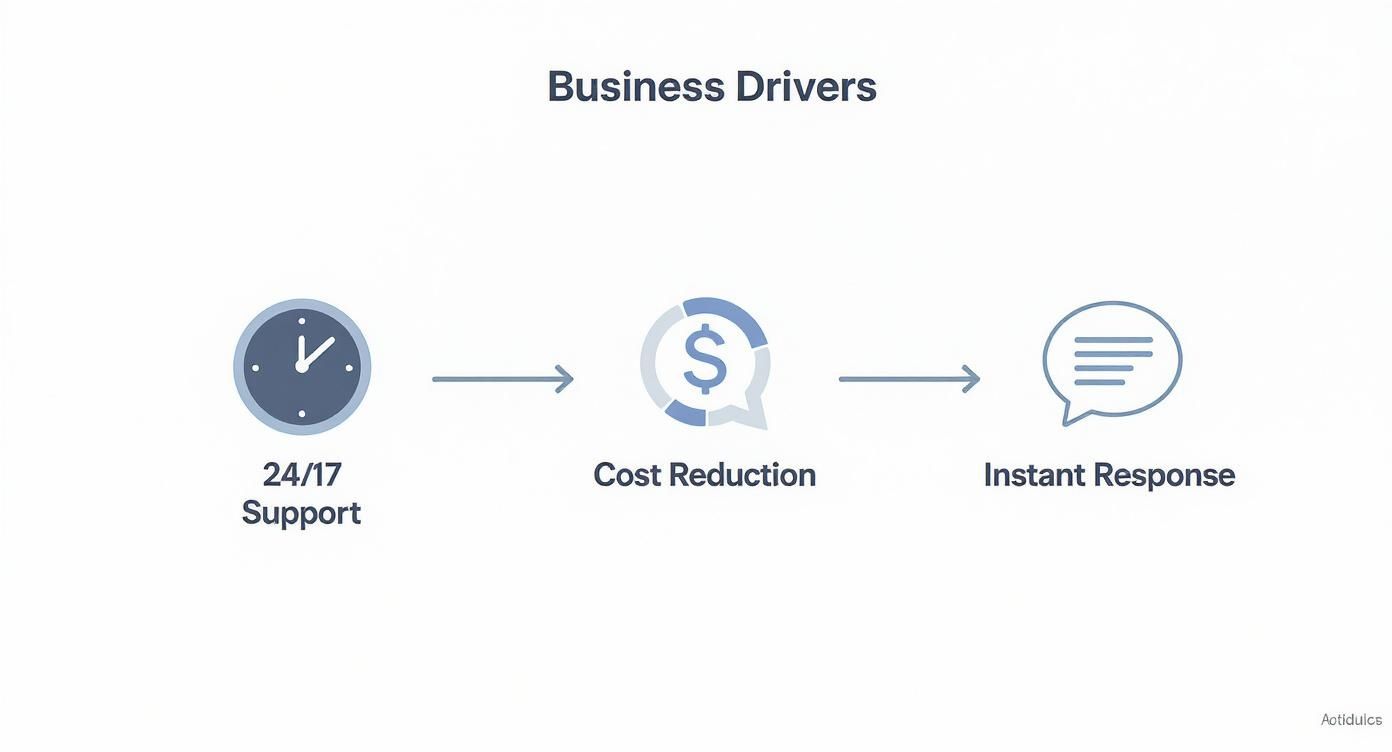
As you can see, the core need for constant availability naturally dominoes into major operational savings and a much better customer experience through immediate help.
Phase 2: NLP Training and System Integration
With the blueprint signed off, it’s time to give the chatbot its brain. This is where the Natural Language Processing (NLP) model comes in—it's the tech that lets the bot understand what humans are actually saying. It’s a bit like teaching a new team member the ropes.
You feed the bot your company-specific data: help centre articles, product manuals, past support tickets, and FAQs. The better the quality of this data, the smarter and more accurate the bot becomes. This is what ensures it understands the unique language and context of your industry, your products, and your customers.
A huge part of professional AI chatbot development services is system integration. A chatbot that can't connect to your other tools is just a glorified FAQ page. It needs to plug seamlessly into your existing tech stack, like your Salesforce CRM or your internal order management system. This is what allows the bot to actually do things—like check on an order status or create a support ticket—making it a truly powerful tool.
Phase 3: Guardrails and Deployment
Once the bot is smart and connected, you have to set the rules of the road. This is where AI guardrails become essential. Think of them as predefined boundaries that keep the chatbot’s answers on-topic, accurate, and aligned with your company’s policies. Guardrails are what stop the bot from making things up or wandering into weird, off-brand conversations.
For instance, guardrails make sure the bot:
- Sticks to what it knows and doesn't invent answers when it's stumped.
- Knows when to quit and escalate a tricky conversation to a human agent.
- Always maintains a professional and helpful tone, no matter what.
After intense testing in a safe environment, the chatbot is ready to go live. This is often a phased rollout, maybe starting with a small group of users before opening the floodgates. But the work doesn't stop at launch. Continuous monitoring of real conversations helps the development team spot where the bot is struggling and refine its performance. It’s a cycle of improvement that makes the chatbot more effective with every interaction.
How AI Chatbots Drive Real Business Growth

It’s one thing to understand the nuts and bolts of development, but the real question is: how does this tech actually move the needle for a business? Companies aren't adopting AI chatbots just to seem innovative; they’re investing in them to fix genuine problems, whether that's lost sales on an e-commerce site or a support team drowning in tickets.
The magic really happens when a chatbot stops being a simple Q&A machine and starts actively contributing to your bottom line. This is where professional ai chatbot development services show their value, building bots that don’t just chat but perform specific, high-impact tasks.
Let's look at a couple of real-world scenarios where these intelligent assistants are making a clear difference.
Use Case 1: E-commerce Sales and Support
Picture an online clothing store. It’s 10 PM, and a customer is trying to find the right pair of running shoes but is swamped with choices. They need to know about sizing, materials, and the return policy. Without instant help, there’s a good chance they’ll just give up and leave.
An AI chatbot can jump in here as a virtual shopping assistant. It can ask the right questions to narrow down the options, recommend products tailored to the customer's needs, and answer policy questions on the spot. This immediate engagement not only keeps the shopper on the site but also guides them towards a purchase with confidence. Often, it even increases the average order value through a few smart upsells.
Use Case 2: Financial Services Lead Qualification
Now, let's think about a mortgage company. Their sales team likely spends hours every day making initial calls, asking the same pre-qualifying questions over and over. It's repetitive, inefficient work that pulls them away from nurturing serious applicants who are actually ready to move forward.
A chatbot can completely handle this initial screening. It can engage website visitors around the clock, asking about their income, credit score, and desired loan amount to see if they meet the basic requirements.
By automating this first touchpoint, the chatbot makes sure that only qualified, high-intent leads get passed to the human sales team. This doesn't just speed up the entire sales cycle; it lets agents focus their energy where it really counts—on closing deals.
The growth in this space is massive. In India, for instance, the chatbot market was worth USD 316.5 million in 2024 and is expected to climb to USD 1,260.8 million by 2030. This boom is happening because businesses are finally seeing the incredible value in automated, intelligent customer conversations. You can explore more data on this market trend to see the full picture.
Calculating Your Potential Return on Investment
Gauging a chatbot's success isn't about gut feelings; it requires a proper framework for calculating your Return on Investment (ROI). While every business is unique, you can build a strong business case by zeroing in on a few key metrics.
Start by putting a number on the value of automation and new efficiencies. This means tracking:
- Reduced Support Tickets: Count how many common queries the chatbot handles for you each month, deflecting them from your human agents. Multiply that number by your average cost per ticket to see the direct savings.
- Time Saved for Agents: Measure how much time your team gets back by not having to answer the same questions all day. This reclaimed time can be put towards more complex, revenue-generating tasks.
- Increased Lead Conversion: Track how many more leads the chatbot captures and qualifies compared to your old methods. By assigning a value to each qualified lead, you can measure the revenue impact directly.
- Boosted Sales Revenue: For e-commerce, keep an eye on the increase in conversion rates and average order value for customers who use the chatbot.
By tracking these hard numbers, you shift the conversation from "a chatbot would be a nice-to-have" to "this chatbot is a vital part of our growth strategy." It turns the investment from a simple expense into a strategic asset with a clear, measurable financial return.
Choosing the Right AI Development Partner

Picking a vendor for your ai chatbot development services is one of the most important calls you'll make. This isn't just about finding someone who can code; it's about securing a strategic partner who genuinely gets your business goals and has the technical chops to make your vision a reality. The right partner becomes an extension of your team, guiding you through the often-complex world of AI.
Get this choice wrong, and you could end up with a chatbot that misses the mark, burns through your budget, and leaves customers frustrated. To sidestep these headaches, you need a solid checklist for vetting potential partners. This means going beyond their glossy portfolio and digging into their process, their real-world expertise, and their commitment to your long-term success.
Evaluating Technical Expertise and Industry Experience
First things first, any potential partner needs a rock-solid foundation in Natural Language Processing (NLP) and machine learning. These aren't just buzzwords; they're the engine that allows a chatbot to understand what people are saying and respond intelligently. Don't be shy—ask them to show you how they train their models and what they do to ensure the conversations feel natural and accurate.
Just as crucial is their track record in your industry. A team that's already built chatbots for other e-commerce businesses, for instance, will hit the ground running. They'll already know the common customer questions and sales flows, which saves a massive amount of time and effort.
A partner with proven industry experience brings more than just technical skill; they bring a playbook of what works. They understand the unique compliance, jargon, and customer expectations of your sector, which drastically shortens the learning curve and leads to a more effective solution from day one.
Always ask for case studies or client references that mirror your own business. If you’re in financial services, a partner whose entire portfolio is in retail might not appreciate the strict security and compliance rules you live by.
Assessing Integration Capabilities and Scalability
A chatbot working in isolation isn't much help. To be truly effective, it needs to plug directly into your existing systems—your CRM, your helpdesk software, and your inventory management. When you’re talking to vendors, ask for specific examples of integrations they’ve built with tools you already use.
You also need to think about the future. The platform they build on must be able to scale, handling more and more conversations as your business grows without slowing down. A good partner designs for growth from the very beginning, ensuring the architecture won't hold you back later.
Here are a few key integration questions to ask:
- API Proficiency: How do you handle custom API integrations with our in-house software?
- System Compatibility: Can you show us examples of bots you’ve connected to systems like Salesforce, Zendesk, or SAP?
- Data Synchronisation: How do you make sure data stays consistent and up-to-date between the chatbot and our other platforms?
For example, businesses in India are using deeply integrated chatbots to cut customer service costs by up to 30% and resolve issues faster. With some reports showing bot-only interaction satisfaction rates over 87%, the value of a well-connected AI agent is undeniable. You can explore more insights on the booming AI chatbot market in India.
Prioritising Security and Ongoing Support
Finally, security and data privacy are absolutely non-negotiable. Your partner must have airtight protocols for protecting sensitive customer data and complying with regulations like GDPR. Grill them on the details: ask about data encryption, access controls, and how often they perform security audits.
Remember, the work isn't over once the chatbot goes live. A trustworthy partner provides solid support and maintenance long after launch. Get clarity on what their support package includes, like performance monitoring, ongoing fine-tuning, and troubleshooting. Platforms like SupportGPT bake enterprise-grade security and guardrails into their very design, giving you a reliable foundation from the start.
Ultimately, choosing the right ai chatbot development services is about finding a partner who is as invested in your long-term success as you are.
So, How Long Does This Take and What Will It Cost?
Let's get straight to the two questions every business leader asks: "How long until it's live?" and "What's the damage?" With AI chatbot development services, the honest answer is... it depends. There’s a world of difference between a simple pop-up bot and a sophisticated conversational AI that’s woven into the fabric of your business operations.
To get a realistic grasp on your timeline and budget, you first need a crystal-clear picture of what you want the bot to do. A basic chatbot that pulls answers from a FAQ page can be up and running relatively quickly. But an advanced assistant that needs to talk to your CRM, check inventory levels, and handle complex user requests? That’s a much bigger project.
Breaking Down the Implementation Timeline
Building a chatbot that actually helps your business isn't something that happens overnight. It's a careful process of planning, building, and testing to make sure you get a tool that delivers real value, not just a gimmick. Naturally, the more you want it to do, the longer it will take.
Any good development partner will walk you through distinct project phases, but here’s a rough guide to help you set expectations:
- Simple FAQ Bots: If you just need a bot to answer common questions from a knowledge base, you can often get this launched in just 2 to 4 weeks.
- Bots with Basic Integrations: Need a bot that can create a support ticket in your helpdesk or look up an order status? You’re probably looking at 4 to 8 weeks to build and test it properly.
- Complex Conversational AI: For a powerhouse bot that connects to multiple systems, needs custom AI model training, and uses advanced logic, you should plan for a project of 3 to 6 months, and sometimes even longer.
Demystifying the Cost Structure
Chatbot pricing isn't a simple one-and-done deal. The total investment usually breaks down into a few different buckets, and knowing what they are is crucial for avoiding any nasty surprises later on. You have to think about the initial build and the ongoing costs to keep it running smoothly.
The smartest way to budget for an AI chatbot is to treat it like a long-term asset, not a one-off project. When you factor in licensing and maintenance from the start, you ensure the bot can be supported and improved over time, which is how you get the best return on your investment.
Here’s a typical breakdown of how the costs are structured:
| Cost Component | Description | Typical Billing Cycle |
|---|---|---|
| Development & Setup Fees | This is the initial, one-time investment to get the chatbot designed, built, trained, and integrated with your systems. | One-Time |
| Platform Licensing Fees | Think of this as the subscription fee for using the underlying technology that powers your bot. | Monthly or Annually |
| Maintenance & Support | This covers the ongoing work to monitor performance, squash bugs, and make continuous improvements. | Monthly or Annually |
This table makes it clear that while a simple bot might have a low upfront cost, a more complex bot could have a higher total cost over its lifetime due to more demanding maintenance needs. By understanding these different cost centres, you can put together a much more accurate financial plan and set clear expectations across your team.
Your Action Plan for Getting Started
Knowing what’s possible is one thing; making it happen is another. Now that you understand the process and the potential returns, it’s time to move from theory to action. Getting your internal house in order before you even talk to an ai chatbot development services provider is the secret to a smooth project. You'll walk into that first meeting with a clear vision, not a blank slate.
Think of it as drawing the map before you hire the driver. A solid plan aligns your team, manages expectations, and seriously speeds up the whole development process. Without this prep work, projects often wander off track, losing momentum and focus. This groundwork is your best defence against scope creep and ensures the final bot actually solves the problems you need it to.
Define Your Primary Business Goal
First things first: what is the one critical thing you need this chatbot to accomplish? Is it about slashing the number of support tickets? Qualifying more sales leads? Or maybe it’s to make the onboarding experience for new users a whole lot smoother? It’s tempting to try and solve everything at once, but you have to resist.
A successful chatbot project starts small and sharp. Pick one high-impact problem to solve first. This gives you a clear target, lets you prove the bot's value quickly, and builds a strong case for doing more later on.
Your goal needs to be specific enough to measure. Instead of a fuzzy objective like "make support better," get concrete. A much better goal would be, "reduce customer questions about order status by 40% in the next three months."
Assemble Your Project Team
Bringing a chatbot to life isn't just a job for the IT department; it’s a team sport. You need a mix of people from across the business to steer the project from idea to launch. This group makes sure the bot fits your business goals, sounds like your brand, and plays nicely with your other technology.
Your core team should have:
- Project Manager: The person who keeps the timeline, budget, and communication flowing.
- Subject Matter Experts: These are the folks from your support or sales teams who live and breathe customer problems. Their insights are gold.
- IT Representative: You'll need someone who knows your tech stack inside and out to handle the integrations.
- Marketing/Brand Stakeholder: This person ensures the chatbot’s personality and tone feel like they belong to your company.
Gather and Organise Your Data
An AI chatbot is only as smart as the information you feed it. You can get a major head start on the project by beginning to pull together all the documents that will become its brain. This one step can shave weeks off your development timeline.
Start pulling together resources like:
- Help Centre Articles: Grab all of your best and most current support guides.
- Frequently Asked Questions (FAQs): Make a list of the top questions your team gets every single day.
- Past Support Tickets: Anonymised chat logs are priceless for understanding how real customers talk about their issues.
- Product Manuals: If your bot needs to help with technical stuff, detailed guides are non-negotiable.
Once you’ve got these pieces in place, you’re in a fantastic position to start talking to potential development partners. You'll be ready for a productive conversation that leads to a successful and genuinely useful chatbot.
A Few Common Questions
Dipping your toes into the world of AI chatbots can feel a bit overwhelming, and it's natural to have questions. To help you get your bearings, I've pulled together some of the most common things business leaders ask when they're thinking about bringing this tech on board.
The idea here is to give you straight, practical answers to your biggest concerns—from whether this will actually make you money to how secure it all is. Let's get into it.
Are AI Chatbots Actually Profitable for a Business?
Yes, and not just in a "nice-to-have" way. A well-built AI chatbot pays for itself in a few different, very tangible ways. First, it cuts down on your operational costs by handling the flood of repetitive questions that tie up your support team. This doesn't just save money; it frees your people to focus on the tricky, high-value conversations that actually close deals or solve major problems.
But the real win comes from how chatbots improve the entire customer experience. They provide instant answers, 24/7, which keeps customers happy and loyal. On the sales side, a chatbot can qualify leads while your team sleeps, making sure they walk in every morning to a pipeline of people who are genuinely interested and ready to talk.
How Is the ROI of an AI Chatbot Measured?
Measuring the Return on Investment (ROI) for a chatbot isn't guesswork. It comes down to tracking a few key numbers that show real, measurable improvements across your business.
It's a mix of cost savings and new value created. Here’s what you should be looking at:
- Reduced Support Volume: Track the dip in support tickets or live chat requests your team has to field. This is your most direct cost saving.
- Increased Lead Conversion: How many new, qualified leads did the bot hand over to sales this month?
- Higher Customer Satisfaction: Look for a lift in your CSAT or NPS scores from customers who've chatted with the bot.
- Time Saved: This one is powerful. Calculate the hours your team gets back by automating away the repetitive stuff.
What Makes a Modern AI Chatbot Different from Older Versions?
The game-changer is the brain behind the bot. The chatbots of a few years ago were mostly rule-based. They were rigid, following a strict script you had to write for them. Ask something slightly different, and they'd break with a frustrating "I don't understand."
Today's AI chatbots run on Natural Language Processing (NLP) and Large Language Models (LLMs). This means they don't just look for keywords; they understand the intent and context of what someone is saying. They can follow conversational twists and turns, remember what was said earlier, and give answers that feel genuinely helpful and human.
Is It Secure to Use a Chatbot with Customer Data?
Security isn't an afterthought; it's the foundation. Any serious ai chatbot development service builds its platform with security at its core. You're dealing with customer data, after all.
A properly secured chatbot platform includes multiple layers of defence:
- Data Encryption: All conversations and data are encrypted, both when they're being sent and when they're stored.
- Access Controls: Strict rules on who can see conversation data and change system settings.
- Compliance: Following regulations like GDPR isn't optional—it's built in to protect user privacy.
- AI Guardrails: These are crucial. They're rules that stop the bot from sharing sensitive information or getting lured into inappropriate conversations.
When done right, a chatbot is a secure channel for your customers to interact with you, not a risk. The key is choosing a provider that takes security as seriously as you do.
Ready to deploy a secure, intelligent AI agent for your business? SupportGPT offers an enterprise-grade platform with powerful guardrails, easy integration, and advanced analytics to help you deliver exceptional support 24/7. Start building your AI assistant for free today.